Epoxy Resin Sensitization and Dermatitis
Updated 2026-09-22
In this bundle Health & Environmental Exposure
Print-ready PDF
Download this talk as a print-ready PDF, available in 4 languages.
Epoxy is everywhere on a modern site — floor coatings, anchoring adhesives for rebar and bolts, crack injection, grouts, tile setting, patching compounds — and it is one of the few materials on the site that can end a career without a single injury. This Epoxy Resin Sensitization and Dermatitis Toolbox Talk (Safety Talk / Tailgate Talk) is about the difference between the hardened floor everyone walks on, which is close to harmless, and the wet material in the bucket, which is a potent skin allergen — and about the way that allergen works: not as a burn that heals, but as a sensitization the body keeps for life. The worker who "just got a little on my hands" every day for a season is the one who cannot work with epoxy again.
Where the boundary of this talk sits#
This talk owns epoxy resin systems as a material: what is in the bucket, what cure does to it, how sensitization happens, why gloves fail in practice, and the hygiene that keeps a crew working with epoxy for a career. It hands the general science of skin disorders — irritant versus allergic contact dermatitis as concepts, the wet-cement mechanism, and skin first aid — to the skin-hazards talk below; the SDS and labeling system to the hazard-communication talk; solvents themselves to the solvent talk; and respirator selection to the respiratory-protection talk. The washing-facilities provision of 1926.51(f) is owned by the personal-hygiene talk and is referenced here, not developed. This talk does not cover polyurethane, isocyanate, or acrylic systems; they sensitize by different chemistry and deserve their own talk.
The anchor#
Here is the distinction that carries this whole talk: the hardened epoxy is not the hazard — the wet material is, because cure consumes the reactive groups that bind to skin, and what that wet material does to skin is not a burn that heals when exposure stops but a sensitization the immune system keeps for life; so the exposure to fear is not the splash you feel and wash off but the smear you never notice — the inside of the glove, the tool handle, the disposable glove pulled back on — repeated across a season and most often in a worker's first year on the material, because once the body has learned epoxy, no glove reopens the trade.
What is in the bucket, and what cure does to it#
An epoxy system is two parts that are each a hazard on their own. Part A is the resin — most commonly a glycidyl ether, and for liquid epoxy overwhelmingly the diglycidyl ether of bisphenol A, DGEBA. Part B is the hardener, and for most construction products that is an amine. Many products also carry reactive diluents, small glycidyl-ether molecules added to thin the resin so it flows, and those diluents are sensitizers in their own right. Published occupational-health guidance puts it plainly: practically all the major ingredients of an epoxy product are moderate-to-strong irritants and moderate-to-strong allergens — the resin, the hardener, and the diluents alike.
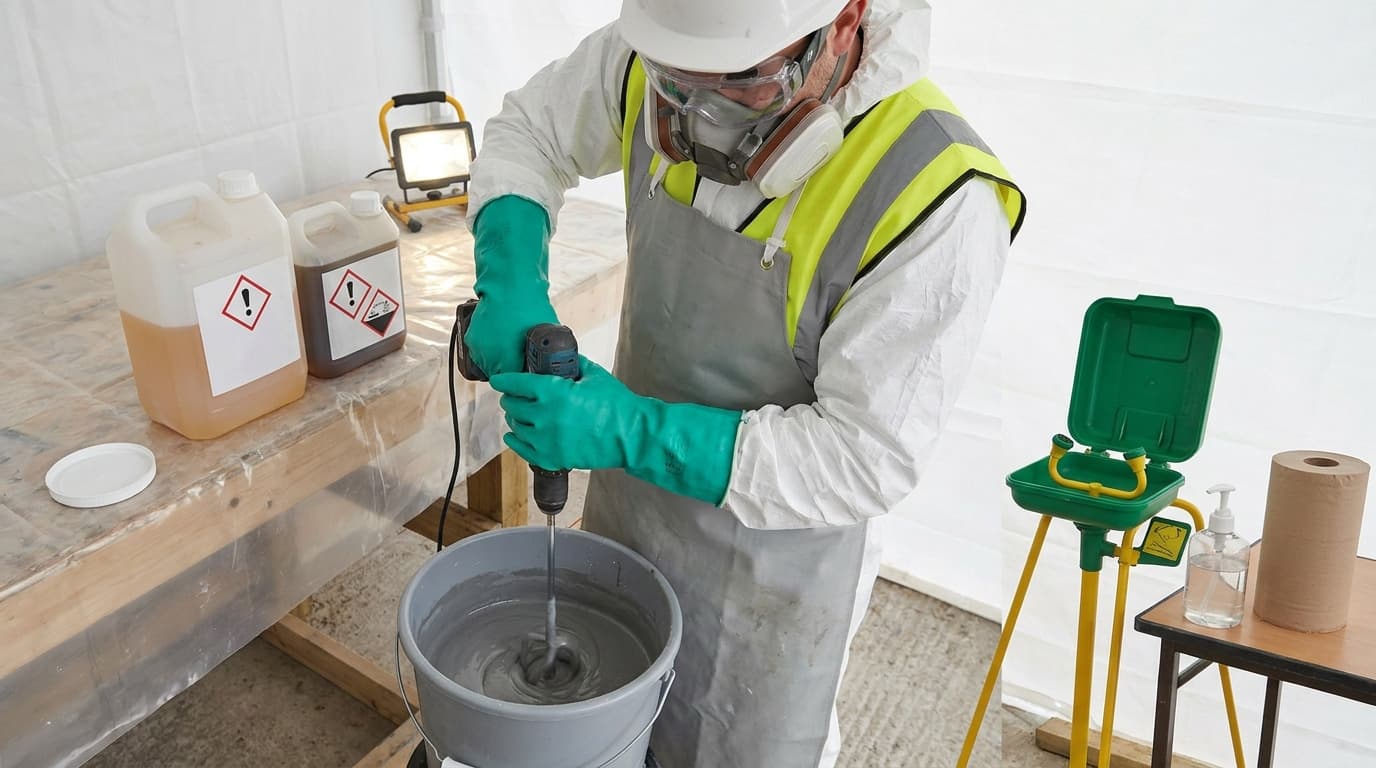
Cure is the chemistry that changes that. When A and B are mixed in the right ratio, the reactive epoxide rings on the resin open and bond with the amine, and the molecules cross-link into one solid polymer. The groups that make epoxy an allergen are the same groups that make it glue; cure uses them up. That is why fully cured epoxy is a different material from the bucket it came from — CPWR's construction guide states that finished, hardened epoxy products are usually hazardous only if they are burned, cut, or sanded.
Two exceptions carry the practical lesson. First, cured is a chemical state, not a feel. A coating that is dry to the touch, a pour that was cold, a batch mixed off-ratio, or anything still inside the product's cure schedule contains unreacted resin and hardener, and sanding or grinding it puts that material into the air and onto skin as dust. Second, heat undoes the deal: torching, welding, or grinding through cured epoxy produces decomposition fumes that are their own hazard. The crew rule that follows: the product's cure schedule is the definition of cured, dust from anything not fully cured is treated as wet epoxy, and hot work through a coating is a respiratory question, not a skin question.
How sensitization happens#
Under HazCom, skin sensitization is a defined health-hazard class. Appendix A.4 of 1910.1200 describes it as an allergic response occurring after skin contact with a substance or mixture, and a Category 1 skin sensitizer is one with evidence in humans that it can lead to sensitization in a substantial number of persons. That classification is what puts the exclamation-mark pictogram, the signal word Warning, and the phrase May cause an allergic skin reaction on the resin and hardener SDS. Read Section 2 of the SDS for every epoxy product on site and you will find it.
Epoxy causes both kinds of contact dermatitis. The irritant kind — from the alkalinity of amine hardeners, from solvents, from the physical abrasion of the work — is real, and it heals when the exposure stops. The allergic kind is the one this talk is about. The general mechanism of allergic contact dermatitis, and the wider family of skin disorders it belongs to, is owned by the skin-hazards talk; what this talk owns is the epoxy pattern, and the epoxy pattern has three parts.
It comes from ordinary contact, and it comes early. A 2022 study of 180 epoxy-exposed production workers in the wind-turbine industry found that 8.9 percent were sensitized to an epoxy component, against none of the unexposed office workers; resins based on the diglycidyl ethers of bisphenol A and F were the most frequent sensitizers, and sensitization was most frequent within the first year of exposed employment. The new hire, still learning where the resin ends up, is the worker most at risk.
It arrives late and it does not come alone. An allergic reaction to epoxy does not show at the moment of contact; it shows a day or two later, as itching, redness, and blistering — usually on the hands and forearms, and often on the face and eyelids, reached by contaminated hands or by dust and vapor. In the same study, dermatitis was reported by 43.8 percent of the sensitized workers against 14.6 percent of the non-sensitized: once sensitized, the exposure the body tolerated last month is the one that now produces a flare.
It is for life. CPWR's construction guide states that the allergy may last a lifetime and that symptoms can recur each time skin is exposed to the allergen, even in tiny amounts; European guidance adds that a sensitized worker faces an ever stronger reaction after each contact and that avoiding every contact is the only option left. Sensitization is not a rash that clears when you switch products. For the floor layer, the anchoring crew, or the injection technician, it is the end of epoxy work.
The glove trap#
"I wore gloves" is the sentence that precedes most epoxy sensitization, and it fails in four distinct ways.
Wrong material. Latex is never acceptable for epoxy: CPWR states that latex absorbs the chemicals in epoxy and may even dissolve in contact with them, and a NIOSH health hazard evaluation of an epoxy-pouring operation found a worker in natural rubber latex gloves and stated flatly that latex is not a suitable material for protecting against epoxy resins. Cotton is never acceptable on its own, for the same reason — it soaks up the resin and holds it against the skin. Nitrile is the common choice and it is rated excellent against the resins, but the same guide rates it only fair against amine hardeners and against solvents; butyl rubber rates excellent against both resin and hardener, and multilayer laminate gloves rate excellent across the board. The glove is selected against the hardener and the solvent in the specific product, from the SDS and the glove manufacturer's data, not from the word "chemical" on the box.
Too thin, too long. Nitrile comes in thicknesses, and thin gloves break down quickly. Every glove material eventually lets the chemical through by permeation, which is why the guidance is to change gloves before permeation or degradation can occur, not after. Published laboratory testing of twelve glove and clothing materials against epoxy resin and diamine hardeners found that heavy chemical-protective gloves showed no detectable penetration in a thirty-minute test and that several affordable disposable materials also performed well — and concluded that every epoxy system in use should be tested separately to find the best material. There is no universal epoxy glove. There is the right glove for this product, on a change schedule.
Contaminated inside. This is the one that sensitizes people who did everything else right. Resin on the outside of a glove ends up on the inside the moment a glove is pulled off with the other gloved hand, adjusted at the cuff, or set down on a contaminated surface. Resin running down a forearm into an oversized cuff does the same. CPWR's instruction is a single line: always keep the inside of gloves free of epoxy. A glove contaminated inside is worse than no glove — it holds the allergen against warm, sweating skin for the rest of the shift. Thin cotton liners inside heavy gloves keep hands dry and clean; oversized gloves, which now fail 1926.95(c)(2)'s requirement that PPE properly fit each employee, let the cuff become a funnel.
Pulled back on. Disposable gloves are removed by peeling from the cuff so they turn inside out, discarded at the site, and never reused — the guide's own emphasis. The disposable glove taken off for a phone call and pulled back on is the classic route from the outside of the glove to the skin. Reusable gloves are cleaned daily, dried, stored in a bag away from tools and materials, and replaced when they degrade.
The rest of the exposure#
Hands are washed with soap and water — nothing else. Warm water, a mild liquid soap, towels, before breaks and lunch, after gloves come off, after any splash, and at the end of the shift. The wrong hand cleaning is a sensitization route of its own: CPWR prohibits cleaning with solvent-containing or abrasive products, including alcohol-based gels and citrus cleaners, because they raise the risk of skin damage, and the NIOSH evaluation found workers wiping resin off with isopropyl alcohol and told them to stop. Acetone on the hands dissolves the resin into the skin and strips the skin's own barrier at the same time. The solvent talk owns the solvents; this talk owns the rule that they never touch skin as a cleaner.
No barrier creams in epoxy work. The guide does not recommend them for many kinds of epoxy work: abrasive contact breaks the film, and re-applying cream in the work area seals the chemical to the skin. Lanolin, petroleum jelly, and other skin softeners are kept off the skin at work for the same reason. Moisturize clean skin after washing at the end of the shift, not resin-contaminated skin during it.
Clothing carries it. Chemical-resistant sleeves, aprons, or coveralls over work clothes stop resin soaking through to the skin; contaminated work clothes are changed before leaving the site and travel in a sealed bag. The forearm and the shin — from kneeling on a coated floor — are the classic contact points people forget.
The hardener is a corrosive, so the eyes get their own rule. Amine hardeners can be corrosive to eyes and skin as well as sensitizing; the SDS will say so. Goggles, not safety glasses, for mixing and pouring, and under 1926.50(g), where the eyes or body may be exposed to injurious corrosive materials, suitable facilities for quick drenching or flushing must be provided within the work area for immediate use.
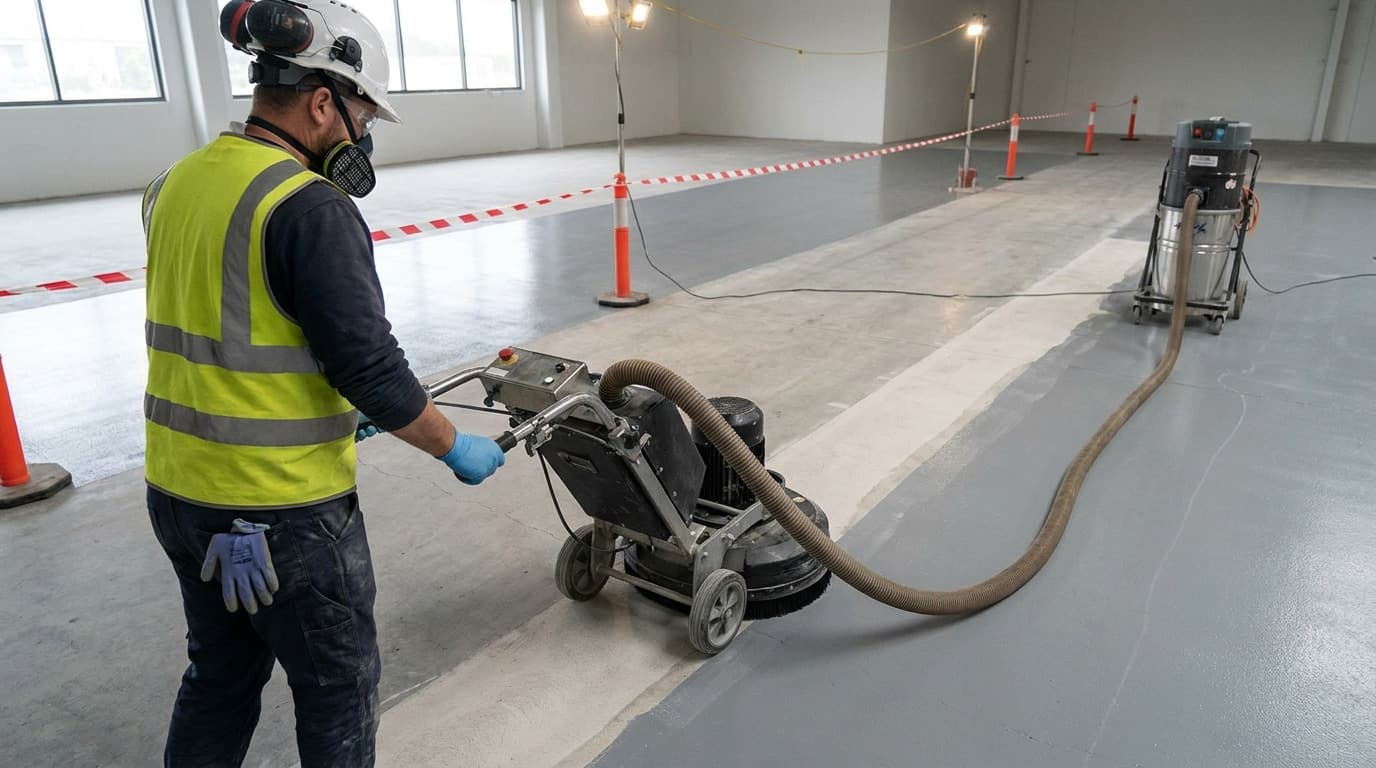
And there is an air route. Grinding and sanding cured or partly cured epoxy is a dust exposure that needs local exhaust — dust collection on the grinder — before anyone reaches for a respirator. Mixing and applying solvent-borne systems produces vapor. Spray application, and hardeners that are volatile, can affect the airways: published guidance warns of strong airway irritation and occupational asthma. Respirator selection belongs to the respiratory-protection talk; the crew's job is to recognize that the sanding shroud and the ventilation are the control, and the mask is what comes after.
Where the duty sits#
There is no OSHA standard for epoxy resin systems; CPWR's guide says so outright. The duty runs through the general rules, and they are sufficient. HazCom, 1926.59, whose requirements are identical to 1910.1200, puts the SDS and the labeled container in the worker's reach and requires training at initial assignment and whenever a new chemical hazard is introduced — an epoxy product with a new hardener is a new hazard. 1926.95(a) requires protective equipment to be provided, used, and maintained wherever chemical hazards are capable of causing injury or impairment through absorption or physical contact; (b) makes the employer responsible for the adequacy of any gloves employees bring themselves; and (c), since January 13, 2025, requires PPE that is of safe design for the work and properly fits each affected employee. 1926.51(f)(1) requires adequate washing facilities, in near proximity to the worksite and equipped to remove the contaminant, for employees applying coatings or engaged in other operations where contaminants may be harmful — epoxy is both. 1926.50(g) supplies the quick-drench requirement for the corrosive hardener. The rest is the employer's general duty and the SDS in the product's own words.
What can go wrong?#
- A new hire mixes anchoring adhesive all week in the thin nitrile gloves from the first-aid kit, pulls them off by the fingertips, and pulls them back on after every break; the first blisters show in month three.
- A floor crew wipes resin off their forearms with acetone-soaked rags at the end of each pour because it "gets it off faster."
- A worker pours hardener in safety glasses instead of goggles; a splash reaches the eye and the nearest water is a cooler forty yards away.
- Resin runs down a forearm into a loose gauntlet cuff and sits inside the glove until lunch.
- A crew sands a floor coating the morning after a cold-night pour, without dust collection, because it is "dry."
- A sensitized worker is moved to "just the cleanup," where the rags, tools, and empty buckets carry more uncured resin than the pour did.
- Hardener is decanted into an unlabeled water bottle and the SDS for it was never on site.
- A worker rubs barrier cream over resin-smeared hands and goes back to work, sealing the allergen in for the rest of the shift.
How do we manage this properly?#
- Select the glove against the product — from the SDS and the glove manufacturer's data, rated against the hardener and any solvent, never latex, never cotton alone; thin nitrile is a short-use layer, and it fits.
- Keep the inside clean — remove gloves by peeling from the cuff, discard disposables at the site, never re-don, clean and bag reusables daily, liners under heavy gloves.
- Treat every smear as a dose — the tool handle, the mixing paddle, the bucket rim, the kneeling surface; wet epoxy on skin is washed off with soap and water at once.
- Soap and water only — no solvents, no alcohol gel, no citrus or abrasive cleaners on skin; no barrier cream or softener in the work area.
- Cured means the cure schedule — no sanding or grinding inside it, dust collection on the tool when it is done, and hot work through a coating handled as a respiratory exposure.
- Goggles and quick-drench for the hardener — corrosive amines get eye protection rated for splash and drenching facilities within the work area.
- SDS, label, and training before the first mix — every resin, hardener, and diluent on site labeled and on file, and the crew trained on this product's sensitization warning under HazCom.
Before you start#
Pull the SDS for the resin and the hardener and read Section 2 and Section 8: confirm the sensitization warning, the corrosivity of the hardener, and the glove material the manufacturer recommends, and confirm the gloves on hand match it and fit. Check that soap, warm water, and towels are within near proximity of the work, and that quick-drench facilities are in the work area if the hardener is corrosive. Confirm goggles for mixing and pouring, sleeves or coveralls for application, and that everyone knows how gloves come off and where they go. Know the product's cure schedule and whether any sanding or grinding is planned inside it; if so, confirm dust collection on the tool.
Talk it over#
- Where did the last smear of epoxy on your skin come from — the pour, or the tool you picked up afterward?
- What is the glove on this crate rated against, and who checked it against this hardener?
- How do you take your gloves off, and where is the last pair you took off right now?
- What do people on this crew actually use to clean resin off their hands?
- Who here has had itching or a rash on the hands or forearms that showed up a day after epoxy work?
The bottom line#
The hardened epoxy is not the hazard; the wet material is, because cure consumes the reactive groups that bind to skin and turn the immune system against it — and what those groups cause is not a burn that heals but a sensitization for life. The exposure that does it is the small one repeated: the inside of the glove, the tool handle, the disposable pulled back on, the acetone rag, most often in a worker's first year. So the glove is chosen against this product's hardener and kept clean inside, hands are washed with soap and water and nothing else, cured is defined by the cure schedule and not by touch, and the hardener gets goggles and quick-drench because it is corrosive on its own. HazCom puts the warning on the SDS in plain words; 1926.95 puts the gloves in your hands and requires them to fit. Read the warning, and remember that once the body has learned epoxy, no glove reopens the trade.
Frequently asked questions about epoxy resin sensitization and dermatitis#
If cured epoxy is safe, why does grinding it need dust collection and a respirator?
Because "cured" is a chemical state defined by the product's cure schedule, and a floor that is dry to the touch is not necessarily there yet — a cold pour, an off-ratio batch, or a thick section can hold unreacted resin and hardener for days. Sanding or grinding inside that window puts those unreacted components into the air as dust that lands on skin and is inhaled. Even fully cured epoxy dust is an irritant, and CPWR's guide notes that hardened epoxy is hazardous when it is burned, cut, or sanded. Local exhaust — dust collection on the grinder or sander — is the control; the respirator is what comes after, and its selection belongs to the respiratory-protection talk.
What gloves are right for epoxy?
The ones rated against the specific hardener and any solvent in the product you are using, from the SDS and the glove manufacturer's chemical-resistance data. In general terms, CPWR rates nitrile as excellent against the resins but only fair against amine hardeners and solvents, butyl rubber as excellent against both resin and hardener, and multilayer laminate gloves as excellent across the board; latex and cotton are never acceptable, because they absorb the chemicals and hold them against the skin. Thickness matters — thin nitrile degrades quickly and is a short-use layer — and so does fit, which 1926.95(c)(2) now requires. Laboratory testing of glove materials against epoxy systems concluded that each system should be tested separately, so there is no universal answer, only the right glove for this product on a change schedule.
I have used epoxy for years without a problem. Am I safe?
Not in the way that sentence assumes. Sensitization is most frequent in the first year of exposed work, and a worker who passed that window has better odds — but it can happen at any point, it is driven by cumulative small contacts, and a change of product, hardener, or diluent is a new exposure. The 2022 wind-turbine study found 8.9 percent of exposed workers sensitized, with the diglycidyl ethers of bisphenol A and F as the most frequent sensitizers; and sensitization was found beyond the first year as well, only less often. Years without a reaction are a reason to keep doing what has kept skin clean, not a reason to relax the glove, the hand washing, or the cure schedule.
How do I know if I am becoming sensitized, and what do I do?
The signs are itching, redness, dryness, cracking, or blistering on skin that has had epoxy contact — hands and forearms most often, sometimes the face and eyelids — appearing a day or two after the work rather than at the moment of contact, and returning each time you work with the material. Report it the day you notice it, stop the exposure, and see a doctor; the diagnosis of an epoxy allergy is made by a clinician, usually by patch testing, and the earlier it is made the more skin is saved. This talk is safety training, not medical advice. What the crew can do is take the report seriously: a worker who is reacting is moved away from uncured epoxy, including cleanup, until a clinician has answered the question.
Can I clean epoxy off my hands with acetone or the alcohol gel?
No. Solvents dissolve the resin into the skin and strip the skin's own barrier at the same time, and waterless cleaners — alcohol-based gels and citrus cleaners — are named by CPWR as products to prohibit because they raise the risk of skin damage. A NIOSH evaluation of an epoxy-pouring operation found workers cleaning skin with isopropyl alcohol and told the employer to replace it with soap and water. The right method is warm water, a mild liquid soap, and a towel, as soon as the resin lands and again before breaks, after gloves come off, and at the end of the shift. The rule is simple enough to say every morning: solvents clean tools, not people.
What does the SDS tell me about sensitization?
Section 2, Hazard Identification, will show the exclamation-mark pictogram, the signal word Warning, and the hazard statement May cause an allergic skin reaction — the marks of a Category 1 skin sensitizer under Appendix A.4 of HazCom, which defines skin sensitization as an allergic response after skin contact and assigns Category 1 where there is human evidence of sensitization in a substantial number of persons. The hardener SDS will usually add the corrosion pictogram and the signal word Danger, because amine hardeners can burn skin and eyes on contact. Section 8 gives the manufacturer's glove and eye-protection recommendation. Under 1926.59 the SDS has to be available to you, and you have to be trained on the product's hazards before you work with it.
Does OSHA have an epoxy standard?
No — CPWR's construction guide states that OSHA has not issued a specific standard for epoxy resin systems. The duty is built from the general rules: HazCom (1926.59, identical to 1910.1200) for the SDS, labeling, and training; 1926.95 for protective equipment against chemical hazards that act through absorption or contact, including gloves that are adequate and properly fit; 1926.51(f)(1) for washing facilities in near proximity to coating work and other operations where contaminants may be harmful; and 1926.50(g) for quick-drench facilities where the eyes or body may be exposed to a corrosive hardener. Those four rules, applied to what the SDS says about this product, are the epoxy standard on your site.
Download the epoxy resin sensitization and dermatitis toolbox talk PDF#
Download this Epoxy Resin Sensitization and Dermatitis Toolbox Talk (Safety Talk / Tailgate Talk) as a printable PDF in English, Spanish, Portuguese, and Turkish for your next tailgate meeting, and hand it out with the SDS for the resin and hardener on your crate.
Related toolbox talks#
Sources#
- OSHA, 29 CFR 1926.59 — Hazard communication (requirements identical to 1910.1200) and 29 CFR 1910.1200 Appendix A, A.4 — Respiratory or skin sensitization (skin sensitization defined as an allergic response occurring after skin contact; Category 1 where there is human evidence of sensitization in a substantial number of persons): https://www.osha.gov/laws-regs/regulations/standardnumber/1910/1910.1200AppA
- OSHA, 29 CFR 1926.95 — Criteria for personal protective equipment ((a) PPE wherever chemical hazards can cause injury through absorption or physical contact; (b) employer responsible for adequacy of employee-owned PPE; (c) safe design and proper fit, per the final rule effective January 13, 2025): https://www.osha.gov/laws-regs/regulations/standardnumber/1926/1926.95
- OSHA, 29 CFR 1926.51(f)(1) — Washing facilities (adequate facilities in near proximity for employees applying coatings or in other operations where contaminants may be harmful) and 29 CFR 1926.50(g) (quick drenching or flushing facilities within the work area where eyes or body may be exposed to injurious corrosive materials): https://www.osha.gov/laws-regs/regulations/standardnumber/1926/1926.51
- CPWR — The Center for Construction Research and Training, Working with Epoxy Resin Systems in Construction: Best Practices Guide to Skin Protection (2008, NIOSH-funded; no OSHA epoxy-specific standard; DGEBA and amine hardeners; cured product hazardous only if burned, cut, or sanded; lifetime allergy recurring on tiny exposures; never latex or cotton gloves; nitrile fair against hardeners, butyl and laminates excellent; keep the inside of gloves free of epoxy; no solvent, alcohol-gel, or citrus hand cleaners; barrier creams not recommended): https://www.elcosh.org/document/2088/d001103/Working+with+Epoxy+Resin+Systems+in+Construction+-+Best+Practices+Guide+to+Skin+Protection.html
- NIOSH, Health Hazard Evaluation Report 2007-0355-3102 — Evaluation of Exposure to Epoxy Resin while Manufacturing Artificial Floral Arrangements (February 2010; latex not a suitable glove material for epoxy; isopropyl alcohol skin cleaning replaced by soap and water; butyl gloves recommended): https://www.cdc.gov/niosh/hhe/reports/pdfs/2007-0355-3102.pdf
- Christiansen AG, Carstensen O, Sommerlund M, et al., Prevalence of skin sensitization and dermatitis among epoxy-exposed workers in the wind turbine industry, British Journal of Dermatology 2022;187(6):988–996 (180 exposed workers, 8.9% sensitized versus none of 41 office workers; sensitization most frequent within the first year; DGEBA/DGEBF most frequent sensitizers; dermatitis in 43.8% of sensitized versus 14.6% of non-sensitized workers): https://academic.oup.com/bjd/article/187/6/988/6972576
- Henriks-Eckerman M-L, Mäkelä EA, Suuronen K, Testing Penetration of Epoxy Resin and Diamine Hardeners through Protective Glove and Clothing Materials, Annals of Occupational Hygiene 2015;59(8):1034–1043 (twelve materials tested against DGEBA and diamine hardeners; chemical-protective gloves showed no detectable penetration at 30 minutes; each epoxy system should be tested separately): https://academic.oup.com/annweh/article/59/8/1034/2196121
- EU-OSHA, OSHwiki, Occupational exposure to epoxy resins (all major ingredients moderate-to-strong irritants and allergens; sensitized workers face an ever stronger reaction and must avoid every contact; volatile amine hardeners and spray application can cause airway irritation and occupational asthma): https://oshwiki.osha.europa.eu/en/themes/occupational-exposure-epoxy-resins
Written by FieldSafetyTalk's safety professional — a CSP, ASP, CHST and OSHA Authorized Outreach Trainer with 14+ years of international construction safety experience across federal, heavy civil, and industrial projects.