Fuel Storage Safety
Updated 2026-07-24
In this bundle Fire, Hot Work & Emergency
Print-ready PDF
Download this talk as a print-ready PDF, available in 4 languages.
There is a sentence in the construction standard that describes something almost nobody on this site has ever done. Transfer of Category 1, 2, or 3 flammable liquids from one container to another shall be done only when containers are electrically interconnected — bonded. Not "should be." Not "where practical." Only when bonded. Think about the last time you saw someone decant fuel from a drum into a can with a bonding cable clipped between them. This Fuel Storage Safety Toolbox Talk (Safety Talk / Tailgate Talk) is about the ignition source you cannot see, smell, or hear coming.
Here is the distinction that carries this whole talk: with most fire hazards, you can point at the ignition source. A torch, a grinder, a hot surface, a cigarette. Fuel handling has a source that generates itself, out of the act of pouring — and it discharges at precisely the point where the fuel-air mixture is most likely to be in range. The liquid does not burn. The vapour above it does, and the spark that lights it is made by the pour.
The rule nobody follows#
29 CFR 1926.152(e)(2) states it plainly: transfer of Category 1, 2, or 3 flammable liquids from one container to another shall be done only when containers are electrically interconnected (bonded).
The physics behind it is straightforward. Liquid flowing through a hose, a nozzle, or into a container generates a static charge through friction. That charge builds on the liquid and on the container. If it discharges to a nearby grounded object, and the path of that discharge passes through vapour that is within its flammable range, it ignites. Bonding removes the potential difference between the two containers so there is nothing to jump.
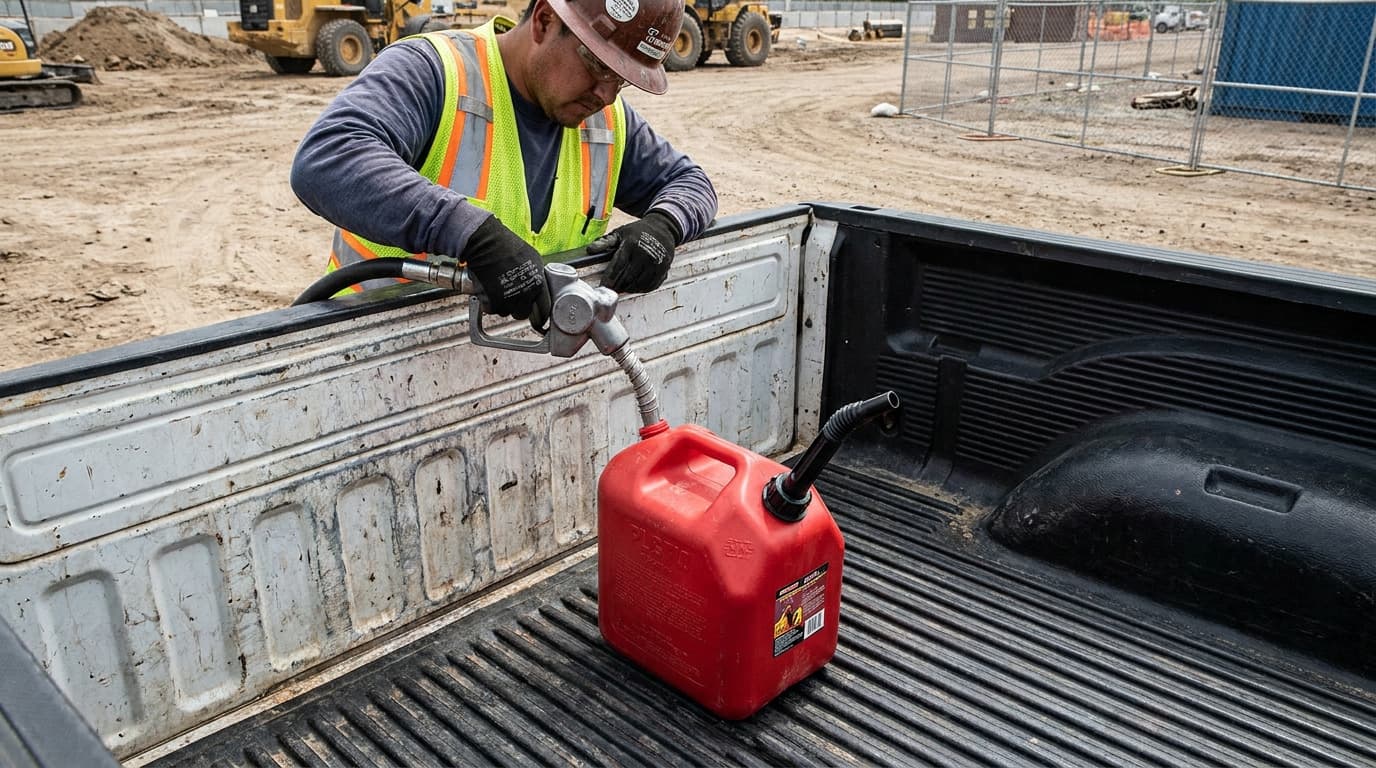
And here is the part that catches people. A plastic can cannot be bonded. Plastic does not conduct, so clipping a bonding cable to it achieves nothing — the charge stays where it is. The common red or yellow plastic can, filled from a drum or a fuel truck, sitting on a plastic bed liner in the back of a pickup, is close to a textbook static ignition scenario. Use a listed metal safety can for Category 1 liquids, or a plastic can specifically manufactured with a built-in conductive ground path, and take containers out of the vehicle and onto the ground before filling.
The numbers that govern the yard#
These are specific, they are in the construction standard, and almost nobody can quote them.
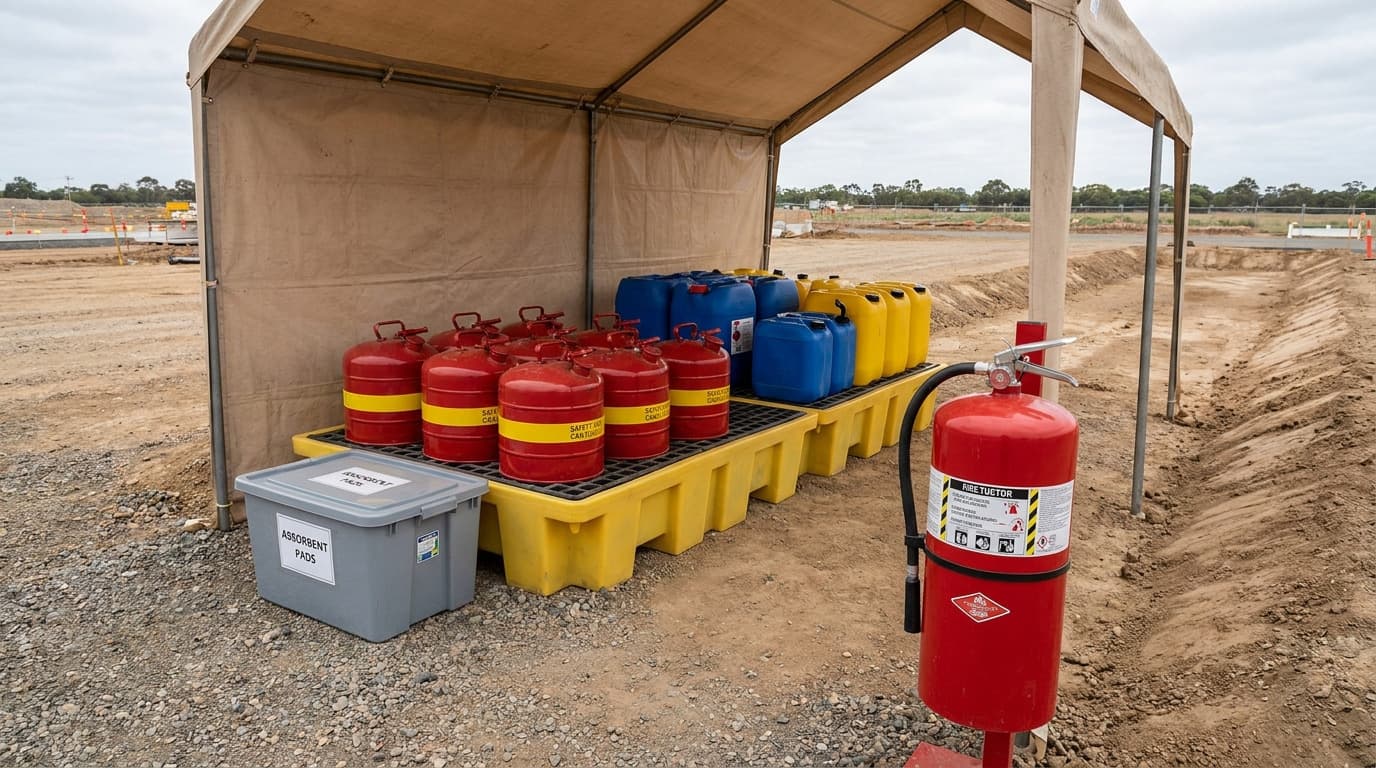
- Five gallons. Under 1926.152(a)(1), approved safety cans or DOT-approved containers must be used for handling and use of flammable liquids in quantities of 5 gallons or less. For quantities of one gallon or less, the original container may be used. A repurposed jug, a water bottle, an unmarked container — none of those satisfies this.
- Twenty-five gallons. Under 1926.152(b)(1), no more than 25 gallons may be stored in a room outside an approved storage cabinet. Above that, (b)(2) requires an acceptable or approved cabinet.
- Sixty and one hundred twenty. Under 1926.152(b)(3), not more than 60 gallons of Category 1, 2 and/or 3 flammable liquids, or 120 gallons of Category 4, may be stored in any one storage cabinet — and not more than three such cabinets may be located in a single storage area. Quantities beyond that require an inside storage room.
- Not in the escape route. 1926.152(a)(2): flammable liquids shall not be stored in areas used for exits, stairways, or normally used for the safe passage of people. Fuel in a stairwell or a corridor is not a housekeeping problem — it is a prohibited storage location.
Fuelling the machine#
1926.152(g) governs service and refuelling areas, and the requirements are short enough to remember:
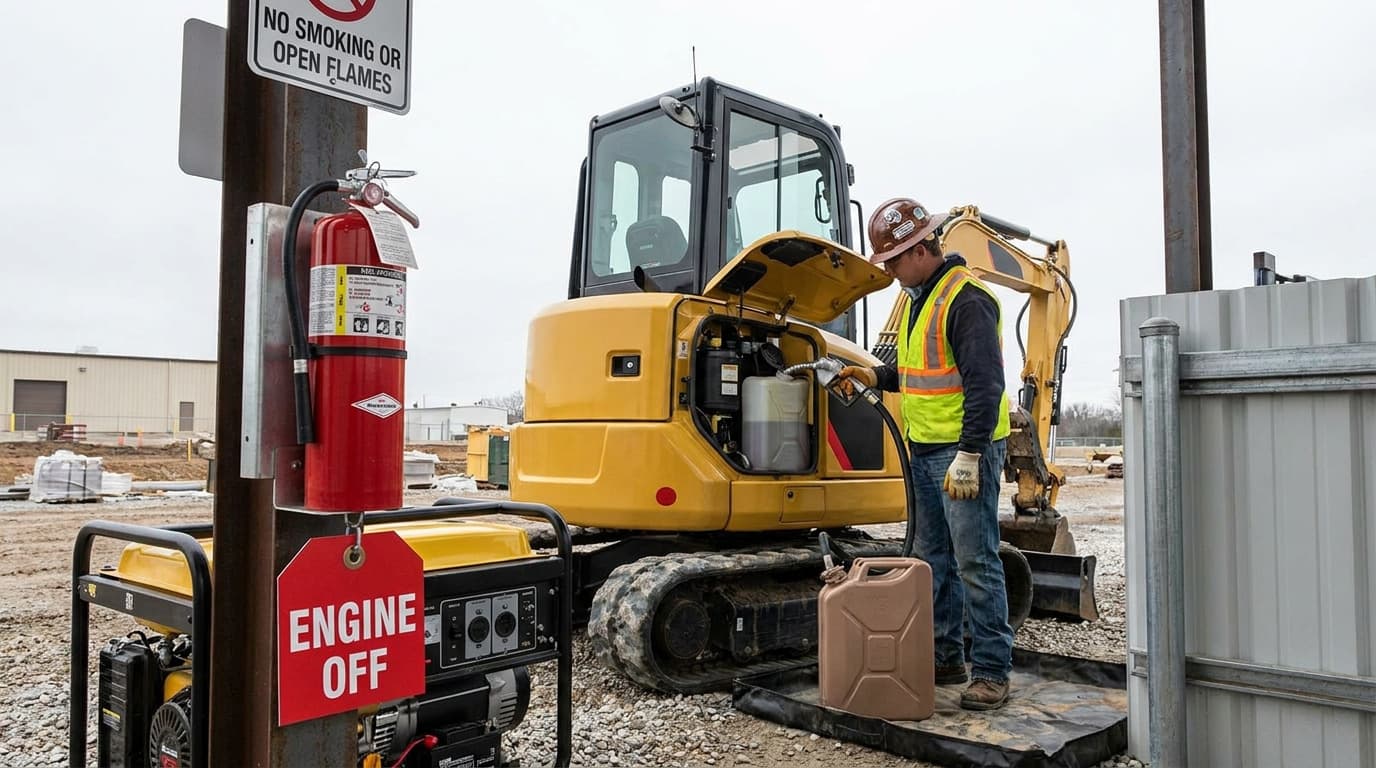
- The motors of all equipment being fueled shall be shut off during the fueling operation — (g)(10). Every operator has left one running "just for a minute."
- No smoking or open flames in areas used for fuelling, servicing fuel systems, or receiving and dispensing flammable liquids — (g)(8) — with conspicuous and legible signs posted under (g)(9).
- At least one fire extinguisher rated not less than 20-B:C within 75 feet of each pump, dispenser, underground fill pipe opening, and lubrication or service area — (g)(11).
- At least one 20-B:C extinguisher on every tank truck or vehicle used for transporting or dispensing flammable liquids — (g)(4).
And where larger transfers happen, 1926.152(e)(1): areas where flammable liquids are transferred in quantities greater than 5 gallons at one time must be separated from other operations by 25 feet or by construction with at least a one-hour fire resistance, with drainage or other means to control spills, and ventilation adequate to keep vapour concentration at or below 10 percent of the lower flammable limit.
Diesel is in scope#
A great deal of jobsite folklore holds that diesel is not flammable, so it does not count. Check the scope.
1926.152(h) applies the section to the handling, storage, and use of flammable liquids with a flashpoint at or below 199.4 °F (93 °C). Diesel sits inside that. What has changed is the language: OSHA now uses GHS Categories 1 through 4 rather than the older Class I / II / III wording, which is why cabinet limits are written as "Category 1, 2 and/or 3" and "Category 4." Old training and old labels still say Class I.
The practical point stands regardless of category. Diesel has a much higher flash point than petrol, so it will not flash at ambient temperature — but heat it, atomise it, soak it into a rag or insulation, and it burns readily. A diesel-soaked absorbent pad next to hot work is fuel. So is a sump of it under a generator.
On USACE and NAVFAC projects, EM 385-1-1 applies and is more prescriptive on fuel storage, secondary containment, and separation distances.
What can go wrong#
Pouring without bonding. The requirement in (e)(2), unmet on almost every site.
Filling a plastic can in a truck bed. Insulated from ground, unbondable, and directly beneath the operator's face.
Fuel in the stairwell or corridor. Directly prohibited by (a)(2), and it blocks the escape route it is stored in.
Unapproved containers. Water bottles, milk jugs, unlabelled drums, old paint tins.
Cans left open or with failed flame arrestors and lids.
Engine running while fuelling. Prohibited by (g)(10) — the machine provides hot surfaces, ignition, and vibration all at once.
No extinguisher, or the wrong one. Nothing within 75 feet, nothing on the fuel truck, or a unit below 20-B:C.
Storage in direct sun. Vapour pressure rises, containers vent, and the vapour cloud sits at ground level because it is heavier than air.
Vapour finding a low point. Petrol vapour flows downhill into trenches, pits, basements, and confined spaces, and it can travel a long way to an ignition source and flash back.
No spill control. No drainage, no bund, no absorbents — so a spill spreads to the ignition source rather than being contained.
Contaminated waste. Fuel-soaked rags, PPE and absorbents left in an open bin, which is both a fire load and a spontaneous ignition risk.
Hot work near the fuel store. The two topics that most need to know about each other are the two least likely to be planned together.
How do we control it?#
Bond before you pour. Metal container to metal container, clip to bare metal, before the first drop moves. If the containers cannot be bonded, the transfer should not be happening in that equipment.
Use listed metal safety cans for Category 1 liquids, and take them out of the vehicle and onto the ground to fill.
Respect the thresholds. Safety cans at 5 gallons and below, cabinet above 25 gallons, 60 or 120 gallons per cabinet, no more than three cabinets in a storage area.
Keep fuel out of exits, stairways, and walkways — this one is absolute.
Shut the engine off, every time, no exceptions for a quick top-up.
Put a 20-B:C extinguisher within 75 feet of every dispensing point, and one on every fuel truck, and check them.
Store outdoors and shaded where you can, on ground that drains away from occupied areas and the fuel store itself.
Contain the spill before it happens. Bunding, drip trays, drainage control, and absorbents staged where the transfer occurs.
Manage the waste. Fuel-contaminated rags and absorbents into closed metal containers, removed daily.
Separate fuel storage from hot work by planning, not by luck — put both on the same site plan and keep the distance.
Check for vapour travel. Look downhill and downwind from the transfer point for trenches, pits, drains, and voids where vapour can collect.
Before you start#
- Confirm the container is an approved safety can or DOT-approved container.
- Confirm you can bond the containers together — and if either is plastic, stop and change the equipment.
- Take the container out of the vehicle and onto the ground before filling.
- Confirm the engine of anything being fuelled is switched off.
- Confirm a 20-B:C extinguisher is within 75 feet and serviceable.
- Check quantities against the 25-gallon cabinet threshold and the 60/120 per-cabinet limits.
- Confirm no fuel is stored in an exit, stairway, or walkway.
- Identify where vapour would travel — downhill, downwind, into trenches and pits.
- Confirm spill control is staged: drip tray, bund, or absorbents.
- Confirm no hot work is planned within range of the fuel store or the transfer point today.
Talk it over#
- When did you last see anyone bond two containers before transferring fuel? What would it take to do it here?
- If you spilled five gallons at the fuel point right now, where would it go?
- What is the nearest ignition source to where fuel gets decanted on this job — and how far is it really?
The bottom line#
Fuel handling has an ignition source that the work itself creates. 29 CFR 1926.152(e)(2) requires that transfer of Category 1, 2, or 3 flammable liquids between containers be done only when the containers are electrically interconnected — bonded — and a plastic can cannot be bonded at all, which makes the plastic can in a truck bed one of the more dangerous routines on any site. Know the thresholds: safety cans at 5 gallons or less, a cabinet above 25 gallons, 60 or 120 gallons per cabinet, three cabinets maximum in a storage area, and never in an exit or stairway. Shut the engine off, keep a 20-B:C extinguisher within 75 feet, and remember the scope covers everything with a flashpoint at or below 199.4 °F (93 °C) — diesel included.
Frequently asked questions about fuel storage#
Does OSHA require bonding when transferring fuel?
Yes. 29 CFR 1926.152(e)(2) provides that transfer of Category 1, 2, or 3 flammable liquids from one container to another shall be done only when containers are electrically interconnected (bonded). Bonding equalises the electrical potential between the containers so that static generated by the flowing liquid has nothing to discharge across.
Can I bond a plastic fuel can?
No — not a standard one. Plastic does not conduct, so a bonding cable clipped to a plastic can achieves nothing and the static charge remains. Use a listed metal safety can for Category 1 liquids, or a plastic can specifically manufactured with a built-in conductive ground path. This is why filling a plastic can inside a truck bed — insulated from ground and unbondable — is a recognised static ignition scenario.
How much fuel can be stored without a cabinet?
Under 29 CFR 1926.152(b)(1), no more than 25 gallons of flammable liquids may be stored in a room outside an approved storage cabinet. Above that, (b)(2) requires an acceptable or approved storage cabinet.
How much can go in one cabinet?
Under 29 CFR 1926.152(b)(3), not more than 60 gallons of Category 1, 2 and/or 3 flammable liquids or 120 gallons of Category 4 flammable liquids may be stored in any one storage cabinet, and not more than three such cabinets may be located in a single storage area. Larger quantities require an inside storage room built to the specified fire-resistive requirements.
What container must be used for 5 gallons or less?
Under 29 CFR 1926.152(a)(1), approved safety cans or Department of Transportation approved containers must be used for handling and use of flammable liquids in quantities of 5 gallons or less. For quantities of one gallon or less, the original container may be used. Improvised containers do not comply.
Does the standard cover diesel?
Yes. 29 CFR 1926.152(h) applies the section to handling, storage, and use of flammable liquids with a flashpoint at or below 199.4 °F (93 °C), which includes diesel. OSHA now classifies these liquids using GHS Categories 1 through 4 rather than the older Class I/II/III system — which is why the cabinet limits are written by category. Diesel will not flash at ambient temperature the way petrol does, but heated, atomised, or soaked into rags and absorbents it burns readily.
What fire extinguisher is required at a fuelling point?
Under 29 CFR 1926.152(g)(11), at least one extinguisher rated not less than 20-B:C must be located so that an extinguisher is within 75 feet of each pump, dispenser, underground fill pipe opening, and lubrication or service area. Under (g)(4), at least one 20-B:C extinguisher must also be provided on every tank truck or other vehicle used for transporting or dispensing flammable liquids.
Download the fuel storage toolbox talk PDF#
Get this fuel storage toolbox talk as a print-ready PDF — available in English, Spanish, Portuguese, and Turkish. Print it, hand it to the crew, and collect signatures on the included attendance sheet.
Download the PDF — free account required. New members get 3 free downloads.
Related toolbox talks#
Sources#
- OSHA, 29 CFR 1926.152 — Flammable liquids: https://www.osha.gov/laws-regs/regulations/standardnumber/1926/1926.152
- OSHA, 29 CFR 1926.150 — Fire protection: https://www.osha.gov/laws-regs/regulations/standardnumber/1926/1926.150
- NFPA, NFPA 30 — Flammable and Combustible Liquids Code
Written by FieldSafetyTalk's safety professional — a CSP, ASP, CHST and OSHA Authorized Outreach Trainer with 14+ years of international construction safety experience across federal, heavy civil, and industrial projects.