Defensive Driving
Updated 2026-07-31
In this bundle Jobsite Fundamentals & Compliance
Print-ready PDF
Download this talk as a print-ready PDF, available in 4 languages.
Construction organises itself around the hazards it can see. Falls get a plan, excavations get a permit, lifts get a competent person and a briefing. Then everyone gets in a vehicle and drives, with no plan, no permit and no method statement — and that is the part that kills the most people. This Defensive Driving Toolbox Talk (Safety Talk / Tailgate Talk) is about the hazard with the worst ratio of risk to attention on any site.
Here is the distinction that carries this whole talk: the most dangerous thing most workers do all day is drive, and it is the only major hazard with no paperwork attached. NIOSH reports that motor vehicle crashes are the leading cause of work-related deaths in the United States — from 2011 to 2022, more than 21,000 U.S. workers died in work-related crashes, 35% of all work-related deaths — and that crashes are the first or second leading cause of death in every major industry group. Not the highest-risk industries. Every industry group.
The scale, precisely#
Worth stating carefully, because most crews have never seen these numbers.
In 2022 alone: 1,369 U.S. workers died driving or riding in a motor vehicle on a public road — 25% of all work-related deaths. A further 510 deaths, 9% of the total, involved workers driving or riding off public roads, or pedestrian workers struck by vehicles.
The risk does not depend on job title. NIOSH is explicit that all workers are at risk whether they drive light or heavy vehicles, and whether driving is a main or incidental duty. The carpenter driving between two sites is in the same statistic as the haulage driver.
That last point is the one that matters for a construction crew, because almost nobody on a site thinks of themselves as a driver.
What "defensive" actually means#
The phrase gets used loosely. Its real content is a single premise: you cannot control the other driver, the road surface, or the weather. You can only control your own space and the number of options you have left.
Everything useful follows from that.
Space is the control. Following distance is the only measure that works against every hazard at once — a blowout ahead, a sudden stop, a car emerging, a patch of ice. It does not need you to predict which one.
Use time, not car lengths. Pick a fixed object, and count the gap after the vehicle ahead passes it. Three seconds is a minimum in good conditions, and it should be extended substantially for heavy or loaded vehicles, wet or icy surfaces, poor visibility, towing, and fatigue. Time-based counting is the only method that stays correct as speed changes.
Keep an escape route. Defensive driving is largely about never being boxed in — not sitting in blind spots, not being surrounded in traffic, and knowing where you would go if the vehicle ahead stopped dead.
Look further ahead than the vehicle in front. Most emergency braking is a reaction to something that was visible several seconds earlier to anyone looking through and beyond the car ahead.
Assume you have not been seen. At every junction, every merge and every reversing manoeuvre, the safe assumption is that the other party has not seen you. It costs nothing and it is right often enough to matter.
Intersections, and the two turns#
Intersections concentrate risk because they are where paths cross at angles that hide people.
Arriving on green is not the same as arriving safely. A brief look left and right before entering costs a second.
The turn across traffic — left in right-hand-drive countries, right in left-hand-drive ones — is the highest-risk routine manoeuvre most drivers perform, because it requires judging the speed of an oncoming vehicle, which people do badly.
And the vehicle in front turning is a common trap, because drivers follow it into a gap that has already closed.
Backing, and what OSHA actually requires#
Reversing deserves its own section because it is disproportionately represented in site vehicle incidents and it is almost entirely preventable.
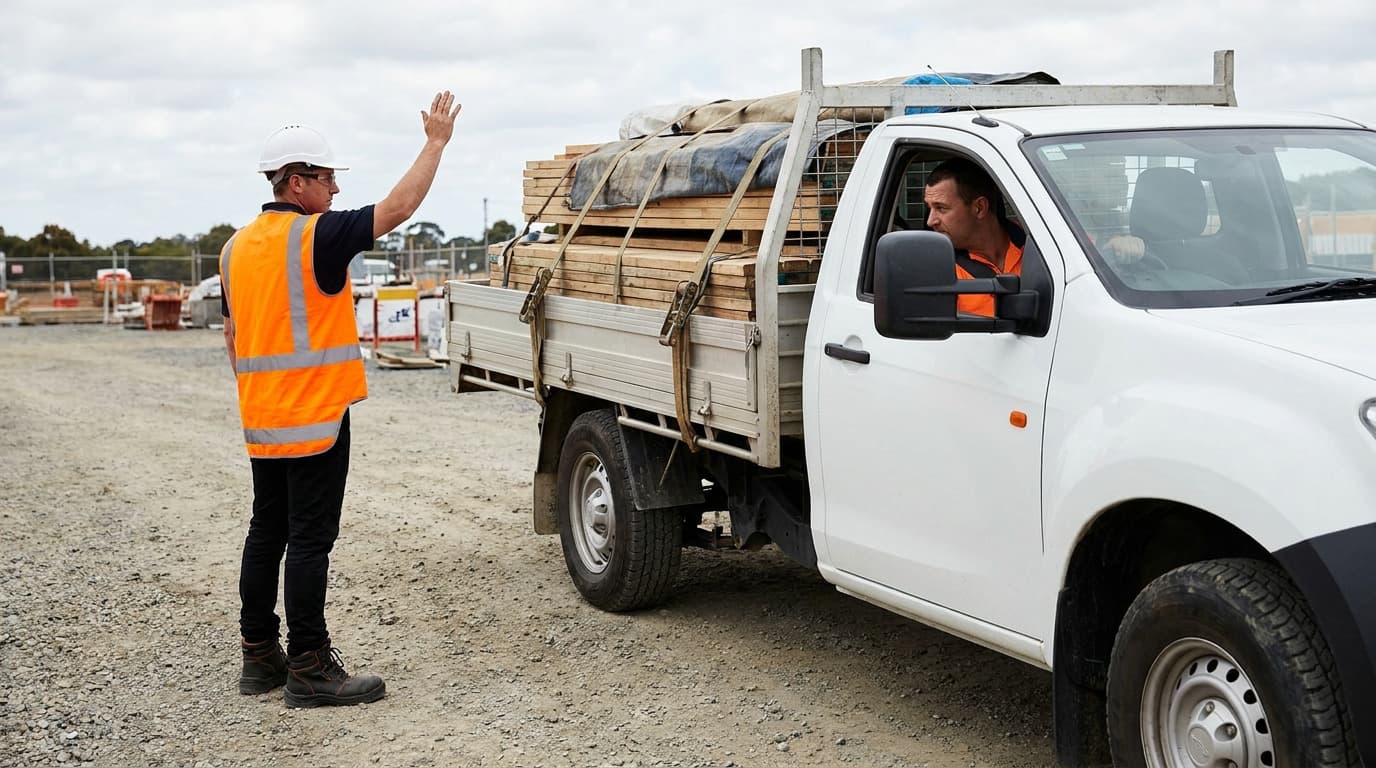
1926.601(b)(4) — no employer shall use motor vehicle equipment having an obstructed view to the rear unless the vehicle has a reverse signal alarm audible above the surrounding noise level, or the vehicle is backed up only when an observer signals that it is safe to do so.
Read the structure: it is an either/or, and the alarm satisfies the requirement on its own. But an alarm only makes noise. On a busy site where reversing alarms sound all day, an alarm is a sound people have stopped hearing — which is why the observer is the stronger control even where the alarm makes it legal without one.
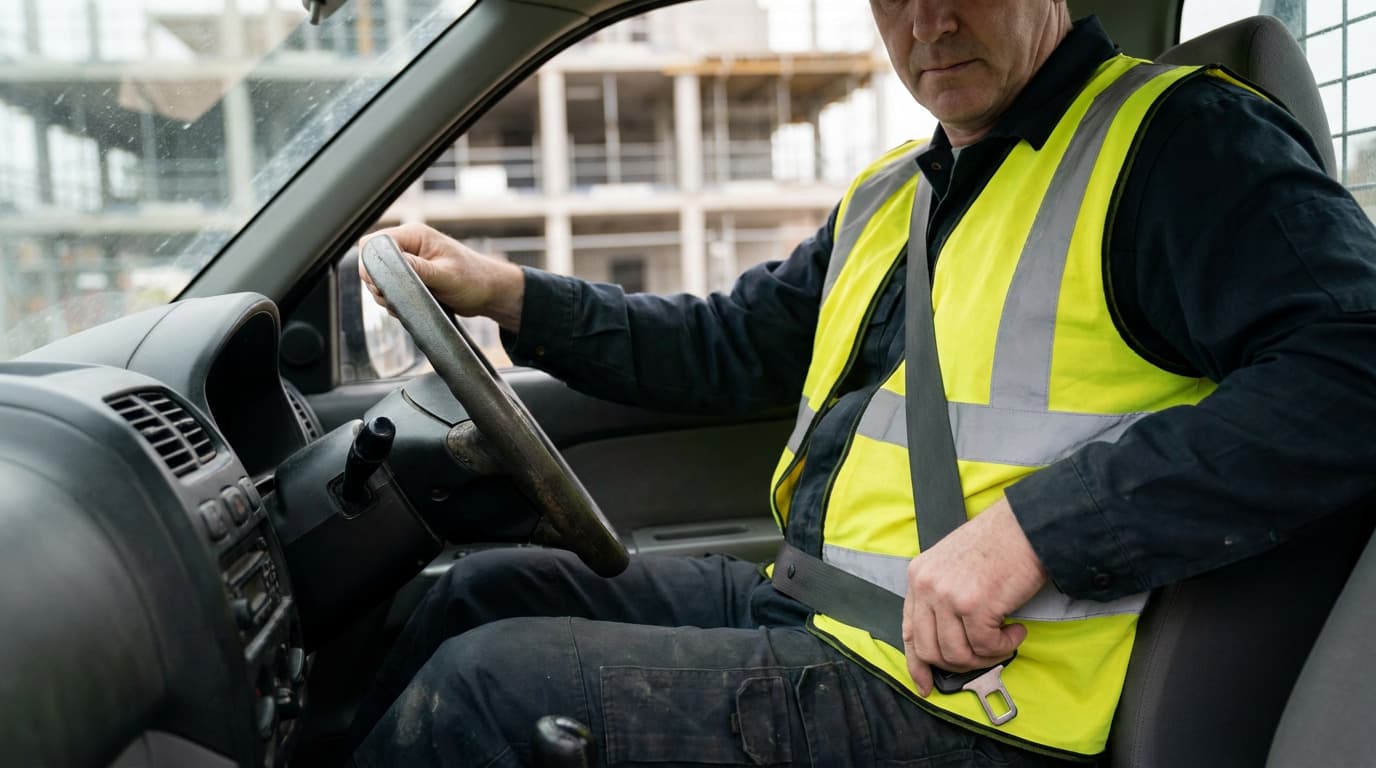
1926.601(b)(9) — seat belts shall be provided, and employees shall be required to use them.
Practical backing discipline: avoid reversing by parking to drive out; walk the area behind before you get in; agree signals with the banksman before moving; and if you lose sight of the observer, stop.
Note the scope honestly: 1926.601 applies to motor vehicles used within an off-highway jobsite not open to public traffic. On the public road, the traffic law of your jurisdiction governs.
The seat belt, with the actual number#
Worth quantifying, because "wear your belt" has become background noise.
Research cited by NHTSA shows that seat belts reduce the risk of fatal injury to front-seat car occupants by 45%, and to light truck occupants by 60%.
Sixty percent. Most construction workers travel in light trucks and pickups. There is no other control available on a site that changes a fatality probability by that margin for zero cost and two seconds of effort.
What can go wrong?#
A following distance of one second, which removes every option you have.
Reversing on a signal from someone who has moved out of sight.
A reversing alarm on a site where alarms sound constantly, and nobody registers it.
A belt not worn on a "short trip" across site, which is where a lot of site vehicle fatalities occur.
Turning across traffic on a misjudged gap.
Driving straight from a twelve-hour shift, at the point of maximum accumulated wakefulness.
Loose tools and materials in a cab or on a flatbed, which become projectiles in a crash.
Nobody treating the commute as work risk, because it happens off the clock.
How do we manage this properly?#
Give driving the same planning as any other high-risk task. Route, timing, fatigue, weather, vehicle condition.
Set the following distance rule explicitly — three seconds minimum, more for heavy vehicles, wet surfaces, poor visibility and fatigue — and count it in time.
Design out reversing. Site layout with drive-through routes, and a parking discipline of reversing into bays so departures are forward.
Use an observer for reversing even where an alarm makes it legal, and stop the moment you lose sight of them.
Enforce belts on site journeys, not just the highway.
Check the vehicle — tyres, lights, mirrors, wipers, load security — as a pre-use inspection, exactly as you would a tool.
Secure everything in the cab and on the bed.
Manage the drive home. It sits at the end of the shift and it is the highest-risk hour of the day; the fatigue talk in this library covers why.
And never require someone to drive and communicate at once — the distracted driving talk covers that ground.
Before you start#
- Confirm the vehicle has been checked — tyres, lights, mirrors, wipers, brakes.
- Confirm everything in the cab and on the bed is secured.
- Confirm your belt is on before the vehicle moves, including on site.
- Confirm your following distance rule for today's conditions.
- Confirm whether any reversing is planned and who the observer will be.
- Confirm you can park so that you drive out forwards.
- Confirm you are fit to drive — hours awake, medication, alcohol the night before.
- Confirm nobody expects you to answer calls or messages while driving.
Talk it over#
- How many seconds are you leaving to the vehicle in front?
- When did you last reverse without anybody watching behind you?
- Does everyone here belt up for a two-minute trip across site?
- How long will you have been awake when you drive home tonight?
The bottom line#
The most dangerous thing most workers do all day is drive, and it is the only major hazard with no paperwork attached. NIOSH reports motor vehicle crashes as the leading cause of work-related deaths in the U.S. — more than 21,000 worker deaths from 2011 to 2022, 35% of all work-related deaths — and the first or second leading cause of death in every major industry group. In 2022, 1,369 deaths (25% of all work-related deaths) occurred driving or riding on public roads, with 510 more (9%) off-road or involving pedestrian workers struck by vehicles — and the risk applies whether driving is a main or incidental duty. Defensive driving rests on one premise: you cannot control the other driver, the surface or the weather — only your space and your remaining options. So: count following distance in time, three seconds minimum and far more for heavy vehicles, wet surfaces, poor visibility and fatigue; keep an escape route; look beyond the vehicle in front; and assume you have not been seen. On backing, 1926.601(b)(4) requires either a reverse signal alarm audible above the surrounding noise or an observer signalling that it is safe — but on a site where alarms sound all day, the observer is the stronger control. 1926.601(b)(9) requires seat belts to be provided and used, and the number is worth knowing: belts reduce fatal injury risk by 45% for car occupants and 60% for light truck occupants.
Frequently asked questions about defensive driving at work#
How dangerous is work-related driving really?
It is the leading cause of work-related death in the United States. NIOSH reports that more than 21,000 U.S. workers died in work-related motor vehicle crashes from 2011 to 2022 — 35% of all work-related deaths — and that motor vehicle crashes are the first or second leading cause of death in every major industry group. In 2022, 1,369 deaths occurred on public roads (25% of all work-related deaths), with 510 more (9%) off-road or involving pedestrian workers struck by vehicles.
Does this apply if driving isn't my job?
Yes. NIOSH is explicit that all workers are at risk whether they drive light or heavy vehicles and whether driving is a main or incidental duty. A tradesperson driving between two sites is inside the same statistic as a haulage driver — which matters, because almost nobody on a construction site thinks of themselves as a driver.
What is the core idea of defensive driving?
That you cannot control the other driver, the road surface or the weather — only your own space and the number of options you have left. Everything else follows: keep distance because it works against every hazard at once, keep an escape route, look beyond the vehicle in front, and assume at every junction and manoeuvre that you have not been seen.
How much following distance is enough?
Count it in time, not car lengths, by picking a fixed object and counting after the vehicle ahead passes it. Three seconds is a minimum in good conditions, and it should be extended substantially for heavy or loaded vehicles, wet or icy surfaces, poor visibility, towing and fatigue. Time-based counting is the only method that stays correct as speed changes.
What does OSHA require for reversing on site?
1926.601(b)(4): no employer shall use motor vehicle equipment with an obstructed view to the rear unless it has a reverse signal alarm audible above the surrounding noise level, or it is backed up only when an observer signals that it is safe to do so. It is an either/or — but on a site where alarms sound all day, an alarm is a noise people have stopped hearing, so the observer is the stronger control. Note that 1926.601 applies to vehicles used within an off-highway jobsite not open to public traffic.
How much difference does a seat belt actually make?
A large and quantified one. Research cited by NHTSA shows seat belts reduce the risk of fatal injury by 45% for front-seat car occupants and 60% for light truck occupants — and most construction workers travel in light trucks and pickups. 1926.601(b)(9) requires belts to be provided and their use required. Short trips across site are exactly where belts get skipped and where many site vehicle fatalities occur.
How does this differ from the distracted driving and adverse weather talks?
They are deliberately separated. Distracted driving covers the three types of distraction and the rules binding commercial motor vehicle drivers. Safe driving in rain and fog covers adverse conditions and the duty to reduce speed or discontinue. This talk covers the core discipline — space management, following distance, intersections, backing and seat belts — plus the scale of the problem.
Download the defensive driving toolbox talk PDF#
Get this defensive driving toolbox talk as a print-ready PDF — available in English, Spanish, Portuguese, and Turkish. Print it, hand it to the crew, and collect signatures on the included attendance sheet.
Download the PDF — free account required. New members get 3 free downloads.
Related toolbox talks#
Sources#
- NIOSH, Motor Vehicle Safety at Work: https://www.cdc.gov/niosh/motor-vehicle/about/index.html
- OSHA, 29 CFR 1926.601 — Motor vehicles: https://www.osha.gov/laws-regs/regulations/standardnumber/1926/1926.601
- NIOSH, Using a Seat Belt: A safety priority on- and off-the-job: https://www.cdc.gov/niosh/bulletin/2016/seatbelts.html
Written by FieldSafetyTalk's safety professional — a CSP, ASP, CHST and OSHA Authorized Outreach Trainer with 14+ years of international construction safety experience across federal, heavy civil, and industrial projects.