Dropping Objects
Updated 2026-07-28
In this bundle Jobsite Fundamentals & Compliance
Print-ready PDF
Download this talk as a print-ready PDF, available in 4 languages.
A dropped object is the only construction hazard where the person who creates it is almost never the person it injures. The spanner leaves your hand on level nine and arrives on somebody you have never met. That asymmetry is why dropped object control is so consistently under-managed: the people best placed to prevent it face none of the consequences. This Dropping Objects Toolbox Talk (Safety Talk / Tailgate Talk) is about closing that gap.
Here is the distinction that carries this whole talk: the hard hat is not the control. It is what you wear because the control might fail. The standard is explicit about this — it requires the hard hat and a physical measure, and treating head protection as the answer to falling objects is the most common misreading in this whole area. A hard hat is rated for impact; it is not rated for a scaffold clip from thirty metres.
Hard hat plus one of three — 1926.501(c)#
The structure of the requirement matters more than any single element:
When an employee is exposed to falling objects, the employer shall have each employee wear a hard hat and shall implement one of the following measures:
(1) Erect toeboards, screens, or guardrail systems to prevent objects from falling from higher levels; or
(2) Erect a canopy structure and keep potential fall objects far enough from the edge of the higher level so that those objects would not go over the edge if they were accidentally displaced; or
(3) Barricade the area to which objects could fall, prohibit employees from entering the barricaded area, and keep objects that may fall far enough away from the edge so that they would not go over if accidentally displaced.
Read the three options and a pattern appears. Option 1 contains the object at the source. Option 2 deflects it. Option 3 removes the people from where it will land. Those are the only three things you can do about a falling object — and the standard requires you to do at least one of them, on top of the hard hat.
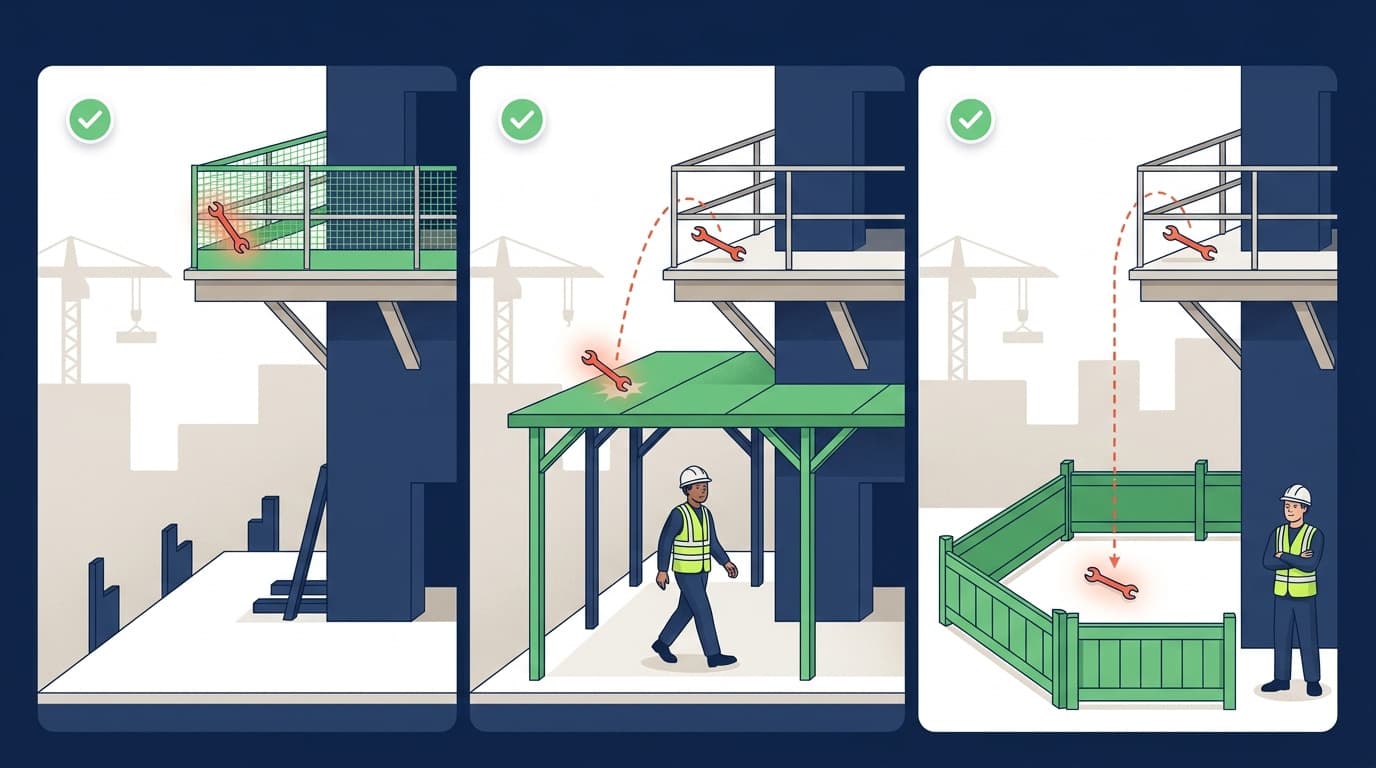
Notice also the phrase repeated in options 2 and 3: "if they were accidentally displaced." The test is not whether material is stacked tidily. It is whether it would go over the edge if someone knocked it.
The toeboard, in numbers — 1926.502(j)#
If you choose the containment route, the criteria are specific:
1926.502(j)(2) — toeboards must be capable of withstanding, without failure, a force of at least 50 pounds (222 N) applied in any downward or outward direction at any point along the toeboard.
1926.502(j)(3) — toeboards must be a minimum of 3½ inches (9 cm) in vertical height from the top edge to the level of the walking or working surface, have not more than ¼ inch (0.6 cm) clearance above that surface, and be solid or have openings not over 1 inch (2.5 cm) in greatest dimension.
That quarter-inch clearance is the detail that decides whether a toeboard works. A board fixed with a gap underneath does not stop the small items — the bolts, offcuts and clips that actually make up most dropped object incidents.
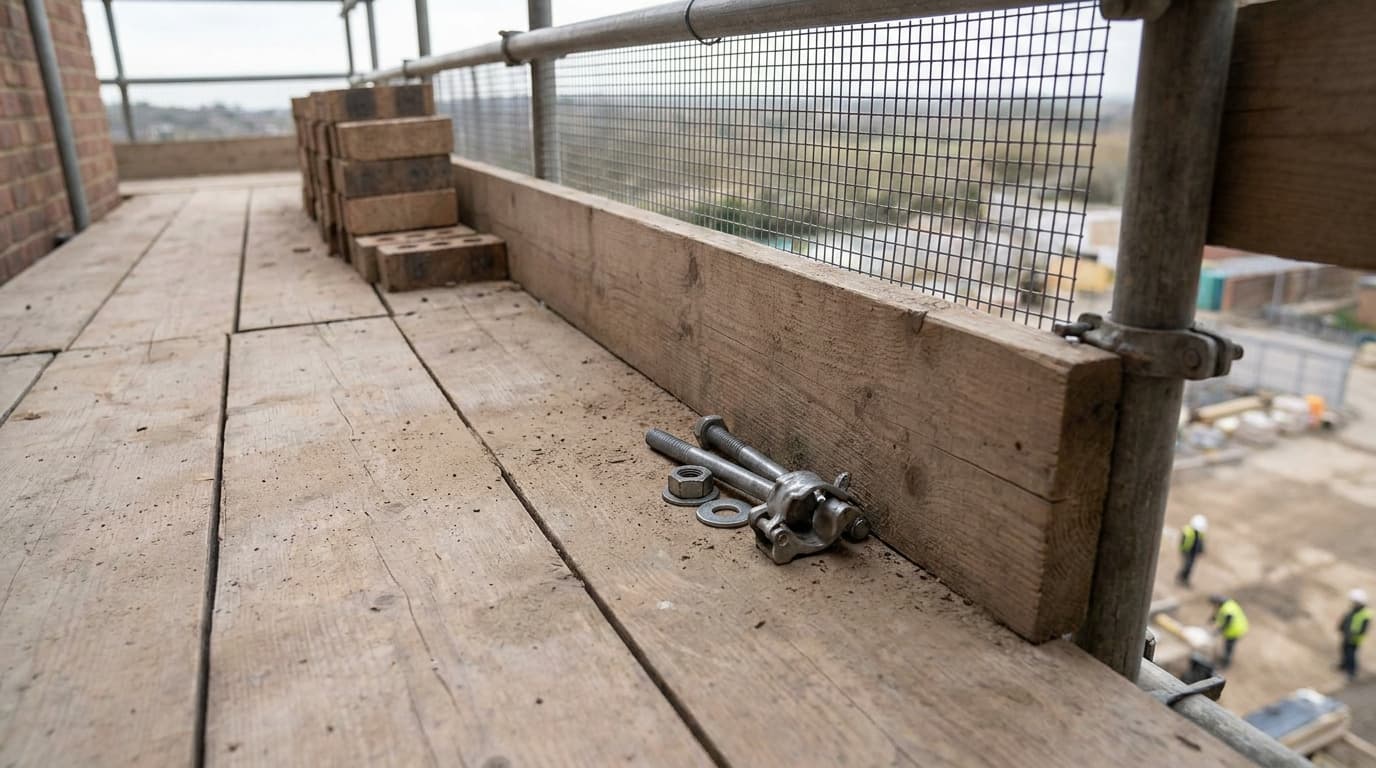
1926.502(j)(4) — where tools, equipment or materials are piled higher than the top edge of a toeboard, paneling or screening must be erected from the walking or working surface, or the toeboard, to the top of the guardrail system's top rail or midrail, for a distance sufficient to protect employees below.
And canopies, when used as falling object protection, must be strong enough to prevent collapse and to prevent penetration by any objects which may fall onto them. A sheet of plywood over a walkway is a canopy only if it can actually take the impact.
Scaffolds and steel erection#
Scaffolds — 1926.451(h)(1). In addition to wearing hard hats, each employee on a scaffold must be provided with additional protection from falling hand tools, debris, and other small objects through toeboards, screens or guardrail systems, or the erection of debris nets, catch platforms or canopy structures that contain or deflect the falling objects. And where objects are too large, heavy or massive to be contained or deflected, the employer must place them away from the edge and secure them as necessary.
Steel erection — 1926.759(a), and this is the most quietly demanding sentence in the whole area:
All materials, equipment, and tools, which are not in use while aloft, shall be secured against accidental displacement.
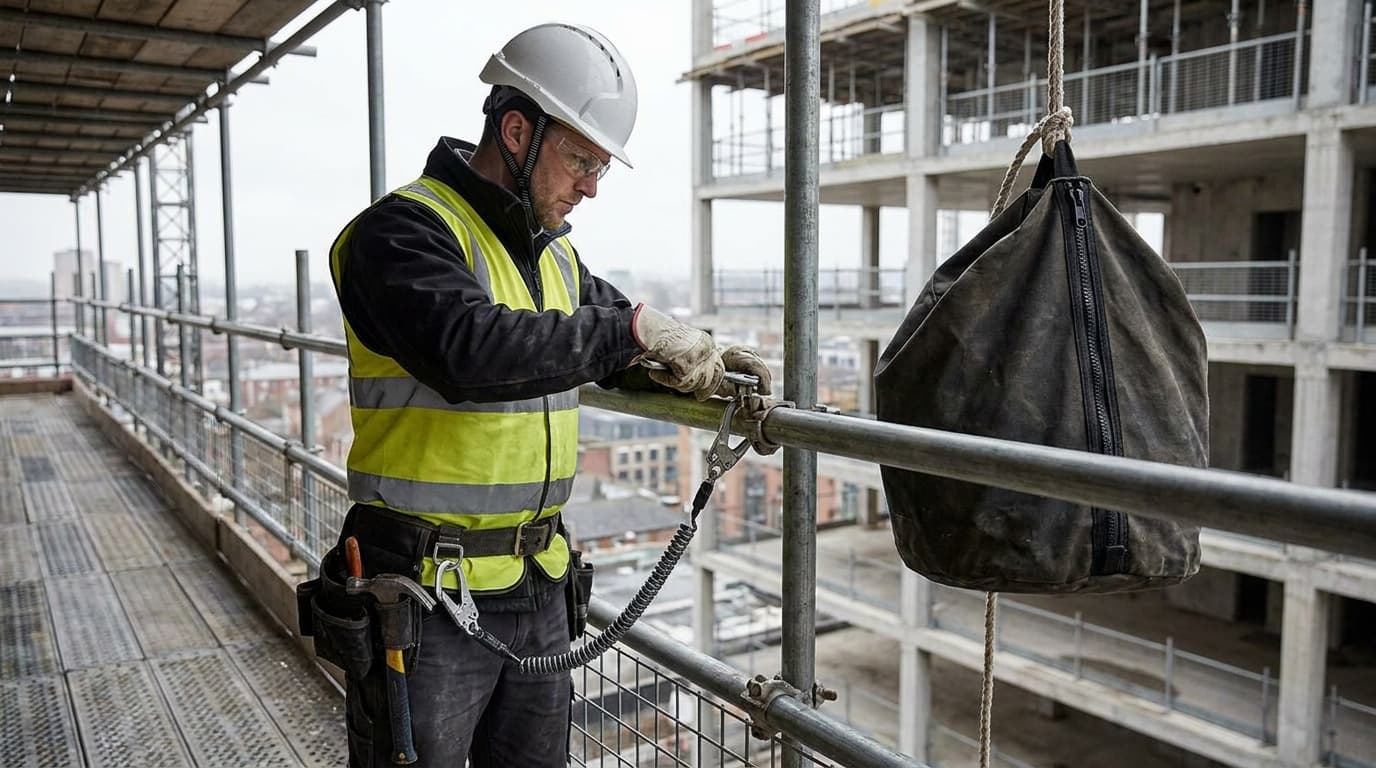
Every tool. Every fixing. Every offcut. Not just the heavy items and not just near the edge. It is the regulatory expression of what the industry now calls dropped object prevention — and it is why tool tethering and the ANSI/ISEA 121 dropped object prevention standard have become normal on serious sites.
1926.759(b) adds the controlling contractor duty: bar other construction processes below steel erection unless overhead protection for employees below is provided.
What actually falls#
Hand tools — the single most common item, usually while being passed, set down or reached for.
Fixings and small components — bolts, nuts, washers, clips, offcuts. Small, numerous, and the reason toeboard clearance matters.
Material being handled — sheet goods lifted in wind, bricks on a wall head, scaffold components during strike.
Debris displaced by sweeping, by another trade, or by weather.
Objects on the person — phones in top pockets, radios, tape measures on belts, unbuttoned pouches when someone leans over.
Things that were never secured because they were "only there for a minute."
What can go wrong?#
Hard hats treated as the control, with no toeboard, canopy or exclusion zone.
A toeboard with a gap underneath, which passes visually and stops nothing small.
Material stacked above the toeboard with no screening above it.
An exclusion zone that people walk through because it is inconvenient and nobody enforces it.
Tools set on the top rail, on a beam flange or on an open edge "for a second."
Passing tools by hand at height rather than raising and lowering them in a container.
Sweeping debris over an edge because the drop looks clear from above.
Nobody looks up. People below assume the level above is under control.
How do we manage this properly?#
Pick the measure before the work starts — contain, deflect, or exclude — and put it in place first. Then wear the hard hat as well.
Get the toeboard right: at least 3½ inches high, no more than ¼ inch clearance below, openings no more than 1 inch, and able to take 50 pounds in any downward or outward direction.
Screen above the toeboard wherever material is stacked higher than it.
Secure everything not in use aloft against accidental displacement — the steel erection rule is the right habit everywhere.
Tether tools where the drop is significant, and use closed containers to raise and lower rather than passing hand to hand.
Barricade properly if that is your chosen measure: a real physical barrier, signed, with entry prohibited, and someone responsible for enforcing it.
Keep material back from edges, and apply the standard's own test — would it go over if it were accidentally displaced?
Coordinate levels. Tell the trades below what is happening above, and stop overhead work when people must be underneath.
Before you start#
- Confirm which of the three measures is in place for today's work: containment, canopy or exclusion.
- Confirm the toeboard is continuous, tight to the surface and high enough.
- Confirm anything stacked above the toeboard has screening above it.
- Confirm nothing is resting on an open edge, a top rail or a beam flange.
- Confirm tools not in use are secured against accidental displacement.
- Confirm how tools and material will be raised and lowered — not by hand.
- Confirm who is working below you and whether they know you are above.
- Confirm any barricade is real, signed and actually being respected.
Talk it over#
- What is sitting on an edge above us right now?
- If you knocked that stack, would anything go over?
- Who is directly below your work area today?
- When did you last drop something? What stopped it hurting someone?
The bottom line#
1926.501(c) requires each exposed employee to wear a hard hat AND the employer to implement one of three measures: toeboards, screens or guardrail systems; a canopy with objects kept back from the edge; or a barricade with entry prohibited and objects kept back from the edge — the test in both being whether objects would go over if accidentally displaced. The hard hat is never the measure. If containment is chosen, 1926.502(j) sets the criteria: toeboards withstanding 50 pounds (222 N) in any downward or outward direction, a minimum of 3½ inches (9 cm) high, not more than ¼ inch (0.6 cm) clearance above the surface, openings not over 1 inch (2.5 cm), and paneling or screening where material is piled above the toeboard. On scaffolds, 1926.451(h)(1) adds debris nets, catch platforms and canopies, and requires objects too large to be contained or deflected to be placed away from the edge and secured. And 1926.759(a) sets the habit worth adopting everywhere: all materials, equipment and tools not in use while aloft shall be secured against accidental displacement.
Frequently asked questions about dropped objects#
Is a hard hat enough protection from falling objects?
No. 1926.501(c) requires the employer to have each exposed employee wear a hard hat and implement one of three measures — toeboards, screens or guardrail systems; a canopy structure with objects kept back from the edge; or a barricaded area with entry prohibited. The hard hat is worn because the control might fail; it is not the control.
What are the three measures?
Containment — toeboards, screens or guardrail systems preventing objects from falling from higher levels. Deflection — a canopy structure, combined with keeping potential falling objects far enough from the edge that they would not go over if accidentally displaced. Exclusion — barricading the area objects could fall into, prohibiting employees from entering it, and again keeping objects back from the edge.
What size must a toeboard be?
Under 1926.502(j)(3), a minimum of 3½ inches (9 cm) in vertical height from the top edge to the walking or working surface, with not more than ¼ inch (0.6 cm) clearance above that surface, and solid or with openings not over 1 inch (2.5 cm) in greatest dimension. Under (j)(2) it must withstand at least 50 pounds (222 N) applied in any downward or outward direction at any point.
What if material is stacked higher than the toeboard?
Then the toeboard alone is not sufficient. 1926.502(j)(4) requires paneling or screening to be erected from the walking or working surface, or the toeboard, to the top of the guardrail system's top rail or midrail, for a distance sufficient to protect employees below.
Do tools have to be tied off?
In steel erection, the requirement is effectively that. 1926.759(a) provides that all materials, equipment and tools which are not in use while aloft shall be secured against accidental displacement. Elsewhere the duty comes through the general falling object measures, but the same habit — tethering tools and using closed containers to raise and lower — is recognised practice, and the ANSI/ISEA 121 standard covers dropped object prevention solutions.
What about objects too big for a toeboard?
1926.451(h)(1) addresses this for scaffolds: where falling objects are too large, heavy or massive to be contained or deflected by toeboards, screens, guardrails, debris nets, catch platforms or canopies, the employer must place those potential falling objects away from the edge of the surface and secure them as necessary.
Is an exclusion zone a legitimate option?
Yes, and it is one of the three named measures — but only if it is real. 1926.501(c)(3) requires the area to be barricaded, employees to be prohibited from entering it, and objects to be kept far enough from the edge that they would not go over if accidentally displaced. A line of tape that people step over does not meet any part of that.
Download the dropped objects toolbox talk PDF#
Get this dropped objects toolbox talk as a print-ready PDF — available in English, Spanish, Portuguese, and Turkish. Print it, hand it to the crew, and collect signatures on the included attendance sheet.
Download the PDF — free account required. New members get 3 free downloads.
Related toolbox talks#
Sources#
- OSHA, 29 CFR 1926.501 — Duty to have fall protection: https://www.osha.gov/laws-regs/regulations/standardnumber/1926/1926.501
- OSHA, 29 CFR 1926.502 — Fall protection systems criteria and practices: https://www.osha.gov/laws-regs/regulations/standardnumber/1926/1926.502
- OSHA, 29 CFR 1926.759 — Falling object protection: https://www.osha.gov/laws-regs/regulations/standardnumber/1926/1926.759
Written by FieldSafetyTalk's safety professional — a CSP, ASP, CHST and OSHA Authorized Outreach Trainer with 14+ years of international construction safety experience across federal, heavy civil, and industrial projects.