Grounding & Arc Flash
Updated 2026-07-28
In this bundle Electrical Safety
Print-ready PDF
Download this talk as a print-ready PDF, available in 4 languages.
Ask ten people on a construction site whether OSHA requires an arc flash study and you will get ten confident answers, most of them wrong. The truthful answer is that OSHA wrote a real one — with a number in it — and then put it in a subpart that does not cover the work most of us do. This Grounding & Arc Flash Toolbox Talk (Safety Talk / Tailgate Talk) is about that gap, and about the eight-word grounding requirement that quietly does more to keep this crew alive than any calculation.
Here is the distinction that carries this whole talk: grounding is what the system does with fault current when something goes wrong; arc rating is what your clothing does with the heat when it goes wrong anyway. They are not two versions of the same protection. One is engineered into the installation before you arrive. The other is worn on your body. Confusing them is how people end up standing in front of a panel wearing a hard hat, safety glasses and a cotton shirt, believing the green wire is looking after them.
OSHA's arc flash rule exists — it is just in the wrong subpart for most of us#
29 CFR 1926.960(g) is as concrete as safety regulation gets. It requires the employer to:
- assess the workplace to identify employees exposed to hazards from flames or electric arcs — (g)(1);
- make a reasonable estimate of the incident heat energy each exposed employee would receive — (g)(2);
- ensure nobody wears clothing that could melt onto the skin or ignite and continue to burn — (g)(3);
- ensure the outer layer is flame resistant under stated conditions, including where the estimated incident energy exceeds 2.0 cal/cm² — (g)(4);
- ensure that clothing and equipment carry an arc rating greater than or equal to the estimated incident energy whenever that estimate exceeds 2.0 cal/cm² — (g)(5).
That is a numerical duty: estimate the energy, then match the clothing to the number. Appendix E to Subpart V even supplies tables so an employer can make broad estimates covering multiple system areas rather than calculating every task.
Now read the scope. 1926.950(a)(1)(i) states that the subpart covers the construction of electric power transmission and distribution lines and equipment — erecting new lines and equipment, and altering, converting and improving existing ones. Building work is not that. And Subpart K, which does cover the electrical installations that provide power and light on our jobsite, says at 1926.402(b) that it does not cover generation, transmission and distribution installations, and points to Subpart V for those.
So the two subparts divide the world between them, and the arc flash number goes with the line crews. Search Subpart K for an incident energy requirement and there is nothing — no estimate, no cal/cm², no arc rating table. The general requirement that survives is 1926.28(a), which requires appropriate personal protective equipment where there is an exposure to hazardous conditions, and 1926.95, which requires PPE to be provided and maintained wherever hazards make it necessary.
Say the honest version to the crew: OSHA has told us in its own words what competent arc flash protection looks like, and has made it enforceable for one class of work. Nobody has told us the hazard behaves differently at a 480-volt distribution panel in a building. The energy in that panel does not know which subpart it is filed under.
That is why NFPA 70E is written into so many contracts and why federal work runs on EM 385-1-1. They are the recognised industry practice, and the General Duty Clause reaches recognised hazards.
The grounding requirement is eight words long#
29 CFR 1926.404(f)(6) says it all: the path to ground from circuits, equipment, and enclosures shall be permanent and continuous.
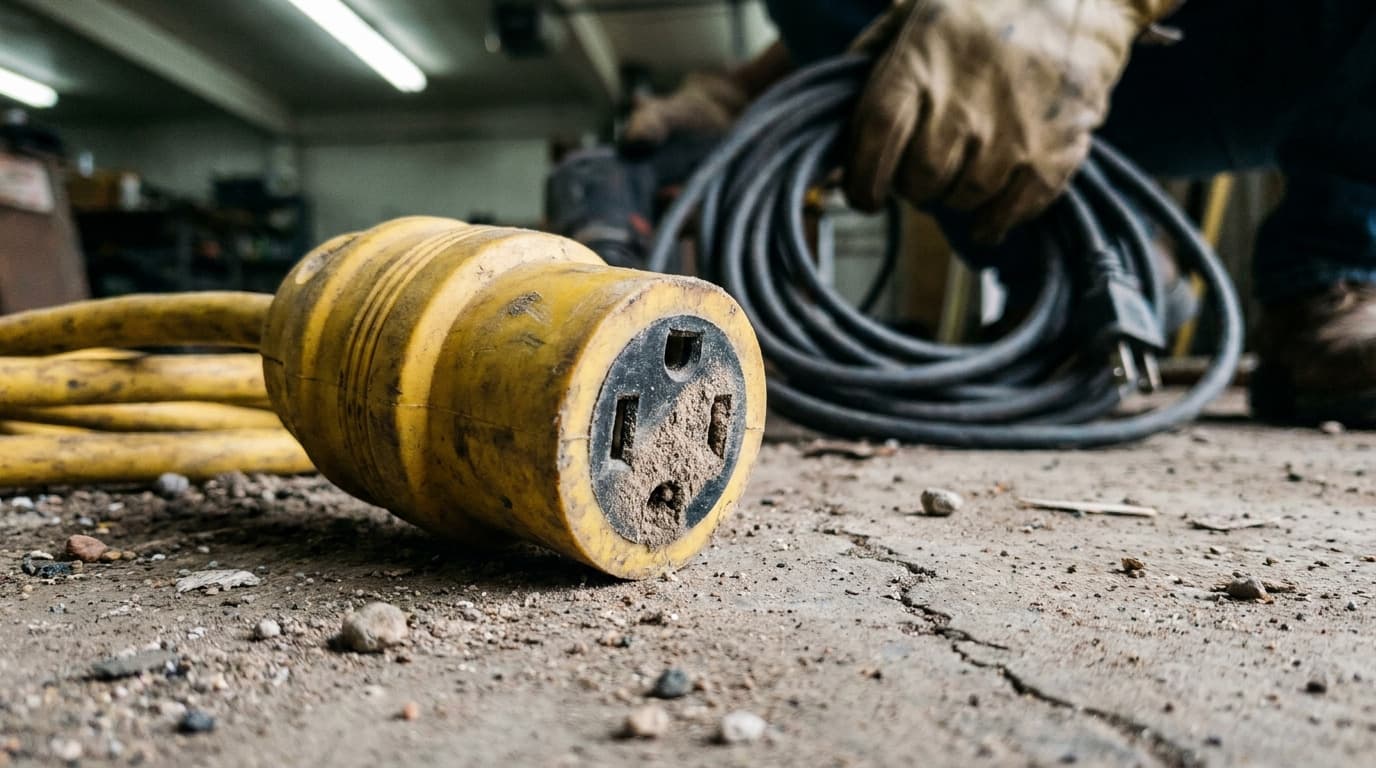
Permanent and continuous. Not present. Not connected at the panel. Not there when it was installed. Every one of the following breaks it, and every one of them is something you can see from where you are standing:
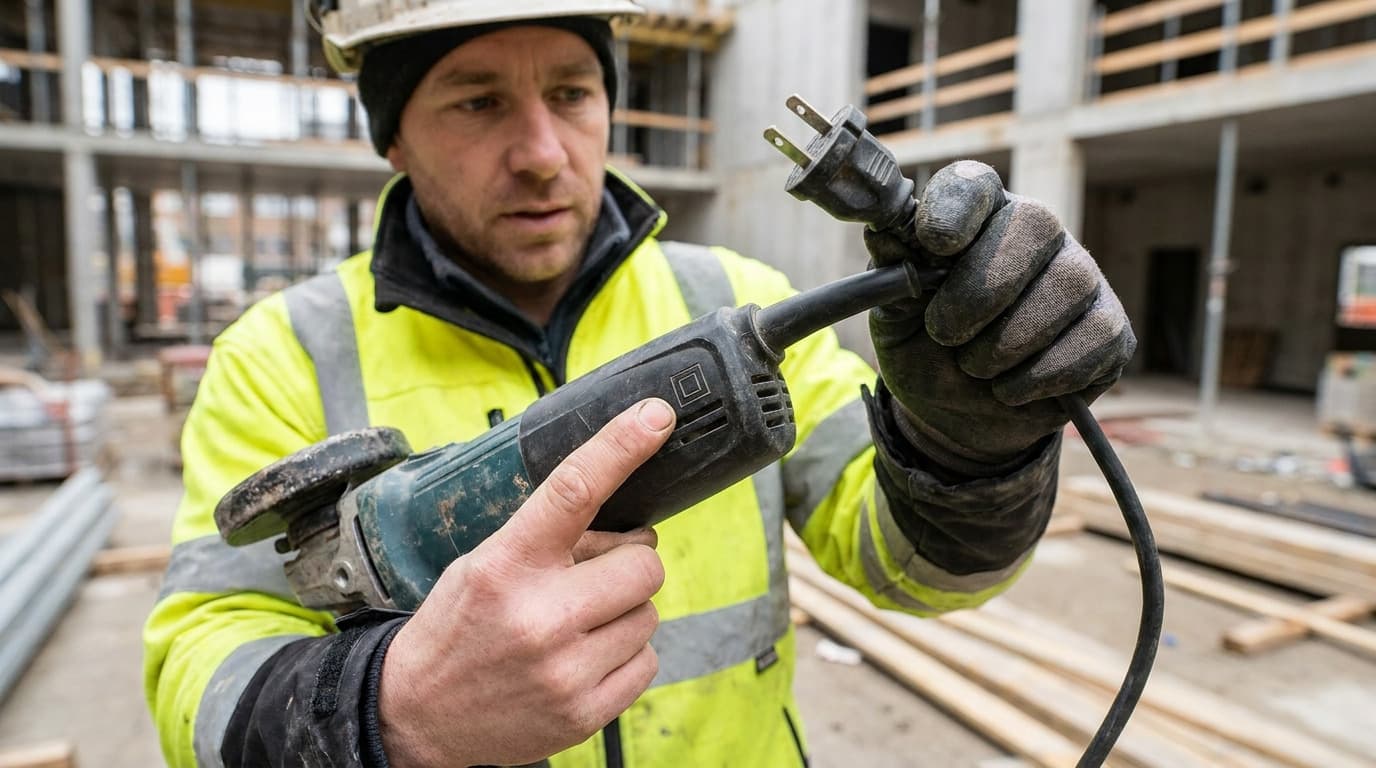
- a ground pin snapped, filed off or cut off a plug;
- a three-to-two adaptor on a hand tool;
- a cord repaired with tape over a nicked jacket that has already broken the green conductor inside;
- a metal enclosure hung on a strut with the bonding jumper left in the bag;
- a grounding terminal used as a convenient tie point — which 1926.404(a)(3) specifically prohibits.
The standard then names what has to be grounded. 1926.404(f)(7)(iv) requires the exposed non-current-carrying metal parts of cord- and plug-connected equipment to be grounded when it is in a hazardous location, operates at over 150 volts to ground, or is one of the listed types — hand-held motor-operated tools, equipment used in damp or wet locations or by employees standing on the ground or on metal, tools likely to be used in wet or conductive locations, and portable hand lamps.
There is one exemption and it has a condition attached. Under (f)(7)(iv)(C)(6), listed double-insulated tools need not be grounded — but the equipment must be distinctively marked to show it uses a system of double insulation. No marking, no exemption. A two-pin tool that is not marked is not a double-insulated tool; it is a tool somebody has removed the ground from.
The 25-ohm rule is almost always stated backwards#
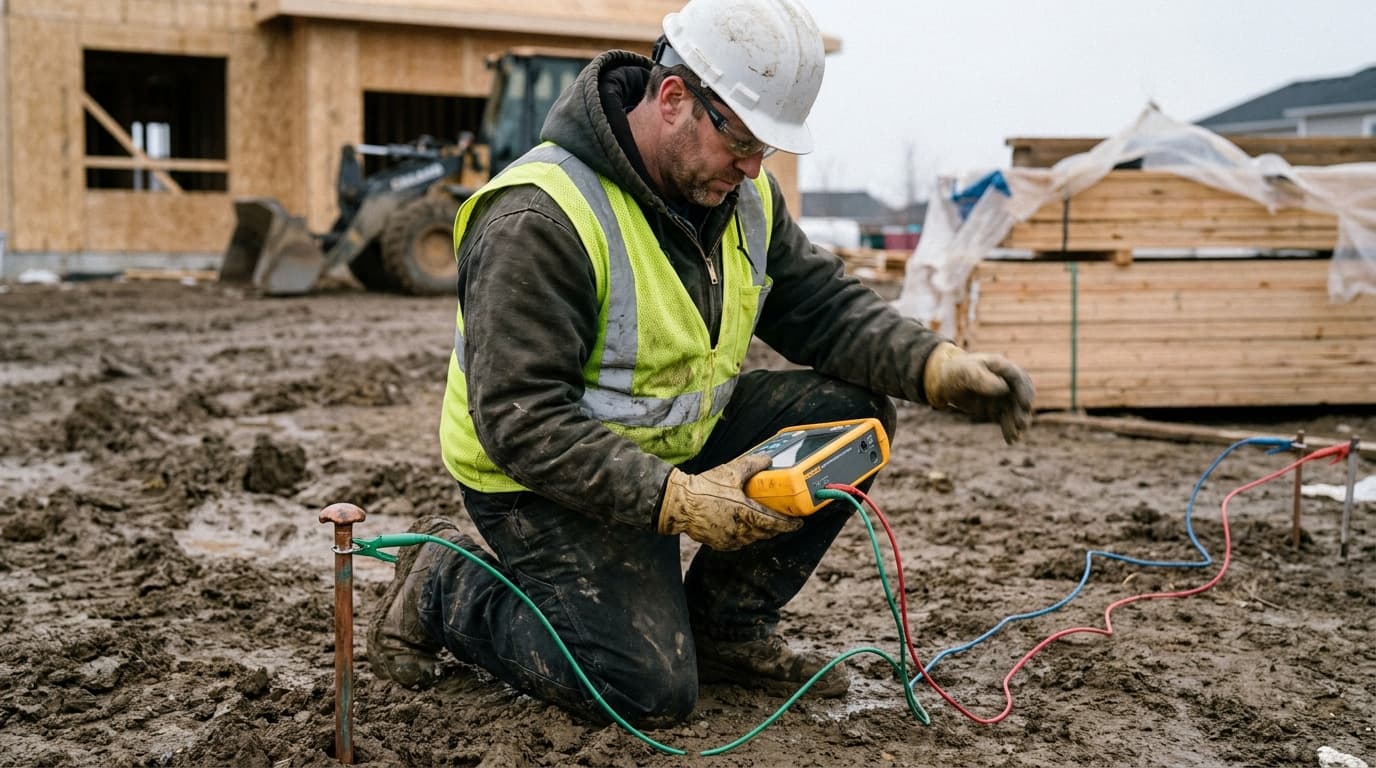
People say OSHA requires a ground rod to reach 25 ohms. It does not. 1926.404(f)(10) says that a single made electrode — rod, pipe or plate — with a resistance to ground greater than 25 ohms shall be augmented by one additional electrode installed no closer than 6 feet (1.83 m) to the first.
The duty is to add a second electrode, not to achieve a number. Drive one rod, measure more than 25 ohms, add a second rod at least 6 feet (1.83 m) away, and you have complied even if the reading is still above 25 ohms. The same paragraph also requires made electrodes to be free of non-conductive coatings such as paint or enamel, and embedded below the permanent moisture level where practicable — which is why a painted rod or a rod driven into dry fill is a defect even when the clamp looks perfect.
Two more provisions worth knowing. 1926.404(f)(8)(ii) requires a grounding conductor to have the capacity to carry safely any fault current that may be imposed on it — an undersized jumper is not a ground. And 1926.404(f)(9) applies the same test to bonding conductors used to assure electrical continuity.
What can go wrong?#
The ground path is broken and nothing announces it. A tool with a defeated ground works perfectly until the day its winding fails. Then the case is live, and the first person to complete the circuit finds out.
PPE is chosen by habit. A crew opens a panel in cotton shirts because that is what was worn last week. Without an incident energy estimate there is no basis for the choice at all — it is not conservative, it is simply unknown.
Flammable clothing under the arc-rated layer. Subpart V bans clothing that melts onto skin for a reason. Polyester base layers and fleece under a rated shirt are a known mechanism of catastrophic burns.
The second electrode is never installed. Somebody takes a reading, does not like it, and moves on. Or nobody takes a reading at all and the rod is assumed good.
Everyone assumes the grounding conductor is a shock protection device. It is a fault-clearing path. It gives the overcurrent device something to trip on. It does not limit the current through a body already in contact with an energised part.
How do we get this right?#
Treat the ground path as an inspection item, not an assumption. Before each day's use, look at the plug, the jacket, the strain relief and the connector — the same inspection required for cord- and plug-connected equipment.
Never accept a tool with a missing ground pin, and never accept an adaptor. Tag it and take it out of service. Repairing a cord plug correctly takes minutes; there is no version of this where the tool goes back on the wall.
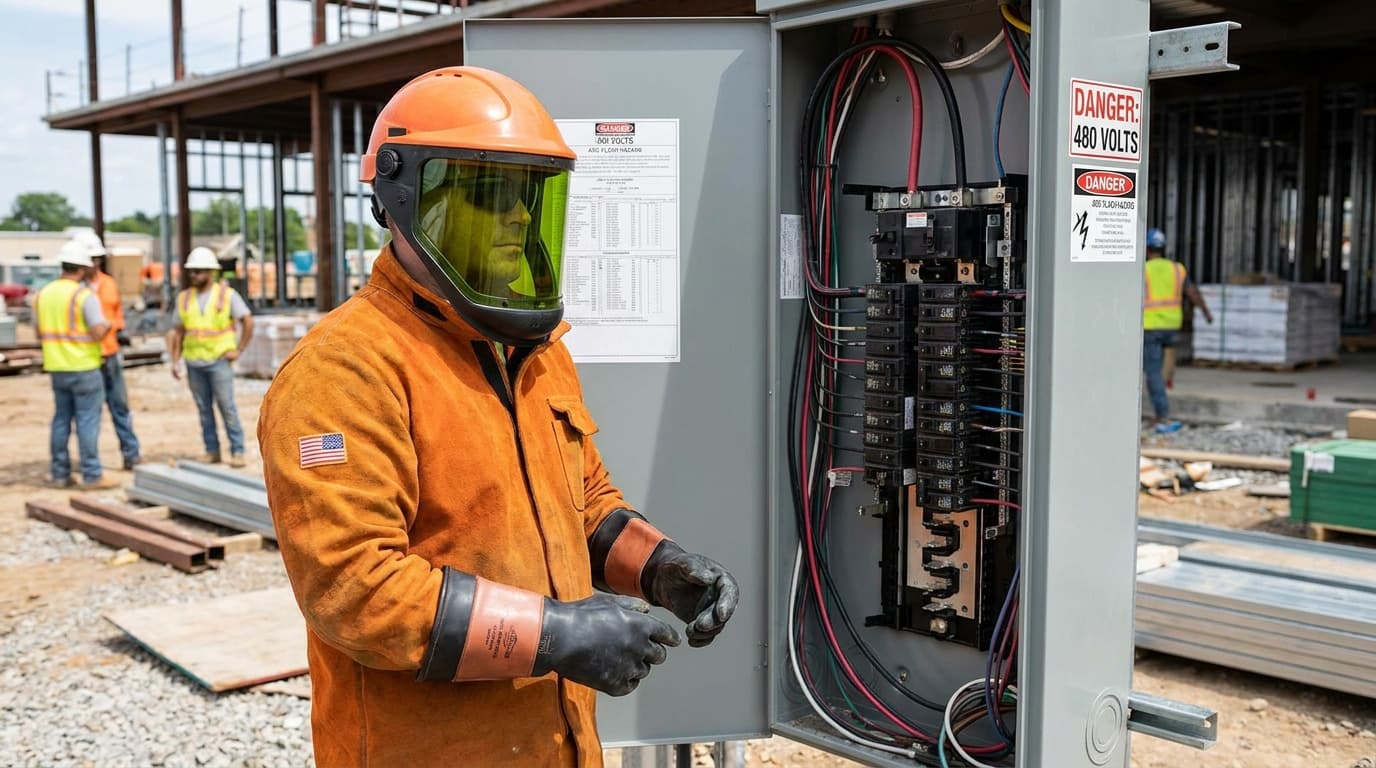
Know the incident energy before the cover comes off. Where the equipment is labelled, work to the label. Where it is not, someone qualified has to establish it. Arc-rated clothing is selected against a number, and if the number is unknown the honest position is that the panel does not get opened today.
Wear the whole system. Arc rating is measured for the garment as worn. Rated outer layer, no meltable synthetics underneath, face and head protection, voltage-rated gloves with leather protectors within test date.
Check made electrodes properly. No paint, no enamel, below the moisture level where practicable, and a second electrode at least 6 feet (1.83 m) away when a single one reads high.
Bond metal enclosures as you install them, not at the end of the shift. The jumper that is not fitted today is the one nobody remembers tomorrow.
Before you start#
- Confirm the equipment grounding conductor is intact on every cord and tool you will use today.
- Confirm no adaptors, no missing pins, no taped repairs over damaged jacket.
- Confirm double-insulated tools carry the marking that entitles them to be double insulated.
- Confirm whether an incident energy value exists for the equipment you are opening, and what it is.
- Confirm your arc-rated layer is rated at or above that value, and that nothing meltable is worn under it.
- Confirm the panel or enclosure you are working in is bonded, and that no grounding terminal has been used as a general tie point.
Talk it over#
- Have you ever used a tool with the ground pin missing? What made it seem acceptable at the time?
- Who on this site can tell you the incident energy at the panel you opened last week?
- If the label is missing, what do we do — and who has the authority to say the work waits?
- What would it take for you to stop a job over a piece of clothing?
The bottom line#
OSHA wrote a numerical arc flash rule — 1926.960(g) — requiring a hazard assessment, an estimate of incident heat energy, and clothing with an arc rating greater than or equal to that estimate once it exceeds 2.0 cal/cm². It applies to the construction of transmission and distribution lines, not to the building work most of us do, and Subpart K contains no equivalent number. The energy at the panel does not care about that distinction, which is why NFPA 70E and EM 385-1-1 fill the gap on serious projects. Meanwhile the requirement that applies everywhere is eight words long: the path to ground shall be permanent and continuous — and it is defeated by one snapped pin.
Frequently asked questions about grounding and arc flash#
Does OSHA require an arc flash study on construction sites?
Not under Subpart K. OSHA's numerical arc flash requirements sit in 29 CFR 1926.960(g), part of Subpart V, which under 1926.950(a)(1)(i) covers the construction of electric power transmission and distribution lines and equipment. For general building work, the applicable duties are the broad PPE requirements of 1926.28(a) and 1926.95, with NFPA 70E as the recognised industry practice — routinely required by contract, and reachable through the General Duty Clause.
What incident energy level triggers arc-rated clothing?
Under 1926.960(g)(5), arc-rated protective clothing and equipment with an arc rating greater than or equal to the estimated incident energy is required whenever that estimate exceeds 2.0 cal/cm². Appendix E to Subpart V explains that untreated cotton will reduce a 2 cal/cm² exposure below the level generally associated with burn injury, which is why that is where the requirement starts.
Does OSHA require a ground rod to measure 25 ohms?
No, and this is the most commonly repeated error in the standard. 1926.404(f)(10) requires that a single made electrode with a resistance to ground greater than 25 ohms be augmented by one additional electrode installed no closer than 6 feet (1.83 m) from the first. The obligation is to install a second electrode — not to reach a particular resistance.
Do double-insulated tools need a ground?
No, provided they qualify. 1926.404(f)(7)(iv)(C)(6) exempts listed or labelled portable tools protected by a system of double insulation, but requires that the equipment be distinctively marked to indicate it. An unmarked two-pin tool is not covered by the exemption.
What does "permanent and continuous" actually mean?
1926.404(f)(6) requires the path to ground from circuits, equipment and enclosures to be permanent and continuous — an unbroken, low-impedance route back to the source that stays that way in service. A cut ground pin, a two-prong adaptor, a broken conductor inside a damaged cord or an unbonded enclosure each defeat it, usually invisibly.
Will the grounding conductor protect me from a shock?
Not directly. The equipment grounding conductor exists to carry fault current so the overcurrent device operates and the enclosure does not stay energised. It does not limit current through a person who is already in contact with a live part, and it does nothing about arc flash. Ground-fault circuit interrupters and de-energising are what address those.
Can I wear a synthetic shirt under arc-rated clothing?
No. 1926.960(g)(3) prohibits clothing that could melt onto the skin or ignite and continue to burn when exposed to flames or the estimated heat energy. Meltable synthetics worn under a rated layer are a recognised cause of severe burns, and the arc rating of the outer garment is not a rating for the whole assembly.
Download the grounding and arc flash toolbox talk PDF#
Get this grounding and arc flash toolbox talk as a print-ready PDF — available in English, Spanish, Portuguese, and Turkish. Print it, hand it to the crew, and collect signatures on the included attendance sheet.
Download the PDF — free account required. New members get 3 free downloads.
Related toolbox talks#
Sources#
- OSHA, 29 CFR 1926.404 — Wiring design and protection: https://www.osha.gov/laws-regs/regulations/standardnumber/1926/1926.404
- OSHA, 29 CFR 1926.960 — Working on or near exposed energized parts: https://www.osha.gov/laws-regs/regulations/standardnumber/1926/1926.960
- OSHA, 29 CFR 1926.950 — General (Subpart V scope): https://www.osha.gov/laws-regs/regulations/standardnumber/1926/1926.950
- OSHA, Appendix E to Subpart V of Part 1926 — Protection From Flames and Electric Arcs: https://www.osha.gov/laws-regs/regulations/standardnumber/1926/1926SubpartVAppE
Written by FieldSafetyTalk's safety professional — a CSP, ASP, CHST and OSHA Authorized Outreach Trainer with 14+ years of international construction safety experience across federal, heavy civil, and industrial projects.