Guardrail Safety
Updated 2026-07-24
In this bundle Fall Protection & Heights
Print-ready PDF
Download this talk as a print-ready PDF, available in 4 languages.
A harness only works if the worker puts it on, connects it, and picks the right anchor. A guardrail works whether anyone is paying attention or not. That difference is the whole reason guardrails sit above personal fall arrest in the hierarchy of controls — and it is also why a guardrail that is slightly wrong is more dangerous than no guardrail at all. This guardrail safety talk is about protection that asks nothing of the person it protects.
Here is the distinction that carries this whole talk: every other fall protection system depends on a decision made by the worker at the edge. A guardrail depends on a decision made by whoever built it, days earlier, and then on nobody undoing it. The worker at the edge contributes nothing to whether it holds — which is exactly what makes it reliable, and exactly why the specifications are not suggestions. A rail that looks right and fails at 150 pounds gives a worker confidence they have not earned, and confidence at an unprotected edge is the thing that kills.
What are the OSHA guardrail requirements?#
Guardrail criteria are set by 29 CFR 1926.502(b), and they are unusually specific because a guardrail either performs or it does not. These are the numbers you can verify with a tape measure and a firm push:
- Top rail height — 1926.502(b)(1). The top edge must be 42 inches, plus or minus 3 inches, above the walking or working level. Where employees are using stilts, the top edge must be raised by the height of the stilts.
- Top rail strength — 1926.502(b)(3). The system must withstand at least 200 pounds of force applied within 2 inches of the top edge, in any outward or downward direction, at any point along the top edge.
- Deflection limit — 1926.502(b)(3). When that 200-pound load is applied downward, the top edge must not deflect below 39 inches above the walking level. This is the requirement most crews do not know, and it is where compliant-looking rails fail.
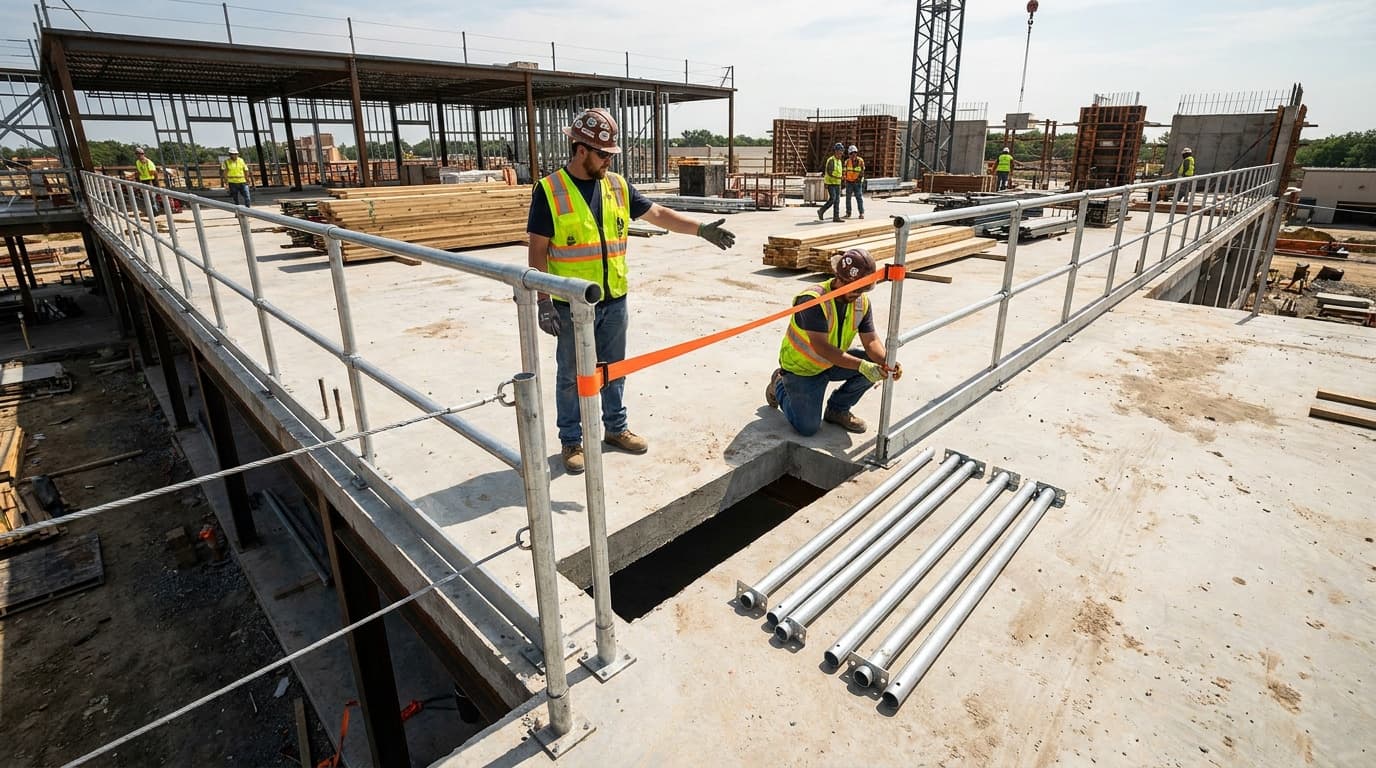
- Midrails — 1926.502(b)(2). Where there is no wall or parapet at least 21 inches high, a midrail, screen, mesh, or equivalent member must be installed midway between the top edge and the walking surface.
- Midrail strength — 1926.502(b)(5). Midrails, screens, mesh, and intermediate members must withstand at least 150 pounds applied in any downward or outward direction.
- Openings — 1926.502(b)(4). Intermediate members must be spaced so there are no openings more than 19 inches wide in the system.
- Surface — 1926.502(b)(6). Guardrail surfaces must be free of anything that could cut hands or snag clothing.
- Rail ends — 1926.502(b)(10). Top rails and midrails must not overhang terminal posts except where the overhang poses no projection hazard.
- Toeboards — 1926.502(j). Where used as falling-object protection, toeboards must be at least 3½ inches high, with no more than ¼ inch clearance above the surface, and must withstand 50 pounds of force. Where material is piled higher than the toeboard, screening or paneling must extend to the top rail.
- Steel and plastic banding — 1926.502(b)(9). Banding must not be used as a top rail or midrail.
Guardrails are one of three approved means of protecting a worker from a fall of 6 feet or more in construction under 1926.501(b)(1) — alongside safety nets and personal fall arrest.
Appendix B to Subpart M gives non-mandatory examples of wood, pipe, and structural steel guardrails that OSHA deems compliant. On USACE and NAVFAC projects, EM 385-1-1 applies and is more restrictive in several places.
What can go wrong with a guardrail?#
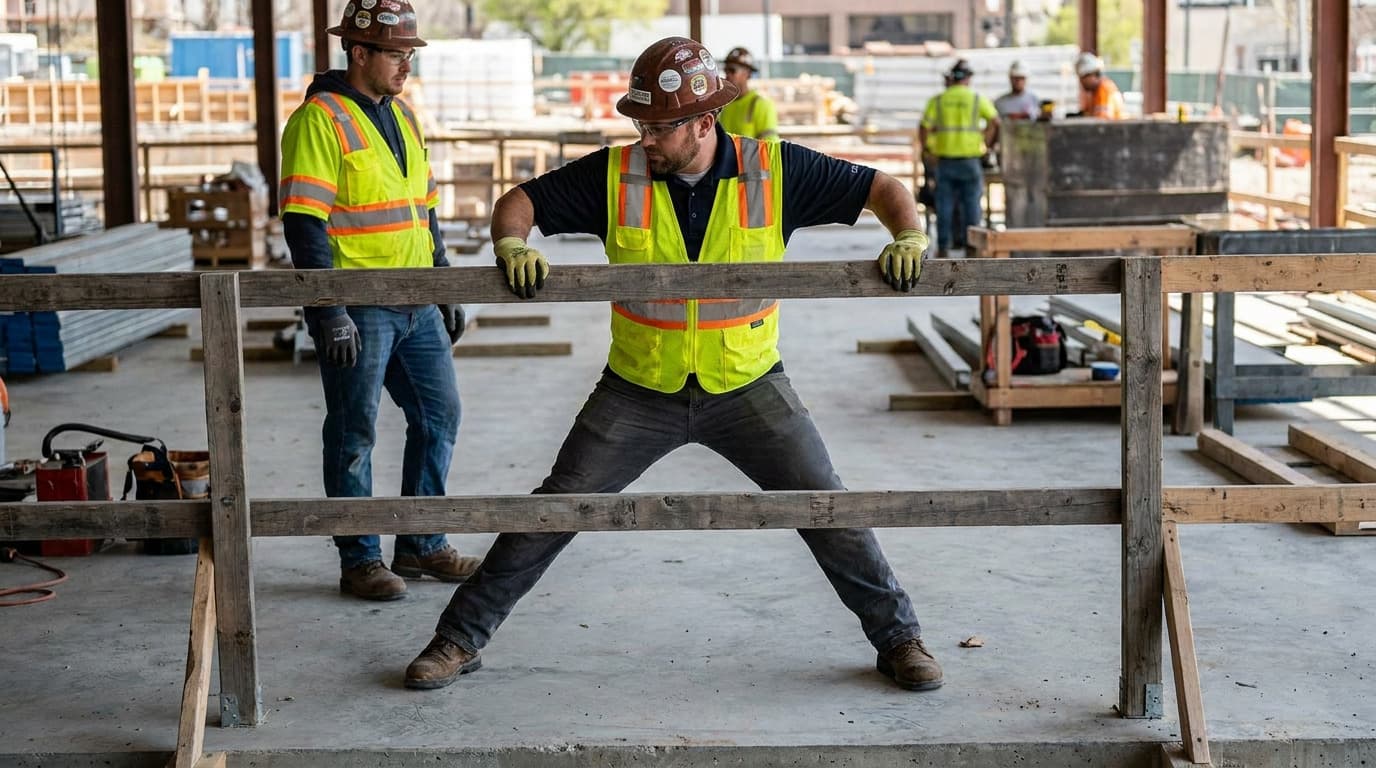
It looks right and fails the test. A rail at the correct 42 inches that deflects below 39 inches under load has failed 1926.502(b)(3). Nobody can see this by looking. It is found by pushing on it, or by a worker falling through it.
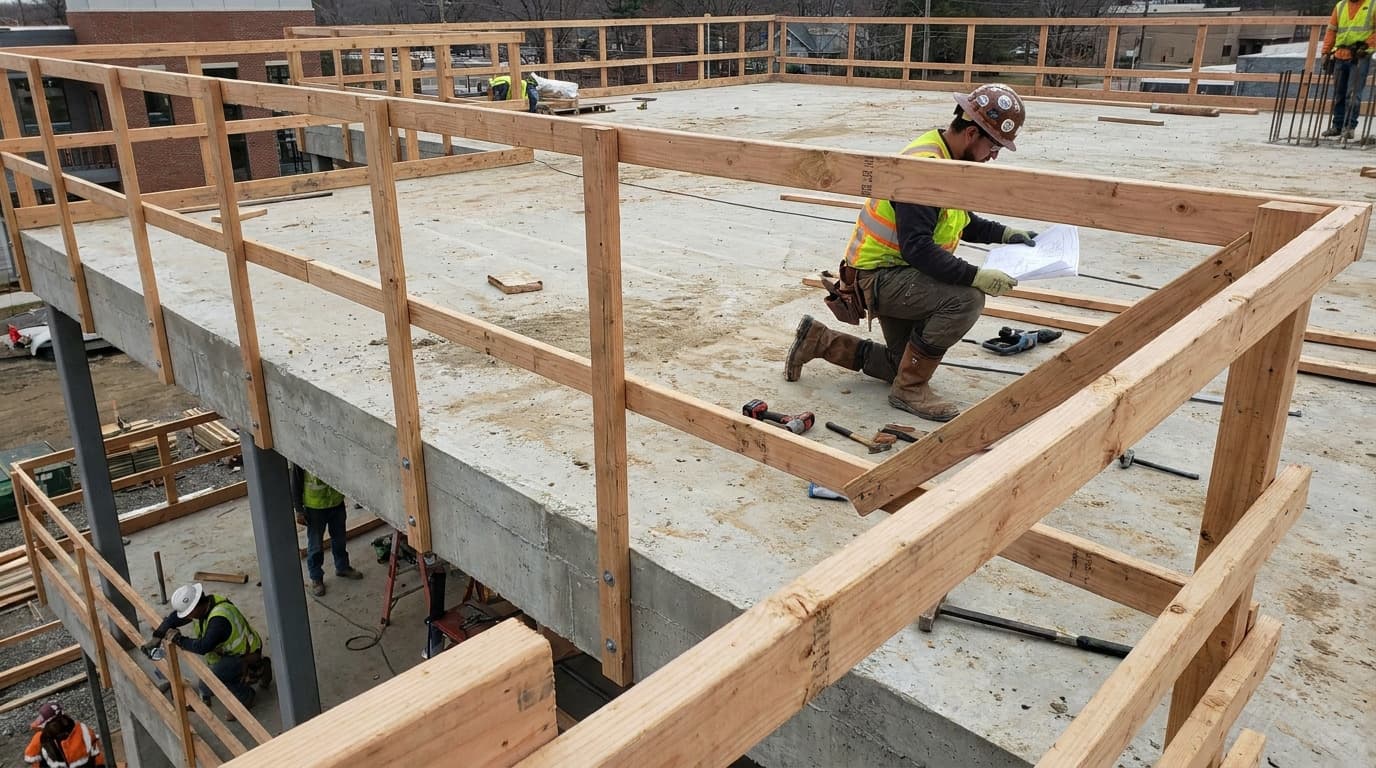
Site-built rails made of the wrong material. Scrap lumber, rebar, steel banding, and plastic banding are used as top rails because they were on hand. Banding is specifically prohibited under 1926.502(b)(9), and scrap timber has no known fibre stress rating.
Missing midrails. A top rail alone leaves an opening a worker can go through — under, not over. Where there is no wall or parapet at least 21 inches high, a midrail is required.
Openings wider than 19 inches. Common where posts are spaced too far apart, where a section has been removed, or where architectural panels leave gaps.
Removed and not replaced. This is the most common failure and the hardest to catch. A section comes off to land material, run a hoist, or move equipment, and the crew that removed it is not the crew that returns to that edge. Nothing about the gap announces itself as recent.
Posts inadequately fixed. The rail is correct in every dimension and the post base is not. Under load, the whole assembly rotates rather than the rail bending.
Toeboards missing where people work below. The guardrail protects the worker at the edge and does nothing for the crew underneath, who are exposed to every tool and offcut on that platform.
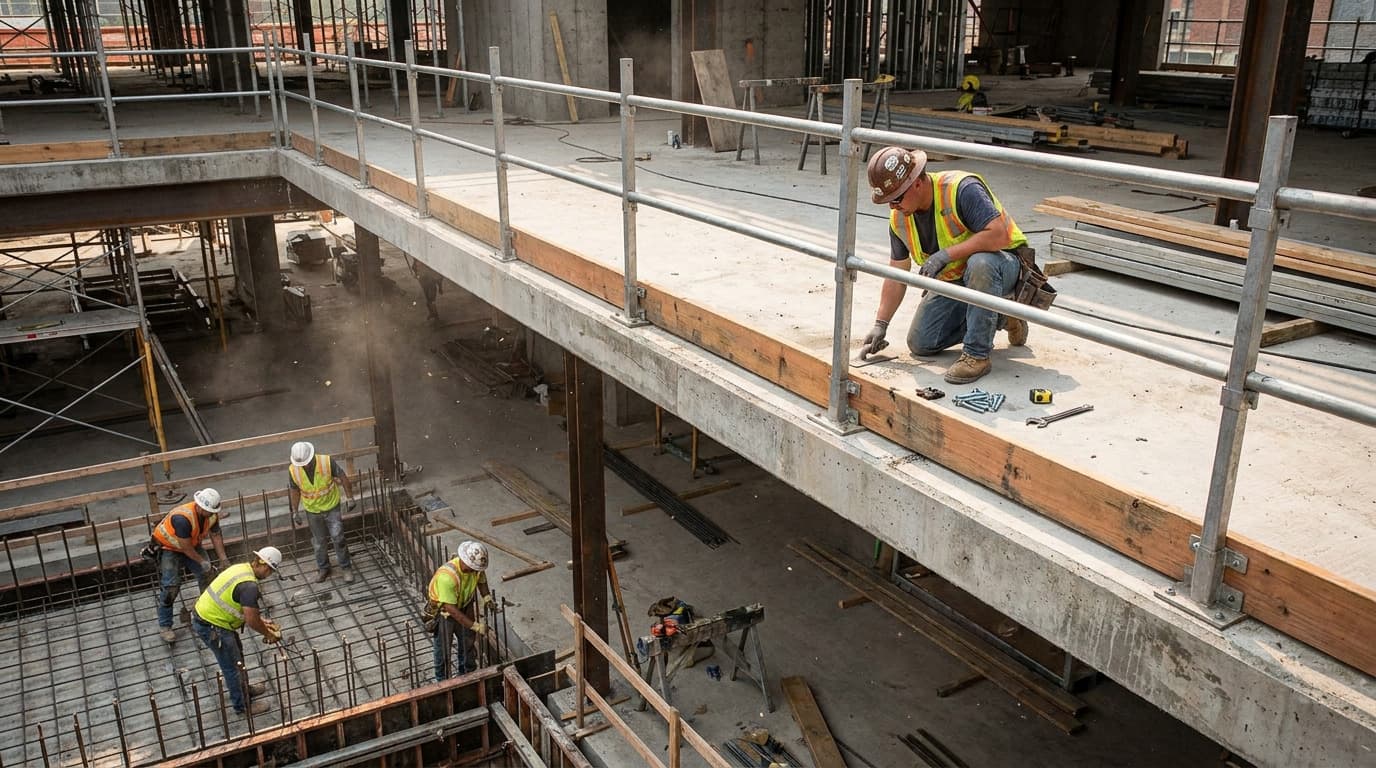
Used as an anchor point. Workers tie off to guardrails. A system rated to hold 200 pounds of static force has no relationship to the roughly 5,000 pounds required of a fall arrest anchor under 1926.502(d)(15).
Damaged and left in service. Impact from equipment, weathering of timber, corrosion, and loosening from vibration all reduce strength without changing appearance.
How do we make guardrails work?#
Build to the specification, not to the eye. 42 inches ± 3, midrail at the midpoint, no openings over 19 inches, and materials that can actually take the load. If you did not build it and cannot see how the posts are fixed, do not assume it holds.
Test it the way the standard does. Push firmly outward and downward near the top edge at several points along the run. If it moves substantially, or if the top edge would drop below 39 inches under a real load, it does not comply — report it rather than working next to it.
Never use banding, scrap, or improvised material. Steel and plastic banding are prohibited outright. Timber must be construction grade. If the right material is not on site, the edge gets a different control until it is.
Add toeboards wherever anyone can be below. 3½ inches minimum, ¼ inch maximum clearance, and screening above it where material is stacked higher. This is the part of the guardrail that protects people who never went near the edge.
Treat removal as a controlled operation. If a section must come out for material handling, the person who removes it owns putting it back, an alternative control covers the gap in the meantime, and the edge is not left open across a shift change. This mirrors the discipline used for machine guards, and for the same reason.
Inspect as part of the area walk. Height, midrail, openings, post fixings, material condition, and toeboards. Rope or synthetic top rails need particular attention, since they lose strength with UV exposure and abrasion.
Never tie off to a guardrail. It is designed for 200 pounds of static force, not the roughly 5,000 pounds a fall arrest anchor must support. Anchors are a separate decision — see the Anchor Point Selection talk.
Report gaps rather than working around them. An open edge that everyone steps around is an open edge nobody has fixed. It will still be there when someone is carrying material and cannot see their feet.
Before you start#
- Measure or eye the top rail against 42 inches — roughly belt-buckle to lower-chest height on most adults.
- Push the top rail outward and downward. Does it feel like it would hold 200 pounds without dropping below 39 inches?
- Confirm a midrail is present, or that there is a wall or parapet at least 21 inches high.
- Look for openings wider than 19 inches anywhere in the run.
- Check what the rail is made of — no banding, no scrap, no rebar.
- Check the post fixings, not just the rail.
- Confirm toeboards are present wherever anyone could be working below.
- Identify any section that has been removed, and find out who removed it and when it is going back.
- Confirm nobody on this crew intends to tie off to the guardrail.
Talk it over#
- Walk this edge with me and push on the rail every few feet. Does any of it move more than you would want?
- Is there a section missing anywhere on this level? Who took it out, and when is it going back?
- If you needed an anchor point on this deck right now, where would you tie off — and why not the guardrail?
The bottom line#
A guardrail is the only fall protection that works without the worker doing anything, which makes it the most reliable control at an edge and the least forgiving of a bad build. The numbers are checkable: 42 inches plus or minus 3, 200 pounds without dropping below 39, a midrail at the midpoint, no opening over 19 inches, and toeboards wherever anyone works below. Never build one from banding or scrap, never tie off to one, and treat a removed section as an open edge until the person who took it out puts it back.
Frequently asked questions about guardrails#
How high does an OSHA guardrail have to be?
Under 29 CFR 1926.502(b)(1), the top edge must be 42 inches, plus or minus 3 inches, above the walking or working level — so between 39 and 45 inches. Where employees use stilts, the top edge must be raised by the height of the stilts.
How much force must a guardrail withstand?
At least 200 pounds, applied within 2 inches of the top edge in any outward or downward direction, at any point along the top edge — 1926.502(b)(3). Midrails and intermediate members must withstand at least 150 pounds under 1926.502(b)(5), and toeboards 50 pounds under 1926.502(j).
What is the 39-inch rule for guardrails?
Under 1926.502(b)(3), when the 200-pound test load is applied downward, the top edge must not deflect to less than 39 inches above the walking level. A rail can be correctly installed at 42 inches and still fail the standard if it deflects too far under load. This is the requirement crews most often do not know.
Can I use steel or plastic banding as a top rail?
No. 29 CFR 1926.502(b)(9) specifically prohibits the use of steel and plastic banding as top rails or midrails. Scrap lumber and rebar are equally unsuitable, since neither has a known load rating.
Can I tie my harness off to a guardrail?
No. A guardrail is designed to resist 200 pounds of static force. A personal fall arrest anchor must support 5,000 pounds per attached worker, or be designed by a qualified person with a safety factor of at least two, under 1926.502(d)(15). The two are not interchangeable.
When are toeboards required on a guardrail?
Wherever workers, equipment, or materials could be below and struck by falling objects. Under 1926.502(j), toeboards must be at least 3½ inches high with no more than ¼ inch clearance above the surface. Where material is stacked higher than the toeboard, screening or paneling must extend up to the top rail.
Download the guardrail toolbox talk PDF#
Get this guardrail toolbox talk as a print-ready PDF — available in English, Spanish, Portuguese, and Turkish. Print it, hand it to the crew, and collect signatures on the included attendance sheet.
Download the PDF — free account required. New members get 3 free downloads.
Related toolbox talks#
Sources#
- OSHA, 29 CFR 1926.502 — Fall protection systems criteria and practices: https://www.osha.gov/laws-regs/regulations/standardnumber/1926/1926.502
- OSHA, 1926 Subpart M App B — Guardrail Systems: https://www.osha.gov/laws-regs/regulations/standardnumber/1926/1926SubpartMAppB
- OSHA, 1926 Subpart R App G — 1926.502(b)-(e) Fall Protection Systems Criteria: https://www.osha.gov/laws-regs/regulations/standardnumber/1926/1926SubpartRAppG
- OSHA, 29 CFR 1926.501 — Duty to have fall protection: https://www.osha.gov/laws-regs/regulations/standardnumber/1926/1926.501