Aerial Lifts and Scissor Lifts
Updated 2026-07-24
In this bundle Fall Protection & Heights
Working in Washington? See the WA DOSH edition → Washington (WA DOSH)
Print-ready PDF
Download this talk as a print-ready PDF, available in 4 languages.
Two machines are parked in the same yard. Both lift a worker in a railed platform. Both have controls in the basket. Both go well past six feet. One of them legally requires you to wear a harness and tie off to the boom or basket, and forbids you from tying off to the building you are working on. The other requires neither. Same crew, same height, same task — two entirely different standards, and the tie-off answer is the opposite in each. This aerial lifts and scissor lifts talk is about knowing which machine you are standing in.
Here is the distinction that carries this whole talk: with almost every other fall hazard, you look at the hazard and work out the control. Here you have to identify the equipment class first, because the class determines which rulebook applies — and applying the wrong one produces a confident, well-intentioned, non-compliant answer. Crews routinely tie off in scissor lifts where it is not required, and fail to tie off in boom lifts where it is. Both errors come from the same gap.
Why a scissor lift is not an aerial lift#
This is not a technicality about wording. It is a matter of what the standard incorporates.
29 CFR 1926.453 — the aerial lift standard, which sits inside Subpart L (Scaffolds) — incorporates by reference the definition of aerial lifts from ANSI A92.2-1969. Under 1926.453(a)(1), aerial lifts include: extensible boom platforms, aerial ladders, articulating boom platforms, vertical towers, and any combination of these. Aerial equipment may be metal, wood, fibreglass reinforced plastic, or other material; powered or manually operated; and is deemed an aerial lift whether or not it can rotate about a substantially vertical axis.
Scissor lifts are not addressed in ANSI A92.2-1969 at all, and OSHA has therefore stated plainly that scissor lifts are not covered by the aerial lift provisions. Because a scissor lift is a type of work platform, it is covered instead by the requirements for mobile scaffolds in 1926.452(w) and the general scaffold requirements in 1926.451.
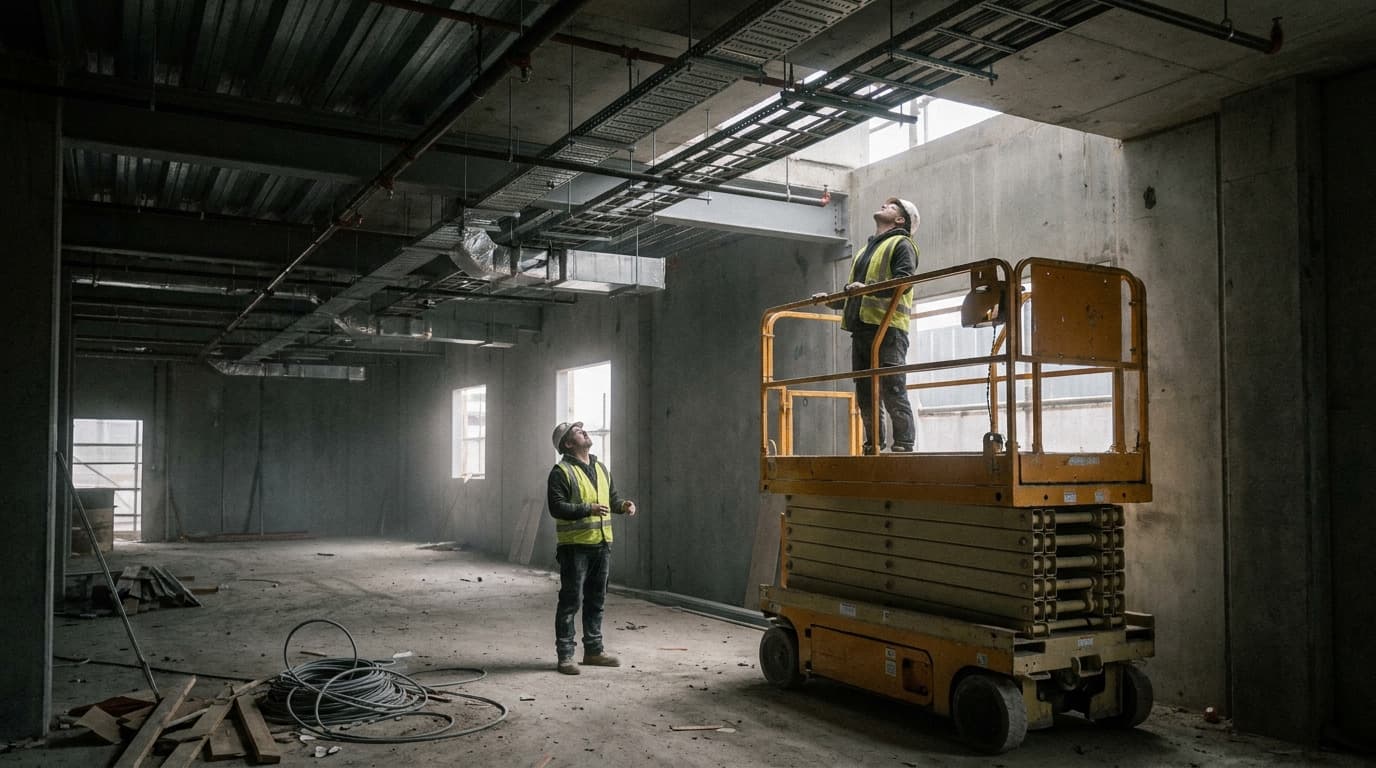
That single classification decision changes everything downstream:
| Boom / aerial lift | Scissor lift | |
|---|---|---|
| Governing rule | 1926.453 | 1926.452(w) and 1926.451 |
| Fall protection | Harness with lanyard tied to boom or basket | Guardrail system on the platform |
| Belting off to adjacent structure | Prohibited by (b)(2)(iii) | The prohibition does not apply |
The rule that surprises people: never belt off to the structure#
29 CFR 1926.453(b)(2)(iii) states it flatly: belting off to an adjacent pole, structure, or equipment while working from an aerial lift shall not be permitted.
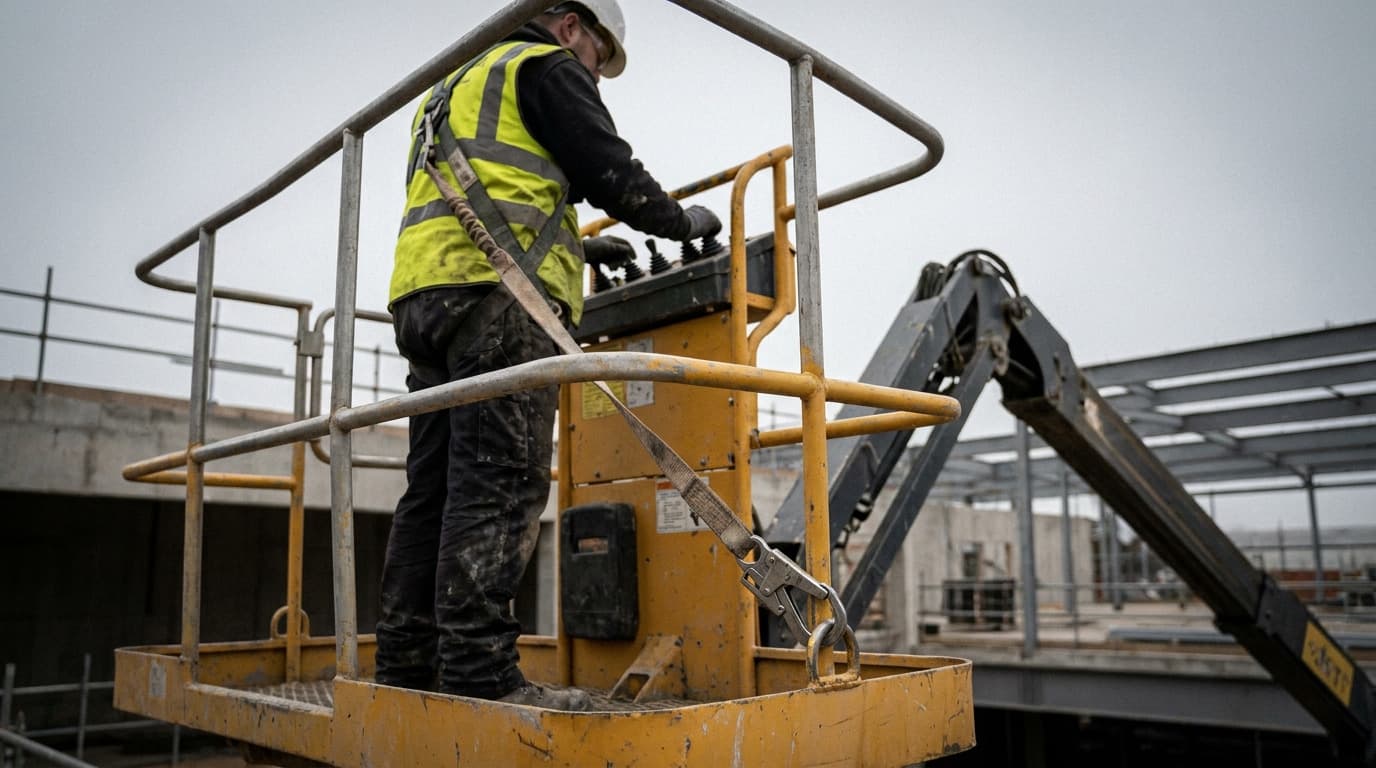
That reads backwards to most people. The building feels more solid than the machine. But the reasoning is sound: an aerial lift moves, and it can be moved unexpectedly — by a bump from below, a control input, ground settlement, or a tip. A worker anchored to a fixed structure while the basket travels is either dragged out of the basket or crushed against it. Tie-off in an aerial lift exists to keep you in the basket, not to arrest a fall to the ground.
That is also why 1926.453(b)(2)(v) specifies attaching the lanyard to the boom or basket — the anchor and the worker move together. OSHA addressed a device tied to both boom and basket simultaneously and noted the bucket and boom move together and share a similar risk of failure, so the hazard that the adjacent-structure prohibition targets is not present in that configuration.
And here is where OSHA says the prohibition stops. Asked directly whether 1926.453(b)(2)(iii) applies to scissor lifts, OSHA's answer was no — the scaffold provisions in 1926.452(w) and 1926.451 simply do not address tying off to an adjacent structure from a scissor lift. Only the General Duty Clause could reach it, and only where that practice is a recognised hazard and another means of protection is feasible.
The body belt wording that is now out of date#
1926.453(b)(2)(v) still says a body belt shall be worn and a lanyard attached to the boom or basket, and the standard carries its own correction in a Note:
As of January 1, 1998, Subpart M (§1926.502(d)) provides that body belts are not acceptable as part of a personal fall arrest system. The use of a body belt in a tethering system or in a restraint system is acceptable and is regulated under §1926.502(e).
So read the two together: a body belt may serve as restraint — keeping you inside the basket — but it cannot be your fall arrest. In practice this means a full body harness with the lanyard attached to the boom or basket, kept short enough that you cannot be thrown out.
What each standard requires#
Aerial lifts — 1926.453(b)(2):
- (i) Lift controls shall be tested each day prior to use to determine they are in safe working condition.
- (ii) Only authorized persons shall operate an aerial lift.
- (iii) Belting off to an adjacent pole, structure, or equipment is not permitted.
- (iv) Employees shall always stand firmly on the floor of the basket, and shall not sit or climb on the edge of the basket or use planks, ladders, or other devices for a work position.
- (v) A body belt shall be worn and a lanyard attached to the boom or basket — read with the Note above.
- (vi) Boom and basket load limits specified by the manufacturer shall not be exceeded.
- (vii) The brakes shall be set, outriggers positioned on pads or a solid surface, and wheel chocks installed before using an aerial lift on an incline.
- (viii) An aerial lift truck shall not be moved when the boom is elevated in a working position with workers in the basket, except for equipment specifically designed for that operation.
Scissor lifts — 1926.451 and 1926.452(w): the general scaffold criteria apply, including guardrail systems, platform construction, capacity, and access. The guardrail is the fall protection. Manufacturer limits on platform load, wind speed, and use on slopes apply through the general duty to follow the equipment's design limits.
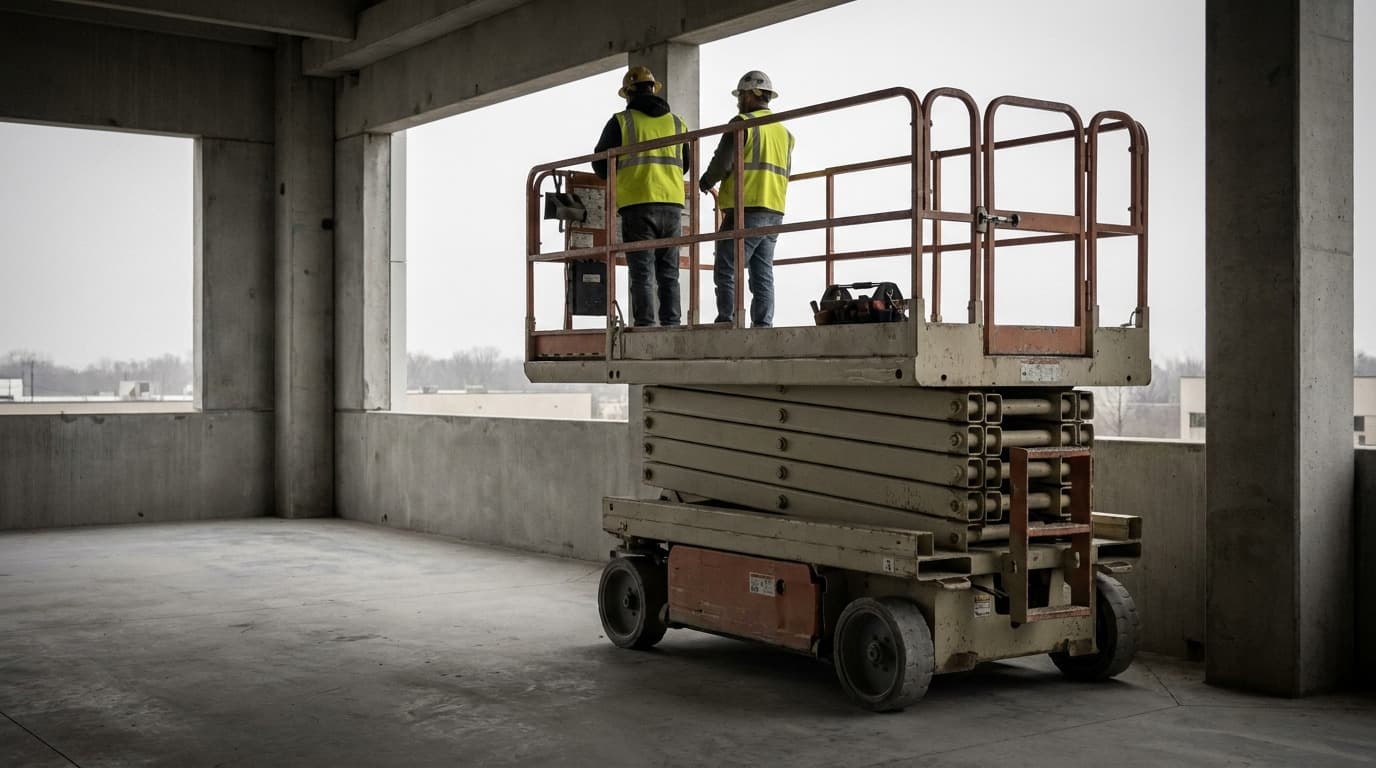
Getting in and out — 1926.501(b)(1). OSHA has confirmed that when employees move between the basket and an elevated surface, Subpart M applies, and fall protection is required at 6 feet. During entry and egress a worker may tie off to the lift — if it is designed to withstand the loads imposed by that movement or an arrested fall — or to an appropriate nearby structure. Note the difference: the adjacent-structure prohibition covers working from the lift, not transferring out of it.
On USACE and NAVFAC projects, EM 385-1-1 applies and is more prescriptive on lift operation, inspection, and fall protection in several places.
What can go wrong#
Not knowing which machine you are in. The root cause of most of the rest.
Tying off to the structure from a boom lift. Explicitly prohibited, and genuinely dangerous — the machine moves, you do not.
Climbing or standing on the mid-rail or a bucket. (b)(2)(iv) forbids sitting or climbing on the basket edge and forbids planks, ladders, or other devices as a work position. Reaching the last two feet this way is a recurring fatality.
Removing or leaving open the platform gate or chain on a scissor lift, which is the guardrail system doing the actual protecting.
Driving elevated. (b)(2)(viii) prohibits moving an aerial lift truck with the boom elevated and workers in the basket unless the equipment is designed for it. On scissor lifts, driving elevated over uneven ground is the classic tip-over.
Uneven ground, slopes, soft fill, and trench spoil. Brakes not set, outriggers on bare soil rather than pads, no chocks on an incline.
Overhead power lines. A boom is a conductor with reach. Approach distances and a spotter matter more here than anywhere else on site.
Overloading the platform. Load limits under (b)(2)(vi) include the workers, tools, and materials — and the load chart changes as the boom extends.
Untrained or unauthorised operators. (b)(2)(ii) is a one-line requirement that is broken constantly on busy sites.
Skipping the daily control test. (b)(2)(i) is a daily duty, not a weekly or a delivery-day one.
Crush hazards overhead. Raising a platform into steel, joists, or ductwork traps the operator between the rail and the structure — a leading cause of scissor lift fatalities and one that no harness addresses.
Being struck or bumped from below. Forklifts, deliveries, and vehicle traffic hitting the base of a lift with someone at height.
How do we control lift work?#
Name the machine in the pre-task brief. "This is a boom lift, so we tie off to the basket and we do not tie off to the building." Or "This is a scissor lift, so the guardrail and the closed gate are the protection." Say it out loud.
Test the controls every day before use, from the lower controls first, and confirm the lower controls override the upper ones.
Confirm the operator is authorised and trained on that specific machine, not on lifts in general.
Set up the ground before the lift goes up. Brakes set, outriggers on pads or solid surface, chocks on any incline, and a check of what is under the wheels — backfill, trench edges, and covers do not carry the load a slab does.
In a boom lift: harness on, lanyard short, attached to the boom or basket. Never to a structure while working. Both feet on the basket floor.
In a scissor lift: keep the guardrail complete. Gate closed, chains hooked, nobody standing on the rail. That is the system.
Look up before you go up. Power lines, steel, pipework, ductwork, and lighting — the crush hazard above the platform kills people who were perfectly protected from falling.
Do not travel elevated unless the machine is specifically designed for it and the ground is suitable.
Plan entry and egress separately if anyone is transferring to a structure — that is a Subpart M task at 6 feet, with its own tie-off arrangement.
Protect the base. Cones, barriers, or a spotter where vehicles or plant move nearby.
Before you start#
- State which machine this is: aerial or boom lift under 1926.453, or scissor lift under the scaffold standard.
- Confirm the daily control test has been done, including the lower-control override.
- Confirm the operator is authorised and trained on this model.
- Confirm the ground: brakes set, outriggers on pads, chocks on any incline, load-bearing surface checked.
- In a boom lift, confirm harness and lanyard attached to the boom or basket — never to the structure.
- In a scissor lift, confirm the guardrail is complete and the gate or chain is closed.
- Confirm the platform load is within the manufacturer's limit, including tools and material.
- Check overhead for power lines, steel, and services before raising.
- Confirm nobody plans to travel elevated unless the machine is designed for it.
- If anyone will transfer to a structure, plan that separately under Subpart M.
Talk it over#
- Which machine are we in today, and which standard does it fall under?
- If you were in a boom lift and clipped to the building instead of the basket, what happens when the machine moves?
- What is directly above this platform for the next twenty feet of travel?
The bottom line#
The first question on a lift is not how high — it is which machine. 1926.453 incorporates the aerial lift definition from ANSI A92.2-1969, and because scissor lifts are not in that standard, OSHA treats them as mobile scaffolds under 1926.452(w) and 1926.451 instead. In a boom lift you wear a harness with the lanyard attached to the boom or basket, and 1926.453(b)(2)(iii) prohibits belting off to an adjacent pole, structure, or equipment — because the machine moves and you would be dragged out of it. In a scissor lift the guardrail is the fall protection and that prohibition does not apply. Both feet on the platform floor, controls tested daily, brakes set and outriggers padded, load limits respected, and eyes up before you raise — because the crush hazard above the rail is the one no harness will save you from.
Frequently asked questions about aerial and scissor lifts#
Is a scissor lift an aerial lift under OSHA?
No. 29 CFR 1926.453 incorporates by reference the definition of aerial lifts in ANSI A92.2-1969, and scissor lifts are not addressed in that standard. OSHA has confirmed that scissor lifts are therefore not covered by the aerial lift provisions. As a type of work platform, a scissor lift is covered by the mobile scaffold requirements in 1926.452(w) and the general scaffold requirements in 1926.451.
Do I have to tie off in a scissor lift?
Generally no, provided the guardrail system is complete and in place — the scaffold standard treats the guardrail as the fall protection. The aerial lift tie-off requirement in 1926.453(b)(2)(v) applies to aerial lifts, not scissor lifts. Always follow the manufacturer's instructions for the specific machine, which may require a restraint in some models or configurations.
Can I tie off to the building from an aerial lift?
No. 29 CFR 1926.453(b)(2)(iii) states that belting off to an adjacent pole, structure, or equipment while working from an aerial lift shall not be permitted. The lift can move unexpectedly, and a worker anchored to something that does not move with it can be pulled out of the basket. 1926.453(b)(2)(v) requires the lanyard to be attached to the boom or basket instead.
Does that prohibition apply to scissor lifts too?
No. OSHA has answered this directly: 1926.453(b)(2)(iii) does not apply to scissor lifts, because scissor lifts fall under the scaffold provisions, and 1926.452(w) and 1926.451 do not address tying off to an adjacent structure. Only the General Duty Clause could apply, and only where the practice is a recognised hazard and another means of fall protection is feasible.
Is a body belt acceptable in an aerial lift?
Only as restraint, not as fall arrest. 1926.453(b)(2)(v) refers to a body belt, but its Note records that as of January 1, 1998, Subpart M (§1926.502(d)) provides that body belts are not acceptable as part of a personal fall arrest system, and that a body belt is acceptable in a tethering or restraint system under §1926.502(e). In practice this means a full body harness with a short lanyard to the boom or basket.
What fall protection applies when getting out of a lift onto a structure?
Subpart M. OSHA has confirmed that when employees move between the basket and an elevated surface, 1926.501(b)(1) requires fall protection at 6 feet, and any fall arrest system must meet 1926.502(d). During entry and egress a worker may tie off to the lift — if it is designed to withstand the loads involved — or to an appropriate nearby structure. The adjacent-structure prohibition applies to working from an aerial lift, not to transferring out of it.
Can an aerial lift be driven while elevated?
Not normally. 1926.453(b)(2)(viii) provides that an aerial lift truck shall not be moved when the boom is elevated in a working position with workers in the basket, except for equipment specifically designed for that type of operation. For any lift, travelling elevated over uneven ground is a leading cause of tip-over.
Download the aerial and scissor lift toolbox talk PDF#
Get this aerial and scissor lift toolbox talk as a print-ready PDF — available in English, Spanish, Portuguese, and Turkish. Print it, hand it to the crew, and collect signatures on the included attendance sheet.
Download the PDF — free account required. New members get 3 free downloads.
Related toolbox talks#
Sources#
- OSHA, 29 CFR 1926.453 — Aerial lifts: https://www.osha.gov/laws-regs/regulations/standardnumber/1926/1926.453
- OSHA, Use of aerial lifts to transport workers to elevated workstations; scissor lifts are not covered by the aerial lift provisions, Letter of Interpretation, May 3, 2001: https://www.osha.gov/laws-regs/standardinterpretations/2001-05-03-0
- OSHA, Compliance of an aerial lift fall protection device connected with a releasable tether and a non-releasable tether, Letter of Interpretation, February 2, 2004: https://www.osha.gov/laws-regs/standardinterpretations/2004-02-02
- OSHA, 29 CFR 1926.502 — Fall protection systems criteria and practices: https://www.osha.gov/laws-regs/regulations/standardnumber/1926/1926.502