Chemical Spill Response
Updated 2026-07-24
In this bundle Fire, Hot Work & Emergency
Print-ready PDF
Download this talk as a print-ready PDF, available in 4 languages.
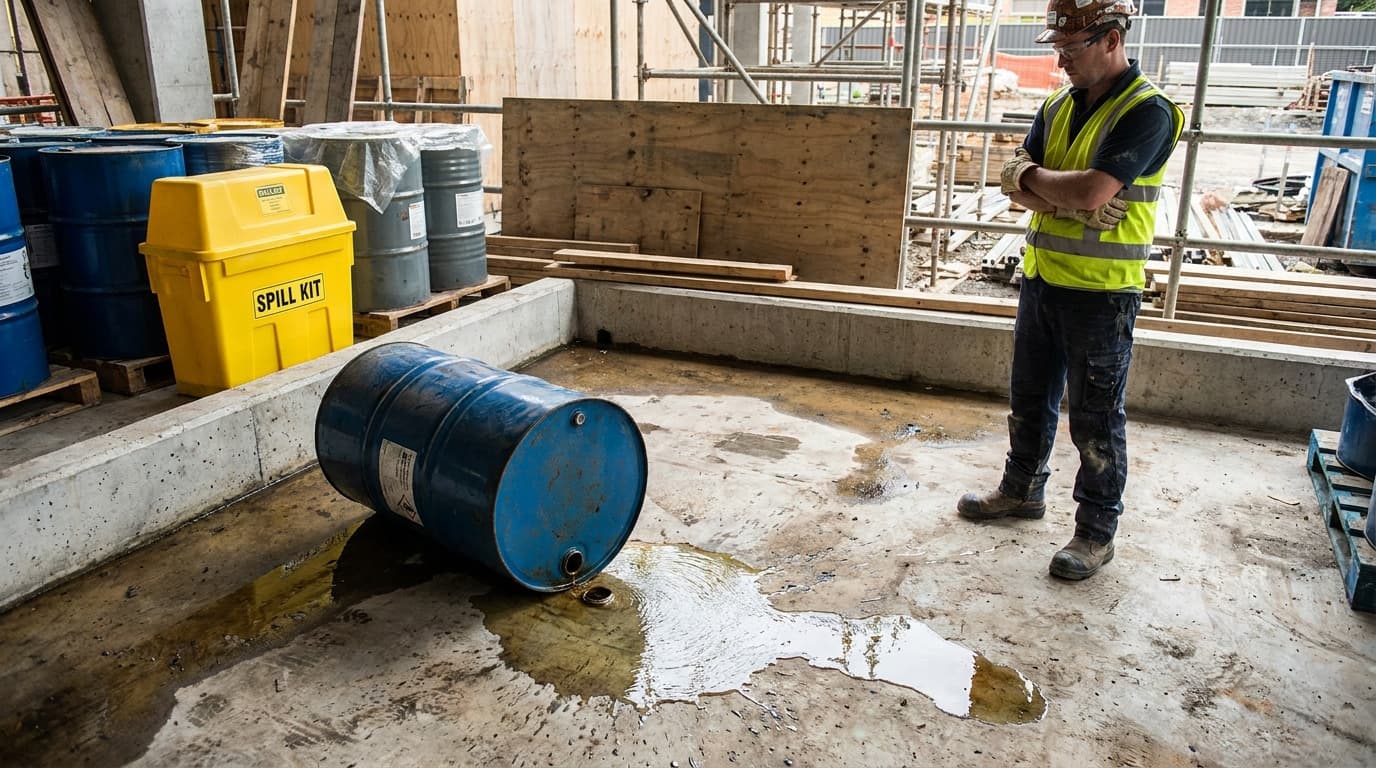
A drum goes over. Somebody reaches for the spill kit. That reflex — reach for the absorbent, deal with it, get back to work — is the moment this talk is about, because a decision was supposed to happen first, and skipping it is what turns a spill into a casualty. This Chemical Spill Response Toolbox Talk (Safety Talk / Tailgate Talk) is about the question you answer before you touch anything.
Here is the distinction that carries the whole talk, and it is the one almost everyone gets wrong: the line between a spill you clean up and an emergency you evacuate is not about how much spilled. Five gallons of one product can be a mop-up. A cupful of another can be an evacuation. The regulation does not measure the puddle.
The line OSHA actually draws#
Construction has its own HAZWOPER standard — 29 CFR 1926.65, nearly identical to the general industry rule at 1910.120. Its definitions section, 1926.65(a)(3), sets the test:
Emergency response means a response effort by employees from outside the immediate release area, or by other designated responders (mutual-aid groups, local fire departments, etc.), to an occurrence which results, or is likely to result, in an uncontrolled release of a hazardous substance.
Responses to incidental releases of hazardous substances where the substance can be absorbed, neutralized, or otherwise controlled at the time of release by employees in the immediate release area, or by maintenance personnel, are not considered to be emergency responses within the scope of this standard.
Responses to releases where there is no potential safety or health hazard (fire, explosion, or chemical exposure) are not emergency responses.
Read what the test actually turns on. Not litres. Three things:
- Who can handle it — people already in the immediate release area, or does it need responders from outside?
- Can it be controlled at the time of release — absorbed, neutralised, stopped now?
- Is there a potential safety or health hazard — fire, explosion, or exposure?
If the people already there can control it now and there is no fire, explosion or exposure hazard, it is an incidental release and it sits outside HAZWOPER's emergency response provisions. If it needs anyone from outside, or cannot be controlled at the time, or carries a real exposure hazard, it is an emergency response — and paragraph (q) engages, with all the training, planning and equipment that implies.
The courts have confirmed this reading. In the Tampa Electric case, OSHA argued that an ammonia release was "uncontrolled" because the gas escaped into the atmosphere. The company argued its own personnel had stopped and controlled it. The Administrative Law Judge, the Review Commission, and the Eleventh Circuit all agreed with the company — "uncontrolled" does not mean any release however small. The definition is what governs, not the size of the cloud.
The exemption most construction sites should be using#
1926.65(q)(1) contains the provision that fits most jobsites better than any spill kit:
Employers who will evacuate their employees from the danger area when an emergency occurs, and who do not permit any of their employees to assist in handling the emergency, are exempt from the requirements of this paragraph if they provide an emergency action plan complying with the emergency action plan requirements.
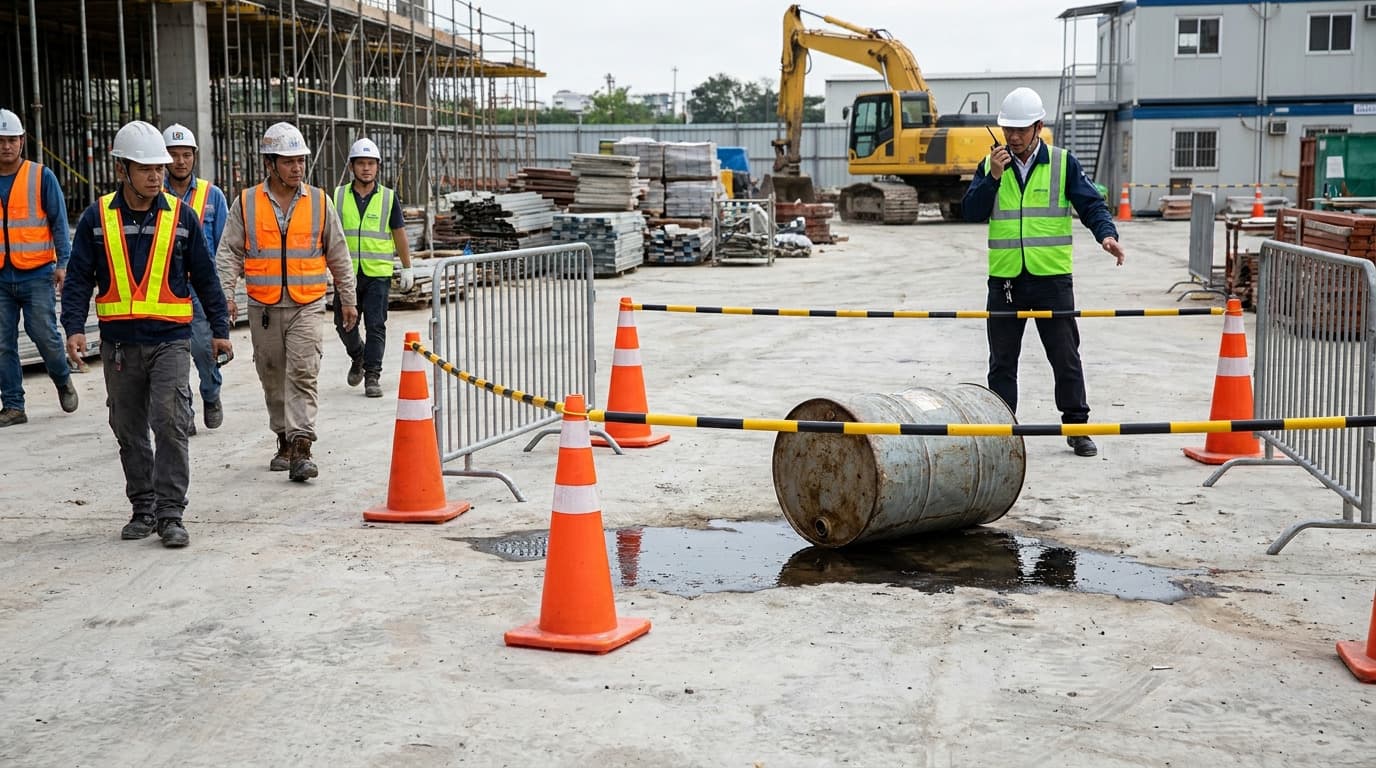
That is a legitimate, deliberate, fully compliant strategy: we do not respond, we evacuate and call. For a construction site with no trained hazmat team, no rescue capability, and no air monitoring, it is usually the right strategy — and choosing it explicitly is far better than a crew improvising with a bag of granules because that is what was in the store.
The failure mode is the middle ground: no plan, no training, no decision — and someone doing hazmat response by instinct.
What decides the answer#
The answer is in the SDS, and the relevant question is not "is this dangerous" but what does it do in the open:
- Does it give off vapour? A pool of solvent is a growing vapour cloud. A pool of oil is a pool.
- Is it heavier than air? Vapour that flows downhill into trenches, pits and basements travels to people who never saw the spill.
- Is it flammable, and what is nearby? This is where the fuel and hot work talks connect.
- Does it react? With water, with other spilled products, with the absorbent someone is about to throw at it.
- Is it corrosive? Skin and eye contact hazard for whoever kneels next to it.
- Where is it going? Drains, watercourses, and soil turn a safety problem into a reportable environmental one.
- Is it in a confined or poorly ventilated space? That changes the answer entirely, whatever the volume.
And 1926.50(g) ties back to first aid: where the eyes or body may be exposed to injurious corrosive materials, suitable facilities for quick drenching or flushing of the eyes and body must be provided within the work area for immediate emergency use. Not across the site. Within the work area.
On USACE and NAVFAC projects, EM 385-1-1 applies and carries its own spill response, containment, and reporting requirements.
What can go wrong#
Cleaning up something you cannot identify. The commonest and worst. No product name, no SDS, no idea.
Judging by volume. "It's only a few litres" as the entire risk assessment.
Vapour, not liquid. The visible spill is on the floor; the hazard is at head height and spreading.
Wrong absorbent. Generic granules on a reactive product, or an absorbent that is itself incompatible.
No PPE, or the wrong gloves. Reaching in with the gloves already on your hands rather than the ones the SDS calls for.
Ignition sources still running. Plant, tools, hot work and vehicles in the vicinity of a flammable pool.
The spill reaches a drain. Often within seconds, and rarely recoverable.
Nobody isolated the source. Absorbing the puddle while the container keeps emptying.
Confined or low-lying space. Trench, pit, basement, or tank where vapour collects and oxygen displaces.
Second casualty. Someone entering to help without knowing what is in the air.
No eyewash within the work area when a corrosive is being used.
No report. The spill gets mopped, nobody records it, and the same failure repeats.
How do we handle a spill?#
Stop, do not touch it yet. The first action is a decision, not an absorbent.
Identify the product and check the SDS. If you cannot identify it, that alone makes it an evacuate-and-call situation.
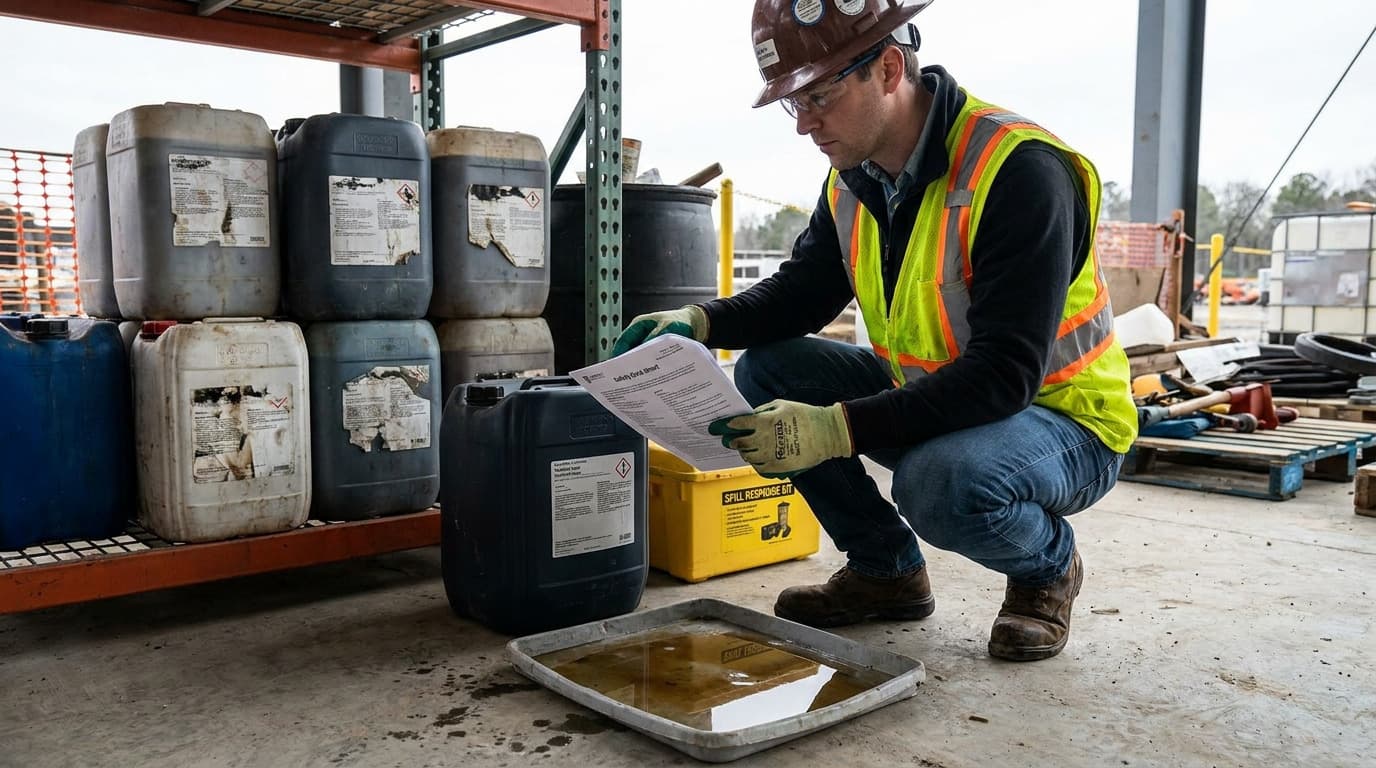
Apply the three-part test. Can the people already here control it now? Can it be absorbed, neutralised or stopped at the time of release? Is there any fire, explosion or exposure hazard? Anything other than a confident yes-yes-no means evacuate and call.
Know which strategy your site has chosen under 1926.65(q)(1) — respond, or evacuate and call. If it is evacuate, then evacuating is the correct professional response, not a failure of nerve.
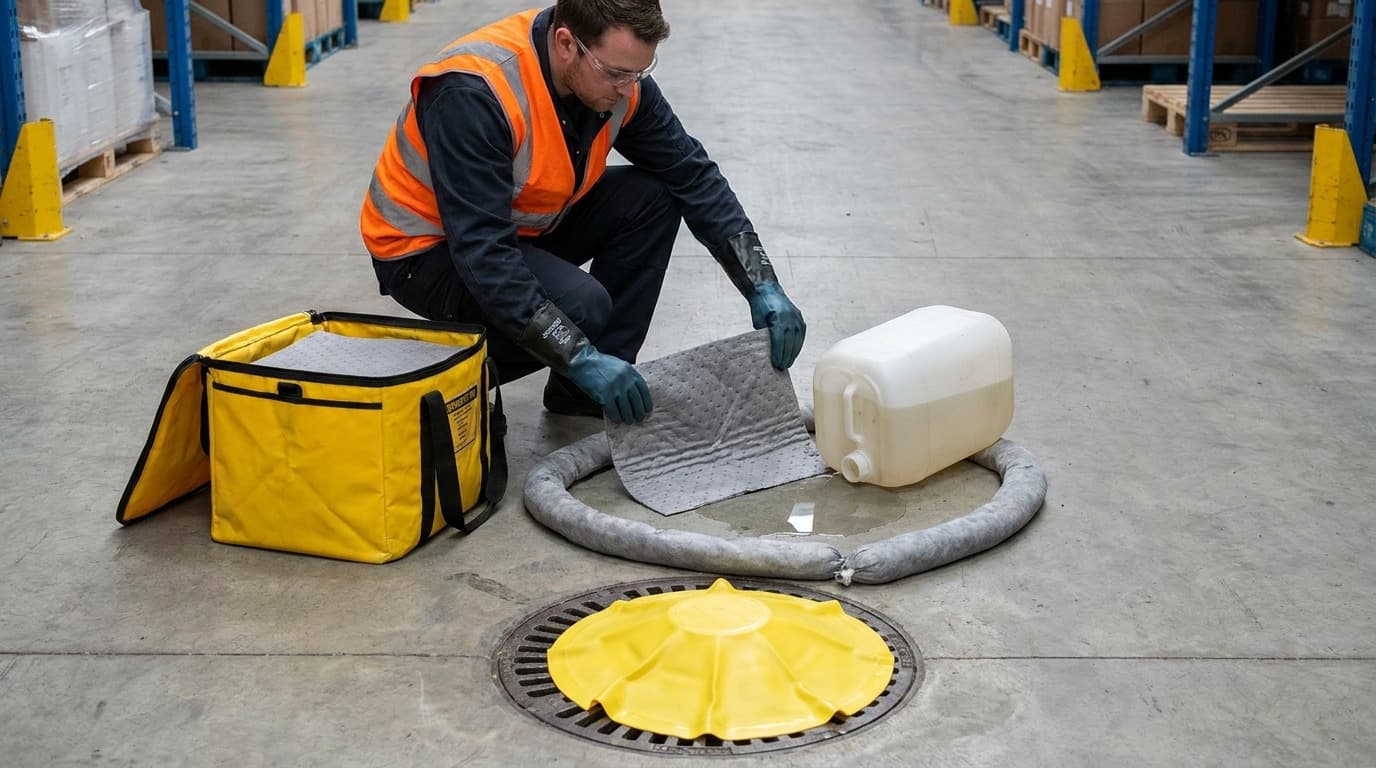
Isolate the source if you can do it safely and without exposure — upright the drum, close the valve, stop the pump.
Protect the drains before the liquid arrives, if there is time and it is safe.
Keep people upwind and uphill, and keep everyone out of low points where vapour collects.
Remove ignition sources in the area for anything flammable.
Use the right absorbent and the right PPE, both taken from the SDS rather than from habit.
Never enter a confined or low-lying space to deal with a spill without the separate confined space controls.
Get contaminated clothing off and use the drenching facilities immediately for skin or eye contact — and treat that as a medical matter, not a wash-and-carry-on.
Report every spill, including the ones that were easy. That record is what gets the storage, the bunding, or the container changed.
Before you start#
- Know what chemicals are being used in your area today and where the SDS is.
- Read the spill and first-aid sections of the SDS before the spill, not during.
- Know whether your site's plan is to respond or to evacuate and call.
- Know where the spill kit is and whether its contents suit these products.
- Confirm eyewash or drenching facilities are within the work area if corrosives are in use.
- Identify the nearest drain, gully, or watercourse from where you are working.
- Identify the low points nearby where vapour would collect.
- Know who to call, and how you would describe the location and the product.
- Confirm you have the gloves the SDS specifies, not just the gloves you are wearing.
- Agree that "I don't know what it is" means evacuate and call.
Talk it over#
- What is the worst thing that could spill in your area today — and what would it do in the open?
- If a drum went over right now, where would it run to?
- Does this site respond to spills or evacuate and call? Does everyone here know which?
The bottom line#
The line is not about volume. Under 29 CFR 1926.65(a)(3), a release is incidental — outside HAZWOPER's emergency response provisions — when it can be absorbed, neutralised, or otherwise controlled at the time of release by employees in the immediate release area, and there is no fire, explosion or exposure hazard. It is an emergency response when it needs people from outside the immediate release area, or cannot be controlled at the time. Courts have upheld that reading, including the Eleventh Circuit in the Tampa Electric case. And 1926.65(q)(1) offers a legitimate strategy most construction sites should be choosing deliberately: evacuate and call, and do not let employees handle the emergency. So identify the product first, apply the test, and treat "I don't know what it is" as the answer that ends the discussion.
Frequently asked questions about chemical spills#
What makes a spill an emergency rather than a clean-up?
Not the volume. 29 CFR 1926.65(a)(3) defines emergency response as a response effort by employees from outside the immediate release area, or by designated responders, to an occurrence resulting or likely to result in an uncontrolled release. Releases that can be absorbed, neutralised, or otherwise controlled at the time of release by employees in the immediate release area, or by maintenance personnel, are incidental and fall outside the emergency response provisions — as are releases where there is no potential safety or health hazard.
Does HAZWOPER apply on construction sites?
Yes, through its own section. Construction follows 29 CFR 1926.65, which is nearly identical to the general industry standard at 1910.120. Its emergency response provisions sit at paragraph (q).
Can a small spill still be an emergency?
Yes. The test is about control, responders, and hazard — not quantity. A small release of a highly toxic or rapidly vaporising substance can require an emergency response, while a much larger release of a low-hazard product controlled on the spot by the people already there is incidental.
Can a large spill be incidental?
Potentially. If the people already in the immediate release area can absorb, neutralise or otherwise control it at the time of release, and there is no fire, explosion or exposure hazard, the definition is satisfied regardless of volume. This is what the Eleventh Circuit confirmed in the Tampa Electric case — "uncontrolled" does not mean any release however small.
Is it acceptable to just evacuate and call the fire service?
Yes, and it is often the correct choice. 1926.65(q)(1) exempts employers who will evacuate employees from the danger area when an emergency occurs and who do not permit any employees to assist in handling the emergency, provided they have an emergency action plan. For a site with no trained responders, no monitoring and no rescue capability, that is the appropriate strategy — but it has to be a decision made in advance, not a reaction.
Where must eyewash and drenching facilities be?
Under 29 CFR 1926.50(g), where the eyes or body of any person may be exposed to injurious corrosive materials, suitable facilities for quick drenching or flushing of the eyes and body must be provided within the work area for immediate emergency use.
What should be checked before deciding to clean a spill up?
Identify the product and read the SDS — specifically what it does in the open: whether it gives off vapour, whether that vapour is heavier than air and will flow into trenches and pits, whether it is flammable and what ignition sources are nearby, whether it reacts with water or with the absorbent, whether it is corrosive, and where it is running to. If the product cannot be identified, that alone means evacuate and call.
Download the chemical spill toolbox talk PDF#
Get this chemical spill response toolbox talk as a print-ready PDF — available in English, Spanish, Portuguese, and Turkish. Print it, hand it to the crew, and collect signatures on the included attendance sheet.
Download the PDF — free account required. New members get 3 free downloads.
Related toolbox talks#
Sources#
- OSHA, 29 CFR 1926.65 — Hazardous waste operations and emergency response: https://www.osha.gov/laws-regs/regulations/standardnumber/1926/1926.65
- OSHA, 29 CFR 1910.120 — Hazardous waste operations and emergency response: https://www.osha.gov/laws-regs/regulations/standardnumber/1910/1910.120
- OSHA, Emergency situations that fall under HAZWOPER, Letter of Interpretation, November 8, 1991: https://www.osha.gov/laws-regs/standardinterpretations/1991-11-08
- OSHA, What constitutes an emergency response or incidental release, Letter of Interpretation, October 2, 2017: https://www.osha.gov/laws-regs/standardinterpretations/2017-10-02
Written by FieldSafetyTalk's safety professional — a CSP, ASP, CHST and OSHA Authorized Outreach Trainer with 14+ years of international construction safety experience across federal, heavy civil, and industrial projects.