Drum and Barrel Handling
Updated 2026-08-01
In this bundle Health & Environmental Exposure
Print-ready PDF
Download this talk as a print-ready PDF, available in 4 languages.
A full drum gets treated with respect. It is obviously heavy, obviously full of something, and nobody tries to move it alone. The empty one gets rolled across the yard, stood on, cut in half for a bin, or dragged behind the cabin to burn offcuts in. Every serious drum incident in construction runs through that second sentence. This Drum and Barrel Handling Toolbox Talk (Safety Talk / Tailgate Talk) is about the container everyone has stopped worrying about.
Here is the distinction that carries this whole talk: an empty drum is more dangerous than a full one, because the hazard is not the liquid — it is the vapour, and a full drum has almost no room for vapour while an empty drum is nothing but vapour space. Fill a drum to the brim with solvent and there is no air in it to burn. Pour that solvent out and you have left behind a 200-litre vessel of fuel-air mixture with a residue at the bottom keeping it topped up. You did not empty the drum. You filled it with the explosive part.
Where the boundary of this talk sits#
Stacking and storage geometry — how high, how tapered, how secured — is owned by the piling and shelving talk under 1926.250. Bonding and grounding for flammable liquid transfer, safety cans and cabinet quantities belong to the fuel storage talk. Response to a spill already on the ground belongs to the chemical spill response talk. Lifting technique and the NIOSH equation belong to the manual handling talks. This talk owns the drum as an object: its vapour space, its pressure, its weight and the moment somebody decides it is empty.
OSHA wrote the rule in the past tense#
This is the regulatory point most crews have never noticed, and it is sitting in plain sight.
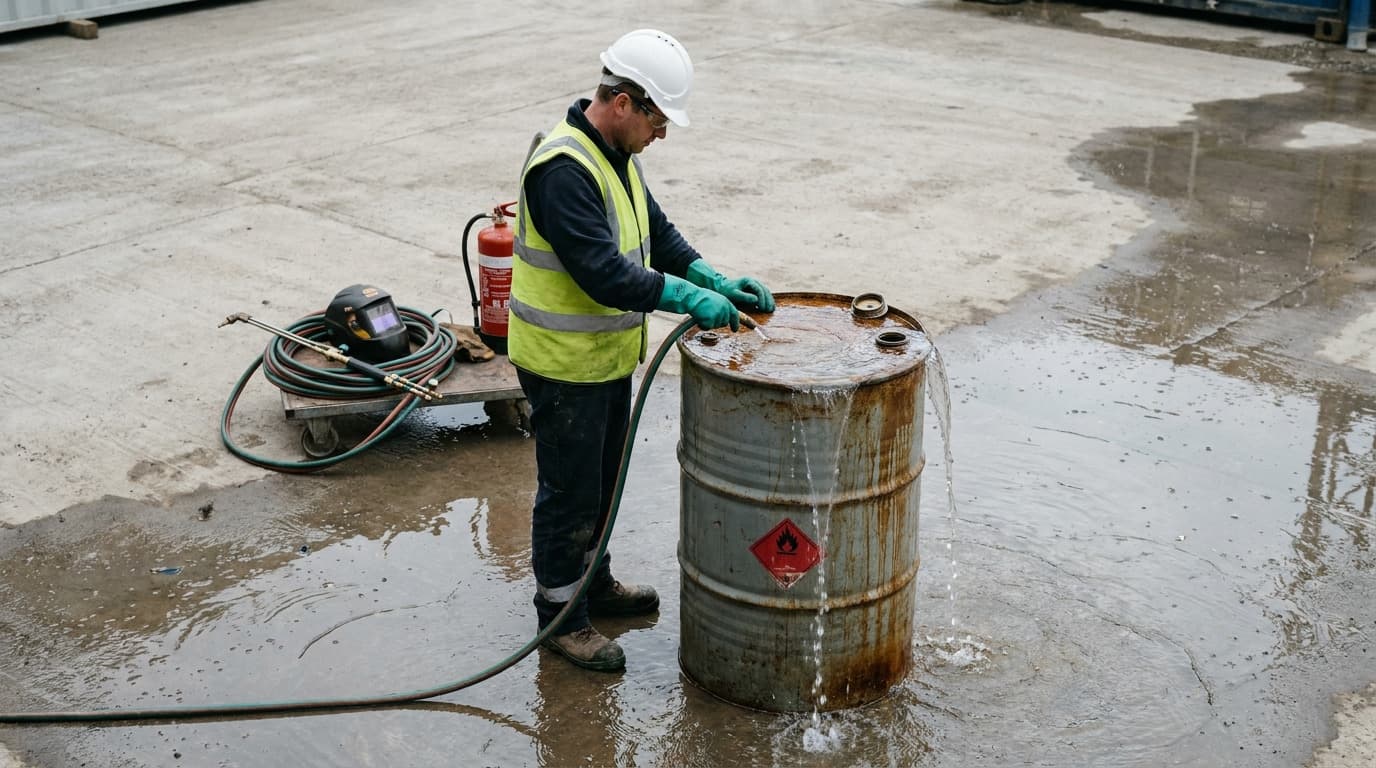
1926.352(i): "Drums containers, or hollow structures which have contained toxic or flammable substances shall, before welding, cutting, or heating is undertaken on them, either be filled with water or thoroughly cleaned of such substances and ventilated and tested."
Read the tense. The standard is not about drums that contain flammable substances. It is about drums that have contained them — past tense, empty, apparently harmless. OSHA wrote the rule specifically about the container somebody has finished with.
Read the requirements too, because there are two routes and people take a third that does not exist. Either you fill it with water — displacing every bit of vapour space — or you do all three of clean it, ventilate it, and test it. Rinsing it out and having a look inside is not one of the options.
And the companion provision, 1926.352(j): "Before heat is applied to a drum, container, or hollow structure, a vent or opening shall be provided for the release of any built-up pressure during the application of heat." A sealed drum warmed by a torch, a hot day or a fire nearby is a pressure vessel.
"Empty" is a legal word, and it permits litres#
Here is the number that closes the argument.
The EPA's definition of an empty container at 40 CFR 261.7 says a container that has held hazardous waste is empty when all waste has been removed by pouring, pumping or aspirating, and then either:
- no more than 2.5 centimetres (one inch) of residue remains on the bottom, or
- no more than 3% by weight of the container's total capacity remains, for containers of 119 gallons or less.
Now put a 208-litre (55-gallon) drum against that. One inch of residue across the bottom of a standard drum is roughly six litres. Three per cent of 208 litres is about six litres. Both routes arrive at the same place.
A drum can be legally, properly, correctly empty and still hold six litres of what it used to contain. That is a bucketful. It is more than enough to keep a 200-litre vapour space saturated indefinitely, and more than enough to hurt somebody who cuts into it.
The weight nobody plans for#
Drums are also a manual handling problem disguised as a container.
A 208-litre drum of water weighs 208 kg, plus roughly 20 kg for the steel drum itself — about 230 kg (500 lb). Most site liquids are in the same range or heavier. That is a quarter of a tonne with a high centre of gravity, no handholds, and a shape that wants to roll.
Two things follow. A drum is moved with equipment — a drum trolley, drum dolly, drum lifter or purpose-made clamp on a forklift — not by a person and a mate. And a drum being tipped and walked on its rim is being balanced, not carried: once it goes past the balance point there is nothing anybody can do, and the injuries are crushed feet, trapped hands and backs.
Never stand a drum on its side on a slope. Never let one roll freely. Never ride it down a ramp or a plank.
Opening it#
Bungs and closures cause a disproportionate share of drum injuries because they are the moment the pressure comes out.
Drums breathe with temperature. A sealed drum that has stood in the sun, come off a hot truck, or held anything that gases off will be under pressure — and the bung is the release point, aimed directly at whoever is leaning over it. Loosen slowly, stand to one side, and let it vent before removing the plug.
Use a proper bung wrench, and where flammables are involved a non-sparking one. Never a hammer and chisel, never a screwdriver levered round, never a pry bar. Anything that generates a spark on a drum containing flammable vapour completes the sequence at the top of this talk.
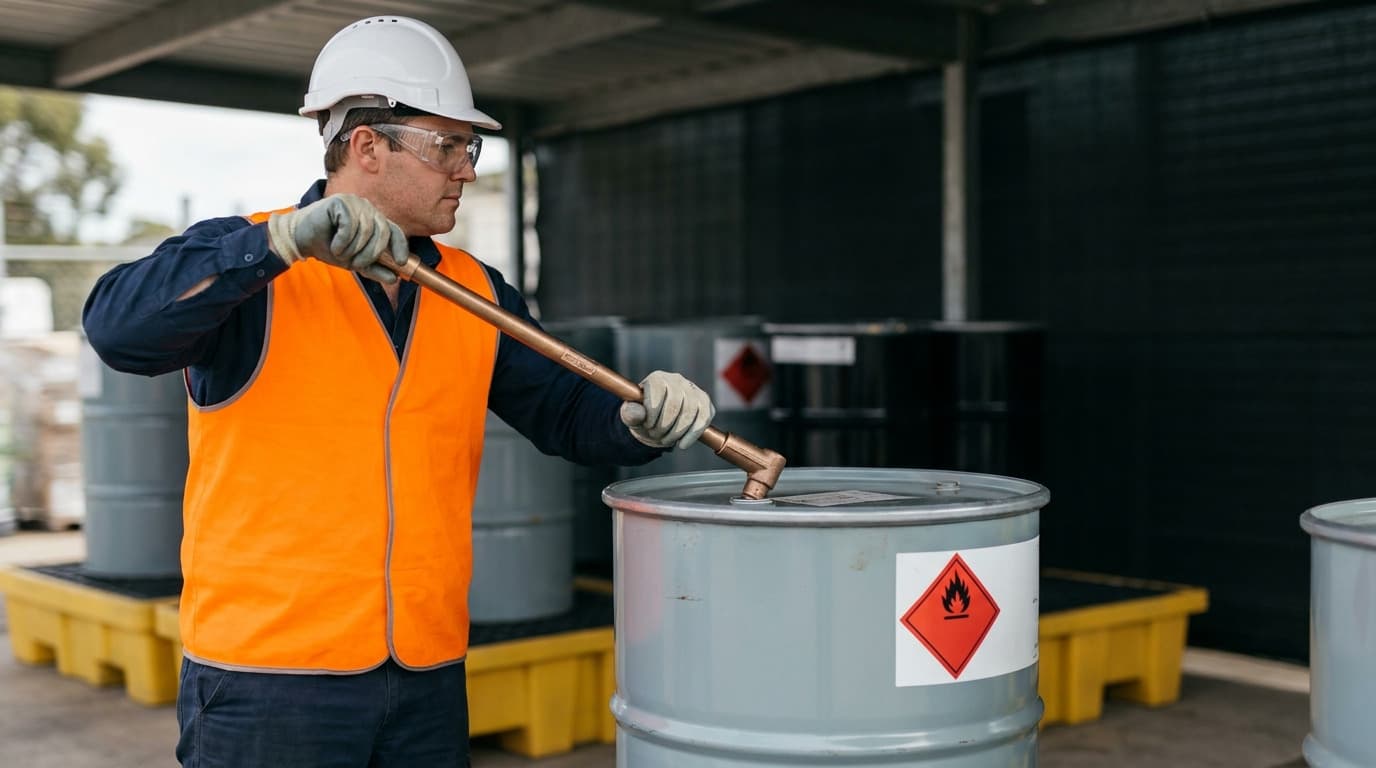
And check the label before you open it, not after. Under 1926.59 the container should carry hazard information and there should be a safety data sheet behind it — an unlabelled drum is an unknown, and an unknown drum is not opened by a general labourer to see what is inside.
The other things drums become#
The hazard follows the drum after it leaves the job.
Cut-in-half burn barrels and bins. Somebody takes an angle grinder or a torch to a drum whose previous contents nobody recorded. This is precisely what 1926.352(i) exists to prevent, and it is still one of the most reliable ways to kill somebody on a yard.
Improvised stands, steps, rollers and work platforms. A drum is not a platform and not a step.
Water butts and fuel containers. A drum that held a solvent, a curing compound or a form release agent is not a water container afterwards, and its residue does not stop being what it was.
Rain-filled drums left outside collect water contaminated with whatever was inside, which then goes somewhere when it is tipped out.
Where the duty sits#
The provisions are scattered rather than gathered into a single drum standard.
1926.352(i) and (j) are the two that carry the hot work rule and the venting rule quoted above. 1926.250 governs the storage and stacking of materials, including securing them against sliding, falling or collapse — the piling and shelving talk covers that ground. 1926.59 brings hazard communication and the safety data sheet, so you know what is in the drum. 1926.21(b)(2) requires the employer to instruct employees in recognising and avoiding these hazards. 40 CFR 261.7 is an EPA rule, not an OSHA one — it defines "empty" for waste purposes and it is quoted here to make a safety point, not a compliance one. Where nothing specific reaches the hazard, Section 5(a)(1) still applies.
What can go wrong?#
Cutting or grinding an "empty" drum without filling it with water or cleaning, ventilating and testing it.
Applying heat to a sealed drum with no vent provided for the pressure.
Assuming empty means empty, when the legal definition permits about six litres of residue in a 55-gallon drum.
Standing over a bung and cracking it open on a drum that has been in the sun.
Using a hammer, chisel or pry bar on a closure instead of a bung wrench, or a sparking tool near flammable vapour.
Moving a 230 kg drum by hand, tipping and walking it on its rim, or letting it roll.
Turning an old drum into a bin, a stand, a step or a water butt without knowing what it held.
Opening an unlabelled drum to find out what is inside.
How do we manage this properly?#
Treat the empty drum as the hazardous one, and say so out loud when you brief the crew — this is the single habit that prevents the fatality.
Never apply heat, flame, grinder or drill to any drum unless it has been filled with water, or cleaned, ventilated and tested, as 1926.352(i) requires — and a vent provided under (j).
Keep the label on the drum for its whole life, including after it is empty, so its history travels with it.
Move drums with equipment — trolley, dolly, drum lifter or proper forklift attachment — never by hand and never by rolling on a slope.
Open closures slowly with a proper bung wrench, non-sparking for flammables, standing to one side and letting pressure vent first.
Store upright, on a level surface, secured and in secondary containment, segregated by compatibility.
Keep drums out of the sun and off hot surfaces, because a sealed drum under a rising temperature is a pressure vessel.
Send empty drums back through a proper route — reconditioner, supplier take-back or licensed waste contractor — rather than letting them wander round the yard.
Never repurpose a drum into a bin, container, stand or platform.
Before you start#
- Confirm what the drum held, from the label and the SDS, not from memory.
- Confirm nobody is planning to cut, grind, drill or apply heat to it.
- Confirm the equipment for moving it is on site and the route is level and clear.
- Confirm the correct bung wrench is available, non-sparking if flammables are involved.
- Confirm the drum has not been standing in the sun before you open it.
- Confirm where it will be stored: upright, level, secured, in containment.
- Confirm it is segregated from incompatible materials.
- Confirm there is a disposal route for it when it is empty.
Talk it over#
- How many empty drums are on this site right now, and does anyone know what was in them?
- Has anyone here ever seen a drum cut open with a grinder or a torch?
- What would we use to move a full drum from the gate to the work face today?
- Which drums here have lost their labels?
The bottom line#
An empty drum is more dangerous than a full one, because the hazard is the vapour and not the liquid — a full drum has almost no vapour space, while an emptied drum is a 200-litre vessel of fuel-air mixture kept topped up by the residue in the bottom. OSHA wrote the rule in the past tense: 1926.352(i) applies to drums "which have contained toxic or flammable substances", and before welding, cutting or heating they must either be filled with water or thoroughly cleaned and ventilated and tested — rinsing and looking inside is not one of the options. 1926.352(j) adds that before heat is applied, a vent or opening shall be provided for built-up pressure. And "empty" is a legal word that permits a great deal: under 40 CFR 261.7 a container is empty once all waste has been removed by pouring, pumping or aspirating and either no more than one inch (2.5 cm) of residue remains or no more than 3% by weight of total capacity for containers of 119 gallons or less — which in a 208-litre (55-gallon) drum works out at roughly six litres either way. On weight: a full 208-litre drum runs about 230 kg (500 lb) with a high centre of gravity and no handholds, so drums are moved with a trolley, dolly, lifter or forklift attachment, never by hand, never rolled on a slope, never balanced on the rim. On opening: drums breathe with temperature, so loosen slowly, stand to one side and vent before removing the plug, using a proper bung wrench — non-sparking for flammables — and never a hammer, chisel or pry bar. Never repurpose a drum into a bin, burn barrel, stand, step or water butt. Duties are scattered: 1926.352(i) and (j) for hot work and venting, 1926.250 for storage and securing, 1926.59 for hazard communication and the SDS, 1926.21(b)(2) for instruction, with 40 CFR 261.7 an EPA definition quoted here to make a safety point rather than a compliance one.
Frequently asked questions about drum and barrel handling#
Why is an empty drum more dangerous than a full one?
Because the explosive hazard is the vapour, not the liquid. A drum filled to the top with solvent has almost no vapour space and no air to support combustion. Pour it out and you have a 200-litre vessel full of fuel-air mixture, kept saturated by the residue left in the bottom. That is why every rule about cutting and welding drums is written about the ones that have contained flammable or toxic substances rather than the ones that still do.
What does OSHA actually require before cutting or welding a drum?
1926.352(i) gives two routes and only two: the drum must either be filled with water, or be thoroughly cleaned of the substance and ventilated and tested. All three parts of the second route are required — cleaning alone is not enough, and neither is a visual check. Separately, 1926.352(j) requires that before heat is applied to a drum, container or hollow structure, a vent or opening be provided to release built-up pressure.
How much can still be inside a drum that is called empty?
More than people expect. Under 40 CFR 261.7 a container is empty when all waste has been removed by pouring, pumping or aspirating and either no more than 2.5 cm (one inch) of residue remains on the bottom or no more than 3% by weight of total capacity for containers up to 119 gallons. In a 208-litre (55-gallon) drum both routes come out at roughly six litres — a bucketful of the original contents, legally present in an empty drum.
How much does a full drum weigh, and can two of us move it?
A 208-litre (55-gallon) drum of water is 208 kg of liquid plus about 20 kg of steel — around 230 kg (500 lb), and many site liquids are heavier. With a high centre of gravity and no handholds, it is not a two-person carry. Use a drum trolley, dolly, lifter or a purpose-made forklift clamp. Tipping a drum onto its rim and walking it is balancing a quarter of a tonne, and past the balance point nobody can stop it.
What is the safe way to open a drum?
Slowly, from the side. Drums breathe with temperature, so one that has stood in the sun or come off a hot truck may be under pressure with the bung aimed at whoever is leaning over it. Crack the closure slowly, stand to one side and let it vent before removing the plug. Use a proper bung wrench — non-sparking where flammables are involved — and never a hammer, chisel, screwdriver or pry bar.
Can we cut an old drum in half to use as a bin?
No, and this is one of the most reliable ways to kill somebody in a yard. Cutting means a grinder or a torch, applied to a container whose previous contents are usually unrecorded — exactly the scenario 1926.352(i) exists to prevent. The same applies to using drums as stands, steps, rollers, work platforms, water butts or fuel containers: the residue does not stop being what it was.
Is there an OSHA standard just for drums?
No — the duties are spread across several provisions. 1926.352(i) and (j) carry the hot work and venting rules; 1926.250 governs storage and securing materials against sliding, falling and collapse; 1926.59 brings hazard communication and the safety data sheet so you know what is inside; and 1926.21(b)(2) requires instruction in recognising and avoiding the hazard. 40 CFR 261.7 is an EPA waste rule, not OSHA, and is used here to make a safety point about residue.
Download the drum and barrel handling toolbox talk PDF#
Get this drum and barrel handling toolbox talk as a print-ready PDF — available in English, Spanish, Portuguese, and Turkish. Print it, hand it to the crew, and collect signatures on the included attendance sheet.
Download the PDF — free account required. New members get 3 free downloads.
Related toolbox talks#
Sources#
- OSHA, 29 CFR 1926.352 — Fire prevention (welding, cutting and heating): https://www.osha.gov/laws-regs/regulations/standardnumber/1926/1926.352
- EPA, 40 CFR 261.7 — Residues of hazardous waste in empty containers: https://www.ecfr.gov/current/title-40/chapter-I/subchapter-I/part-261/subpart-A/section-261.7
- OSHA, 29 CFR 1926.250 — General requirements for storage: https://www.osha.gov/laws-regs/regulations/standardnumber/1926/1926.250
This talk is general awareness guidance for training purposes. It does not qualify anyone to clean, gas-free, cut or dispose of drums that have held flammable or toxic substances, which require specific procedures, testing and authorisation. Where the previous contents of a drum are unknown, treat it as hazardous and refer it to a competent person.
Written by FieldSafetyTalk's safety professional — a CSP, ASP, CHST and OSHA Authorized Outreach Trainer with 14+ years of international construction safety experience across federal, heavy civil, and industrial projects.