Fatigued Driving
Updated 2026-07-31
In this bundle Jobsite Fundamentals & Compliance
Print-ready PDF
Download this talk as a print-ready PDF, available in 4 languages.
Fatigue in general is covered elsewhere in this library — the hours, the sleep debt, the physiology, the schedule. This talk is about one specific thing fatigue does that has no equivalent anywhere else on a construction site: it removes the driver from the vehicle for a few seconds at a time, without telling them. This Fatigued Driving Toolbox Talk (Safety Talk / Tailgate Talk) is about that mechanism and what it means for the journey home.
Here is the distinction that carries this whole talk: you are waiting for a warning that may never arrive. About half of drivers who survived a drowsy-driving crash reported that their bodies gave them no warning at all before they fell asleep. Everyone assumes there will be a build-up — heavy eyes, a few nods, a moment of "I should stop." For roughly half of people, there is nothing. The plan of "I'll pull over when I feel it coming" is a plan that fails half the time, and it fails at the moment it is needed.
Microsleep: what it actually is#
Long before anyone falls properly asleep, the brain starts taking involuntary sleep in fragments.
A microsleep is a short, involuntary period of inattention lasting a handful of seconds. Your eyes may stay open. You do not decide to have one, you do not feel it start, and — the part that matters — you frequently do not know it happened.
The distance is the reason this belongs in a safety talk. In the four or five seconds of a microsleep, at highway speed a vehicle travels the length of a football field.
Read that as the whole hazard in one sentence. A hundred yards of road, covered by a vehicle with nobody driving it. Not distracted. Not slow to react. Absent.
And it repeats. A driver in this state is not having one microsleep — they are having a series of them, separated by moments of ordinary awareness in which they feel basically fine.
The scale, and the gap in the record#
This is a hazard that is both large and systematically undercounted, and the two figures side by side make the point.
NHTSA data shows that of the drowsy-driving crashes reported by police in 2023, 633 people died.
A 2024 study by the AAA Foundation for Traffic Safety estimated that 17.6% of all fatal crashes from 2017 to 2021 involved a drowsy driver — around 30,000 fatalities over the five-year period.
That estimate is roughly ten times higher than the reported number.
The gap is not an accounting error. It is inherent: there is no test for fatigue at a crash scene. A breath test detects alcohol; nothing detects the sleep debt of a driver who did not survive, and a driver who did survive is unlikely to volunteer it. Fatigue is the impairment that leaves no evidence.
For context on cost, NHTSA estimates fatigue-related crashes resulting in injury or death cost society $109 billion annually, before property damage.
The crash signature#
Because there is no test, investigators read the scene. Fatigue crashes have a recognisable shape, and knowing it is useful — it is how a crew comes to understand that this is not a rare exotic event.
No braking. No skid marks, no deceleration. A driver who is awake brakes, however late.
No evasive action. The vehicle does not swerve. It continues on its heading.
Off the road, or across the centre line, following the natural drift of an unsteered vehicle.
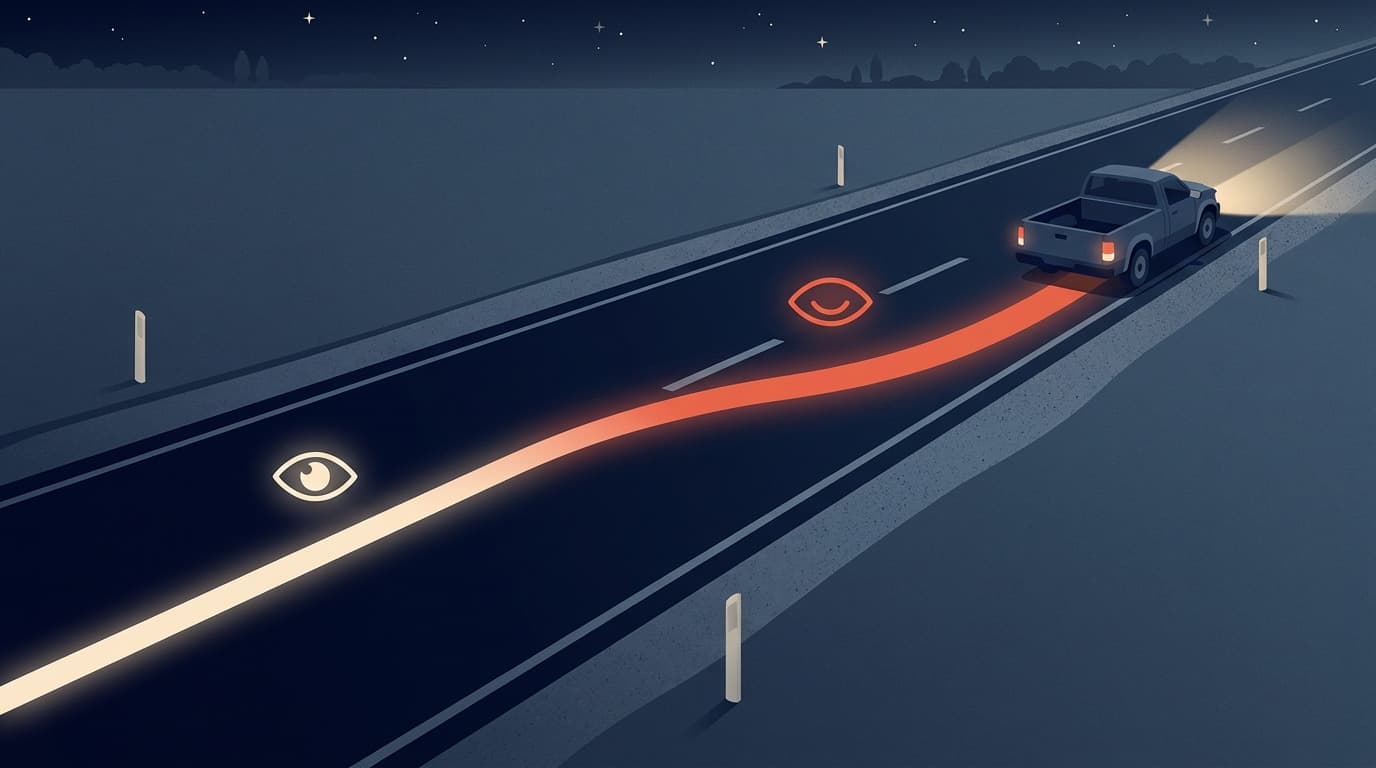
Often a single vehicle, and often a driver alone.
Frequently on a straight, familiar, monotonous road — the conditions that demand least, and therefore hold attention least.
And commonly in the circadian lows covered in the fatigue management talk.
The signature is defined by what is missing. Nothing happened before the crash, because nobody was there to make it happen.
The countermeasures that do nothing#
Every crew has a favourite, and they are all versions of the same mistake — stimulation is not sleep.
The window down. Cold air produces a brief arousal and no recovery.
The radio up. The same, shorter.
Coffee or an energy drink. Caffeine is genuinely useful and genuinely temporary — it masks the signal for a while and repays nothing. The sleep debt continues to accrue underneath it and arrives later, often abruptly.
Talking to a passenger. Helps somewhat while the conversation lasts. Ends when it does.
Slapping yourself, chewing, singing. If you have reached the point of using these, you have already answered the question.
"I'm nearly home." The most dangerous of all, because the last few miles are the most familiar, the most monotonous and the least demanding — and familiarity is precisely what allows attention to switch off.
The only thing that treats sleepiness is sleep. A short nap of around fifteen to twenty minutes, somewhere safe, is the only intervention on this list that actually addresses the deficit — and it works.
What to do instead#
Decide before you set off, when you are still capable of deciding well. Fatigue degrades the judgement that would tell you to stop, which is why the decision must be made in advance.
Stop and sleep, properly. Somewhere safe and legal, engine off, alarm set. Expect to feel groggy for a few minutes afterwards and account for that before driving on.
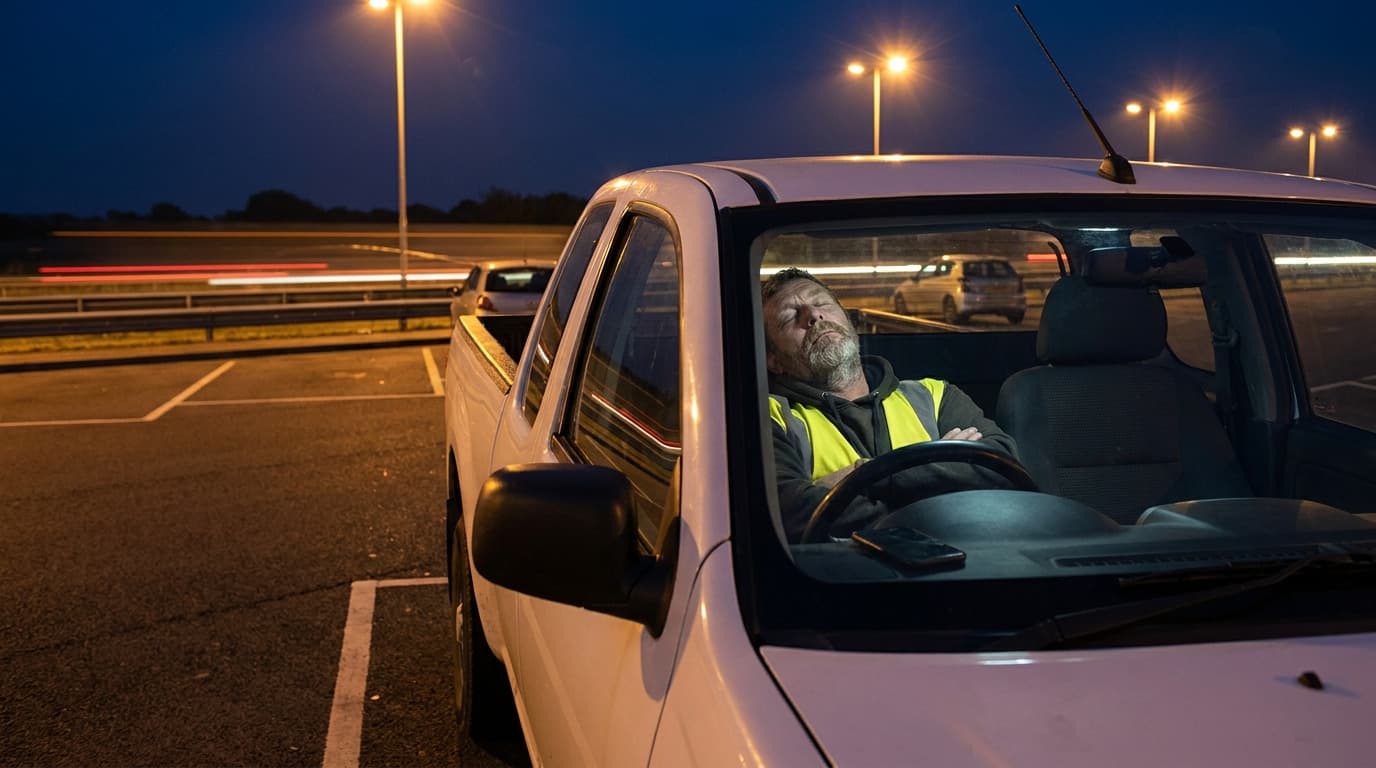
Treat the first microsleep as the last warning you will get — if you become aware of one, you have already been having them.
Watch for the tells you can notice: missing an exit or a turning, no memory of the last few miles, drifting within the lane, repeated yawning, difficulty holding your head up.
Break the journey rather than pushing to complete it.
Let somebody else drive if there is anybody else.
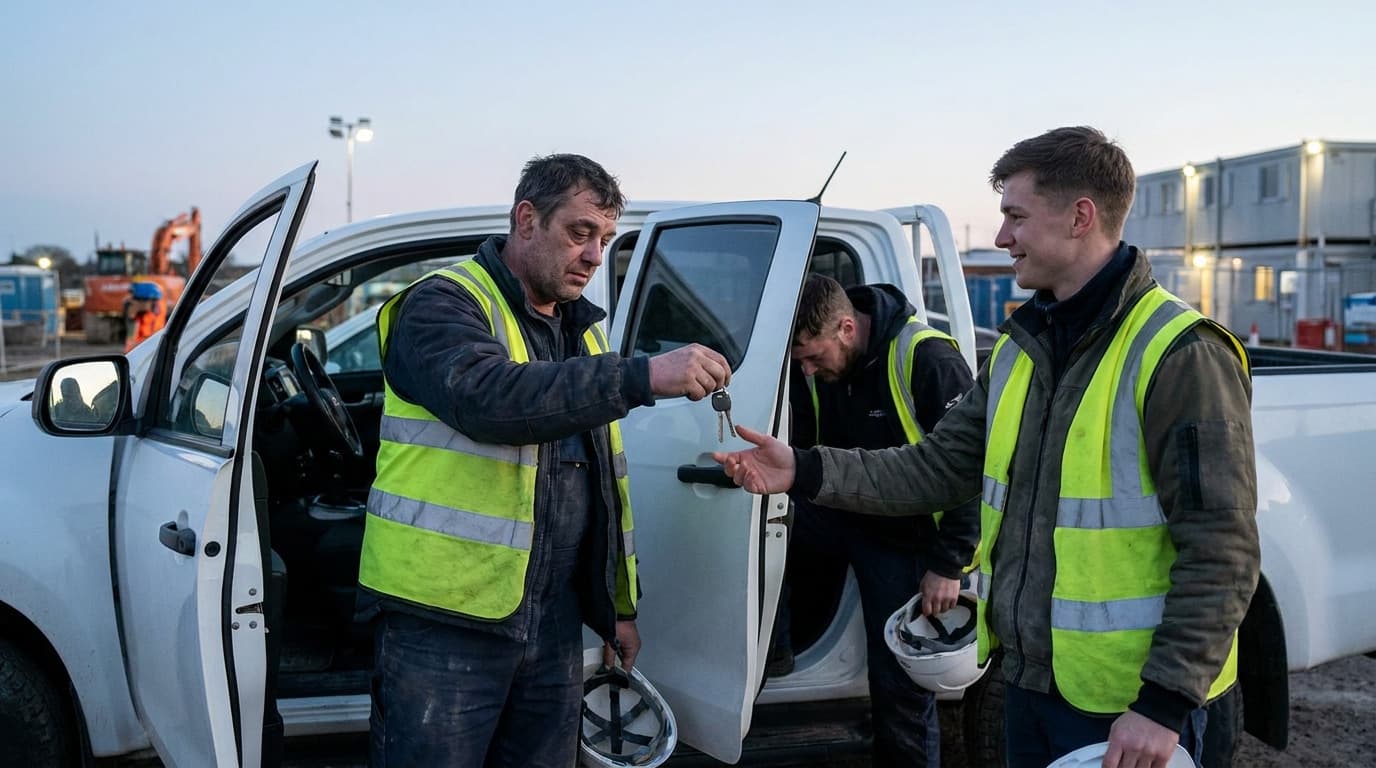
And do not start the journey at all after an unusually long shift, or in the small hours, if there is any alternative.
Where the duty sits#
There is no OSHA standard on fatigue — no maximum shift, no minimum rest, no cap on consecutive days — and no OSHA standard on driving fatigued. That is covered in more depth in the fatigue management talk.
The hard limits are the hours-of-service rules at 49 CFR Part 395, which bind commercial motor vehicle drivers and nobody else.
Alongside them: Section 5(a)(1) and recognised hazards — a schedule that reliably puts people on the road after excessive hours is one, once it is known — 1926.21(b)(2) on instruction, and 1926.601(b)(9) on seat belts, which matter more in exactly the run-off-road crash this hazard produces.
The honest position is that for most construction workers the commute is entirely unregulated and entirely uncontrolled, which is why it has to be managed by planning rather than by rules.
What can go wrong?#
A double shift followed immediately by a long drive.
The 2am drive home from a night shift, in the deepest circadian low.
A driver waiting for a warning that half of people never receive.
Caffeine used as a substitute for stopping, with the debt arriving later.
The last ten miles treated as safe because they are familiar.
No memory of the last few miles, noticed and driven through anyway.
A crew of four where the only person who has slept is not the one driving.
A journey scheduled by someone who will not be making it.
How do we manage this properly?#
Plan the drive home as part of the shift, especially after long or night shifts.
Make stopping normal. Somebody who arrives an hour late because they slept in a lay-by has done exactly the right thing and should be told so.
Offer an alternative — accommodation, a lift, a taxi, a later start. All of them are cheaper than the alternative.
Brief the microsleep facts once, properly. Four seconds, a football field, and no reliable warning.
Correct the coffee belief explicitly, because it is the most common substitute for the only thing that works.
Ask about the journey, not just the shift, in planning — how far, what time, what road.
Never schedule a long drive at the end of the longest shift where any other sequence is possible.
And check on the crew who live furthest away. They carry the largest exposure and nobody counts it.
Before you start#
- Confirm how long you will have been awake by the time you finish driving.
- Confirm what time you will be on the road, and whether it falls in the small hours.
- Confirm you have a plan for stopping, and somewhere you could stop safely.
- Confirm you are not relying on coffee to get you there.
- Confirm somebody knows your route and expected arrival.
- Confirm whether anyone else in the vehicle is fit to drive.
- Confirm your belt is on — this hazard produces run-off-road crashes.
- Confirm that arriving late because you slept would not cost you anything here.
Talk it over#
- Has anyone here arrived somewhere with no memory of the last few miles?
- What do you do when you start feeling it — and does it work?
- How long will you have been awake tonight when you get home?
- Would anyone here pull over and sleep for twenty minutes?
The bottom line#
You are waiting for a warning that may never arrive — about half of drivers who survived a drowsy-driving crash reported their bodies gave them no warning at all before they fell asleep, so "I'll stop when I feel it" fails half the time, at the moment it is needed. The mechanism is the microsleep: a short, involuntary period of inattention of a few seconds that you neither choose nor notice, during which — in four or five seconds at highway speed — the vehicle travels the length of a football field with nobody driving it. The scale is both large and undercounted: NHTSA recorded 633 deaths in police-reported drowsy-driving crashes in 2023, while a 2024 AAA Foundation study estimated 17.6% of all fatal crashes from 2017–2021 involved a drowsy driver — about 30,000 deaths, roughly ten times the reported figure — because there is no test for fatigue at a crash scene. The crash signature is defined by absence: no braking, no skid marks, no evasive action, often single-vehicle, often a driver alone, on a straight familiar road. And the countermeasures crews trust — cold air, radio, coffee, conversation, "I'm nearly home" — provide arousal, not recovery. The only thing that treats sleepiness is sleep: a short nap of fifteen to twenty minutes, somewhere safe.
Frequently asked questions about fatigued driving#
Will I know when I'm about to fall asleep at the wheel?
Often not. About half of drivers who survived a drowsy-driving crash reported that their bodies gave them no warning at all before they fell asleep. That makes the common plan — "I'll pull over when I feel it coming" — unreliable in roughly half of cases, and unreliable precisely when it is needed. The decision to stop has to be made in advance, while judgement is still intact.
What is a microsleep?
A short, involuntary period of inattention lasting a few seconds, which you do not choose, do not feel beginning, and frequently do not know occurred — your eyes may even remain open. The reason it matters on the road is distance: in the four or five seconds of a microsleep, at highway speed the vehicle travels the length of a football field, with nobody driving it.
How many crashes are caused by drowsy driving?
More than the record shows. NHTSA data shows 633 deaths in police-reported drowsy-driving crashes in 2023. But a 2024 study by the AAA Foundation for Traffic Safety estimated that 17.6% of all fatal crashes from 2017 to 2021 involved a drowsy driver — around 30,000 fatalities, roughly ten times the reported number. NHTSA estimates fatigue-related crashes causing injury or death cost society $109 billion annually.
Why is drowsy driving so badly undercounted?
Because there is no test for fatigue at a crash scene. Alcohol has a breath test; sleep debt has nothing. A driver who did not survive cannot be assessed for it, and one who did is unlikely to volunteer it. Fatigue is the impairment that leaves no physical evidence, which is why investigators fall back on reading the crash pattern.
How do you recognise a fatigue crash?
By what is missing. No braking and no skid marks — an awake driver brakes, however late. No evasive action; the vehicle holds its heading off the road or across the centre line. Often a single vehicle and often a driver alone, frequently on a straight, familiar, monotonous road, and commonly during the circadian lows. Nothing happened before the crash because nobody was there to make it happen.
Does coffee, cold air or the radio help?
Only briefly, and none of them addresses the deficit. Cold air and loud music produce short-lived arousal with no recovery. Caffeine is genuinely useful and genuinely temporary — it masks the signal while the sleep debt continues to accrue underneath, and that debt arrives later, often abruptly. The only thing that treats sleepiness is sleep — a nap of around fifteen to twenty minutes somewhere safe.
Is fatigued driving regulated?
Largely not for construction workers. There is no OSHA standard on fatigue and none on driving fatigued. The hard limits are the hours-of-service rules at 49 CFR Part 395, which bind commercial motor vehicle drivers only. Otherwise Section 5(a)(1) on recognised hazards applies once a schedule is known to put people on the road after excessive hours, alongside 1926.21(b)(2). For most workers the commute is unregulated, so it has to be managed by planning.
Download the fatigued driving toolbox talk PDF#
Get this fatigued driving toolbox talk as a print-ready PDF — available in English, Spanish, Portuguese, and Turkish. Print it, hand it to the crew, and collect signatures on the included attendance sheet.
Download the PDF — free account required. New members get 3 free downloads.
Related toolbox talks#
Sources#
- National Safety Council, Fatigued Driving: https://www.nsc.org/road/safety-topics/fatigued-driver
- NHTSA, Drowsy Driving: https://www.nhtsa.gov/risky-driving/drowsy-driving
- NIOSH, Motor Vehicle Safety at Work: https://www.cdc.gov/niosh/motor-vehicle/about/index.html
Written by FieldSafetyTalk's safety professional — a CSP, ASP, CHST and OSHA Authorized Outreach Trainer with 14+ years of international construction safety experience across federal, heavy civil, and industrial projects.