Earthquake
Updated 2026-08-06
In this bundle Health & Environmental Exposure
Print-ready PDF
Download this talk as a print-ready PDF, available in 4 languages.
Every other hazard in the weather group gives you something ahead of time. A storm shows up on the forecast. Lightning announces itself with thunder. A tornado gets a watch and often a warning. Even a heat wave is on the schedule days out. An earthquake gives you none of that. The ground starts moving with no notice at all, and you have seconds — not minutes — to protect yourself. This Earthquake Toolbox Talk (Safety Talk / Tailgate Talk) is about what that missing warning means, why the only protection is a response you have already trained until it is automatic, and why a construction site is one of the more dangerous places to be when it happens.
Here is the distinction that carries this whole talk: an earthquake gives no warning at all, so it is the one hazard you cannot prepare for in the moment — your only protection is the response you already trained until it is automatic. With a storm you can watch it come and decide what to do. With an earthquake there is no deciding; there is only reacting, and you will react the way you have practiced or not at all. That is why earthquake safety is not really about the plan on paper — it is about Drop, Cover, and Hold On being muscle memory, something your body does before your mind catches up. The people who get hurt are usually the ones who freeze, or who do the instinctive wrong thing — run, or stand in a doorway — because they never trained the right one.
Where the boundary of this talk sits#
The emergency response and emergency evacuation talks own getting people out and accounting for them after an event. The severe weather and extreme weather talks own storms. The struck-by talk owns falling and flying objects generally. This talk owns the earthquake specifically — the no-warning problem, the Drop-Cover-Hold-On response during the shaking, and what makes a jobsite different from an office. Where the question is evacuating after the shaking stops, that is the emergency talks; this one owns the seconds while the ground is actually moving.
Drop, Cover, and Hold On — and why it is the answer#
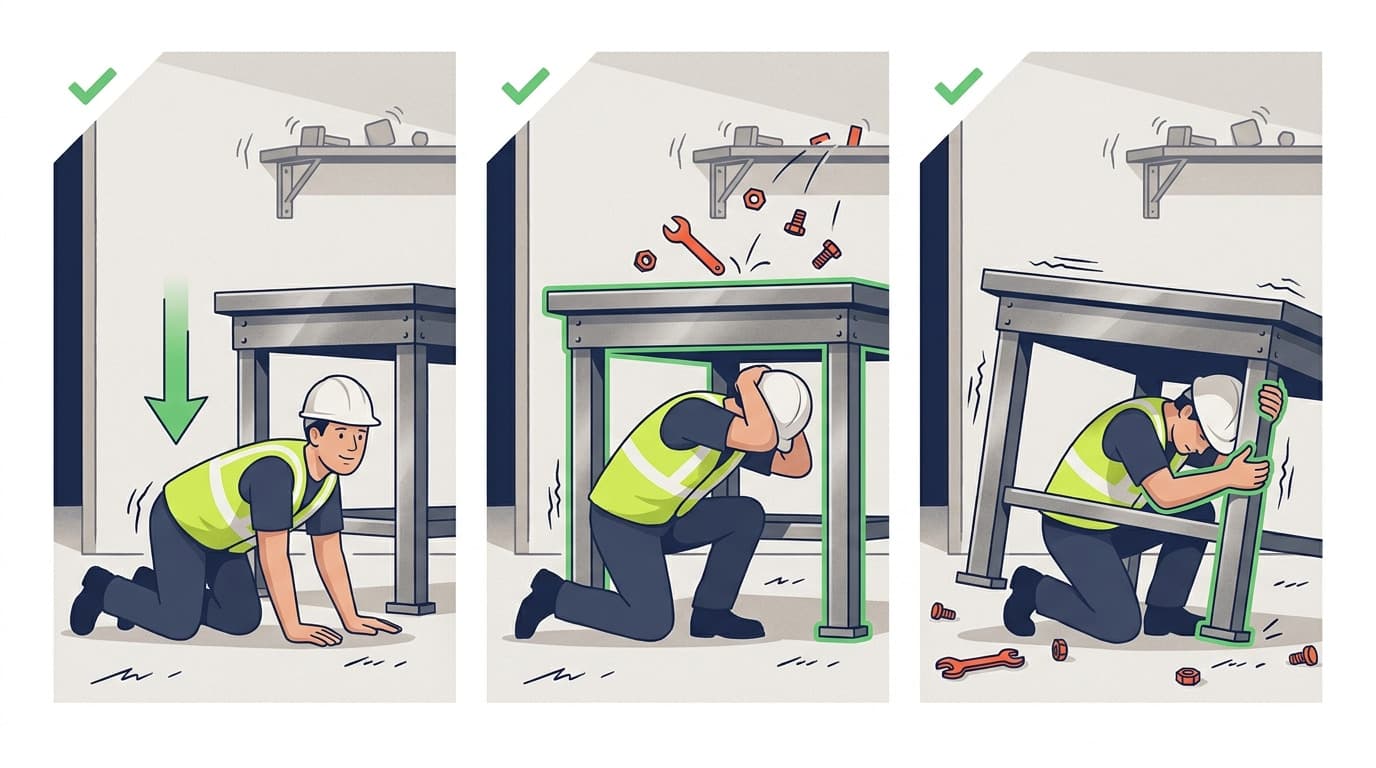
The response recommended by FEMA, the USGS, and the Red Cross is three words, and each one is doing a job.
Drop to your hands and knees before the shaking knocks you down. Most people who are injured are hurt while trying to walk or run during the shaking — the ground is moving, and you will fall. Getting low on your own terms takes that fall away and lets you move to cover.
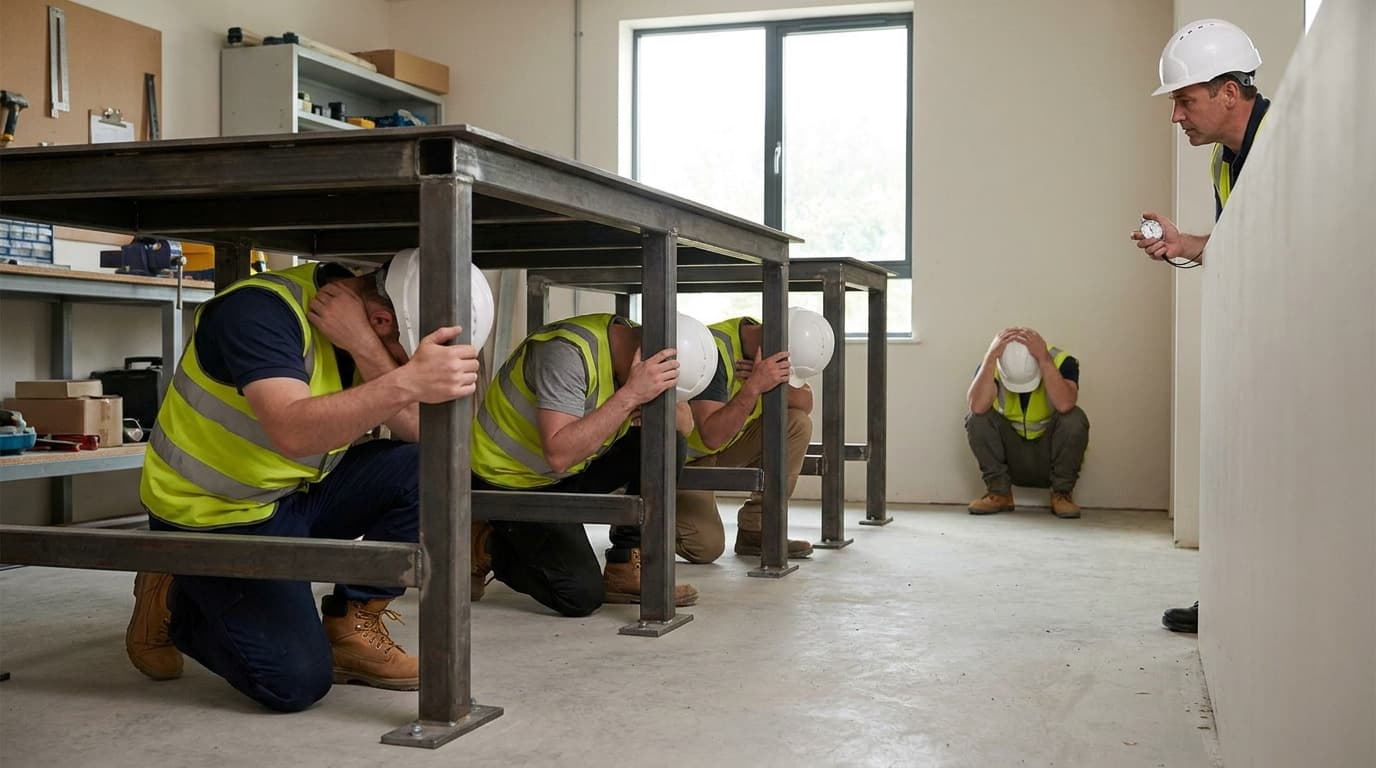
Cover your head and neck, because that is what falling debris hits first. If there is sturdy furniture or a solid workbench within a step or two, get under it. If there is nothing to get under, get down against an interior wall, away from windows, and cover your head and neck with your arms — a hard hat is doing real work here. Do not travel far to find cover; you have seconds, so take the best protection within a step or two, not the perfect one across the room.
Hold On to whatever you are under until the shaking stops, because the shaking will move your cover, and you want to move with it and stay protected. When it stops, that is when you assess and, if needed, evacuate.
That is the whole method, and it is deliberately simple because it has to work in a few seconds of chaos. Its simplicity is the point: a response you can execute without thinking is the only kind that works when there is no time to think.
The myths that get people killed#
Two pieces of old advice are still believed, and both are dangerous.
Do not stand in a doorway. This comes from old photos of collapsed adobe houses where the door frame was the only part left standing. In a modern building, the doorway is no stronger than any other part of the structure, it gives you no protection from falling objects, and a swinging door can slam into you. Get under something sturdy instead.
Do not believe the "triangle of life." This is a widely circulated idea that you should lie down next to furniture rather than under it. It is based on observations of one collapsed building in one country and does not apply to how buildings behave elsewhere; official rescue teams and emergency agencies reject it. Drop, Cover, and Hold On remains the recommendation.
And the strongest instinct of all: do not run outside during the shaking. Running while the ground moves is how you fall, and the area just outside a building — where glass, brick, cladding, and other components come down — is often the most dangerous place of all. You are safer getting low and covered where you are than trying to reach the exit.
Why a jobsite is worse than an office#
This is the part that makes an earthquake a construction problem and not just a general one. Most earthquake injuries do not come from buildings collapsing — they come from non-structural things falling and striking people, and a construction site is full of exactly those things, out in the open, unsecured.
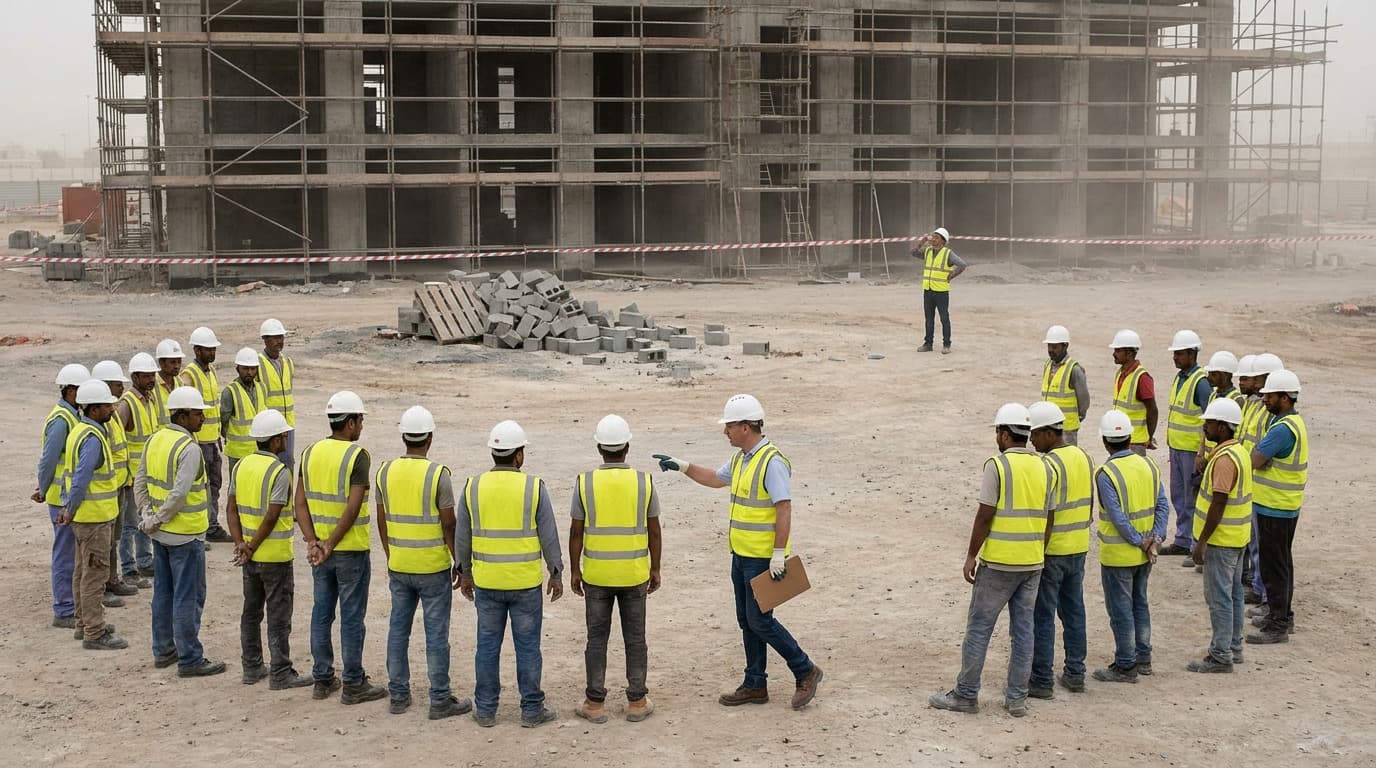
Think about what is around you: stacked and stored materials that can topple, unbraced or partially built masonry walls that can come down, scaffolds that can collapse or throw you off, suspended loads and cranes that can drop or swing, stacked pipe and rebar that can roll, tools and materials at height, and trench and excavation walls that can cave in. A finished office has a desk to get under and secured furniture; an open deck of structural steel, a scaffold platform, or the floor of a trench has none of that, and the "get under something sturdy" instruction is genuinely harder to follow. So on a jobsite the response has to be adapted: get low, get your head and neck covered, and get away from the specific things around you that can fall, roll, or collapse — the wall, the stack, the load, the trench edge. Where you are standing when the shaking starts decides a lot, which is why knowing your immediate hazards is part of the preparation.
After the shaking stops#
The event is not over when the ground goes still. Aftershocks follow, sometimes large, so stay alert and be ready to Drop-Cover-Hold-On again. Watch for damaged structures, scaffolds, and excavations that the quake weakened; assume anything that shook is compromised until checked. Watch for utility damage — gas leaks especially, so no open flames, matches, or switching electrical equipment until the area is confirmed safe; and downed or damaged power lines. When you evacuate, use stairs, never elevators, and move carefully. Account for everyone per the emergency action plan, and get medical help to the injured rather than searching damaged areas untrained.
Where the duty sits#
Earthquakes run on the same framework as the rest of the weather group. OSHA has no earthquake-specific standard, so the duty runs through the General Duty Clause, Section 5(a)(1) — a recognized hazard the employer must address in seismic regions — and through the Emergency Action Plan standards, 1910.38 and 1926.35, which OSHA itself names as the vehicle for earthquake planning: a written plan (unless the employer has few enough employees to qualify for the oral exception), covering escape procedures, accounting for personnel, and training so the response is known. OSHA's own guidance points employers to FEMA and Ready.gov for the Drop-Cover-Hold-On method and to a workplace survey to identify what could fall or block egress, and its Disaster Site Worker program exists precisely because disaster sites and construction sites carry different hazards. On federal contract work, EM 385-1-1 carries emergency-planning provisions. Where a site plan or a seismic-region contract sets specific earthquake requirements, those govern.
What can go wrong?#
- A worker freezes or runs when the shaking starts, because the response was never trained.
- Someone stands in a doorway or follows the "triangle of life," believing an old myth.
- A worker runs outside into falling glass, brick, and cladding during the shaking.
- Unsecured stacked materials, masonry walls, or a scaffold topple onto workers.
- A suspended load or crane drops or swings during the shaking.
- A trench or excavation wall caves in on workers below.
- An aftershock hits people who assumed the event was over.
- Someone uses a flame or switch near an undetected gas leak after the quake.
How do we manage this properly?#
- Train Drop, Cover, and Hold On until it is automatic — there is no time to think in a quake.
- Drop low before you are knocked down; Cover head and neck; Hold On through the shaking.
- Take the nearest cover within a step or two, not the perfect cover across the room.
- Never run outside during shaking, never use a doorway, never trust the "triangle of life."
- On site, get away from stacks, masonry walls, scaffolds, suspended loads, and trench edges.
- Know your immediate hazards for where you work, because location decides a lot.
- After: expect aftershocks, treat shaken structures as compromised, watch for gas leaks.
- Evacuate by stairs not elevators; account for everyone per the emergency action plan.
Before you start#
- Confirm the crew knows Drop, Cover, and Hold On and has practiced it.
- Confirm everyone knows the doorway and "triangle of life" myths are wrong.
- Confirm workers know not to run outside during shaking.
- Confirm the immediate falling/collapse hazards for each work area are identified.
- Confirm the Emergency Action Plan covers earthquakes and accounts for all personnel.
- Confirm the post-quake plan addresses aftershocks, gas, and damaged structures.
- Confirm the crew knows to use stairs, never elevators, when evacuating.
- On federal work, confirm the EM 385-1-1 emergency-planning provisions apply.
Talk it over#
- If the ground started shaking right now, what's the nearest sturdy thing you could get under?
- What's around your work area that would fall, roll, or collapse in a quake?
- Why is running outside during shaking more dangerous than staying low where you are?
- What do we do about aftershocks and gas after the shaking stops?
The bottom line#
An earthquake gives no warning at all, so it is the one hazard you cannot prepare for in the moment — your only protection is the response you already trained until it is automatic. Unlike every other weather hazard, there is no forecast, no siren, no time to decide — only seconds to react, and you will react the way you practiced or not at all. That response is Drop, Cover, and Hold On: drop low before the shaking drops you, cover your head and neck under something sturdy or against an interior wall, and hold on until it stops — taking the nearest cover within a step or two, because there is no time for the perfect one. The myths kill: do not stand in a doorway, do not believe the "triangle of life," and above all do not run outside into falling glass and brick. And a jobsite is worse than an office, because most quake injuries come from non-structural things falling — stacks, masonry walls, scaffolds, suspended loads, rolling pipe, trench walls — all of which surround an open site, so the response adapts to getting low, covered, and away from the specific hazard nearest you. After the shaking: expect aftershocks, treat shaken structures as compromised, watch for gas leaks, and evacuate by stairs, not elevators. The duty runs through the General Duty Clause 5(a)(1) — there is no OSHA earthquake standard — and the Emergency Action Plan standards (1910.38 / 1926.35), with FEMA and USGS providing the response method OSHA points to. The test for any crew in a seismic area is one question: if the ground moved this second, would your body already know what to do — or would you be deciding while the debris comes down?
Frequently asked questions about earthquakes#
What is Drop, Cover, and Hold On?
It is the response recommended by FEMA, the USGS, and the Red Cross for the moment shaking starts. Drop to your hands and knees before the shaking knocks you down; Cover your head and neck by getting under sturdy furniture or, if there is none, getting down against an interior wall and covering with your arms; and Hold On to your cover until the shaking stops, moving with it if it shifts. It is deliberately simple because it has to work in a few seconds of chaos, and it addresses the real threat — being knocked down and struck by falling objects.
Why can't I just run outside?
Because running during shaking is one of the most dangerous things you can do. The ground is moving, so you are likely to fall, and the area just outside a building is often the worst place of all — glass, brick, cladding, and other components come down along the exterior. Most injuries happen to people trying to move during the shaking. You are far safer getting low and covered where you are, then evacuating carefully after the shaking stops, using stairs rather than elevators.
Isn't a doorway the safest place?
No. That belief comes from old photos of collapsed adobe houses where the door frame was the only part left standing. In a modern building, a doorway is no stronger than the rest of the structure, it gives you no protection from falling objects, and a swinging door can injure you. Get under something sturdy instead, or against an interior wall away from windows. The doorway advice is out of date, and official agencies no longer recommend it.
What is the "triangle of life," and is it safe?
It is a widely circulated idea that you should lie next to furniture rather than under it, on the theory that a survivable void forms beside crushed objects. It is based on observations of one collapsed building and does not apply to how buildings behave generally; official rescue teams and emergency agencies reject it and continue to recommend Drop, Cover, and Hold On. Following the "triangle of life" instead of getting under cover can put you in a more dangerous position, not a safer one.
Why is a construction site more dangerous in an earthquake?
Because most earthquake injuries come from non-structural things falling and striking people, and a construction site is full of exactly those — out in the open and unsecured. Stacked materials topple, unbraced masonry walls come down, scaffolds collapse, suspended loads and cranes drop or swing, pipe and rebar roll, and trench walls cave in. A finished office has a desk to get under; an open steel deck, a scaffold, or a trench does not, so the response has to adapt: get low, cover your head and neck, and get away from the specific stack, wall, load, or edge nearest you.
What do we do after the shaking stops?
Expect aftershocks — sometimes large — and be ready to Drop, Cover, and Hold On again. Treat any structure, scaffold, or excavation that shook as compromised until it is checked. Watch for utility damage, especially gas leaks, so no flames, matches, or electrical switching until the area is confirmed safe, and stay clear of downed power lines. Evacuate by stairs, never elevators, account for everyone per the emergency action plan, and get medical help to the injured rather than entering damaged areas untrained.
Download the earthquake toolbox talk PDF#
Get this earthquake toolbox talk as a print-ready PDF — available in English, Spanish, Portuguese, and Turkish. Print it, hand it to the crew, and collect signatures on the included attendance sheet.
Download the PDF — free account required. New members get 3 free downloads.
Related toolbox talks#
Sources#
- OSHA, Earthquake Preparedness and Response (no earthquake standard; EAP under 1910.38/1926.35; FEMA Drop-Cover-Hold-On; workplace survey): https://www.osha.gov/earthquakes
- USGS, Great ShakeOut / Drop, Cover, and Hold On (the recommended response; doorway and "triangle of life" myths): https://www.usgs.gov/faqs/what-are-great-shakeout-earthquake-drills
- FEMA / Ready.gov, Earthquakes (Drop, Cover, and Hold On; before, during, and after actions): https://www.ready.gov/earthquakes
This talk is general awareness guidance for training purposes. It does not replace your employer's emergency action plan, the OSHA emergency-planning standards, the OSH Act General Duty Clause, FEMA/USGS guidance, or a competent person's duties, and it is not legal advice. Where a site plan or a seismic-region contract sets a stricter requirement, that requirement governs.
Written by FieldSafetyTalk's safety professional — a CSP, ASP, CHST and OSHA Authorized Outreach Trainer with 14+ years of international construction safety experience across federal, heavy civil, and industrial projects.