Synthetic Sling Protection
Updated 2026-08-06
In this bundle Rigging & Lifting
Print-ready PDF
Download this talk as a print-ready PDF, available in 4 languages.
Synthetic slings have quietly taken over rigging on most sites, for good reasons: they are light, they do not mar a finished surface, they grip a load without crushing it, and a rigger can carry three over a shoulder. But the same properties that make them easy hide a hard truth about how they fail. A wire rope tells you it is dying, wire by wire, over weeks; a synthetic sling can look perfect right up to the lift that parts it. This Synthetic Sling Protection Toolbox Talk (Safety Talk / Tailgate Talk) is about why that is, and what it changes in how you use them.
Here is the distinction that carries this whole talk: you inspect a wire rope by counting; you cannot inspect a synthetic sling the same way, because its most dangerous damage hides inside a cover that still looks fine — so the whole job shifts from detecting damage to preventing it. With wire rope, the standard gives you thresholds to measure against, because the failure is gradual and visible. With a synthetic sling, OSHA gives you no numbers at all — the removal criteria are pass/fail, any one of them ends the sling — precisely because the loss of strength cannot be measured by looking. The practical consequence is the opposite of wire rope: your safety does not come from inspecting well after the fact, it comes from protecting the sling before the damage ever happens.
Where the boundary of this talk sits#
The rigging inspections talk owns the general inspection regime that applies to all rigging. The wire rope inspection talk owns wire rope on cranes and hoists, with its three deficiency categories and countable broken-wire criteria. The crane and lifting talk owns the lift itself. This talk owns synthetic slings specifically — web and round slings of nylon, polyester and polypropylene — how they fail, their pass/fail removal criteria, the environmental and temperature limits unique to them, and the edge protection that is their real defense. Where a number matters it is the synthetic-sling number, not the wire-rope or chain number; the talk keeps them apart because mixing them passes a bad sling.
The removal criteria are pass/fail — and that is the point#
For synthetic web slings, 1926.251(e)(8) lists the conditions that require immediate removal from service, and the striking thing about the list is what it does not contain: any number to measure against. A web sling is out if it has acid or caustic burns; melting or charring of any part of the sling surface; snags, punctures, tears or cuts; broken or worn stitches; or distortion of fittings. That is the whole list. There is no "how many," no "how deep," no threshold you count up to. One qualifying condition, anywhere on the sling, and it is finished.
This is not vagueness — it is the standard being honest. OSHA explained the reasoning in a longstanding interpretation: a synthetic sling with burned fibers, melting, snags, cuts or worn stitches has lost some of its ability to carry a load, and the extent of that loss cannot be easily quantified. You can count broken wires on a wire rope because each is a roughly known fraction of its strength. On a synthetic sling, a single cut can sever a large share of the load-bearing fibers in one place, with no reliable way to look and say "that is 20% gone." So the standard does not ask you to judge severity — any listed damage means out, because the alternative, guessing how much strength a cut removed, is the guess that drops loads.
Why the damage hides — and what the cover is really for#
The reason a synthetic sling can look fine and be finished is built into how it is made. A round sling is a bundle of continuous load-bearing core yarns inside a protective cover that carries no load. The cover's jobs are to hold the core in shape, resist surface abrasion, and — the part crews miss — serve as a warning layer. Many round slings run a brightly colored inner core cover, often red, so that when the outer jacket wears or cuts through far enough to expose that color, the sling is condemned on sight. The color is not decoration; it is a designed tell-tale.
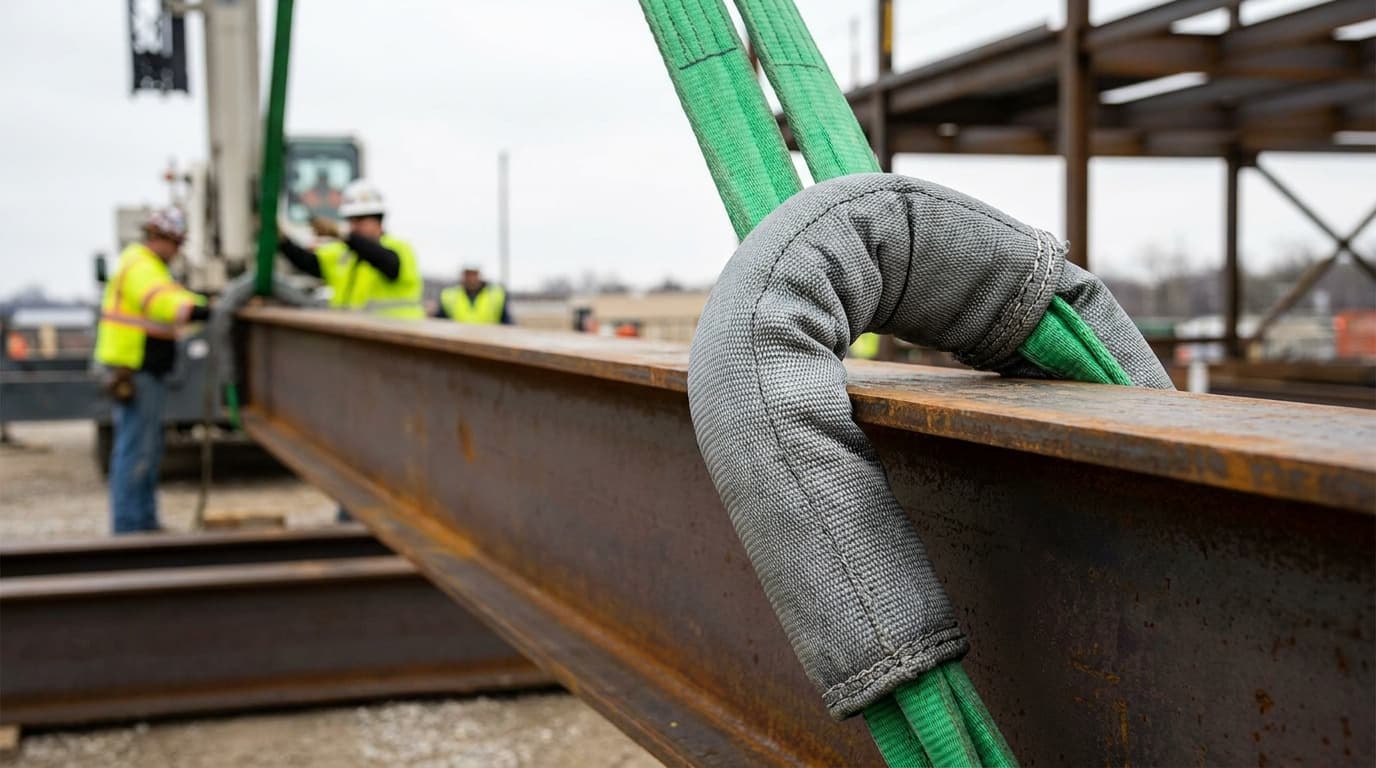
But the cover has a limit that matters more than its warning function. It shields against gradual surface wear; it cannot resist a sharp edge. A flame-cut beam, a shackle pin, the corner of a steel plate — under load these focus the entire weight onto a tiny contact area, and the fibers can cut or tear through almost immediately. Here is the trap: a sharp edge can sever load-bearing core fibers inside the sling while the outer cover still looks acceptable. The sling loses strength where you cannot see it — so you cannot rely on catching it afterward, because by the time it shows on the outside, the lift where it mattered may already have happened.
Edge protection: the control that actually works#
If the damage hides and cannot be measured, then the only reliable control is to stop the sharp edge from ever reaching the fibers. That is what edge protection does, and it is why it is the center of gravity of this whole topic rather than a footnote.
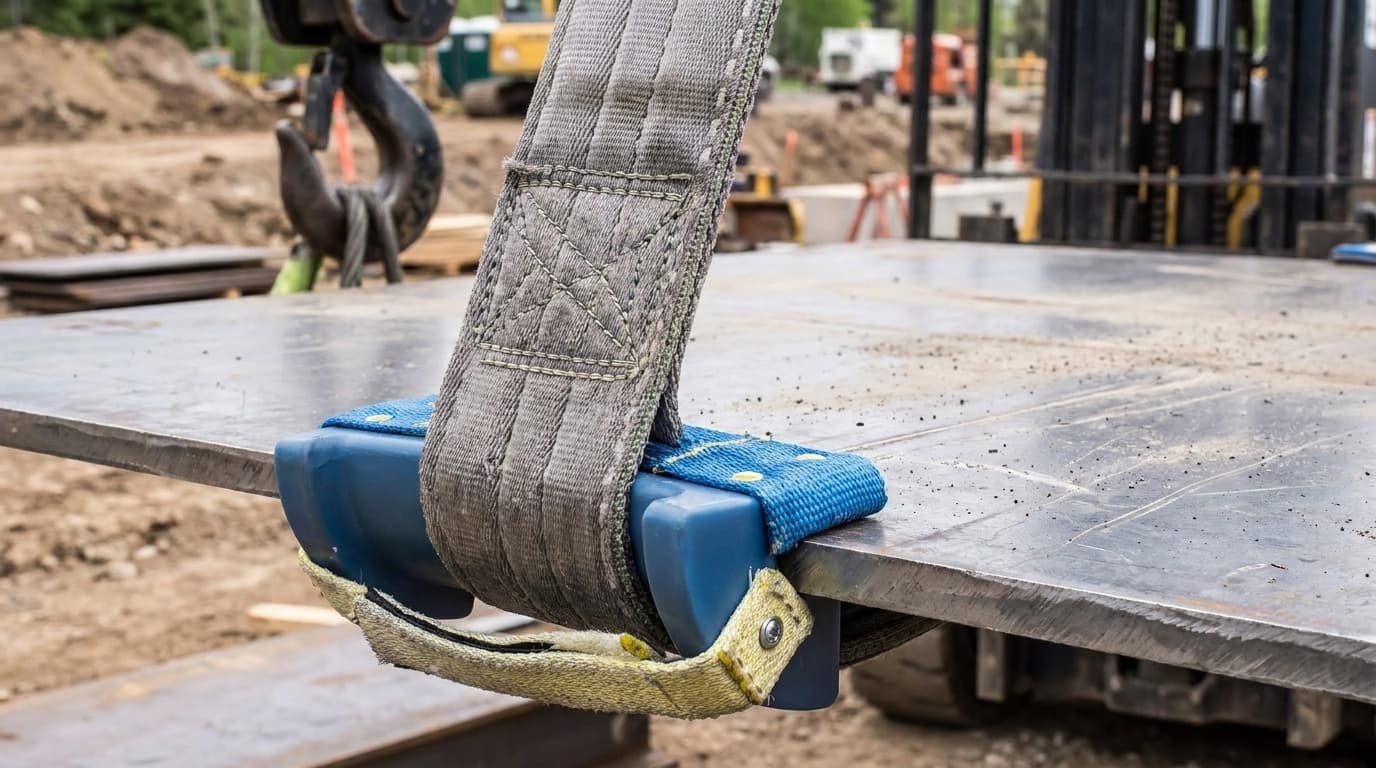
The rule that makes it non-optional is in the consensus standard the industry works to, ASME B30.9: slings in contact with edges, corners, protrusions or abrasive surfaces must be protected with material of sufficient strength and thickness to prevent damage — unless the edge is rounded to a suitable radius. The timing is what crews get wrong: protection goes on before the lift, not after damage appears. Waiting to see whether the edge cuts the sling is not inspection, it is a test with the load in the air. And what counts as sharp is wider than it looks — an edge that felt smooth can cut once the load concentrates force onto it, so on a mixed load the working assumption is that any corner is sharp until protected.
The protection has to match the hazard. A softener or pad handles abrasion; a true cut hazard — a plate edge, a coil, flame-cut steel — needs engineered cut-resistant protection, not cardboard or a scrap of belt that looks like protection while cutting through as fast as the sling would. The shackle is a quiet offender: rigging a synthetic sling on the sharp edge where the pin passes through the shackle ear damages it, which is why a sling belongs in the bowl of the shackle, not on the pin's edge.
The limits synthetics have that steel does not#
Beyond cuts, synthetic slings have chemical and temperature limits written directly into the standard, because the material itself has boundaries that steel does not.
Environmental conditions, under 1926.251(e)(6): nylon web slings must not be used around fumes, sprays or liquids of acids or phenolics; polyester and polypropylene not around caustics; and web slings with aluminum fittings not around caustics. The material and the chemistry have to match — a nylon sling fine in one environment degrades in another, and the resulting acid or caustic burns are a pass/fail removal condition. Safe operating temperatures, under 1926.251(e)(7): polyester and nylon web slings not above 180°F (82.2°C), polypropylene not above 200°F (93.33°C). Heat past those limits weakens the fiber whether or not it visibly chars.
Two more use rules matter because they quietly destroy strength. A knot is never a repair and never a shortening method — a knot in a synthetic sling creates a stress concentration that can cut its strength dramatically, and knots are a listed removal condition. And a sling with missing or illegible identification — the tag stating its rated capacity, its type, its material — is out, because a sling you cannot identify is a sling whose limits you are guessing at. None of these is severity you judge; each is pass/fail, like the damage criteria.
Where the duty sits#
Synthetic slings fall under 1926.251, Rigging equipment for material handling, in Subpart H.
1926.251(a)(1) requires all rigging, synthetic slings included, to be inspected prior to use on each shift and as necessary during use, with defective rigging removed from service. 1926.251(e) carries the synthetic-web-sling specifics: environmental limits at (e)(6), temperature limits at (e)(7), pass/fail removal criteria at (e)(8). Fiber rope slings have their own criteria at 1926.251(d)(6); shackles and hooks are governed at 1926.251(f), including not exceeding the marked working load limits. The consensus standard ASME B30.9 supplies the edge-protection requirement and the periodic-inspection detail OSHA's guidance points to.
On federal contract work, EM 385-1-1 carries its own rigging inspection, tagging and sling-protection requirements, generally at least as strict as the OSHA baseline; where a manufacturer's instruction or a contract sets a tighter limit, that limit governs. And across all of it, the sling manufacturer's instructions are not optional background — the standard repeatedly defers to them for rated capacities, environmental suitability and any repair.
What can go wrong?#
- A synthetic sling is run over a sharp or flame-cut edge with no protection, and the fibers cut under load.
- The outer cover looks fine, but core fibers were already severed by an earlier edge contact.
- A "sharp edge" is judged by touch, and an edge that felt smooth cuts through once the load concentrates force on it.
- A knot is tied to shorten a sling, creating a stress concentration that guts its strength.
- The wrong material is used for the chemistry present — a nylon sling near acids, a polyester sling near caustics.
- A sling is used above its temperature limit and weakened without visibly charring.
- Cardboard or a scrap of belt is used as "edge protection" against a true cut hazard and fails as fast as the sling would.
- A sling with a missing or illegible tag is used, so nobody actually knows its rated capacity.
How do we manage this properly?#
- Treat synthetic slings as prevent-don't-detect: protect the sling before the lift, because the damage hides and cannot be measured.
- Apply engineered edge protection wherever the sling meets a corner, edge, protrusion or abrasive surface — before the load moves.
- Match the protection to the hazard: pads for abrasion, cut-resistant protection for true cut edges like plate, coil or flame-cut steel.
- Assume any corner is sharp until protected; a load concentrates force onto the contact point.
- Learn the pass/fail removal list — burns, melting or charring, snags/punctures/tears/cuts, broken or worn stitches, distortion of fittings — and act on any one of them.
- Condemn a round sling the moment the inner core cover shows through the outer jacket.
- Never knot a synthetic sling to shorten or repair it; use the correct length or a method the manufacturer approves.
- Match the material to the chemistry and stay within the temperature limits; remove any sling with a missing or illegible tag.
Before you start#
- Confirm every sharp edge, corner and protrusion on today's load is identified and will be protected before the lift.
- Confirm the edge protection matches the hazard — cut-resistant where there is a real cut edge, not just a pad.
- Confirm the slings have been inspected this shift and none shows a pass/fail removal condition.
- Confirm no round sling is showing its inner core cover through the jacket.
- Confirm the sling material suits any chemicals present and the temperature of the load and environment.
- Confirm no sling is knotted, and none has a missing or illegible identification tag.
- Confirm slings sit in the bowl of the shackle, not on the pin's edge.
- On federal work, confirm the EM 385-1-1 rigging and sling-protection requirements are met.
Talk it over#
- On today's load, where are the edges that would cut a sling, and what is going on each of them?
- Have you ever seen a sling that looked fine on the outside but had a cut core? How would you catch that?
- What is being used for edge protection right now — and would it actually stop a cut, or just look like it?
- Is there a sling on this site with a tag you cannot read? What is its rated capacity, then?
The bottom line#
You inspect a wire rope by counting; you cannot inspect a synthetic sling the same way, because its most dangerous damage hides inside a cover that still looks fine — so the job shifts from detecting damage to preventing it. For synthetic web slings, 1926.251(e)(8) gives no numbers at all: the sling is out immediately for acid or caustic burns, melting or charring, snags/punctures/tears/cuts, broken or worn stitches, or distortion of fittings — any one of them, no severity to judge — because OSHA has said the loss of strength from such damage cannot be easily quantified. The damage hides because a round sling's load is carried by inner core yarns inside a non-load-bearing cover whose job is partly to be a warning layer: when the inner core cover (often red) shows through, the sling is condemned. But the cover resists abrasion, not a sharp edge — a flame-cut beam, a plate corner or a shackle pin can sever core fibers while the outside still looks acceptable. So the real control is edge protection applied before the lift, required by ASME B30.9 wherever a sling meets an edge, corner, protrusion or abrasive surface unless that edge is rounded to a suitable radius — with the protection matched to the hazard, cut-resistant for a true cut edge, and any corner assumed sharp until protected. Respect the limits steel does not have: nylon away from acids, polyester and polypropylene away from caustics (1926.251(e)(6)), polyester/nylon under 180°F and polypropylene under 200°F (1926.251(e)(7)), never a knot, and never a sling with an illegible tag. The test for any synthetic sling going under load is one question: is every edge it touches protected before the load lifts — because you will not get a second look once it is in the air?
Frequently asked questions about synthetic sling protection#
When does OSHA require a synthetic web sling to be removed from service?
Immediately, if any one of these is present: acid or caustic burns; melting or charring of any part of the sling surface; snags, punctures, tears or cuts; broken or worn stitches; or distortion of fittings. Under 1926.251(e)(8) there is no threshold or count — a single qualifying condition ends the sling, because the strength lost cannot be reliably measured.
Why are there no "how many" numbers like there are for wire rope?
Because the damage to a synthetic sling cannot be easily quantified. A broken wire is a roughly known fraction of a wire rope's strength, so you can count. A single cut can sever a large share of a synthetic sling's load-bearing fibers in one place, with no reliable way to judge how much strength is gone — so OSHA makes any qualifying damage an automatic removal rather than a severity call.
What is the inner colored cover on a round sling for?
It is a designed inspection warning. The load-bearing core yarns sit inside an outer cover that carries no load; many slings run a brightly colored inner core cover, often red, so that when the outer jacket wears or cuts through enough to expose that color, the sling is condemned on sight. Seeing the inner core cover means the sling is out.
Why is edge protection so important for synthetic slings?
Because the outer cover resists abrasion but cannot resist a sharp edge, and a sharp edge can cut load-bearing fibers under load while the outside still looks fine. You cannot count on catching that afterward, so the reliable control is to protect the sling before the lift. ASME B30.9 requires protection wherever a sling contacts an edge, corner, protrusion or abrasive surface unless the edge is suitably rounded.
Can I use cardboard or a piece of old belt for edge protection?
Not against a real cut hazard. A pad or softener handles abrasion, but a true cut edge — plate, coil, flame-cut steel — needs engineered cut-resistant protection that will actually stop the edge. Cardboard or scrap that cuts through as fast as the sling would gives the appearance of protection without the function, which is worse than nothing because it invites the lift.
Can I tie a knot in a synthetic sling to shorten it?
No. A knot creates a stress concentration that can dramatically reduce the sling's strength, and a knot is itself a removal condition. Use a sling of the correct length, or shorten only by a method the manufacturer or a qualified person approves — never by knotting.
Does the type of synthetic material matter for chemicals?
Yes. Nylon web slings must not be used around acids or phenolics; polyester and polypropylene must not be used around caustics; and web slings with aluminum fittings must not be used around caustics. The material has to match the chemistry present, because the wrong pairing causes acid or caustic burns — which are themselves an automatic removal condition.
Download the synthetic sling protection toolbox talk PDF#
Get this synthetic sling protection toolbox talk as a print-ready PDF — available in English, Spanish, Portuguese, and Turkish. Print it, hand it to the crew, and collect signatures on the included attendance sheet.
Download the PDF — free account required. New members get 3 free downloads.
Related toolbox talks#
Sources#
- OSHA, 29 CFR 1926.251 — Rigging equipment for material handling: https://www.ecfr.gov/current/title-29/subtitle-B/chapter-XVII/part-1926/subpart-H/section-1926.251
- OSHA, Guidance on Safe Sling Use — Synthetic Web Slings: https://www.osha.gov/safe-sling-use/synth-web
- OSHA, Letter of Interpretation — Removing synthetic web slings from service (29 Mar 1982): https://www.osha.gov/laws-regs/standardinterpretations/1982-03-29
This talk is general awareness guidance for training purposes. It does not replace your employer's rigging program, the sling manufacturer's instructions, ASME B30.9, or a competent or qualified person's inspection duties, and it is not legal advice. Where the manufacturer's instruction or a contract sets a specific limit, that limit governs.
Written by FieldSafetyTalk's safety professional — a CSP, ASP, CHST and OSHA Authorized Outreach Trainer with 14+ years of international construction safety experience across federal, heavy civil, and industrial projects.