Ladder Safety
Updated 2026-07-23
In this bundle Fall Protection & Heights
Working in California? See the Cal/OSHA edition → California (Cal/OSHA)
Print-ready PDF
Download this talk as a print-ready PDF, available in 4 languages.
Nobody holds a pre-task briefing before climbing a ladder. It is the most ordinary thing on this site — you grab it, you lean it, you go up. That familiarity is exactly the problem. This ladder safety talk is about the equipment that gets used constantly and planned for almost never.
Here is the distinction that carries this whole talk: the dramatic hazards on this site get respect automatically. Nobody walks up to an energized panel or a leading edge casually — the danger announces itself and the crew slows down. A ladder announces nothing. It is the same object you have a version of at home, it gets used dozens of times a shift, and the vast majority of those uses end fine. That track record builds a confidence the equipment does not earn, because the failure modes are all in the setup — the angle, the footing, the securing, the height — and every one of those decisions gets made in about four seconds by someone who has already made it a thousand times.
How dangerous is ladder work?#
Ladders are among the most cited hazards in American construction, year after year. Ladders (29 CFR 1926.1053) ranked third on OSHA's Top 10 Most Frequently Cited Standards for Fiscal Year 2025, with 2,405 citations (National Safety Council, preliminary FY2025 data — OSHA has indicated final figures may rise).
The injury picture behind those citations:
- Falls remain the leading cause of construction death. BLS recorded 1,075 construction fatalities in 2023, with 421 — 39.2 percent — from falls, slips, and trips (BLS Census of Fatal Occupational Injuries).
- Nationally in 2024, BLS counted 844 fatal falls, slips, and trips across all industries (BLS CFOI).
- Ladder citations are dominated by two failures that cost nothing to fix: ladders not extending three feet above the landing, and improper setup angle.
That last point is what makes this talk worth having. These are not equipment-cost problems or engineering problems. They are four-second decisions made by experienced people.
OSHA ladder requirements (29 CFR 1926.1053)#
Ladders in construction are governed by 29 CFR 1926 Subpart X, principally section 1926.1053, with training under 1926.1060.
- Load capacity — 1926.1053(a)(1). Self-supporting and non-self-supporting portable ladders must support at least four times the maximum intended load.
- Extension above landing — 1926.1053(b)(1). When a portable ladder is used to access an upper landing surface, the side rails must extend at least 3 feet above the landing. Where that is not possible because of the ladder's length, the ladder must be secured at its top to a rigid support, and a grasping device such as a grab rail provided.
- Setup angle — 1926.1053(b)(5)(i). Non-self-supporting ladders must be set so the horizontal distance from the top support to the base is approximately one-quarter of the working length — the 4:1 rule, roughly a 75-degree angle.
- Securing — 1926.1053(b)(6) and (b)(8). Ladders must be used only on stable and level surfaces unless secured, and must be secured to prevent accidental displacement. Ladders may not be used on slippery surfaces unless secured or fitted with slip-resistant feet.
- Doorways — 1926.1053(b)(8). Where a ladder is placed in a passageway, doorway, or driveway, it must be secured or protected by a barricade to keep traffic away.
- Top step — 1926.1053(b)(13). The top or top step of a stepladder must not be used as a step.
- Conductive ladders — 1926.1053(b)(12). Ladders with conductive side rails must not be used where the worker or ladder could contact exposed energized electrical equipment.
- Three-point contact and hands free — 1926.1053(b)(21) and (b)(22). Employees must face the ladder when climbing, use at least one hand to grasp the ladder, and must not carry any object or load that could cause loss of balance.
- Inspection — 1926.1053(b)(15). Ladders must be inspected by a competent person for visible defects periodically and after any occurrence that could affect safe use. Defective ladders must be immediately marked or tagged "Do Not Use" and withdrawn from service.
- Training — 1926.1060. A training program must ensure each employee can recognize ladder hazards and use ladders correctly, delivered by a competent person.
On USACE and NAVFAC projects, EM 385-1-1 applies and is more restrictive in several places.
What can go wrong on a ladder?#
Sliding out at the base. Set too steeply or too shallow, on a smooth or wet surface, without securing — the feet kick out and the whole thing goes down with the worker on it. Too steep tips backward; too shallow slides.
Tipping sideways. This happens when a worker overreaches — the rule of thumb is that your belt buckle stays between the side rails — or when the ladder sits on uneven ground with one foot lower than the other.
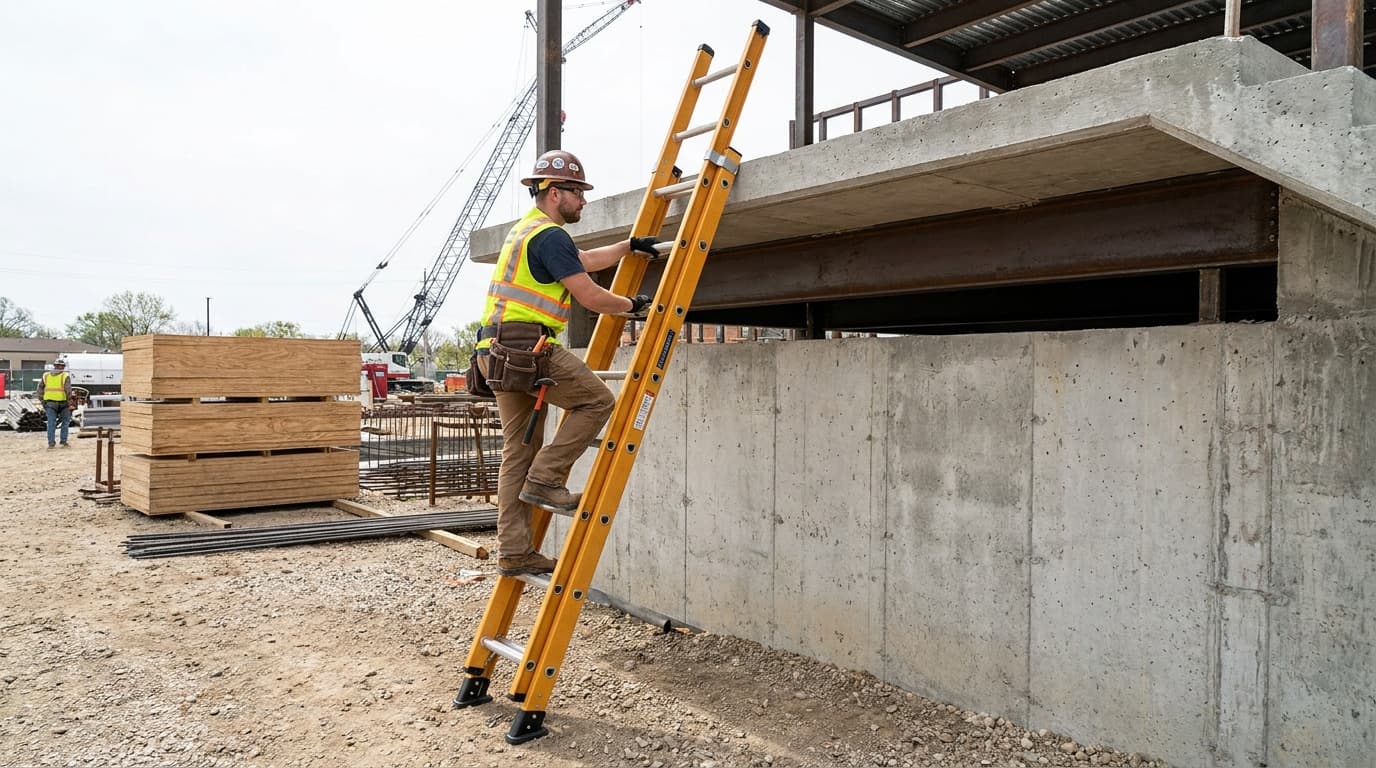
The transition at the top. A ladder that does not extend three feet above the landing leaves the worker nothing to hold while stepping off, which is where a large share of ladder falls occur.
Climbing errors that compound setup errors:
- Carrying tools or material in one hand while climbing, removing a point of contact
- Facing away from the ladder while descending
- Climbing with wet, muddy, or oily boots
- Standing on the top cap or top step of a stepladder
- Using a stepladder that has not been fully opened and locked, or leaning one against a wall as if it were an extension ladder
Equipment condition. Cracked or split rails, bent or missing rungs, damaged feet, loose rivets, and worn locks get overlooked because a damaged ladder still works right up until it does not. Painted wooden ladders hide defects beneath the paint.
Electrical contact. A conductive ladder near a live conductor or an overhead line is an electrocution risk, not just a fall risk. This is the failure mode that kills rather than injures.
Misuse patterns. Makeshift ladders, ladders used as work platforms or walk boards, ladders overloaded past their duty rating, two workers on a single-person ladder, and ladders set up in doorways or traffic paths without barricades.
How do we prevent ladder falls?#
Ask whether a ladder is the right tool at all. For extended work at height, a scaffold, mobile elevating work platform, or rolling tower is safer because it provides a working surface rather than a climbing surface. Ladders are for access and short-duration tasks. If the job needs both hands, sustained effort, or heavy material, it probably should not be done from a ladder.
Inspect before every use. Rails, rungs, feet, spreaders, locks, and labels. Look for cracks, splits, bends, corrosion, missing components, and slippery contamination. Anything defective is tagged "Do Not Use" and removed from service per 1926.1053(b)(15) — not leaned back against the wall for the next person.
Select the right ladder. Correct duty rating for the worker plus tools and material. Correct length so it can be set at the proper angle and still extend three feet above the landing. Non-conductive fiberglass for any work near electrical hazards.
Set it up properly:
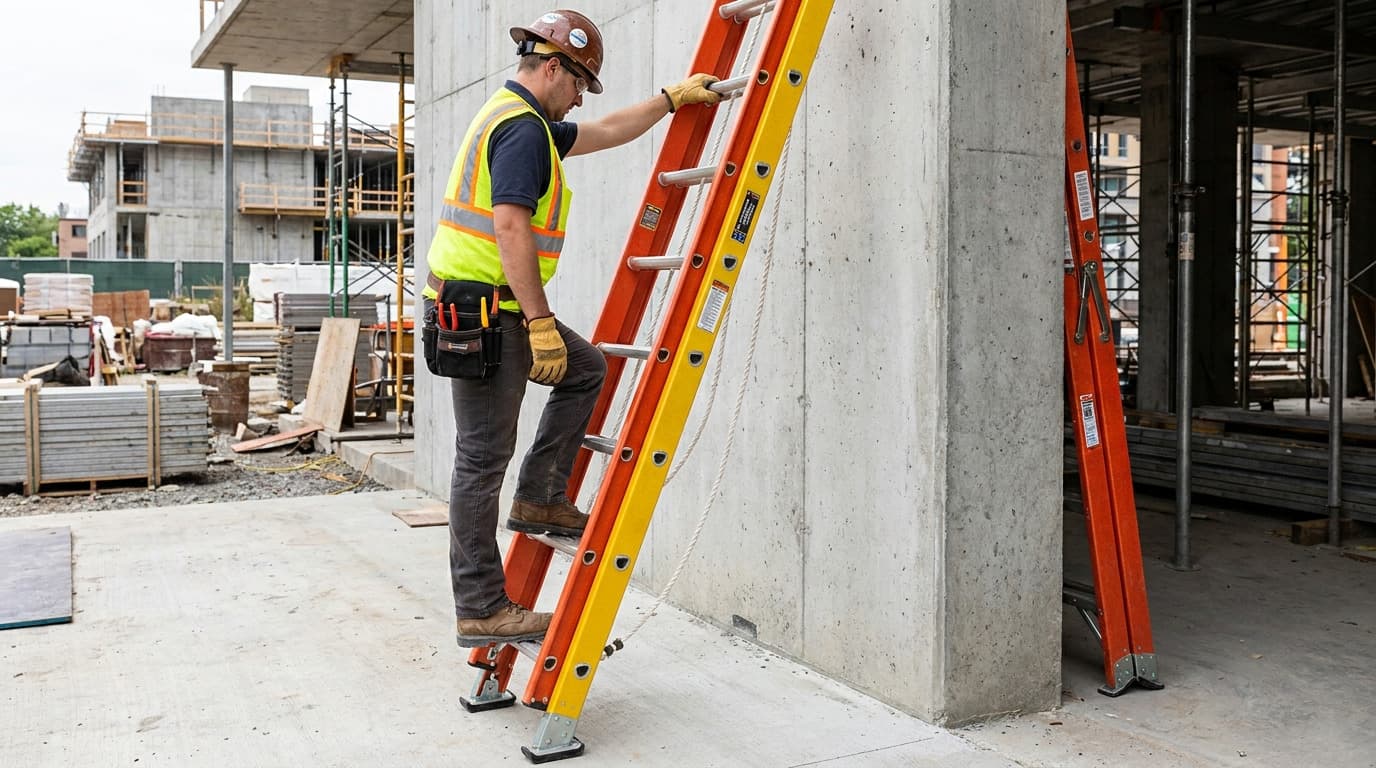
- 4:1 angle — base one foot out for every four feet of working height
- Level, firm footing on both feet; use leg levelers on uneven ground rather than blocking one foot with scrap
- Secure the top, or have someone hold the base until it is secured
- Extend three feet above the landing, or secure the top and provide a grab rail
- Fully open and lock a stepladder before it takes any weight
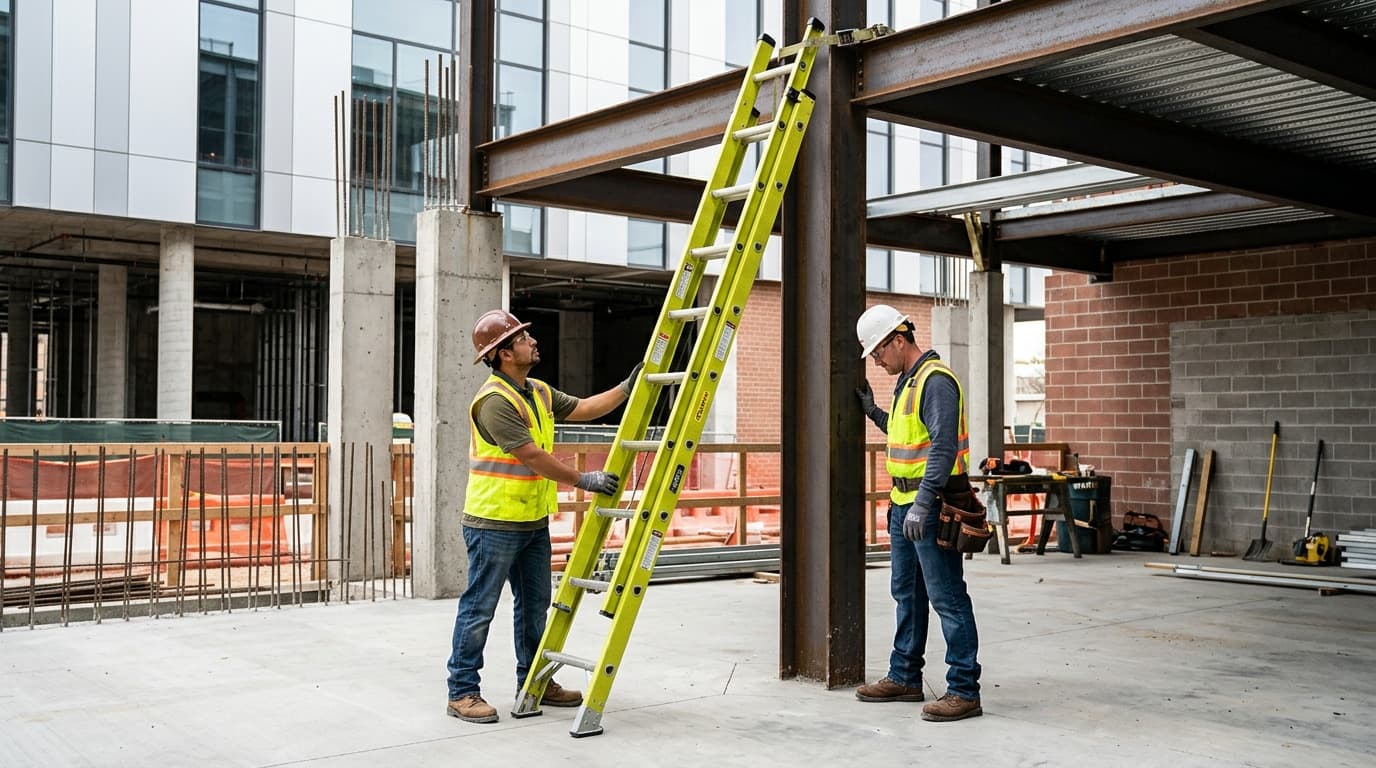
Control the area around it. Never set a ladder in a doorway, traffic path, or in front of a door that opens toward it without barricading and signage.
Maintain three points of contact at all times. Two hands and a foot, or two feet and a hand. Tools and material go up in a bag, on a belt, or by rope — not in your hand. Face the ladder going both up and down.
Stay within the rails. Move the ladder rather than reaching for the last bit. Overreaching is the most common cause of the sideways tip, and it is entirely a matter of deciding that repositioning is not worth the time.
Respect the top limits. Never stand on the top cap or top step of a stepladder, and never on the top three rungs of an extension ladder unless the manufacturer specifically permits it.
Before you start#
- Ask whether a scaffold or lift would be safer for this task than a ladder.
- Inspect the ladder fully: rails, rungs, feet, locks, spreaders, and labels.
- Confirm the duty rating covers you plus your tools and material.
- Check that the ladder is long enough to set at 4:1 and still extend three feet above the landing.
- Confirm the footing is level and firm under both feet, and use levelers rather than blocking.
- Secure the top before climbing, or have someone hold the base until you can.
- Confirm the ladder is not in a doorway or traffic path, and barricade if necessary.
- Plan how tools and material get up there without occupying your hands.
- If there is any electrical exposure nearby, confirm you have a non-conductive ladder and adequate clearance.
Talk it over#
- Look at the ladder set up over there. Is that angle right, and how would you check it without measuring?
- What are you carrying up the ladder today, and how does that work with three points of contact?
- When was the last time any of us actually inspected a ladder before climbing it, rather than just looking at it?
The bottom line#
Ladders are OSHA's third most cited standard because the failures are all four-second setup decisions made by experienced people. Ask whether a scaffold or lift is the better tool. Then inspect before every use, set the 4:1 angle on firm level footing, secure the top, extend three feet above the landing, keep three points of contact, and never reach past the rails. The routine climb is the one that gets people, precisely because it never feels like it deserves the attention.
Frequently asked questions about ladder safety#
What is the 4:1 rule for ladders?
Under 29 CFR 1926.1053(b)(5)(i), a non-self-supporting ladder must be set so the horizontal distance from the top support to the base is about one-quarter of the working length — one foot out for every four feet of height, roughly a 75-degree angle. A quick field check: stand with your toes at the ladder's feet and extend your arms straight forward; your palms should reach the rung at shoulder height.
How far must a ladder extend above a landing?
At least 3 feet, under 29 CFR 1926.1053(b)(1). Where the ladder's length makes that impossible, it must be secured at the top to a rigid support and a grasping device such as a grab rail provided. This is one of the most frequently cited ladder violations, and the fix usually costs nothing.
How many citations do ladders receive?
Ladders (1926.1053) ranked third on OSHA's Top 10 for Fiscal Year 2025, with 2,405 citations (National Safety Council, preliminary data). The most common violations are failure to extend three feet above the landing, improper setup angle, and failure to secure the ladder against displacement.
Can I stand on the top step of a stepladder?
No. 29 CFR 1926.1053(b)(13) prohibits using the top or top step of a stepladder as a step. Doing so raises your centre of gravity above the ladder's stable base. If you need that height, you need a taller ladder or a different means of access.
What does three-point contact mean?
Maintaining two hands and one foot, or two feet and one hand, in contact with the ladder at all times. Under 29 CFR 1926.1053(b)(21) and (b)(22), employees must face the ladder when climbing, keep at least one hand grasping it, and must not carry anything that could cause loss of balance. Tools go up in a bag, on a belt, or by rope.
Can I use a metal ladder near electrical equipment?
No. 29 CFR 1926.1053(b)(12) prohibits ladders with conductive side rails where the employee or ladder could contact exposed energized electrical equipment. Use non-conductive fiberglass, maintain minimum approach distances, and treat every overhead line as energized.
Download the ladder safety toolbox talk PDF#
Get this ladder safety toolbox talk as a print-ready PDF — available in English, Spanish, Portuguese, and Turkish. Print it, hand it to the crew, and collect signatures on the included attendance sheet.
Download the PDF — free account required. New members get 3 free downloads.
Related toolbox talks#
Sources#
- OSHA, 29 CFR 1926.1053 — Ladders: https://www.osha.gov/laws-regs/regulations/standardnumber/1926/1926.1053
- OSHA, Top 10 Most Frequently Cited Standards: https://www.osha.gov/top10citedstandards
- National Safety Council, OSHA's Top 10 FY2025 preliminary: https://www.safetyandhealthmagazine.com/27597-the-most-frequently-cited-standards-in-fy-2025/
- Bureau of Labor Statistics, Census of Fatal Occupational Injuries: https://www.bls.gov/iif/