Blind Spots
Updated 2026-08-06
In this bundle Vehicle Safety
Print-ready PDF
Download this talk as a print-ready PDF, available in 4 languages.
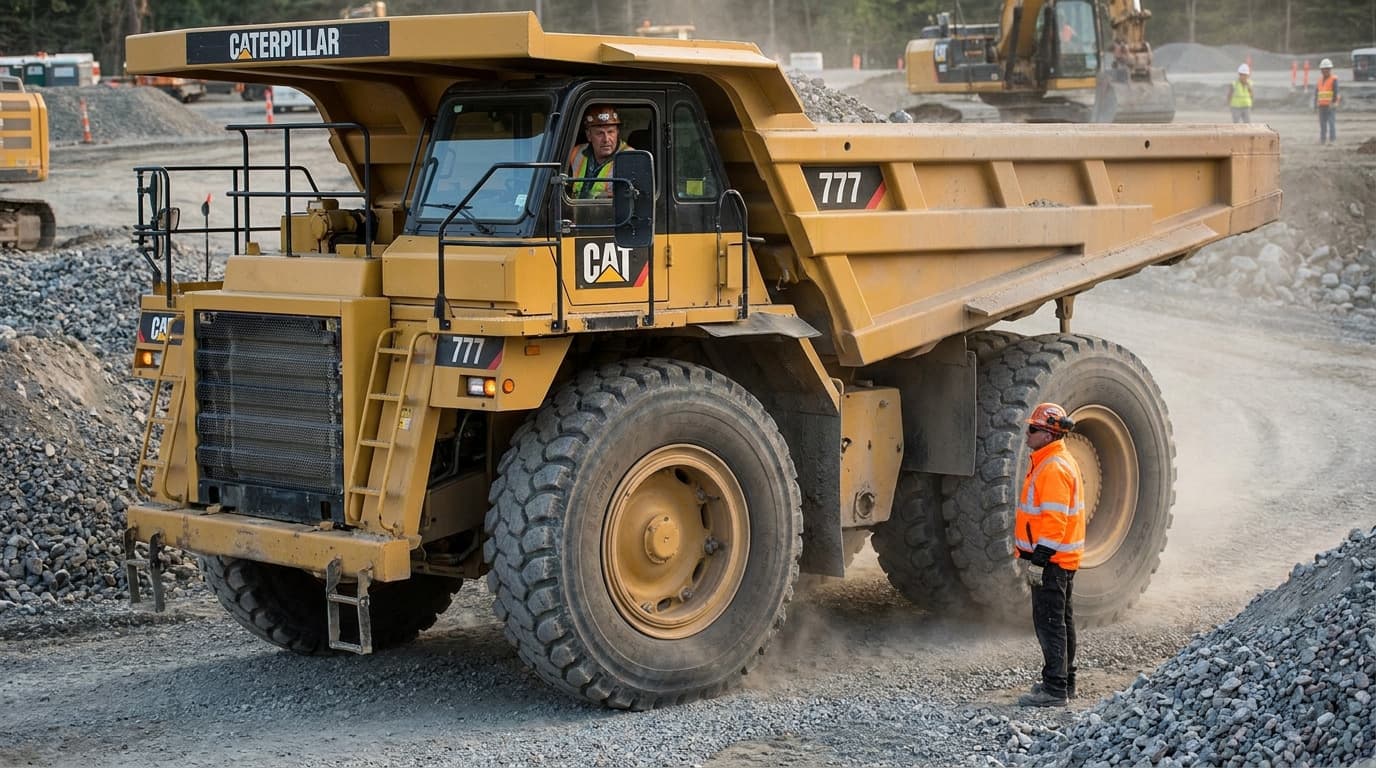
Stand behind a loaded dump truck or beside an excavator and you can see the machine perfectly — every bolt, the cab, the operator's mirror. It is easy to believe that because you can see them, they can see you. That belief is exactly what gets people run over. This blind spots talk is about why the operator's view is nothing like yours, why the blind spot belongs to the machine and not to your alertness, and why the real fix is designing the site so you and the equipment never need to share the same ground.
Here is the distinction that carries this whole talk: being able to see the operator does not mean the operator can see you — the blind spot belongs to the machine, not to your awareness, so you cannot fix it by watching more carefully. A blind spot is the area around a vehicle or piece of equipment that the operator simply cannot see, by direct line of sight or by mirrors. It exists because of how the machine is built — the cab height, the engine hood, the load, the attachments — not because the operator is careless. On a large dump truck, a person standing at the rear is completely invisible to the operator, and a person in front may need to be thirty feet away to be seen at all. You can be looking straight at the operator, doing everything right, and still be in a zone where you do not exist to them. That is why "just pay attention" is not the answer: the hazard is a property of the machine, and the only real protections are staying out of those zones and making sure the operator knows you are there before you enter them.
Where the boundary of this talk sits#
The struck-by talk owns being hit by objects and equipment in general. The heavy equipment talk owns operating the machine. This talk owns the blind spot specifically — the zones an operator cannot see, why seeing the machine is not being seen, and how to keep people on foot out of them. Its companion, the backing-up and spotters talk, owns the spotter's own safety and the backing operation. Where the question is operating the equipment, that is the heavy equipment talk; this one owns the worker on foot and the space around the machine.
A blind spot is a planning problem, not an attention problem#
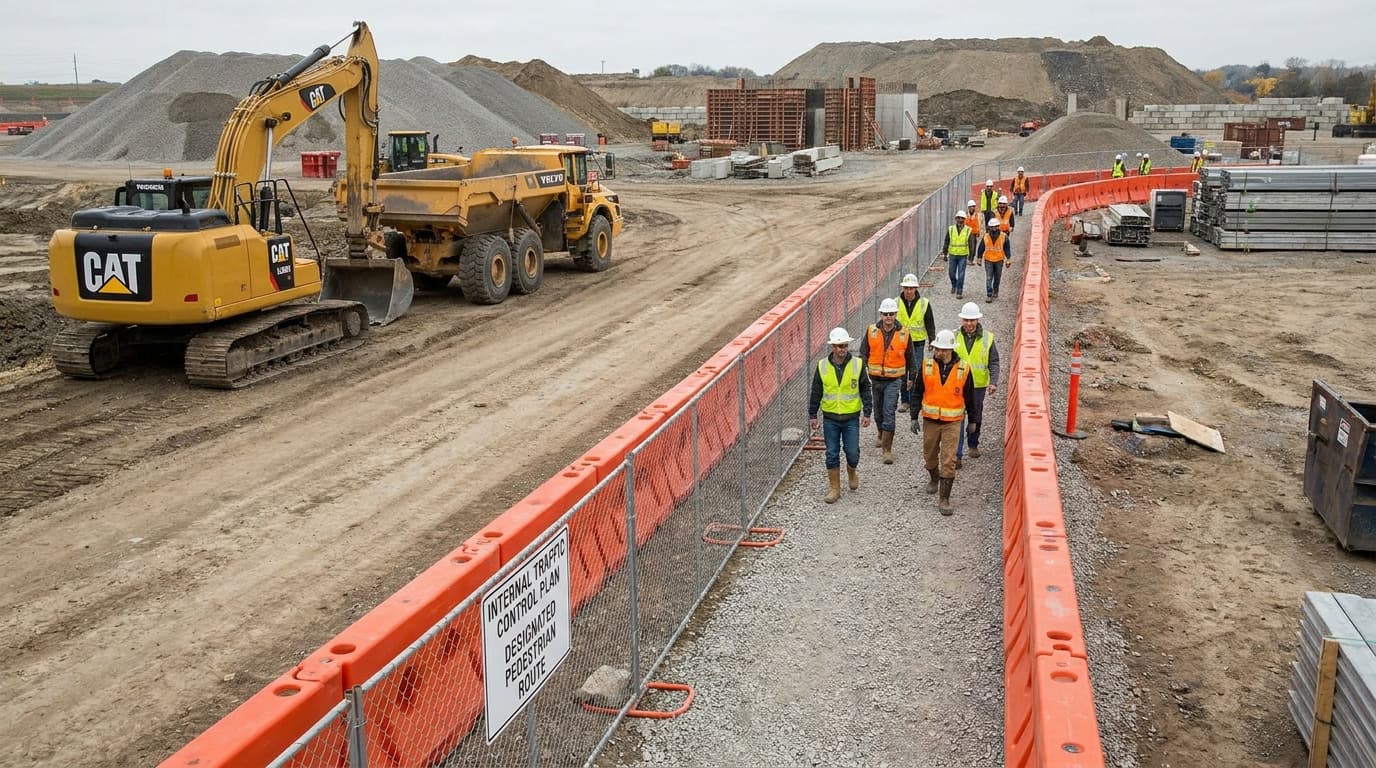
The most common mistake crews make is treating blind spots as something workers should solve by being more careful. NIOSH — the research arm behind much of this — frames it the opposite way, and the difference matters. The purpose of an Internal Traffic Control Plan (ITCP) is to separate vehicles and equipment from workers on foot as much as possible, so that the two do not need to occupy the same space in the first place. That is a design decision made before the shift, not a moment-to-moment judgment made by a tired worker next to a moving machine.
This is worth sitting with, because it changes what "doing something about blind spots" means. Telling everyone to watch out is an attention solution, and attention fails — people get focused on their task, alarms fade into background noise, and someone walks a familiar path without thinking. A planning solution designs the hazard out: map where the equipment moves and where people walk, keep those apart, set no-go zones around operating machines, route foot traffic away from vehicle paths, and put controls in place so that when the two must interact, it happens on purpose and with communication. NIOSH even distinguishes this from public traffic control — an ITCP is specifically about the construction vehicles and equipment operating inside the work zone, and the people working around them.
Why the backup alarm is not enough#
Every operable backup alarm helps, and OSHA requires them in specific conditions, but a crew that relies on the alarm alone is trusting a warning to do the job of a plan. A backup alarm is a warning, not a traffic plan. It can be drowned out by site noise — other equipment, generators, traffic — or masked by a worker's own hearing protection. It only addresses the rear; it does nothing about the side and front blind spots that are just as deadly. And when a site is full of equipment, alarms blur into a constant background beeping that stops registering as a specific warning. So the alarm is a backstop, not the control. The control is keeping people out of the blind spots to begin with.
What actually protects people on foot#
Since the blind spot cannot be fixed by watching harder, the protections are about separation and communication.
Know where the blind spots are. They differ by machine — a dump truck, an excavator, a loader, a dozer, a roller each have their own — and they are largest to the rear and along the sides. NIOSH publishes blind-area diagrams for common construction vehicles precisely so crews can see what the operator cannot; map them during pre-task planning for the equipment on your site.
Stay out of them, and out of no-go zones. The single most effective thing a worker on foot can do is not be in the blind spot in the first place. Give operating equipment a wide berth, respect the no-go zones around it, and take the routed foot path even when the direct line looks quicker — because the path that crosses a vehicle route is where people get hit.
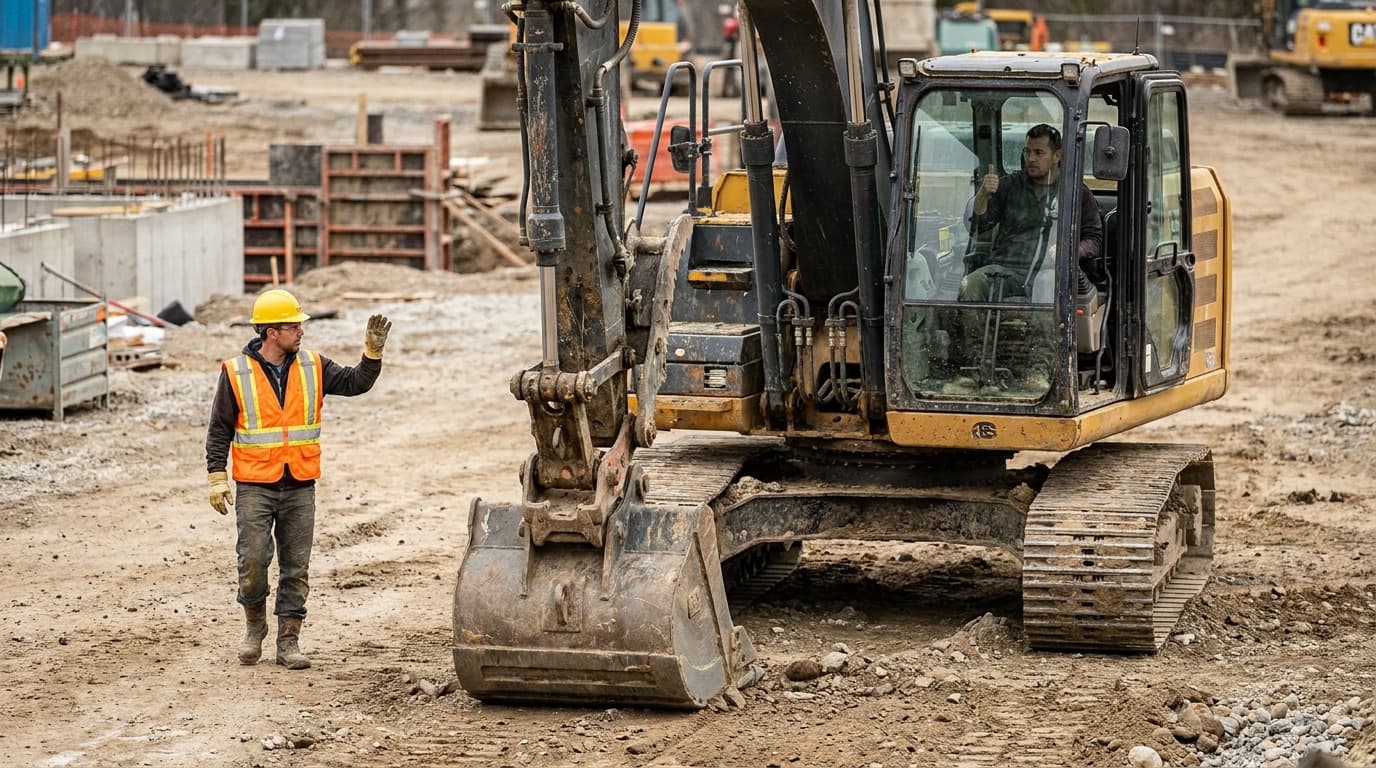
Never assume you have been seen. If you must approach a machine, make eye contact with the operator and get an acknowledgment — but do not rely on eye contact alone, because the operator may look away the instant you move. Agree on communication before anyone approaches: a signal, a radio call, a confirmed stop of the machine. The operator lowering the bucket to the ground and confirming they see you is worth more than any glance.
Use spotters where the conditions call for them, positioned where they can see both the operator and the hazard and stay out of the path themselves — which is the subject of the backing-up and spotters talk. And every worker has stop-work authority when visibility is unclear: if you cannot confirm the operator knows where you are, the machine stops until you can.
Where the duty sits#
Blind spots run on the motor-vehicle and equipment standards, with the struck-by hazard behind them. For motor vehicles, 1926.601(b)(4) states that no employer shall use motor vehicle equipment with an obstructed rear view unless the vehicle has a reverse signal alarm audible above the surrounding noise level, or is backed up only when an observer signals that it is safe. For material handling equipment, 1926.602(a)(9)(ii) carries the same rule for earthmoving and compacting equipment with an obstructed rear view, and 1926.602(a)(9)(i) requires bidirectional machines — rollers, compactors, front-end loaders, dozers — to have a horn distinguishable from the surrounding noise. Note what these require: an alarm or an observer, precisely because the operator cannot see. Behind them, 1926.21(b)(2) requires instruction, and the General Duty Clause, Section 5(a)(1) covers the recognized struck-by-by-vehicle hazard. The NIOSH Internal Traffic Control Plan and blind-area diagrams are guidance, not a standard, but they are how the planning duty gets met. On federal contract work, EM 385-1-1 carries traffic-control and equipment provisions. Where a site traffic plan sets specific requirements, those govern.
What can go wrong?#
- A worker assumes that because they can see the machine, the operator can see them.
- Someone stands or walks in the rear or side blind spot of a backing truck or excavator.
- A crew treats blind spots as a "watch out" problem instead of planning separation.
- A backup alarm is drowned out by site noise or masked by hearing protection.
- People rely on the rear alarm while the side and front blind spots go unaddressed.
- A worker takes a direct path across a vehicle route because it looks quicker.
- Eye contact is assumed but the operator looks away the instant the worker moves.
- No internal traffic control plan exists, so foot and vehicle paths cross everywhere.
How do we manage this properly?#
- Treat the blind spot as the machine's, not your awareness — you cannot watch your way out of it.
- Plan separation of people on foot and equipment; use an internal traffic control plan.
- Set no-go zones around operating machines and route foot traffic away from vehicle paths.
- Know each machine's blind spots (NIOSH blind-area diagrams), largest to the rear and sides.
- Treat the backup alarm as a backstop, not the control — it misses side and front, and fades in noise.
- Never assume you were seen; get acknowledgment and agree communication before approaching.
- Use spotters where needed, positioned to see operator and hazard and stay out of the path.
- Everyone has stop-work authority when visibility is unclear.
Before you start#
- Confirm the crew knows that seeing the machine is not the same as being seen.
- Confirm the blind spots of the equipment on site are identified and understood.
- Confirm an internal traffic control plan separates foot and vehicle routes.
- Confirm no-go zones around operating equipment are set and known.
- Confirm required reverse alarms and horns are operable and audible above the noise.
- Confirm the communication method for approaching a machine is agreed.
- Confirm spotters are assigned where conditions call for them.
- On federal work, confirm the EM 385-1-1 traffic-control provisions apply.
Talk it over#
- Which machine on this site has the blind spot you're most likely to end up in?
- What's our routed foot path here, and where does it cross a vehicle route?
- How do you confirm an operator actually sees you before you approach?
- If you couldn't tell whether the operator knew where you were, what would you do?
The bottom line#
Being able to see the operator does not mean the operator can see you — the blind spot belongs to the machine, not to your awareness, so you cannot fix it by watching more carefully. A blind spot is a zone the operator cannot see because of how the machine is built; on a large truck the rear is invisible and the front may need thirty feet of clearance to see a person, so you can be looking right at the operator and still not exist to them. That is why the real fix is a planning problem, not an attention problem: an internal traffic control plan separates people on foot from equipment so they do not share ground, backed by no-go zones, routed foot paths, and confirmed communication before anyone approaches. The backup alarm is a backstop, not the control — it misses the side and front, gets drowned in site noise, and does nothing a plan should do. Know each machine's blind spots (NIOSH blind-area diagrams), stay out of them, never assume you were seen, use spotters where conditions call for them, and remember everyone has stop-work authority when visibility is unclear. The duty runs through the reverse-alarm-or-observer rules (1926.601(b)(4), 1926.602(a)(9)) and the General Duty Clause 5(a)(1), with the NIOSH ITCP as the planning tool. The test for any worker on foot is one question: does the operator know exactly where I am right now — or am I trusting that they can see me?
Frequently asked questions about blind spots#
What exactly is a blind spot?
It is the area around a vehicle or piece of construction equipment that the operator cannot see, either by direct line of sight or through mirrors. It exists because of how the machine is built — the cab, the hood, the load, the attachments — not because the operator is inattentive. Blind spots are largest to the rear and along the sides, and they differ from machine to machine. On a large dump truck, someone at the rear is completely invisible to the operator, and someone in front may need to be about thirty feet away before they can be seen.
If I can see the operator, can't they see me?
No, and that assumption is one of the most dangerous on a jobsite. Seeing the machine tells you nothing about whether the operator can see you, because the operator's view is shaped by the machine's design, not by where you happen to be looking. You can be staring straight at the cab and still be standing in a zone where you are invisible to the person inside it. Never assume you have been seen — confirm it, and agree on communication before you approach.
Isn't the backup alarm enough to keep me safe?
No. A backup alarm is a warning, not a traffic plan. It can be drowned out by site noise or masked by your own hearing protection, it only addresses the rear, and it does nothing about the side and front blind spots that are just as dangerous. On a busy site, constant alarms also blur into background noise that stops registering. The alarm is a useful backstop, but the real protection is keeping people on foot out of the blind spots and separating foot and vehicle traffic by design.
What is an internal traffic control plan?
It is a plan that separates construction vehicles and equipment from workers on foot inside the work zone, so the two do not have to share the same space. NIOSH developed the concept, and it is distinct from public traffic control, which manages the public moving through a work zone. An ITCP maps where equipment operates and where people walk, sets no-go zones and routed paths, minimizes backing, and defines how communication happens when foot and vehicle traffic must interact. It is a planning tool, and it is the strongest control for blind-spot hazards.
What does OSHA require for blind spots and backing?
For motor vehicles, 1926.601(b)(4) prohibits using equipment with an obstructed rear view unless it has a reverse signal alarm audible above the surrounding noise, or it is backed up only when an observer signals that it is safe. For material handling equipment, 1926.602(a)(9)(ii) carries the same rule for earthmoving and compacting equipment, and 1926.602(a)(9)(i) requires bidirectional machines to have a horn distinguishable from the noise. The rule is an alarm or an observer — because the operator cannot see. The General Duty Clause covers the broader struck-by hazard.
How should I approach a machine that's operating?
Do not, unless you have to — and when you must, treat it as a deliberate, communicated action. Get the operator's attention and confirm they see you, but do not rely on eye contact alone, because they can look away the instant you move. Agree on a signal or radio call first, and the safest approach is to have the operator bring the machine to a stop and set the bucket or attachment down before you enter the area. If you cannot confirm the operator knows where you are, use your stop-work authority and wait until you can.
Download the blind spots toolbox talk PDF#
Get this blind spots toolbox talk as a print-ready PDF — available in English, Spanish, Portuguese, and Turkish. Print it, hand it to the crew, and collect signatures on the included attendance sheet.
Download the PDF — free account required. New members get 3 free downloads.
Related toolbox talks#
Sources#
- OSHA, Motor Vehicles — 1926.601 (reverse signal alarm audible above surrounding noise, or an observer signals it is safe): https://www.osha.gov/laws-regs/regulations/standardnumber/1926/1926.601
- OSHA, Material Handling Equipment — 1926.602 (audible alarms; obstructed rear view; bidirectional horns): https://www.osha.gov/laws-regs/regulations/standardnumber/1926/1926.602
- NIOSH / CDC, Construction Equipment Visibility — Blind Area Diagrams and Internal Traffic Control (separate vehicles and equipment from workers on foot): https://www.cdc.gov/niosh/motor-vehicle/constructionequipmentvisibilitydiagram/index.html
This talk is general awareness guidance for training purposes. It does not replace your employer's traffic-control or equipment program, the OSHA motor-vehicle and material-handling standards, the OSH Act General Duty Clause, or a competent person's duties, and it is not legal advice. Where a site traffic plan or contract sets a stricter requirement, that requirement governs.