Proper Labeling of Chemicals
Updated 2026-07-28
In this bundle Jobsite Fundamentals & Compliance
Print-ready PDF
Download this talk as a print-ready PDF, available in 4 languages.
A label is the only piece of hazard information that travels with the chemical. The data sheet is somewhere else, the training was months ago, and the person holding the container may never have seen the product before. Everything the system does depends on that label being there, being right, and being understood. This proper labeling of chemicals talk is about what has to be on it and what may be left off.
Here is the distinction that carries this whole talk: a label is not a list of everything a chemical can do — it is a prioritised summary. The standard contains explicit rules that suppress information: where one signal word applies, the other is forbidden; where one pictogram applies, another must not appear. That is deliberate. A label showing every possible warning tells you nothing, because nothing on it stands out. Understanding what has been left off is as useful as reading what is there.
The six elements#
Under 1910.1200(f)(1) — applied to construction through 1926.59 — the chemical manufacturer, importer or distributor must ensure that each container of hazardous chemicals leaving the workplace is labelled, tagged or marked with:
- Product identifier — the name or number used on the label and matching the identifier in Section 1 of the safety data sheet
- Signal word
- Hazard statement(s) — what the chemical does
- Pictogram(s)
- Precautionary statement(s) — prevention, response, storage and disposal
- Name, US address and US telephone number of the chemical manufacturer, importer or other responsible party
Two facts about the pictograms are worth knowing. They are a black hazard symbol on a white background inside a red frame, in a square set at a point — a diamond. And OSHA designates eight, not the nine in the GHS, because the environmental hazard pictogram covers an area outside OSHA's jurisdiction.
There is no small-container exemption. OSHA has confirmed that small container labels must contain all the information in paragraph (f); size does not exempt anything. Where a container is genuinely too small and pull-out labels, fold-back labels or tags are not feasible, OSHA has allowed a practical accommodation — but the starting position is that everything must be there.
The precedence rules nobody teaches#
This is the part of Appendix C that almost no site training covers, and it is what stops labels becoming noise.
If the signal word "Danger" is included, the signal word "Warning" shall not appear. There is only ever one signal word on a label, no matter how many hazards the chemical has. Danger is used for the more severe hazards within a hazard class, Warning for the less severe. If a product warrants both, only Danger appears.
The pictograms work the same way:
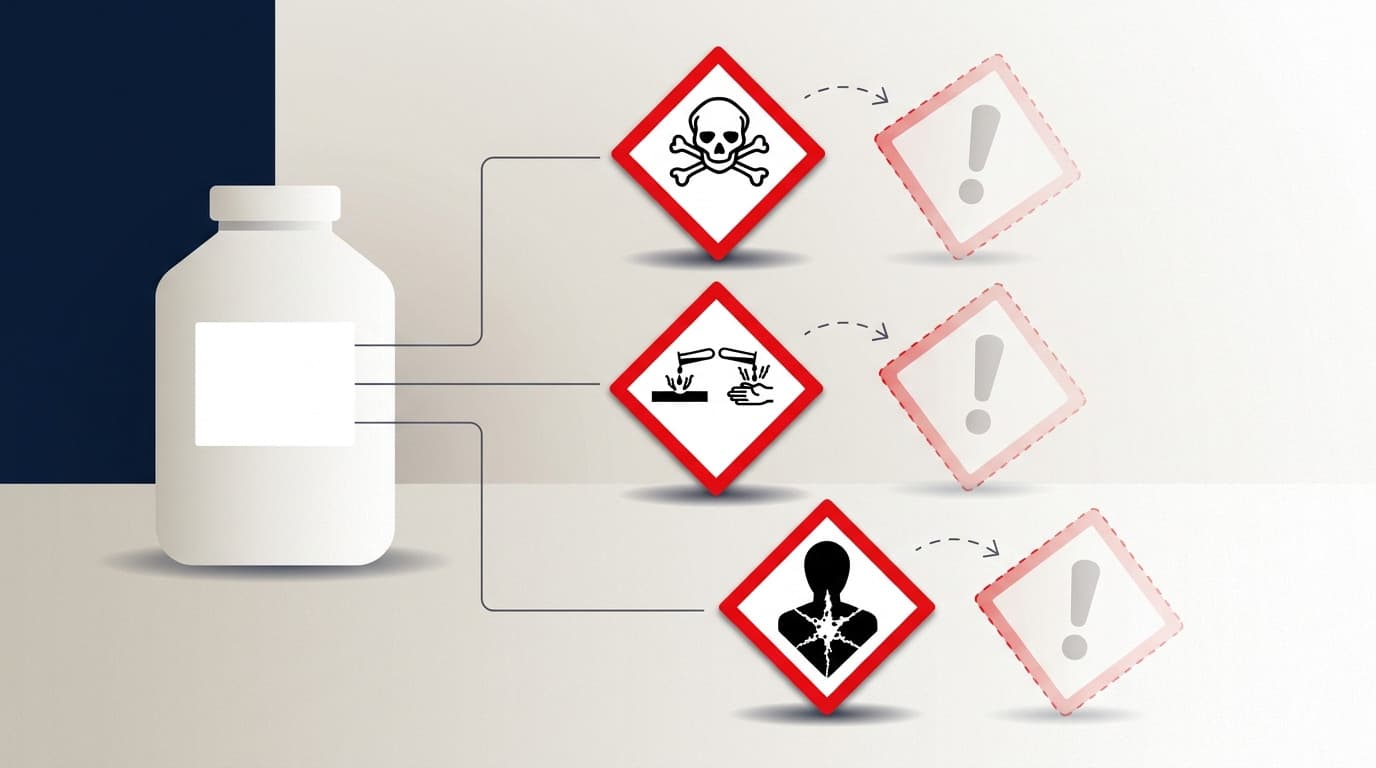
- If the skull and crossbones is included, the exclamation mark shall not appear where it is used for acute toxicity
- If the corrosive pictogram is included, the exclamation mark shall not appear where it is used for skin or eye irritation
- If the health hazard pictogram is included for respiratory sensitisation, the exclamation mark shall not appear where it is used for skin sensitisation or for skin or eye irritation
The logic is consistent: the more serious symbol suppresses the milder one for the same hazard. So the practical reading rule is the opposite of what people assume — the absence of an exclamation mark does not mean the product is mild. It may mean something worse is already displayed.
Labels inside your own workplace#
1910.1200(f)(6) treats workplace containers differently from shipped ones. The employer has two options.
The standard system: the same elements as a shipped label, minus the supplier contact details — so product identifier, signal word, hazard statement(s), pictogram(s) and precautionary statement(s).
An alternative system: the product identifier plus words, pictures, symbols or a combination conveying general information on the hazards. This is what permits in-house systems, provided the information reaches the employee. Where an alternative rating system is used, hazards it does not address — chronic health hazards, for example — must still be communicated by words, pictures or symbols in addition to the rating.
Either way, the information must be immediately available to employees throughout each work shift.
Two further rules that catch people out. The employer shall not remove or deface existing labels on incoming containers unless the container is immediately marked with the required information. And for bulk shipments, the label may be on the immediate container, transmitted with the shipping papers or bills of lading, or — by agreement with the receiving entity — transmitted electronically so that it is immediately available in printed form on receipt.
The immediate use exemption, in full#
The most misused provision in HazCom. A portable container does not need a label only where all of the following are true:
The chemical is transferred from a labelled container, and
it is under the control of and used only by the person who performs the transfer, and
it is used only within the work shift in which it was transferred.
Three conditions, all of them. Hand the container to someone else and the exemption is gone. Leave it on the bench overnight and the exemption is gone. Fill six sprayers for the crew and the exemption never applied. That is why the unlabelled decanted bottle is one of the most reliable HazCom citations there is — the exemption people rely on almost never actually covers what they are doing.
What can go wrong?#
Decanted product left overnight or handed to someone else, with no label.
A sprayer filled for the crew, which is outside the exemption from the moment it is passed on.
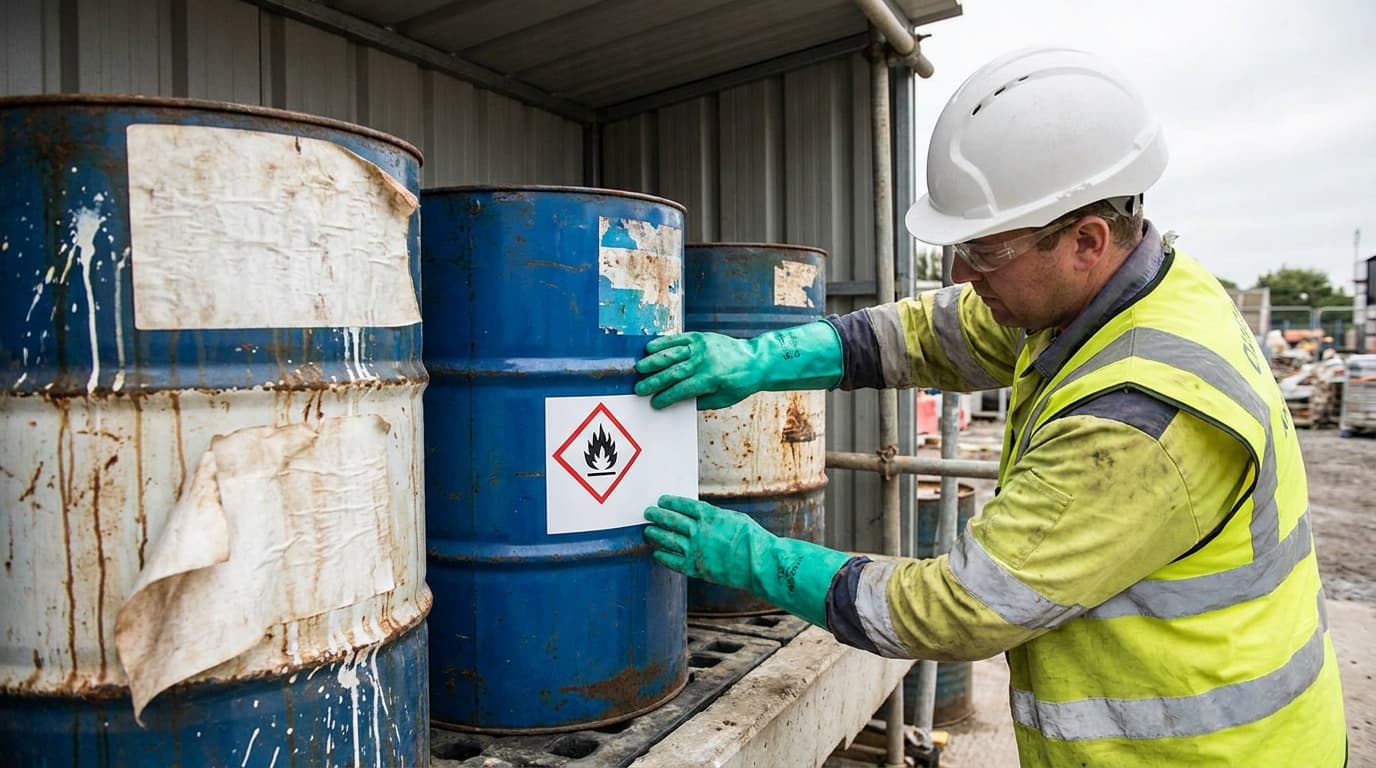
Labels removed or covered — overpainted, taped over, or peeled off during storage — with nothing put in their place.
Faded or unreadable labels on containers stored outdoors.

A workplace rating system used alone, with chronic health hazards it does not cover left uncommunicated.
The product identifier does not match the data sheet, so the sheet cannot be found.
Nobody knows what the absence of a pictogram means, and treats a two-symbol label as milder than a three-symbol one.
Bulk deliveries with no label at the point of receipt, where nobody knows the information came with the paperwork.
How do we label properly?#
Label at the moment of transfer, not later. A marker and a blank label at the decanting point costs nothing.
Use the product identifier that appears on the data sheet, so the two can be connected.
Never remove or deface a supplier label unless the container is immediately marked with the required information.
Check the immediate use test honestly — transferred by you, used only by you, used within this shift. If any part fails, label it.
Read the signal word first. One word tells you the severity band the manufacturer assigned.
Read pictograms for what they suppress, not just what they show.
Replace weathered labels rather than working from memory of what a container used to hold.
Make workplace labels legible to the people reading them — including language, on a multilingual site.
Before you start#
- Confirm every container you will use is labelled, including any you fill yourself.
- Confirm the product identifier matches the safety data sheet you would look up.
- Confirm anything you decant will stay with you and be used this shift — or label it.
- Confirm no supplier label has been removed, covered or made unreadable.
- Confirm the signal word and what it tells you about severity.
- Confirm the pictograms, and consider what may have been suppressed.
- Confirm workplace labels are readable by everyone who will handle the container.
- Confirm bulk deliveries arrived with their label information, however transmitted.
Talk it over#
- Is there an unlabelled container within sight of you right now?
- If you filled that sprayer and went to lunch, would the exemption still apply?
- What does the signal word on your most-used product say — Danger or Warning?
- Could the newest person on the crew read and understand the labels here?
The bottom line#
1910.1200(f)(1) requires six elements on a shipped container: product identifier, signal word, hazard statement(s), pictogram(s), precautionary statement(s), and the name, US address and US telephone number of the responsible party — with pictograms shown as a black symbol on white inside a red frame, and eight designated by OSHA rather than the GHS's nine. There is no small-container exemption. Appendix C then suppresses information deliberately: if "Danger" is included, "Warning" shall not appear, and the skull and crossbones, corrosive and health hazard pictograms each displace the exclamation mark for the same hazard — so a shorter label is not a milder product. Workplace containers under (f)(6) may carry the shipped elements minus supplier contact details, or an alternative system of product identifier plus words, pictures or symbols, with the information immediately available throughout each work shift. And the immediate use exemption requires all three conditions: transferred from a labelled container, under the control of and used only by the person who transferred it, and used only within that work shift.
Frequently asked questions about chemical labelling#
What must be on a chemical label?
Six elements under 1910.1200(f)(1): product identifier, signal word, hazard statement(s), pictogram(s), precautionary statement(s), and the name, US address and US telephone number of the chemical manufacturer, importer or other responsible party.
Can a label have both "Danger" and "Warning"?
No. There is only ever one signal word on a label, however many hazards a chemical has. Appendix C states that if the signal word "Danger" is included, the signal word "Warning" shall not appear. Danger is used for the more severe hazards within a hazard class and Warning for the less severe.
Why do some labels have fewer pictograms than expected?
Because Appendix C suppresses milder symbols. If the skull and crossbones appears, the exclamation mark must not appear where it is used for acute toxicity; if the corrosive pictogram appears, the exclamation mark must not appear for skin or eye irritation; and if the health hazard pictogram appears for respiratory sensitisation, the exclamation mark must not appear for skin sensitisation or skin or eye irritation. Fewer symbols can mean a more serious hazard, not a milder one.
When can a container go unlabelled?
Only under the immediate use exemption, and only when all three conditions hold: the chemical was transferred from a labelled container; it is under the control of and used only by the person who performed the transfer; and it is used only within the work shift in which it was transferred. Handing it over, or leaving it beyond the shift, ends the exemption.
What can a workplace label leave off?
Under 1910.1200(f)(6) an in-house label may use the shipped-container elements minus the supplier contact details, or an alternative system consisting of the product identifier plus words, pictures, symbols or a combination conveying general hazard information. The information must be immediately available to employees throughout each work shift.
Are small containers exempt?
No. OSHA has confirmed that small container labels must contain all the information required by paragraph (f), and that there are no exemptions from labelling due to the size of the container. Where a container is genuinely too small and pull-out labels, fold-back labels or tags are not feasible, OSHA has allowed a practical accommodation — but the requirement is the starting point.
Can we remove a supplier's label?
Not unless the container is immediately marked with the required information. The standard provides that the employer shall not remove or deface existing labels on incoming containers of hazardous chemicals unless that is done — so a stripped or overpainted drum with nothing in its place is a straightforward violation.
Download the chemical labelling toolbox talk PDF#
Get this chemical labelling toolbox talk as a print-ready PDF — available in English, Spanish, Portuguese, and Turkish. Print it, hand it to the crew, and collect signatures on the included attendance sheet.
Download the PDF — free account required. New members get 3 free downloads.
Related toolbox talks#
Sources#
- OSHA, 29 CFR 1910.1200 — Hazard Communication: https://www.osha.gov/laws-regs/regulations/standardnumber/1910/1910.1200
- OSHA, 29 CFR 1910.1200 App C — Allocation of Label Elements (Mandatory): https://www.osha.gov/laws-regs/regulations/standardnumber/1910/1910.1200AppC
- OSHA, Letter of Interpretation, 23 March 2017 — Labeling small containers: https://www.osha.gov/laws-regs/standardinterpretations/2017-03-23