Lockout / Tagout (LOTO)
Updated 2026-07-24
In this bundle Electrical Safety
Working in California? See the Cal/OSHA edition → California (Cal/OSHA)
Print-ready PDF
Download this talk as a print-ready PDF, available in 4 languages.
Open 29 CFR 1926.417, the standard behind every lockout / tagout (LOTO) programme in construction. It is titled Lockout and tagging of circuits, and it is three short paragraphs — under a hundred words in total. Read the requirements themselves and you will notice something: the word "lock" never appears. Not once. The standard that everyone on this site calls "lockout" does not, in its operative text, require a lock. This lockout / tagout talk is about what it does require, and about why that gap is a reason to be more careful rather than less.
Here is the distinction that carries this whole talk: on most topics, the regulation is stricter than what crews do, and the job is to close that gap. Here it is the other way round. The construction standard is thinner than good practice, which means the discipline cannot come from fear of a citation. It has to come from the crew.
Three paragraphs, in full#
The whole of 1926.417 reads:
(a) Controls. Controls that are to be deactivated during the course of work on energized or deenergized equipment or circuits shall be tagged.
(b) Equipment and circuits. Equipment or circuits that are deenergized shall be rendered inoperative and shall have tags attached at all points where such equipment or circuits can be energized.
(c) Tags. Tags shall be placed to identify plainly the equipment or circuits being worked on.
That is it. And OSHA has confirmed the reading: in a letter of interpretation the agency noted it had previously indicated that positive lockout is not the only means of complying with §1926.417.
So why does every competent site still lock? Because of the two words in (b) doing the actual work: rendered inoperative.
"Rendered inoperative" is the real requirement#
A tag is a piece of card. It communicates; it does not prevent. Under (b), a de-energised circuit must be rendered inoperative — placed in a condition where it cannot be energised — and tagged at every point where it could be brought back.
A lock is simply the most reliable way to achieve that on a breaker or a disconnect. Other means exist: removing a fuse, disconnecting and isolating the conductors, removing the operating handle, blanking a line. What does not satisfy it is a tag hung on a breaker that anyone can still switch on. That arrangement satisfies the tagging half of (b) and fails the half that keeps a person alive.
Two more details in the text that get missed:
- "at all points where such equipment or circuits can be energized" — plural, and deliberately so. One breaker is rarely the whole story. Backfeed from a generator, a second supply, a UPS, a photovoltaic array, or a temporary tie can re-energise a circuit that was correctly isolated at its main.
- (c) "identify plainly" — a tag with no name, no date, and no description identifies nothing. The person who needs to read it is a stranger on another shift deciding whether they can throw a breaker.
What construction does not have#
This is the part worth being straight about, because it explains why sites drift.
29 CFR 1910.147 — the Control of Hazardous Energy standard — does not apply to construction. OSHA has stated it directly: 1910.147 does not cover construction activities, and to the extent you are engaged in construction you must comply with the lockout and tagout provisions of Part 1926, such as 1926.417 and 1926.555(a)(7).
That matters because of what 1910.147 contains and 1926.417 does not:
- a written energy control programme
- equipment-specific written procedures
- periodic inspections of those procedures
- defined roles for authorised and affected employees
- specified training and retraining requirements
None of that is imposed on a construction site by 1926.417. Which means a construction employer running a proper LOTO programme is doing so because it works, not because a standard compels it — and a construction employer running no programme at all may still be technically compliant with a very thin rule while being one mistake from a fatality.
Other construction provisions fill part of the gap. 1926.702(j) requires that, for concrete and masonry equipment, no employee shall perform maintenance or repair activity where the inadvertent operation of the equipment could occur and cause injury, unless all potentially hazardous energy sources have been locked out and tagged. Note the wording there: locked out and tagged. 1926.555(a)(7) covers conveyors. Confined space entry under 1926.1206 treats isolation of energy as part of the permit.
On USACE and NAVFAC projects, EM 385-1-1 applies and is considerably more prescriptive on hazardous energy control than 1926.417 — closer to the general industry model.
Energy is not only electrical#
The word "circuits" in the title makes people think of breakers. The hazard on a construction site is broader, and every one of these has killed someone during maintenance:
- Electrical — mains, temporary supplies, generators, backfeed, capacitors holding charge.
- Gravity — a raised bucket, boom, bed, platform, or suspended load that descends when pressure bleeds off.
- Hydraulic and pneumatic — pressure trapped in lines and accumulators long after the machine is off.
- Mechanical — springs under tension or compression, flywheels, rotating masses still turning.
- Thermal — hot surfaces and fluids that do not cool when the power does.
- Chemical — lines that still contain product.
Stored energy is the one crews most often miss, because switching off feels like finishing. It is not. Blocking a raised component, bleeding pressure down, and letting rotation stop are separate steps from isolation.
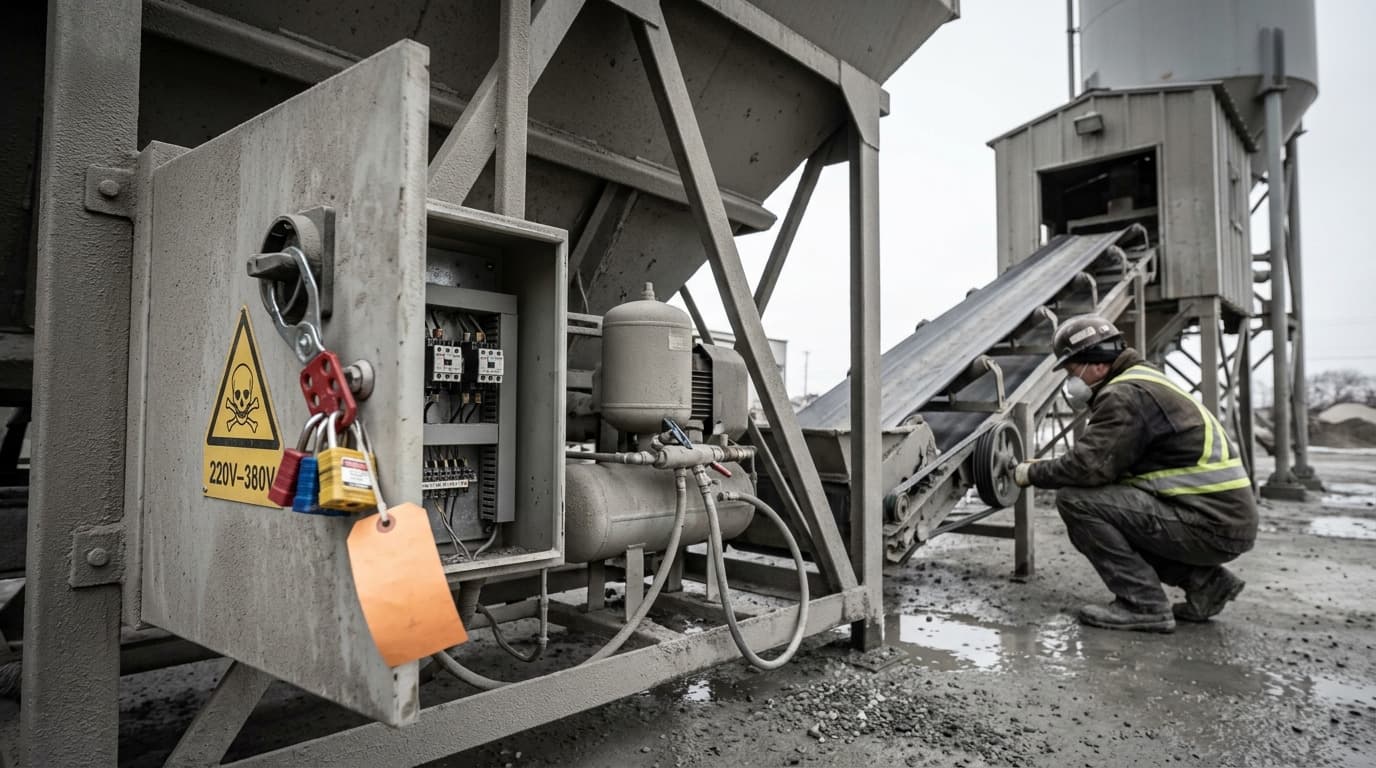
What can go wrong#
A tag with no lock on a breaker anyone can reach. Tagged, not rendered inoperative.
Only the main isolated. Backfeed from a generator, a second feed, or a temporary tie left live.
Somebody else's lock removed so the job can finish.
One lock for a crew of four. The person who applied it leaves; the others are working under an isolation they do not control.
Stored energy ignored. Bucket up, accumulator charged, spring compressed, flywheel still turning.
No test before touching. Isolation assumed rather than verified with a meter proved before and after.
Tags with no name or date, so nobody knows whose they are or whether the work finished last week.
Shift change with no handover. The incoming crew inherits an isolation nobody explained.
Subcontractor with a different system, or no system, working on the same equipment.
"It's only a five-minute job." The overwhelming majority of LOTO fatalities happen during short tasks.
Restoring power without checking who is still inside, under, or behind the equipment.
How do we do this properly?#
Lock it, even though 1926.417 does not say the word. A lock is the most reliable way to satisfy "rendered inoperative," and it is what every recognised programme expects.
One person, one lock, one key. Every individual working on the equipment applies their own personal lock. Group work needs a group lockbox, not a shared padlock.
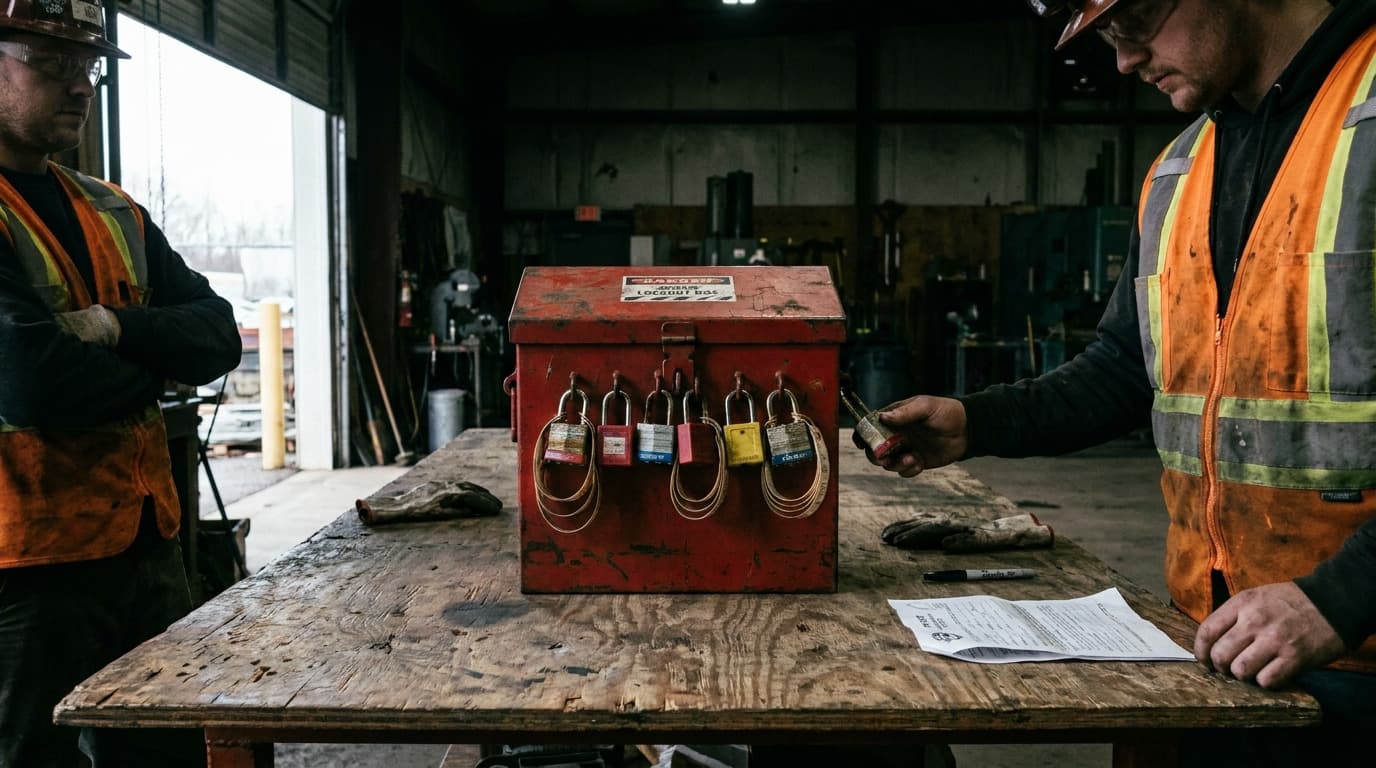
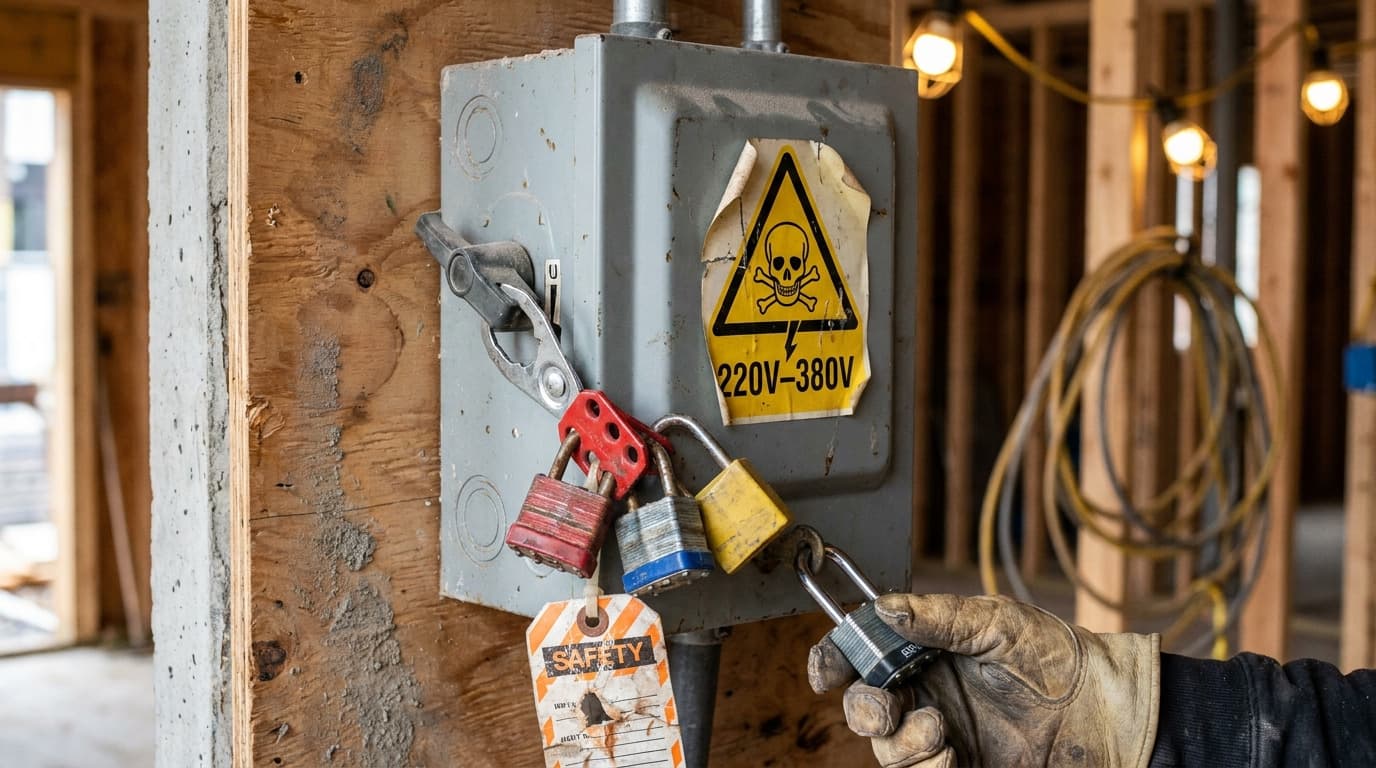
Isolate every source, not just the obvious one. Walk the circuit or the machine and ask what else could bring this back to life — generator, second feed, UPS, PV, stored pressure.
Dissipate stored energy before you start. Lower or block raised components, bleed hydraulic and pneumatic pressure, allow rotation to stop, allow surfaces to cool.
Test dead. Prove the meter on a known live source, test the conductors, prove the meter again. Live-dead-live, every time.
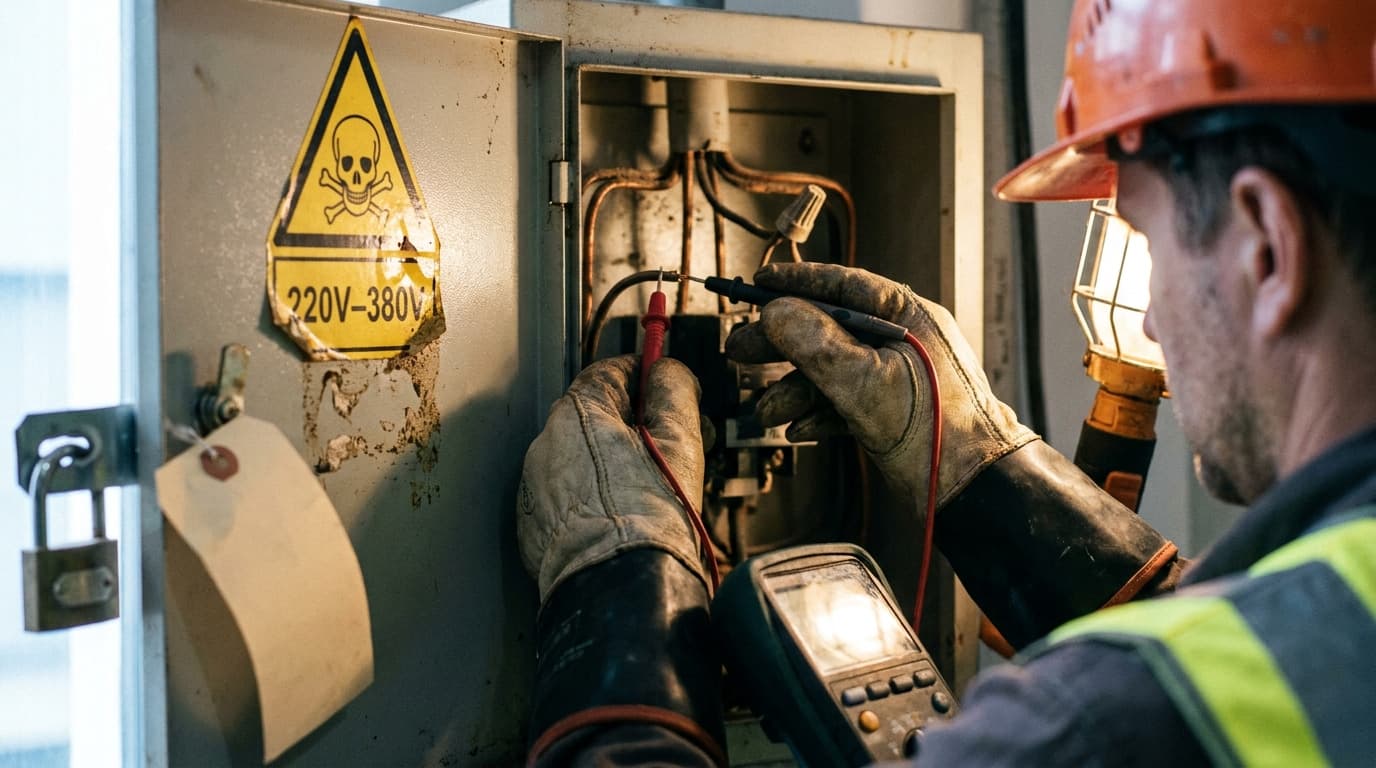
Tag so a stranger understands it — name, date, and what is being worked on, per (c)'s "identify plainly."
Never remove another person's lock. If it genuinely must come off, that is a documented management process with attempts to contact the owner, not a decision made at the panel.
Hand over at shift change, physically, at the isolation point.
Run one system across all trades on site. Different subcontractors with different padlocks and different rules is how equipment gets energised with someone inside it.
Write a procedure even though construction does not require one. The regulation's thinness is not a reason to have no method; it is the reason your method has to be your own.
Before you start#
- Identify every energy source that could reach the equipment, not just the main one.
- Confirm the isolation point is genuinely rendered inoperative, not only tagged.
- Apply your own personal lock, and confirm everyone else on the job has applied theirs.
- Check for stored energy: raised loads, pressure, springs, rotation, heat.
- Test dead with a meter you proved before and after.
- Confirm the tag identifies the equipment, the person, and the date.
- Confirm no second supply, generator or temporary tie can backfeed the circuit.
- Confirm any other trade working on the same system is inside your isolation.
- Agree who removes locks, and when, before anyone starts.
- Before restoring power, walk it and confirm every person is clear.
Talk it over#
- Look at the isolation for the job you are on. Could anyone switch it back on right now?
- What could bring this equipment back to life other than the breaker you opened?
- If your lock had to come off while you were off site, what would happen?
The bottom line#
29 CFR 1926.417 is three paragraphs, and the word "lock" appears only in its title — OSHA has confirmed that positive lockout is not the only means of compliance. But (b) requires de-energised equipment to be rendered inoperative and tagged at all points where it can be energized, and a tag alone renders nothing inoperative. Note too that 1910.147 does not apply to construction, so there is no required energy control programme, no written equipment-specific procedures, and no periodic inspections — the discipline has to be yours. So lock it anyway, one person one lock, isolate every source, dissipate stored energy, test dead with a proved meter, tag so a stranger understands it, and never remove somebody else's lock.
Frequently asked questions about lockout/tagout in construction#
Does 1910.147 apply to construction?
No. OSHA has stated in interpretation that 1910.147 does not cover construction activities, and that to the extent an employer is engaged in construction they must comply with the lockout and tagout provisions of Part 1926 — such as 1926.417 and 1926.555(a)(7). Maintenance of electric power generation, transmission and distribution work falls under 1910.269 instead.
What does 1926.417 actually require?
Three things. (a) Controls to be deactivated during work on energised or de-energised equipment or circuits shall be tagged. (b) Equipment or circuits that are de-energised shall be rendered inoperative and have tags attached at all points where they can be energised. (c) Tags shall be placed to identify plainly the equipment or circuits being worked on.
Does OSHA require a lock in construction?
Not in those words. The operative text of 1926.417 does not use the word "lock," and OSHA has noted that positive lockout is not the only means of complying with the section. What the standard does require is that de-energised equipment be rendered inoperative — and a lock is the most reliable and widely accepted way of achieving that. A tag hung on a breaker anyone can still operate does not meet (b).
What does "rendered inoperative" mean?
It means the equipment or circuit is placed in a condition where it cannot be energised — not merely labelled as one that should not be. A lock on the disconnect is the usual method; removing a fuse, disconnecting and isolating conductors, or removing an operating handle can also achieve it. The test is whether someone could restore power without defeating a physical measure.
Is a written energy control programme required in construction?
Not by 1926.417. The written programme, equipment-specific procedures, periodic inspections, and defined authorised and affected employee roles all sit in 1910.147, which does not apply to construction. Employers running such a programme on a construction site are doing so as good practice rather than because that specific standard compels it — and other provisions such as 1926.702(j) for concrete and masonry equipment do require energy sources to be locked out and tagged.
Does lockout/tagout cover more than electricity?
Yes, and the title's focus on "circuits" is misleading in practice. Hazardous energy on a construction site includes gravity (raised buckets, booms, platforms and suspended loads), hydraulic and pneumatic pressure held in lines and accumulators, mechanical energy in springs and rotating masses, thermal energy in hot surfaces and fluids, and chemical energy in lines still holding product. Stored energy must be dissipated or restrained as a separate step from isolation.
Can one lock cover a whole crew?
No. Each person working on the equipment should apply their own personal lock, so that nobody's protection depends on somebody else remaining on site. Where a single isolation point cannot take multiple locks, a group lockbox is used: the isolation key is locked inside, and every worker applies a personal lock to the box.
Download the lockout/tagout toolbox talk PDF#
Get this lockout tagout toolbox talk as a print-ready PDF — available in English, Spanish, Portuguese, and Turkish. Print it, hand it to the crew, and collect signatures on the included attendance sheet.
Download the PDF — free account required. New members get 3 free downloads.
Related toolbox talks#
Sources#
- OSHA, 29 CFR 1926.417 — Lockout and tagging of circuits: https://www.osha.gov/laws-regs/regulations/standardnumber/1926/1926.417
- OSHA, Applicability of OSHA's LOTO standards; isolation and verification procedures, Letter of Interpretation, November 16, 2000: https://www.osha.gov/laws-regs/standardinterpretations/2000-11-16
- OSHA, Lockout and tagging of circuits; §1926.417, Letter of Interpretation, September 28, 2006: https://www.osha.gov/laws-regs/standardinterpretations/2006-09-28
- OSHA, The Control of Hazardous Energy (Lockout/Tagout), OSHA 3964: https://www.osha.gov/sites/default/files/publications/OSHA3964.pdf