Extension Ladder 4 to 1 Rule
Updated 2026-07-31
In this bundle Fall Protection & Heights
Print-ready PDF
Download this talk as a print-ready PDF, available in 4 languages.
Everybody in construction can recite the 4 to 1 rule. Far fewer can say what it is measured from, which is why so many ladders that look right are wrong. This talk takes one rule apart properly — the geometry, the wording, the two exceptions and the field checks — because a rule you can recite and cannot apply is not a control. This extension ladder 4 to 1 rule talk is a deep dive into a single line of the standard.
Here is the distinction that carries this whole talk: the ratio is measured against the working length, not the ladder's length — and those are almost never the same number. 1926.1053(b)(5)(i) requires that non-self-supporting ladders be used at an angle such that the horizontal distance from the top support to the foot of the ladder is approximately one-quarter of the working length of the ladder — and the standard then defines working length in the same sentence: the distance along the ladder between the foot and the top support. Not the ladder's overall length. Not how far it is extended. The distance from where it stands to where it leans.
Why that distinction matters on site#
Take a 24-foot extension ladder set against a roof edge 16 feet up.
The wrong calculation uses the ladder: 24 ÷ 4 = 6 feet out. That angle is far too shallow, and the base is now sitting where it can slide.
The right calculation uses the working length — the distance along the rails from foot to the point of support. For a leaning ladder reaching about 16 feet of height, that run is roughly 16.5 feet, so the base belongs about 4 feet out.
Two feet of error on one setup, entirely from measuring the wrong thing. And the error always runs the same direction: using the whole ladder always puts the base too far out, which is the failure mode that slides.
The rule of thumb people actually use — one foot out for every four feet of height to the support point — gets you there, because for a ladder at this angle the height and the working length are close. The mistake is substituting the ladder's length for either of them.
Why the angle is a range, not a preference#
The 4:1 ratio produces roughly 75 degrees, and both directions away from it fail differently.
Too shallow — base too far out. The force pushing the foot outward grows, and the friction available at the shoes has to hold more. This is the classic ladder that shoots out from under someone. It is also the more common error, and the more dangerous one, because it fails suddenly and completely.
Too steep — base too close in. The ladder becomes unstable rearwards. A climber leaning back, or reaching, or carrying something, can tip the whole ladder over backwards. It also becomes very difficult to climb comfortably, which encourages people to grip the rungs rather than the rails.
So 4:1 is not a compromise between convenience and safety. It is the band where neither failure is close.
The two things the standard says about the top#
The angle is only half of the setup, and the other half gets skipped more often.
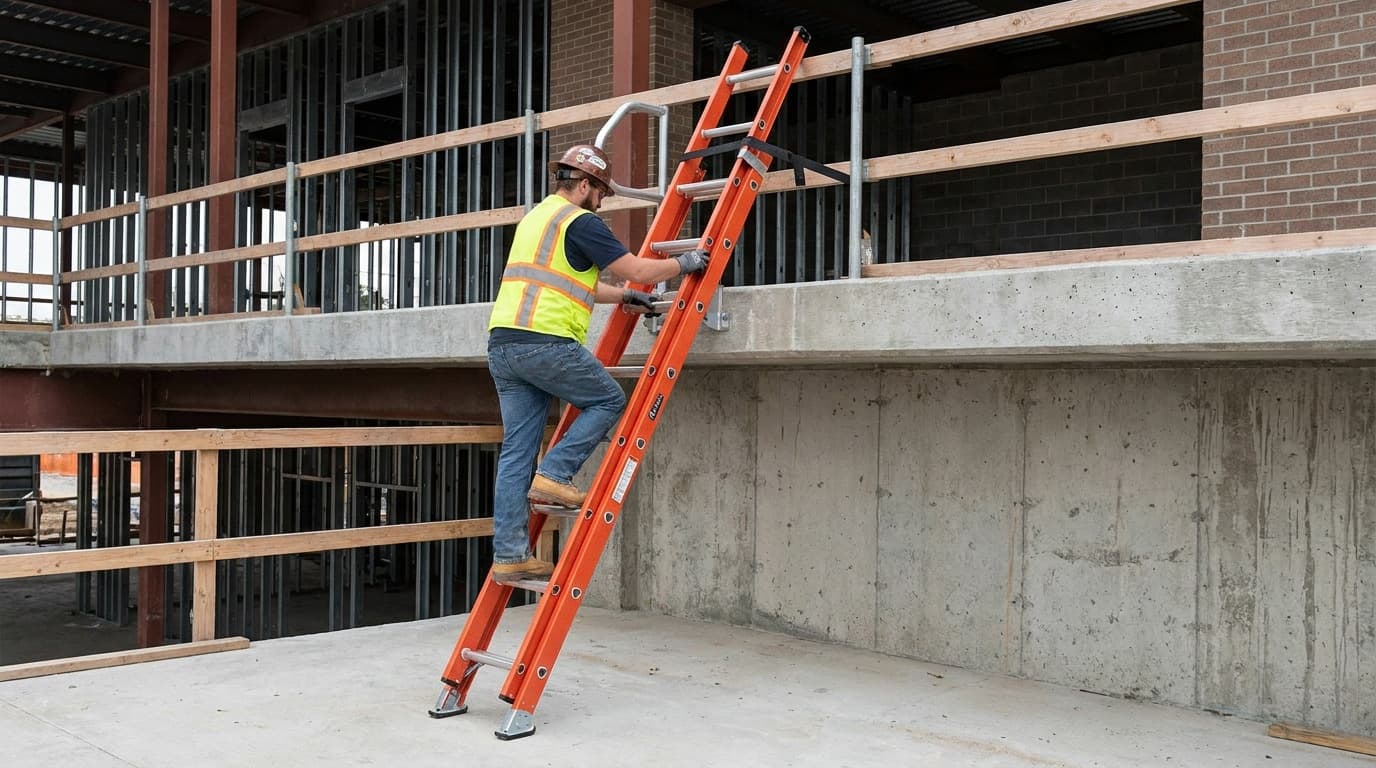
1926.1053(b)(1) — where portable ladders are used for access to an upper landing surface, the side rails shall extend at least 3 feet (0.9 m) above the upper landing surface.
The alternative, which most crews have never read: when that extension is not possible because of the ladder's length, then the ladder shall be secured at its top to a rigid support that will not deflect, and a grasping device, such as a grabrail, shall be provided to assist employees in mounting and dismounting.
So "the ladder is too short to stick up 3 feet" is not a reason to use it anyway. It is a trigger for two extra controls — a secured top and a grab handle.
And a clause worth quoting because it catches the opposite error: in no case shall the extension be such that ladder deflection under a load would, by itself, cause the ladder to slip off its support. Too much sticking up above the landing is also a defect — a long unsupported top section flexes under load and can walk itself off the edge.
The exception almost nobody knows#
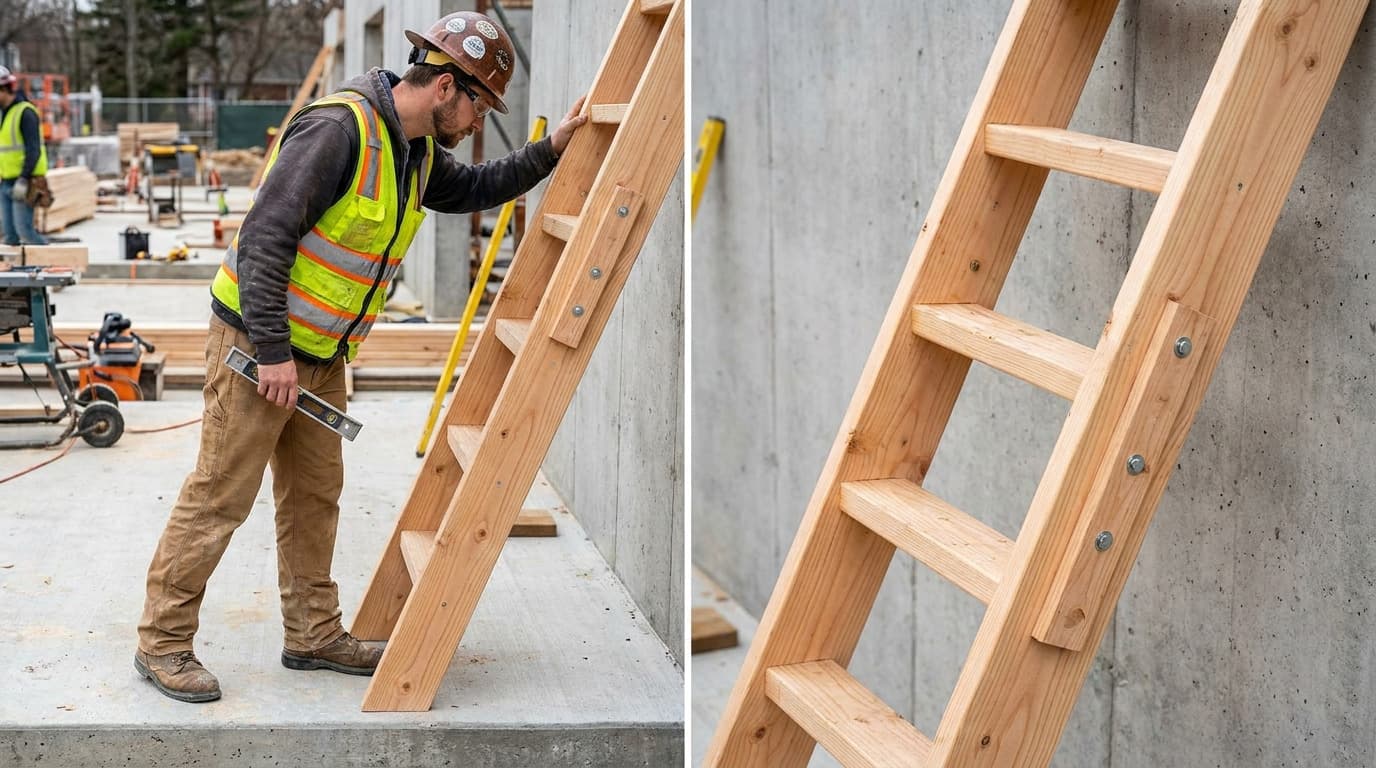
1926.1053(b)(5)(ii) — wood job-made ladders with spliced side rails shall be used at an angle such that the horizontal distance is one-eighth the working length of the ladder.
One-eighth, not one-quarter. A steeper setup, because spliced rails are less able to take the bending that a shallower angle imposes. If your site builds wooden access ladders, this is the number that applies — and it is a genuinely obscure requirement that gets missed.
For completeness: 1926.1053(b)(5)(iii) covers fixed ladders, used at a pitch no greater than 90 degrees from the horizontal, measured to the back side of the ladder.
Checking it without a tape#
The rule is only useful if it can be applied in ten seconds.
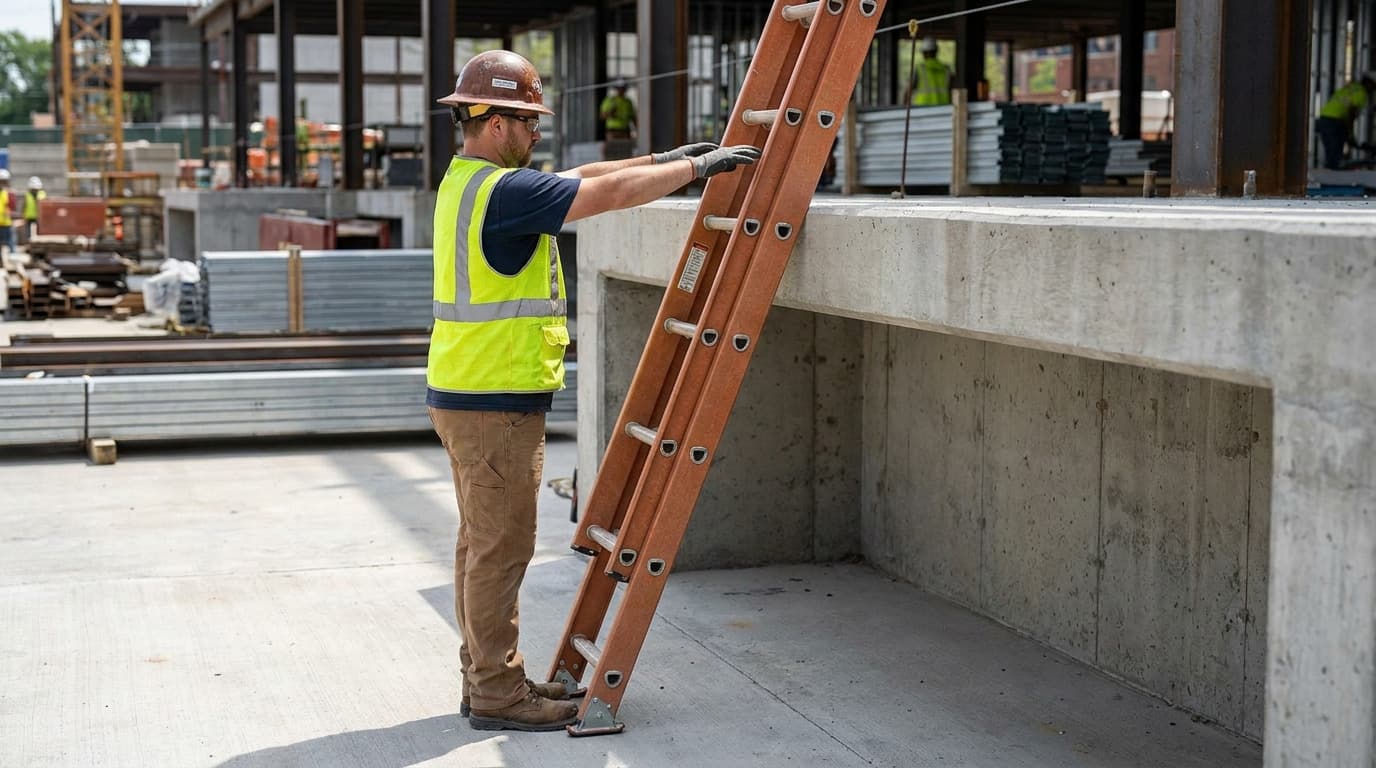
The arm test. Stand with your toes touching the feet of the ladder, facing it. Extend your arms straight out in front of you at shoulder height. Your fingertips should just reach a rung. If you have to lean forward, the base is too far out. If your arms bend, it is too close in. This works for ladders roughly between 10 and 24 feet; taller setups deserve a measurement or a built-in angle indicator.
The label. Many extension ladders carry an angle indicator or a printed setup guide on the rail — use it, it is faster than any of this.
And the base and top both have to be right. 1926.1053(b)(6) requires ladders to be used only on stable and level surfaces unless secured to prevent accidental displacement, and 1926.1053(b)(8) deals with securing ladders where they could be displaced by workplace activity or traffic. A perfect angle on soft ground, or in a doorway, is not a safe setup.
What can go wrong?#
Dividing the ladder's length instead of the working length, which always puts the base too far out.
Setting the angle by eye and getting it shallow, because a shallower ladder feels easier to climb.
Nothing above the landing, and no secured top or grabrail either.
A top section flexing far above the support, walking off the edge under load.
A perfect angle on a soft or sloping base, with no levelling and nothing secured.
A ladder in a doorway or a traffic route with nothing to stop it being displaced.
One rail on the support and one in the air, so the load is not shared.
A wood job-made ladder with spliced rails set at 4:1 instead of 8:1.
How do we manage this properly?#
Teach working length, not ladder length. This single correction fixes most bad setups.
Use the arm test every time, and make it a visible habit — it takes one second and it is checkable by anyone walking past.
Set the top first. Get 3 feet above the landing, or accept that you now owe a secured top and a grabrail.
Secure the top as routine, not only when the rule forces it.
Level and firm the base, using levellers rather than packing under one foot with whatever is lying about.
Protect the base from displacement — barrier, cone, closed door, or a second person.
Both rails on the support, evenly.
Know your ladder type. Spliced wood job-made ladders are 8:1.
And check somebody else's ladder as you pass it. The angle is one of the few things on a construction site that can be assessed correctly from thirty feet away by anyone.
Before you start#
- Confirm the working length — foot to top support along the ladder — not the ladder's length.
- Confirm the base is about one-quarter of that distance out.
- Confirm the arm test passes: toes at the feet, arms straight, fingertips on a rung.
- Confirm at least 3 feet of side rail above the landing, or a secured top plus a grabrail.
- Confirm the top is not flexing far above its support.
- Confirm both rails bear evenly on the support.
- Confirm the base is level, firm and protected from being knocked or opened into.
- Confirm whether this is a spliced wood job-made ladder, in which case the ratio is one-eighth.
Talk it over#
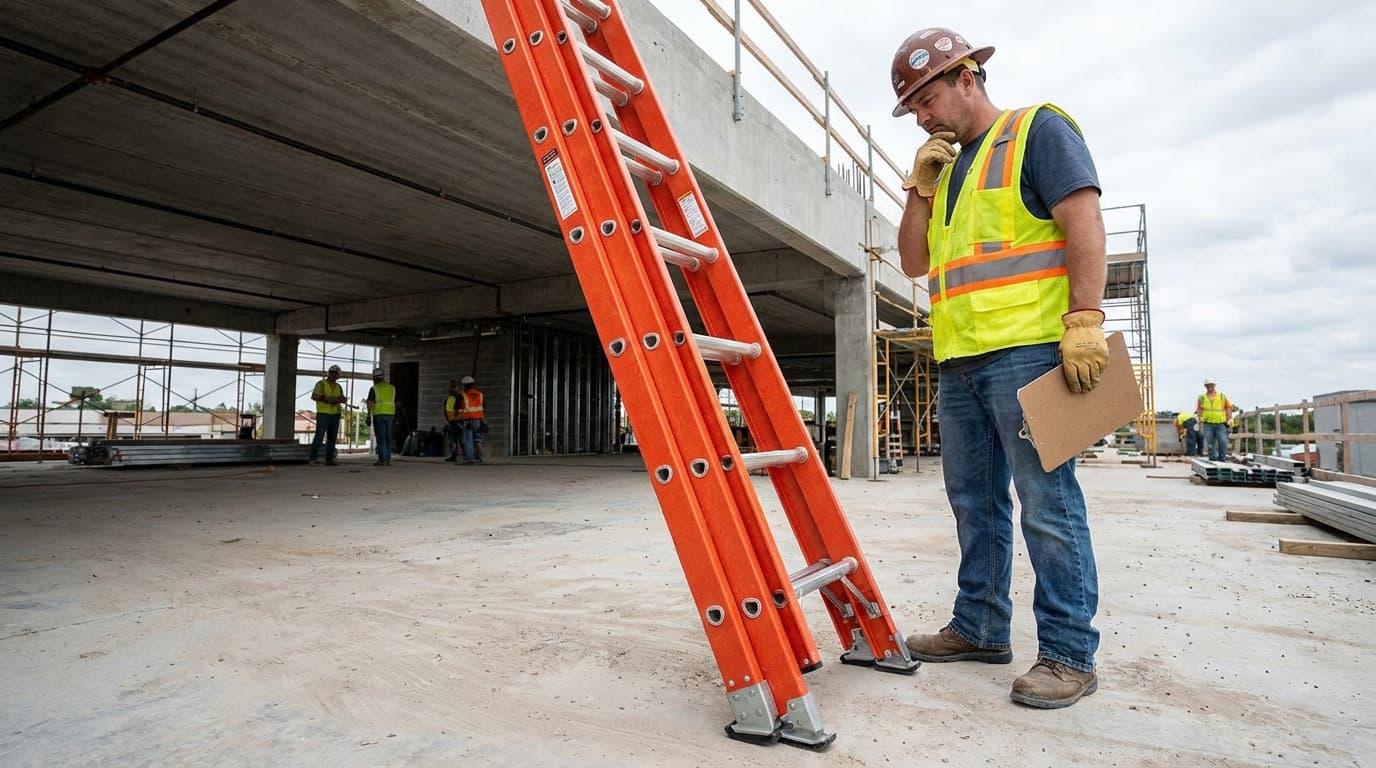
- What do you divide by four — the ladder, or the distance to where it leans?
- Does the ladder on this job pass the arm test right now?
- What do you do when the ladder will not reach 3 feet above the landing?
- When did anyone here last tie off the top of a ladder?
The bottom line#
The ratio is measured against the working length, not the ladder's length. 1926.1053(b)(5)(i) requires the horizontal distance from the top support to the foot to be approximately one-quarter of the working length, defined in the same sentence as the distance along the ladder between the foot and the top support. Using the whole ladder instead always puts the base too far out — the failure mode that slides. The ratio gives about 75 degrees, and both directions fail: too shallow slides the base out, too steep tips backwards. At the top, 1926.1053(b)(1) requires side rails to extend at least 3 feet above the upper landing surface — and where that is not possible because of the ladder's length, the ladder shall be secured at its top to a rigid support that will not deflect and a grasping device such as a grabrail shall be provided; also, in no case shall the extension be such that deflection under load would by itself cause the ladder to slip off its support. The exception worth knowing: wood job-made ladders with spliced side rails are one-eighth, not one-quarter — 1926.1053(b)(5)(ii). Check it with the arm test: toes at the feet, arms straight out at shoulder height, fingertips just reaching a rung. And remember the base — 1926.1053(b)(6) requires stable and level surfaces unless secured.
Frequently asked questions about the 4 to 1 ladder rule#
What exactly does 1926.1053(b)(5)(i) require?
That non-self-supporting ladders be used at an angle such that the horizontal distance from the top support to the foot of the ladder is approximately one-quarter of the working length of the ladder — with working length defined in the same sentence as the distance along the ladder between the foot and the top support. That produces an angle of roughly 75 degrees.
Is the ratio based on the ladder's length or the height?
Neither, strictly — it is based on the working length, the distance along the ladder from its foot to the point where it rests. The common field rule of one foot out for every four feet of height to the support works because at this angle height and working length are close. The error is substituting the ladder's overall length, which always puts the base too far out.
What happens if the angle is wrong?
The two errors fail differently. Too shallow — base too far out — increases the outward force at the feet and produces the classic ladder that shoots out from under the climber; it is the more common and more dangerous error because it fails suddenly. Too steep — base too close — makes the ladder unstable rearwards, so a climber leaning or reaching can tip it over backwards.
How do I check the angle without measuring?
The arm test. Stand with your toes touching the ladder's feet, facing it, and extend your arms straight forward at shoulder height — your fingertips should just reach a rung. Leaning forward means the base is too far out; bent arms mean it is too close in. It is reliable for ladders roughly 10 to 24 feet; taller setups warrant a measurement or the angle indicator printed on the rail.
How far must the ladder extend above the landing?
At least 3 feet (0.9 m) of side rail above the upper landing surface, under 1926.1053(b)(1). Where that extension is not possible because of the ladder's length, the ladder shall be secured at its top to a rigid support that will not deflect, and a grasping device such as a grabrail shall be provided. Too short is not a reason to proceed unchanged — it triggers two additional controls.
Can a ladder extend too far above the landing?
Yes. The standard states that in no case shall the extension be such that ladder deflection under a load would, by itself, cause the ladder to slip off its support. A long unsupported top section flexes under a climber's weight and can work itself sideways off the edge.
Is the rule different for any type of ladder?
Yes, and it is easy to miss. 1926.1053(b)(5)(ii) requires wood job-made ladders with spliced side rails to be used at a horizontal distance of one-eighth of the working length — a steeper setup than 4:1, because spliced rails tolerate bending less well. Separately, 1926.1053(b)(5)(iii) covers fixed ladders, used at a pitch no greater than 90 degrees from the horizontal.
Download the 4 to 1 ladder rule toolbox talk PDF#
Get this extension ladder 4 to 1 rule toolbox talk as a print-ready PDF — available in English, Spanish, Portuguese, and Turkish. Print it, hand it to the crew, and collect signatures on the included attendance sheet.
Download the PDF — free account required. New members get 3 free downloads.
Related toolbox talks#
Sources#
- OSHA, 29 CFR 1926.1053 — Ladders: https://www.osha.gov/laws-regs/regulations/standardnumber/1926/1926.1053
- OSHA, Stairways and Ladders: A Guide to OSHA Rules: https://www.osha.gov/sites/default/files/publications/osha3124.pdf
- OSHA, Falling Off Ladders Can Kill: Use Them Safely: https://www.osha.gov/sites/default/files/publications/portable_ladder_qc.pdf