Working Near Unprotected Edges
Updated 2026-07-24
In this bundle Fall Protection & Heights
Print-ready PDF
Download this talk as a print-ready PDF, available in 4 languages.
There is a wall along that edge. It comes up to about mid-thigh, it feels solid when you lean on it, and every person on this crew has walked past it today without a harness. Whether that was legal came down to a number almost nobody on a jobsite can quote: 39 inches. Above it, there is no unprotected edge and no duty. Below it, the edge is legally wide open and every worker near it needed a guardrail, a net, or a harness. This working near unprotected edges talk is about a hazard defined by a measurement, not by how safe something feels.
Here is the distinction that carries this whole talk: most fall hazards get missed because nobody saw them. Edges are different — everybody sees them. Edges get missed because people misjudge them. They look at a parapet and conclude it counts. They stand six feet back and conclude the distance protects them. They walk a perimeter with no intention of going near the drop. None of that is a control, and the standard does not care how careful anyone intended to be.
The most-cited standard in OSHA's inventory#
This is one of the rare fall topics with a genuinely robust statistic behind it, and it is not about deaths — it is about how consistently this exact requirement is broken.
29 CFR 1926.501 — Fall Protection, General Requirements — has been OSHA's number one most frequently cited standard for 15 consecutive fiscal years, and holds the top position again on OSHA's published Top 10 list for fiscal year 2025 (October 1, 2024 to September 30, 2025). It is not cited slightly more than the others. It is cited roughly twice as often as the standard in second place.
One honest caveat on the count itself. The preliminary FY2025 figure announced at the National Safety Council Congress in September 2025 was about 5,900 violations, with OSHA's regional administrator noting the number was likely to grow when finalised data was published. Some outlets have since reported a higher figure. Treat the exact total as provisional — the fact that does not move is the ranking: fifteen years at number one, and roofing is consistently the leading industry cited.
That record is the argument. This is not an obscure provision. It is the single most broken rule in American construction, and the majority of what it covers is people working near an edge without protection.
The number that decides it: 39 inches#
29 CFR 1926.500(b) defines the term precisely:
Unprotected sides and edges means any side or edge (except at entrances to points of access) of a walking/working surface, e.g., floor, roof, ramp, or runway, where there is no wall or guardrail system at least 39 inches (1.0 m) high.
So the test is not whether something is there. It is whether what is there reaches 39 inches. A parapet at 40 inches means the edge is not unprotected and no fall protection duty is triggered. A barrier wall at 32 inches — a common bridge-deck detail, and the subject of its own OSHA interpretation letter — leaves the edge unprotected, and every worker within reach of it is owed a guardrail, a safety net, or a personal fall arrest system. The wall being solid, permanent, and load-bearing changes nothing. It is short.
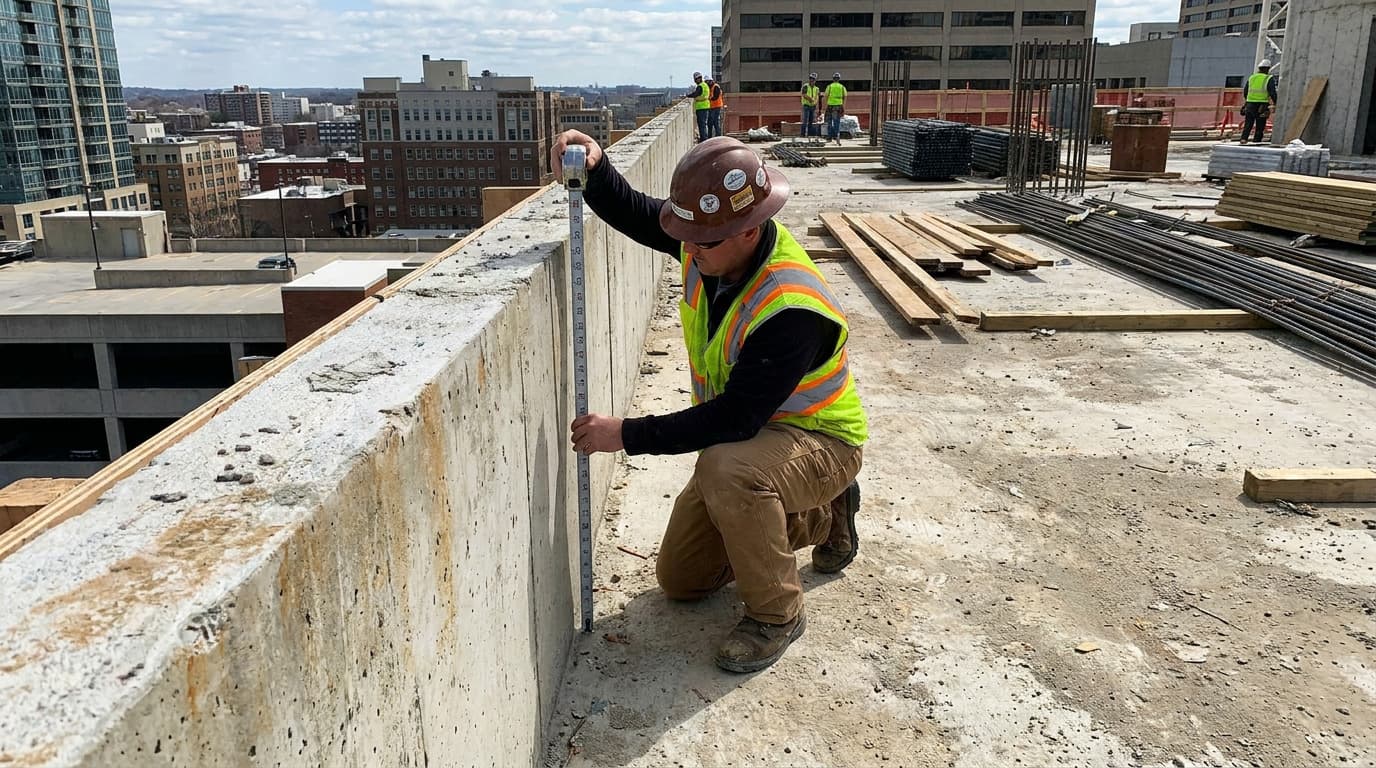
Watch the two thresholds, because they are not the same number. The 39-inch figure is the definition test — it decides whether an unprotected edge exists at all. If instead you choose to install a guardrail system as your control, 1926.502(b)(1) requires the top rail at 42 inches (1.1 m), plus or minus 3 inches. Crews mix these up constantly. Thirty-nine inches tells you whether you have a problem; forty-two tells you what a purpose-built solution has to measure.
And note the carve-out: "except at entrances to points of access." A doorway, a ladder access point, or a gap for material landing is not automatically an unprotected edge by that definition — but other provisions of Subpart M then apply to those openings, so this is not a loophole to work through.
What the standard requires#
- The general duty — 1926.501(b)(1). Each employee on a walking/working surface (horizontal and vertical surface) with an unprotected side or edge which is 6 feet (1.8 m) or more above a lower level shall be protected from falling by a guardrail system, safety net system, or personal fall arrest system. Three options, and no fourth.
- Edge or hole? — 1926.500(b) and OSHA interpretation. In general, a fall hazard at the perimeter of a walking/working surface creates a side or edge; a fall hazard through a walking/working surface creates a hole. The distinction matters because holes carry a separate duty under 1926.501(b)(4) with no height threshold for the stepping-into hazard.
- Guardrail criteria — 1926.502(b). If guardrails are the control, they must meet the full criteria — top rail height, midrails, strength, and surfacing. A rope strung between columns is not a guardrail system.
- Training — 1926.503(a). A competent person must train each employee to recognise fall hazards and the procedures to minimise them. Recognising an edge sounds trivial until you ask a crew to tell you, by measurement, which walls on this job count.
On USACE and NAVFAC projects, EM 385-1-1 applies and is more restrictive than Subpart M in several places.
Staying back from the edge is not a control#
This is the belief that puts most people at risk, so it is worth stating plainly. There is no general rule in Subpart M that says you are safe if you stay a certain distance from an edge.
OSHA has addressed this directly in interpretation: in a few very specific situations the standard permits control lines or warning lines to keep employees away from a hole or an edge — but apart from those situations, distance from the edge does not substitute for the required fall protection systems. Those specific situations are narrow: controlled access zones for leading edge work, precast erection and overhand bricklaying under 1926.502(g), and warning line systems for roofing work on low-slope roofs under 1926.501(b)(10) and 1926.502(f).
If your work is not one of those, then "we're staying well back" is not a compliance position and it is not a physical control. It relies entirely on attention — which is exactly the thing that fails when someone reverses with a load, trips, is startled, or gets pushed by wind.
What can go wrong#
The short wall. Anything under 39 inches: bridge barrier walls, low parapets, curbs, knee walls, mezzanine kerbs, half-height masonry. They read as protection and do not meet the definition.
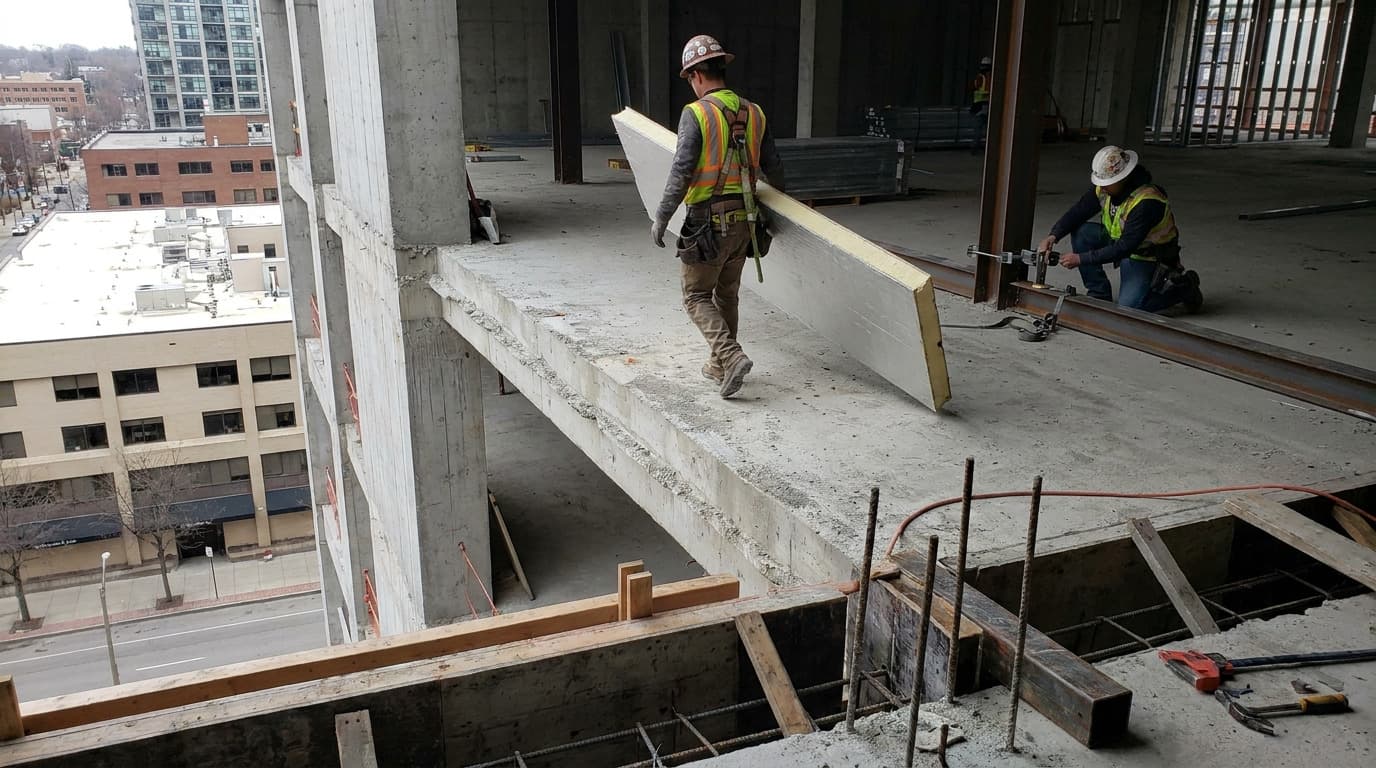
Working with your back to it. Carrying, dragging, sighting, reversing. The same pattern that dominates skylight incidents dominates edges — the hazard does not need to be hidden, it needs to be behind you.
The task that was only going to take a second. Leaning out to grab a line, checking a measurement, taking a photo of the elevation. The exposure is brief and the fall does not care.
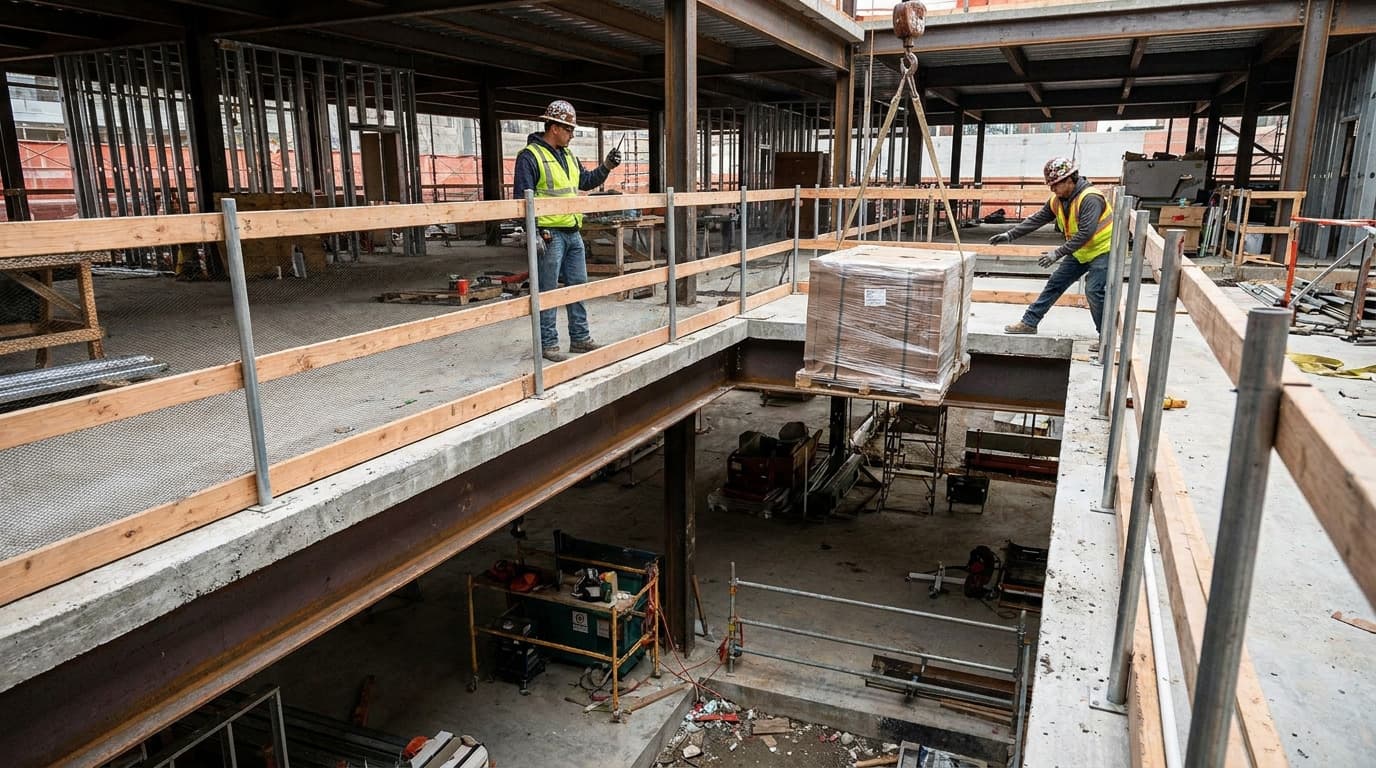
Guardrail removed and not replaced. Taken out for a material landing, a crane pick, or an inspection, and then the next crew arrives to an opening that looks like it was meant to be there.
Wind and load. A person carrying a sheet of ply or a panel near an open edge has a sail. The wind decides where they end up.
Assuming a rope or tape is a guardrail. Barrier tape and a rope between columns are warnings, not guardrails, and they meet none of the 1926.502(b) criteria.
Treating a perimeter as protected because part of it is. Guardrail on three sides and an open corner is an unprotected edge.
Access openings left open after use. The carve-out for entrances to points of access does not license leaving a hoist opening unguarded once the load has landed.
Edges created by the work itself. Demolition, saw cutting, form stripping, and removing decking all manufacture new edges mid-shift. Yesterday's walkthrough does not cover them.
Vertical surfaces forgotten. 1926.501(b)(1) covers walking/working surfaces including vertical ones. Formwork faces and similar positions are inside the duty.
Nobody measured. The single most common failure. The question "is that wall 39 inches?" has a definite answer, and on most sites nobody has gone and found it.
How do we control unprotected edges?#
Measure the walls. Take a tape to every parapet, barrier, and knee wall on this job once, and mark what passes and what does not. This converts a judgement call into a known fact, and it takes an hour.
Guardrail first. Of the three options in (b)(1), only the guardrail works without the worker doing anything — no clipping in, no remembering, no inspection that morning. It protects visitors and other trades too.
If you use fall arrest, solve the anchor before the shift, and check the clearance below the edge — a fall over an edge is exactly where clearance and swing get ugly.
Replace guardrail the moment the reason for removing it ends. Assign that to a person, not to the crew in general.
Re-walk the perimeter whenever the work creates new edges, and treat a new edge as a stop-and-fix rather than a note for tomorrow.
Never accept distance as the control unless you are in one of the specific situations where the standard allows a control line or warning line — leading edge work, precast erection, overhand bricklaying, or low-slope roofing.
Protect the line where it bears if a lanyard or lifeline will run over the edge, and use edge-rated equipment.
Brief every trade and every visitor on which edges are protected and which are not. The plumber, the surveyor, and the client's engineer did not hear this talk.
Say the number out loud in the pre-task plan. "That wall is 34 inches, so that edge is unprotected, and here is what we are doing about it." Specific beats general every time.
Before you start#
- Identify every unprotected edge on your work area, by walking it.
- Measure any wall or parapet you are relying on — under 39 inches means the edge is unprotected.
- Confirm which of the three systems protects each edge: guardrail, safety net, or personal fall arrest.
- Confirm any guardrail meets 1926.502(b), including a top rail at 42 inches plus or minus 3.
- Confirm nothing has been removed for access and left open.
- Confirm you are not relying on distance from the edge unless the standard specifically permits it here.
- If using fall arrest, confirm anchor, clearance, and swing path before you clip.
- Confirm edge protection for any line that will bear on the edge.
- Identify which edges the work today will create, and who closes them.
- Confirm other trades and visitors have been told what is open.
Talk it over#
- Point at the wall you would trust near that drop. How tall is it, in inches? Has anyone measured it?
- Where on this job would you be within one step of an edge while walking backwards with something in your hands?
- Which edges are going to exist at the end of this shift that do not exist now?
The bottom line#
An edge is legally unprotected whenever there is no wall or guardrail at least 39 inches (1.0 m) high — 1926.500(b) — and any worker on a surface with such an edge 6 feet or more above a lower level must be protected by a guardrail system, safety net system, or personal fall arrest system under 1926.501(b)(1). That is OSHA's most frequently cited standard, and has been for fifteen consecutive years. Distance from the edge is not a fourth option; control lines and warning lines are permitted only in specific situations the standard names. So measure the walls instead of judging them, guardrail wherever you can, replace what gets removed the moment it can go back, and re-walk the perimeter whenever the work makes new edges.
Frequently asked questions about unprotected edges#
What counts as an unprotected side or edge?
29 CFR 1926.500(b) defines unprotected sides and edges as any side or edge — except at entrances to points of access — of a walking/working surface such as a floor, roof, ramp, or runway where there is no wall or guardrail system at least 39 inches (1.0 m) high. If the wall or rail is shorter than 39 inches, the edge is unprotected regardless of how solid the structure is.
At what height is fall protection required at an edge?
6 feet (1.8 m) or more above a lower level, under 29 CFR 1926.501(b)(1). At that point each employee on a walking/working surface with an unprotected side or edge must be protected by a guardrail system, safety net system, or personal fall arrest system.
Is a 42-inch guardrail the same as the 39-inch rule?
No — they are two different tests. The 39-inch figure in 1926.500(b) is part of the definition: it decides whether an unprotected edge exists at all. The 42-inch (1.1 m), plus or minus 3 inches figure in 1926.502(b)(1) is the criterion for a guardrail system you install as a control. An existing wall at 40 inches means no unprotected edge; a guardrail you build must still meet the 42-inch specification.
Can I just stay back from the edge instead of using fall protection?
Generally, no. 1926.501(b)(1) gives three options — guardrail, safety net, or personal fall arrest — and distance is not among them. OSHA has explained in interpretation that only in a few very specific situations does the standard permit control lines or warning lines to keep employees away from a hole or edge: controlled access zones under 1926.502(g) for leading edge work, precast erection and overhand bricklaying, and warning line systems for roofing work on low-slope roofs under 1926.501(b)(10).
Is a rope or barrier tape across an opening acceptable?
No. If a guardrail system is your chosen control it must satisfy 1926.502(b) in full — top rail height, midrails or equivalent intermediate protection, strength criteria, and surfacing requirements. Barrier tape and rope are warning devices; they neither meet the criteria nor arrest a person.
How often is this standard actually cited?
29 CFR 1926.501 has been OSHA's most frequently cited standard for 15 consecutive fiscal years, and tops OSHA's published Top 10 list for fiscal year 2025. Preliminary FY2025 figures announced in September 2025 were around 5,900 violations, with OSHA noting the number was likely to rise once finalised — roughly double the standard ranked second, with roofing the leading industry cited.
What is the difference between an edge and a hole?
OSHA has explained the distinction in interpretation: in general, a fall hazard at the perimeter of a walking/working surface creates a side or edge, while a fall hazard through a walking/working surface creates a hole. It matters because holes carry their own duties under 1926.501(b)(4), including a cover requirement for the stepping-into hazard that has no minimum height at all.
Download the unprotected edges toolbox talk PDF#
Get this unprotected edges toolbox talk as a print-ready PDF — available in English, Spanish, Portuguese, and Turkish. Print it, hand it to the crew, and collect signatures on the included attendance sheet.
Download the PDF — free account required. New members get 3 free downloads.
Related toolbox talks#
Sources#
- OSHA, 29 CFR 1926.500 — Scope, application, and definitions: https://www.osha.gov/laws-regs/regulations/standardnumber/1926/1926.500
- OSHA, 29 CFR 1926.501 — Duty to have fall protection: https://www.osha.gov/laws-regs/regulations/standardnumber/1926/1926.501
- OSHA, Top 10 Most Frequently Cited Standards, Fiscal Year 2025: https://www.osha.gov/top10citedstandards
- OSHA, Clarification of the terms "hole" versus "unprotected sides or edges", Letter of Interpretation, August 14, 2000: https://www.osha.gov/laws-regs/standardinterpretations/2000-08-14