First Aid Kit Familiarization
Updated 2026-07-31
In this bundle Fire, Hot Work & Emergency
Print-ready PDF
Download this talk as a print-ready PDF, available in 4 languages.
There is a piece of safety equipment on every site that nobody has ever opened. Harnesses get inspected, extinguishers get checked, gas monitors get bumped and calibrated — but the first aid kit sits on the wall until the day somebody needs it. This talk is about opening it before that day. This First Aid Kit Familiarization Toolbox Talk (Safety Talk / Tailgate Talk) covers the kit itself: what is in it, what should be, and who knows.
Here is the distinction that carries this whole talk: the first aid kit is the only equipment on site that gets used for the first time during an emergency, by somebody who has never handled it. Everything else is rehearsed. This is not. And it is used in the worst three minutes of somebody's life, by a person under stress, often in poor light, looking for an item they have never seen, in a box they have never opened. The familiarization is the control. The contents are just the shopping list.
Class A and Class B, and why it matters here#
The consensus standard is ANSI/ISEA Z308.1-2021, approved 15 April 2022 with an effective date of 15 October 2022. It sorts kits two ways, and the distinction is worth knowing precisely.
Class A kits are intended to provide a basic range of products for the most common workplace injuries — major wounds, minor wounds such as cuts and abrasions, minor burns and eye injuries.
Class B kits are for workplaces with a high risk for severe injuries. They contain everything a Class A kit does in greater quantities, plus two items not found in Class A at all: a splint and a tourniquet.
Read that against what a construction site actually does. Falls from height, crushing injuries, machinery, blades, rebar, glass, plant. A splint and a tourniquet are precisely the two items a serious construction injury needs — and they are exactly the two items that a Class A kit does not contain.
So the question to ask on your own site is simple and checkable: is that a Class A kit on the wall, and is this a Class A environment? For most construction work the honest answer to the second question is no.
Also worth clearing up: Types I to IV describe the container, not the contents. Type I is stationary and mounted indoors; Type II portable indoors; Type III portable for mobile indoor and outdoor use, with a water-resistant seal; Type IV is intended for portable use in mobile industries and outdoor settings — which is what a construction site is. A Class B kit in a Type I cabinet is still the wrong kit for a job that moves.
What OSHA actually requires#
This surprises people, so state it plainly.
OSHA does not require specific first aid kit contents. With the exception of the logging standard at 1910.266, neither 1926.50 for construction nor 1910.151 for general industry specifies what goes in the box. Appendix A to 1926.50 is non-mandatory and exists as a reference, pointing to ANSI/ISEA Z308.1.
What is mandatory:
1926.50(d)(1) — first aid supplies shall be easily accessible when required.
1926.50(d)(2) — the contents of the first aid kit shall be placed in a weatherproof container with individual sealed packages for each type of item, and shall be checked by the employer before being sent out on each job and at least weekly on each job to ensure that the expended items are replaced.
That second provision contains three requirements crews routinely miss:
A weatherproof container. Not a toolbox, not a carrier bag, not a drawer.
Individual sealed packages for each type of item. Loose dressings rattling in the bottom of a box do not comply and are not sterile.
Checked before being sent out on each job, and at least weekly on each job. Weekly. Not when it looks empty. Not at the monthly inspection. Weekly, on every job.
And separately, 1926.50(c) requires that where no infirmary, clinic, hospital or physician is reasonably accessible in terms of time and distance, a person with valid first aid training shall be available at the worksite — covered in more detail in the first aid and AED talk in this library.
What is actually in a compliant kit#
The point of walking through this is not to memorise a list. It is so that nobody is reading labels for the first time while somebody bleeds.
Wound care — adhesive bandages, adhesive tape, sterile pads, trauma pads, roller bandage, triangular bandage.
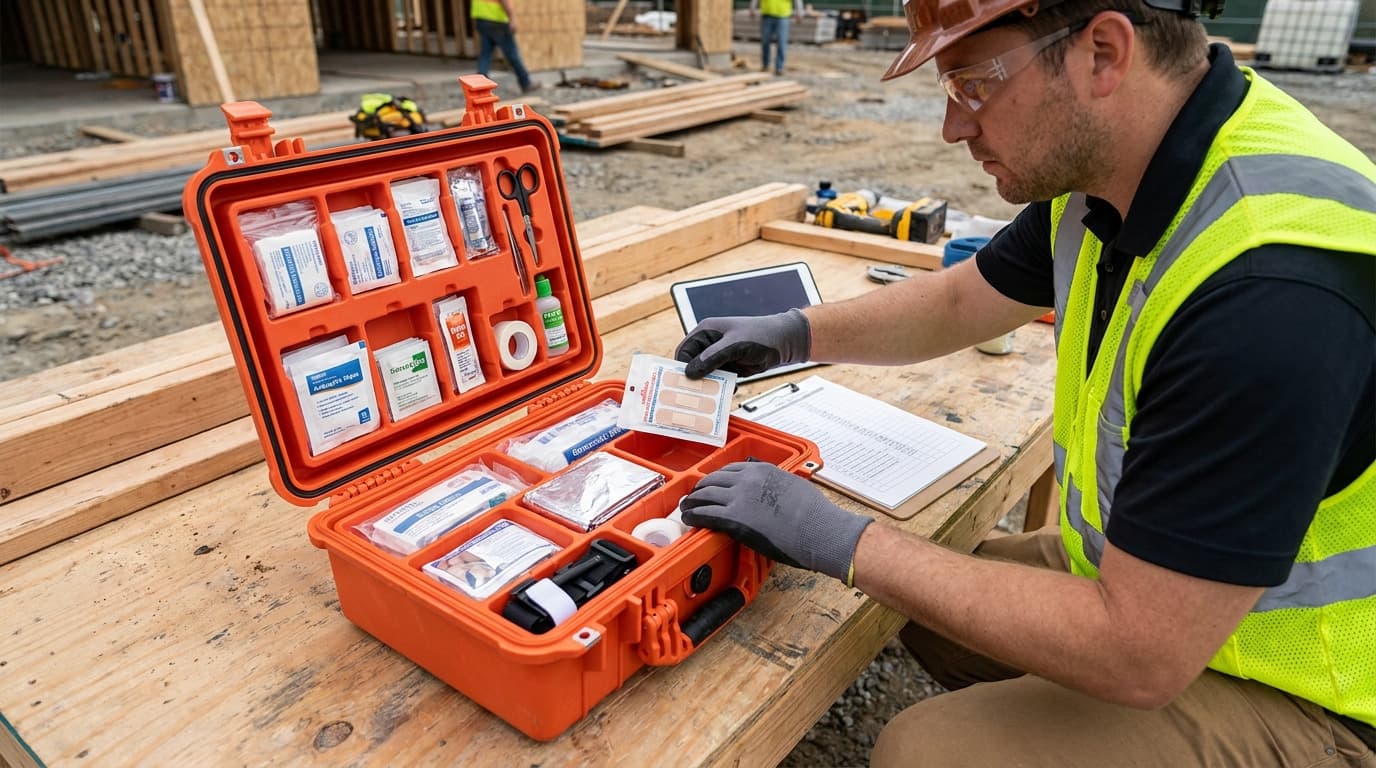
Antiseptic and burn treatment — antiseptic wipes, burn dressing and burn treatment, antibiotic application.
Barrier protection — medical exam gloves and a CPR breathing barrier. Nobody should be treating anybody else's bleeding without gloves.
Eye wash and eye covering — which connects to the eyewash provisions and the contact lens talk.
Scissors and tweezers.
A foil blanket, which the 2021 revision made mandatory in both classes — useful for hypothermia, as a windbreak, or as an emergency waterproof wrap.
And in a Class B kit: a splint and a tourniquet. The 2021 revision also added more specificity for tourniquets — distinguishing a real tourniquet from the elastic bands used to draw blood, which are not effective at preventing blood loss — and greater guidance on bleeding control.
Note what a kit does not do: it does not replace a trained person, and it does not replace calling for help. It buys minutes.
The familiarization itself#
This is the part that makes the talk worth running, and it takes ten minutes once.
Open the kit in front of the crew. Physically. Not a photograph, not a list on a wall.
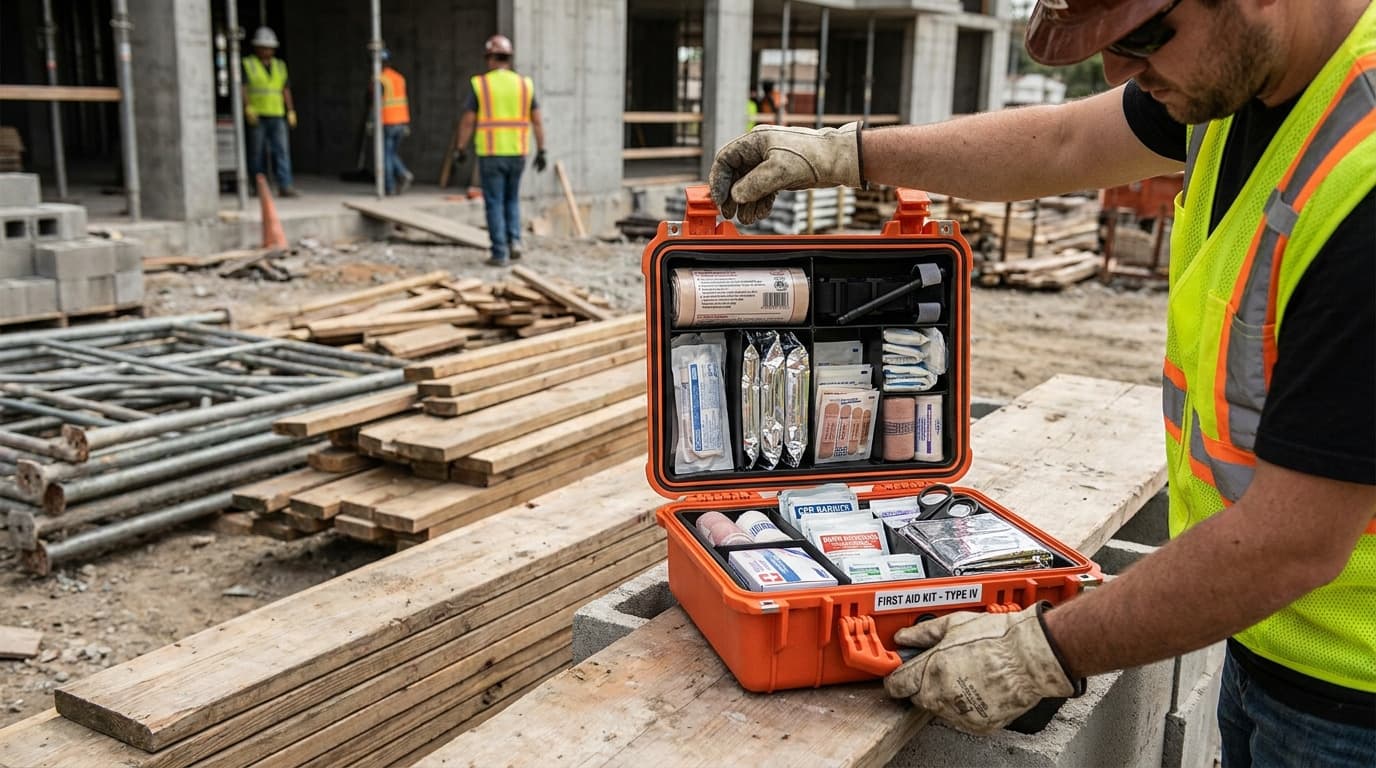
Have somebody who is not a first aider find three items while the others watch. That single exercise reveals more about your readiness than any inspection record.
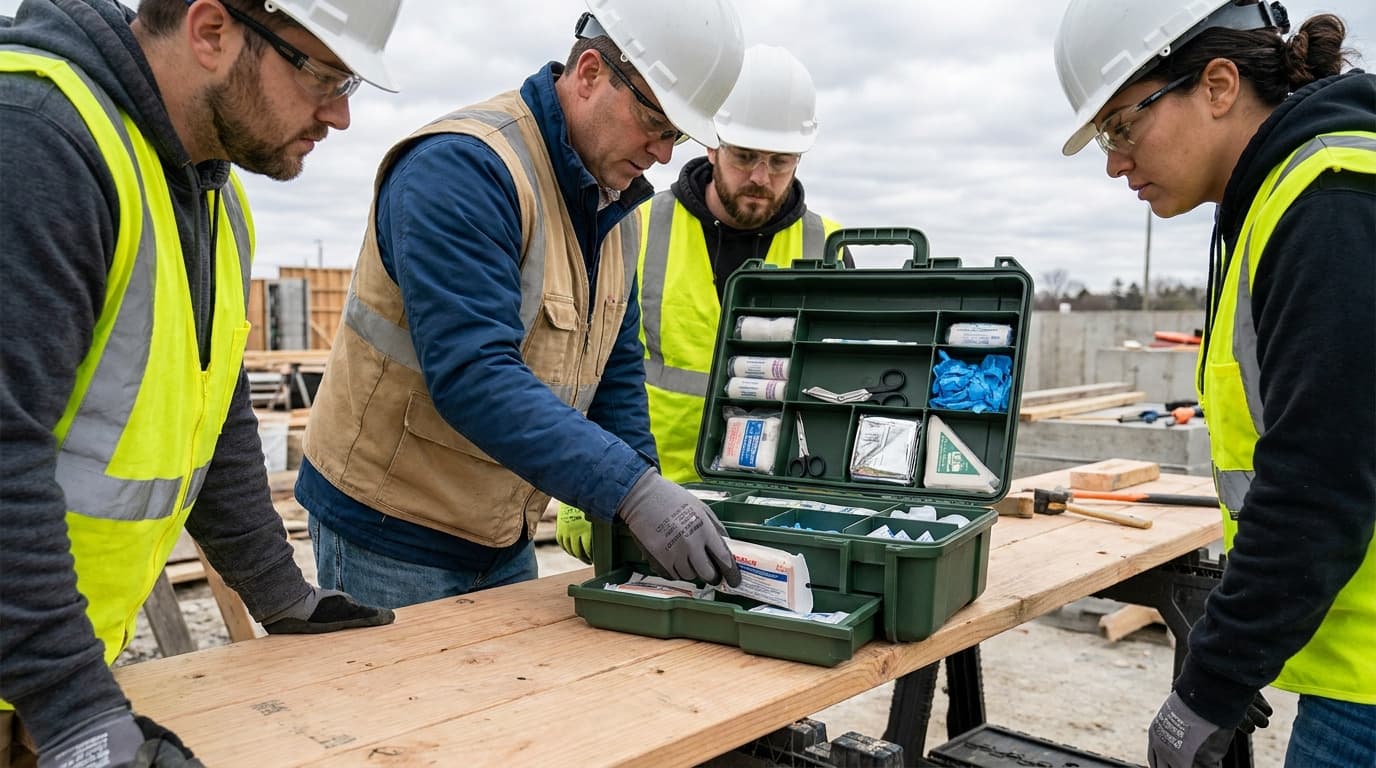
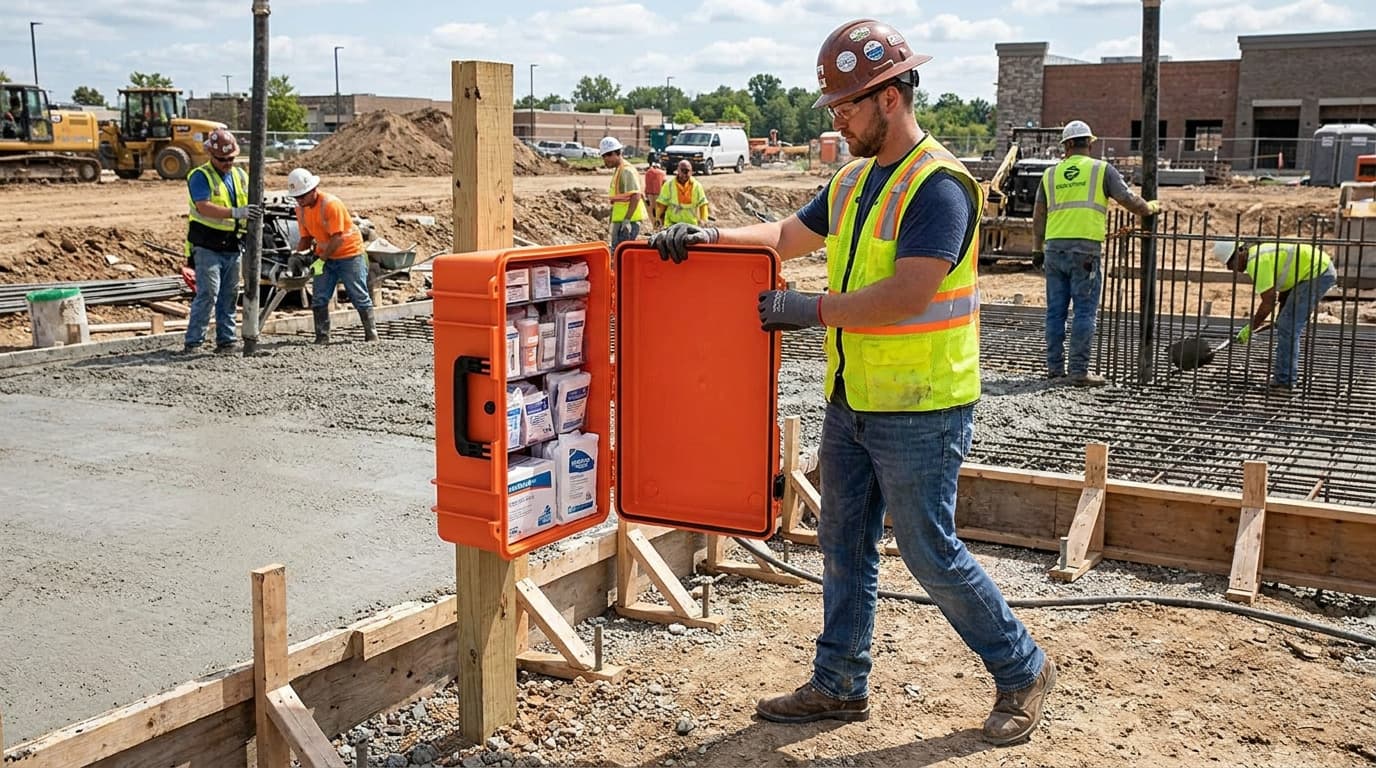
Say where every kit on site is — and confirm people can find them from where they actually work, not from the office.
Check the expiry dates together. Sterile items and treatments expire, and expired items should be discarded and replaced.
Name the trained people. If nobody in the room can name the first aider on this shift, that is the finding.
Confirm who calls for help and what they say — location, access, nature of injury.
And agree who restocks. A kit that gets used and not replenished is worse than useless, because everybody still believes it is full.
What can go wrong?#
A Class A kit on a Class B site, missing exactly the items a serious injury needs.
A kit nobody has opened, searched for the first time under pressure.
Missing weekly checks, so the kit is inspected the day it is needed.
Expired contents, unnoticed because nothing has ever been checked.
Used items not replaced, with everyone assuming otherwise.
A kit locked in an office or a vehicle that has left site.
No gloves, so the responder is exposed or hesitates.
Nobody knowing who the trained first aider is on this particular shift.
How do we manage this properly?#
Match the kit class to the hazard, and be honest about whether this is a high-risk environment.
Match the container type to the job — Type IV for mobile and outdoor work.
Do the weekly check and record it, because 1926.50(d)(2) requires it on every job.
Open the kit at a toolbox talk at least once per project, with the crew watching.
Post the locations, and make sure a new starter is shown them on day one.
Keep gloves at the top, because they are the first thing needed and the most often buried.
Restock immediately after any use, and treat an unreplenished kit as a reportable condition.
Know your trained first aiders by name, per shift.
And check accessibility for real — a kit behind a locked door or a stack of materials is not "easily accessible."
Before you start#
- Confirm where the nearest first aid kit is from where you will be working today.
- Confirm you have opened it, or seen it opened.
- Confirm it is a class appropriate to the work — splint and tourniquet for high-risk work.
- Confirm it is in a weatherproof container with items individually sealed.
- Confirm the weekly check has been done and recorded.
- Confirm nothing inside is expired and nothing used has gone unreplaced.
- Confirm you know who the trained first aider on this shift is, by name.
- Confirm you know who calls for help and what location they will give.
Talk it over#
- Without looking, what is in the kit on this site?
- Where is the nearest one from where you are working right now?
- Who is the trained first aider on this shift?
- If you used the last dressing today, who would replace it?
The bottom line#
The first aid kit is the only equipment on site used for the first time during an emergency, by somebody who has never handled it — so the familiarization is the control and the contents are just the shopping list. Under ANSI/ISEA Z308.1-2021 (effective 15 October 2022), Class A kits cover the most common workplace injuries — major and minor wounds, minor burns, eye injuries — while Class B kits are for workplaces with a high risk for severe injuries and add, beyond greater quantities, two items Class A does not contain at all: a splint and a tourniquet. Those are precisely what a serious construction injury needs, so ask whether you have a Class A kit on a Class B site. Types I–IV describe the container, not the contents — Type IV is for portable use in mobile industries and outdoor settings. OSHA does not specify kit contents outside logging; Appendix A to 1926.50 is non-mandatory. What is mandatory: 1926.50(d)(1) supplies easily accessible when required, and 1926.50(d)(2) a weatherproof container, individual sealed packages for each type of item, checked before being sent out on each job and at least weekly on each job to replace expended items. The 2021 revision made a foil blanket mandatory in both classes and added more specificity for tourniquets and greater guidance on bleeding control.
Frequently asked questions about first aid kits on site#
What does OSHA require to be in a first aid kit?
Nothing specific. OSHA does not require particular first aid kit contents — with the exception of the logging standard at 1910.266, neither 1926.50 for construction nor 1910.151 for general industry lists what must be inside. Appendix A to 1926.50 is non-mandatory and serves as a reference, pointing to ANSI/ISEA Z308.1, which sets minimum performance requirements for workplace kits and supplies.
What is the difference between a Class A and a Class B first aid kit?
Class A kits provide a basic range of products for the most common workplace injuries — major wounds, minor wounds such as cuts and abrasions, minor burns and eye injuries. Class B kits are for workplaces with a high risk for severe injuries: they contain everything in a Class A kit in greater quantities, plus two items not found in Class A at all — a splint and a tourniquet.
Which class does a construction site need?
That is a hazard assessment rather than a rule, but consider what the work involves: falls, crushing, machinery, blades, rebar and plant. A splint and a tourniquet are exactly the two items a serious construction injury needs, and exactly the two a Class A kit lacks. Many sites carry a Class A kit in an environment that is plainly high-risk — which is a checkable gap worth closing.
What do the Type I to Type IV designations mean?
They describe the container, not the contents. Type I is stationary and mounted for indoor use; Type II is portable for indoor use; Type III is portable for mobile indoor and outdoor settings, with a water-resistant seal; Type IV is intended for portable use in mobile industries and outdoor settings. Either class of supplies can sit in any type of container, so a construction site generally wants Class B supplies in a Type IV container.
How often must a first aid kit be checked?
Weekly, on every job. 1926.50(d)(2) requires that the contents be checked by the employer before being sent out on each job and at least weekly on each job to ensure that the expended items are replaced. The same provision requires a weatherproof container with individual sealed packages for each type of item — so loose dressings in the bottom of a toolbox do not comply.
What changed in the 2021 revision of Z308.1?
Several things worth knowing. A foil blanket is now mandatory in both Class A and Class B kits, recognised for treating hypothermia, acting as a windbreak or serving as an emergency waterproof wrap. The standard also provides more specificity for tourniquets — distinguishing them from the elastic bands used to draw blood, which are not effective at preventing blood loss — and greater guidance on bleeding control.
Why run a familiarization talk if the kit is already compliant?
Because compliance and usability are different things. A compliant kit still gets opened for the first time by a stressed person searching for an unfamiliar item in poor light. Open it in front of the crew, have somebody who is not a first aider find three items, check the expiry dates together, and name the trained first aider on this shift. Ten minutes once per project is the whole intervention.
Download the first aid kit familiarization toolbox talk PDF#
Get this first aid kit familiarization toolbox talk as a print-ready PDF — available in English, Spanish, Portuguese, and Turkish. Print it, hand it to the crew, and collect signatures on the included attendance sheet.
Download the PDF — free account required. New members get 3 free downloads.
Related toolbox talks#
Sources#
- OSHA, 29 CFR 1926.50 — Medical services and first aid: https://www.osha.gov/laws-regs/regulations/standardnumber/1926/1926.50
- OSHA, 29 CFR 1926.50 App A — First aid kits (Non-Mandatory): https://www.osha.gov/laws-regs/regulations/standardnumber/1926/1926.50AppA
- ISEA, ANSI/ISEA Z308.1-2021, Minimum Requirements for Workplace First Aid Kits and Supplies: https://safetyequipment.org/isea-standards/
This talk is general guidance for training purposes and is not medical advice. First aid does not replace professional medical care — call for emergency help early, and anyone injured should be assessed by a qualified medical professional.
Written by FieldSafetyTalk's safety professional — a CSP, ASP, CHST and OSHA Authorized Outreach Trainer with 14+ years of international construction safety experience across federal, heavy civil, and industrial projects.