Chain Hoist Safety
Updated 2026-08-06
In this bundle Rigging & Lifting
Print-ready PDF
Download this talk as a print-ready PDF, available in 4 languages.
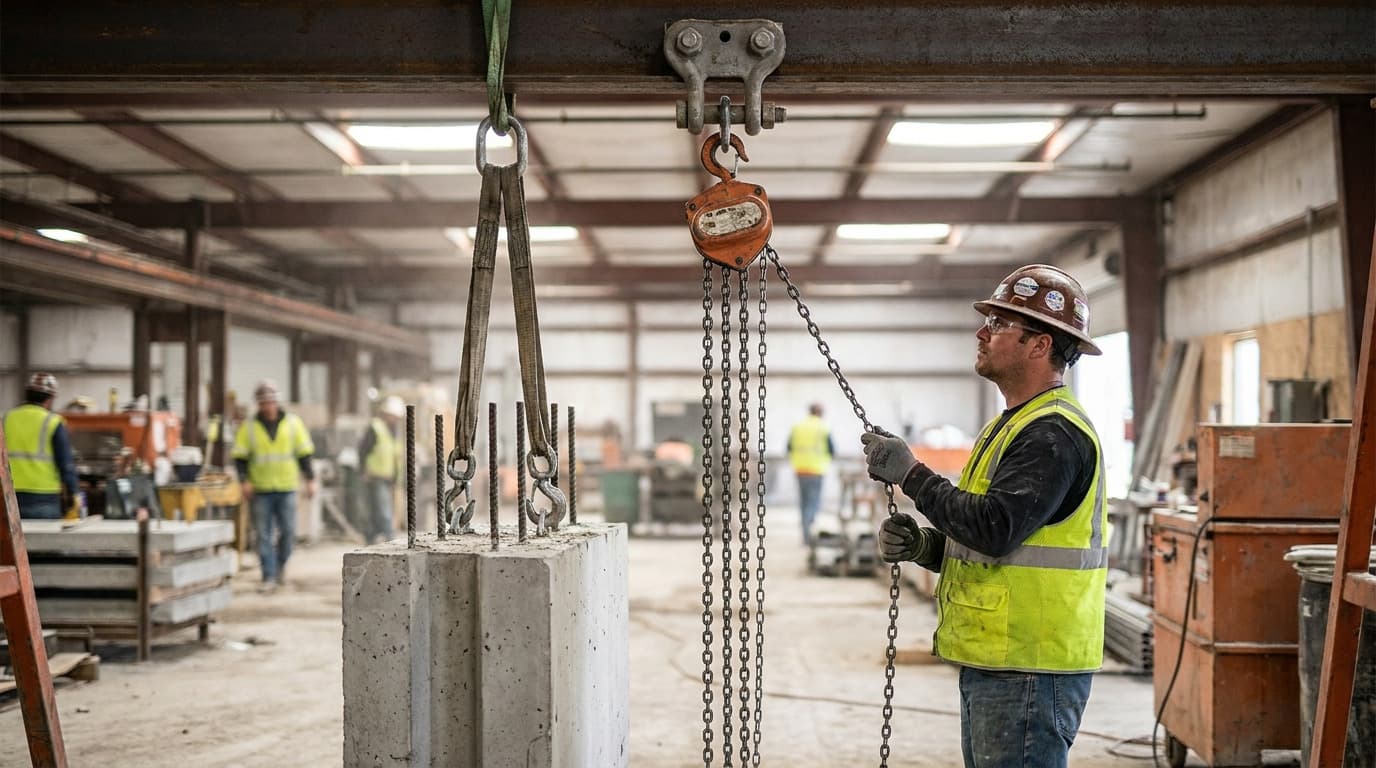
A chain hoist — a hand-chain hoist overhead, or a lever hoist (come-along) in the hand — is one of the most useful tools on a site and one of the most quietly abused. It multiplies one person's pull into tons of force, which is what makes it valuable and what makes it dangerous: the same mechanism that lifts a load far heavier than yourself will just as happily overload the hoist far past what it can survive, silently, through a handle that still turns. This Chain Hoist Safety Toolbox Talk (Safety Talk / Tailgate Talk) is about the one thing the tool is trying to tell you, and the habit that silences it.
Here is the distinction that carries this whole talk: a manual chain hoist is designed to be operated by one person's normal effort — and that is not a convenience, it is a built-in overload gauge. The engineering assumes one person of ordinary strength pulling the hand chain or the lever. When the load is within the hoist's rating, one person can move it. When the load is too heavy, one person cannot — and that resistance, the point where it takes two people or a pipe over the handle to make it move, is the hoist telling you the load exceeds what it is rated for. The cheater bar does not solve that problem. It silences the warning. Every extension on a lever handle and every second person on a hand chain is the act of overriding the one gauge the tool has.
Where the boundary of this talk sits#
The rigging inspections talk owns the general daily-inspection duty and the periodic record for all rigging, including the month-per-sling record for alloy chain slings. The wire rope inspection talk owns wire rope on cranes and hoists. The synthetic sling protection talk owns web and round slings. The crane and lifting talk owns powered crane operation. This talk owns the manual chain hoist as a lifting and pulling device — the hand-chain hoist and the lever hoist / come-along — how it is meant to be powered, how it warns you, and the specific misuses that defeat it. Where a separate chain sling does the rigging, that is the rigging inspection talk's ground, and this talk says so.
The cheater bar: silencing the gauge#
The single most dangerous habit with a lever hoist is the extension — a pipe slipped over the handle to get more leverage. It is worth being blunt about why, because on most sites it is treated as resourcefulness rather than what it is.
Manual hoists and lever tools are designed to lift under the power of one person. The manufacturer sizes the handle and mechanism so that one person of normal strength, pulling normally, reaches the rated capacity and no further — a deliberate design limit. So when the load will not move with normal effort, the tool is not failing; it is telling you the load is at or beyond its rating. A cheater bar does not add capacity — the gears, brake, load chain and hooks are all still rated for the same load. It just adds enough force to drive the mechanism past that rating while the person still feels comfortable. As one manufacturer puts it, needing more than normal hand effort is a sure sign you are overloading the hoist. The result is bent handles, stripped gearing, a failed brake, or a load chain that lets go — found out only when it broke.
The same logic rules out the quieter version: two people on a hand chain, or one person yanking. If one person cannot raise the load with a steady pull, the answer is a higher-capacity hoist or a different plan, not more muscle. The moment the effort stops being one person's normal pull, the built-in gauge has been overridden.
Never free-chain under load, never side-load#
Two more misuses defeat the tool in ways that are not obvious until they fail.
On a lever hoist, the free-chaining knob lets you pull the chain through quickly to take up slack — with no load on it. Turning that knob while a load is applied disengages the mechanism holding the load, and the load drops. It is a setup-only control, and using it under load is an explicit "never" in every lever-hoist manual. The related habit is letting the lever fly back — keep a firm grip through the full stroke, because a released lever under load can snap back with real force.
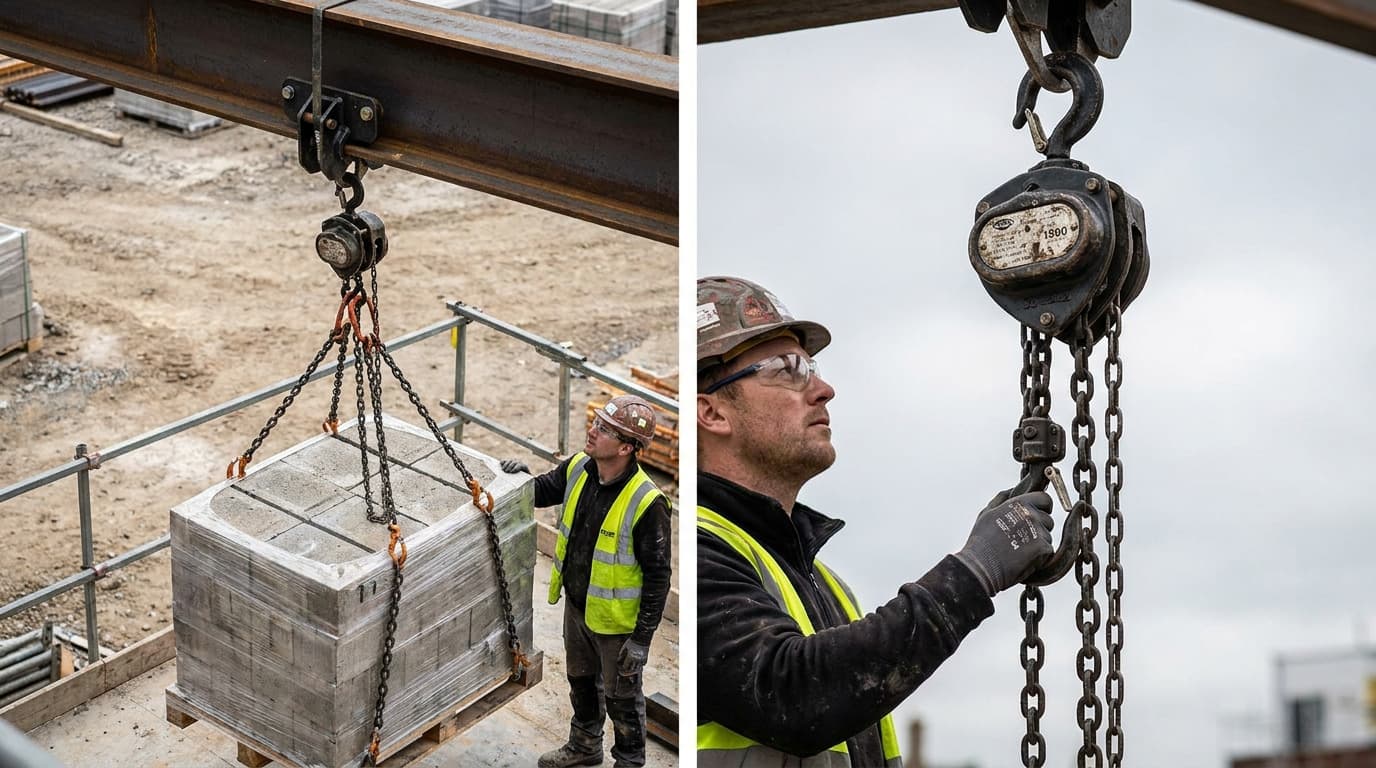
The second is side-loading. A chain hoist is built to lift straight down, the load hanging freely below the hook. Dragging a load sideways, pulling horizontally, or lifting at an angle applies force it was never designed to carry, and the angle multiplies it: a load well within the vertical rating can exceed it once a 45-degree pull adds sling tension and angle forces. The load must hang free and centered under the hook before you lift. And the load chain is not a sling — wrapping the hoist's own load chain around the load, or choking with it, damages the chain and the hoist both.
The tool is built to tell on itself#
Here is the part that turns inspection from a chore into something you can actually read. Manual hoist hooks and handles are designed to bend or stretch when overloaded — that deformation is not incidental damage, it is a built-in overload indicator. A hook that has opened up, a handle that is bent, a load chain whose links have stretched: each is physical evidence that the tool was loaded past its rating at some point, whether or not anyone admitted it. This is why a bent hook is never "still usable" — it is a record of an overload, and the next lift starts from already-compromised metal.
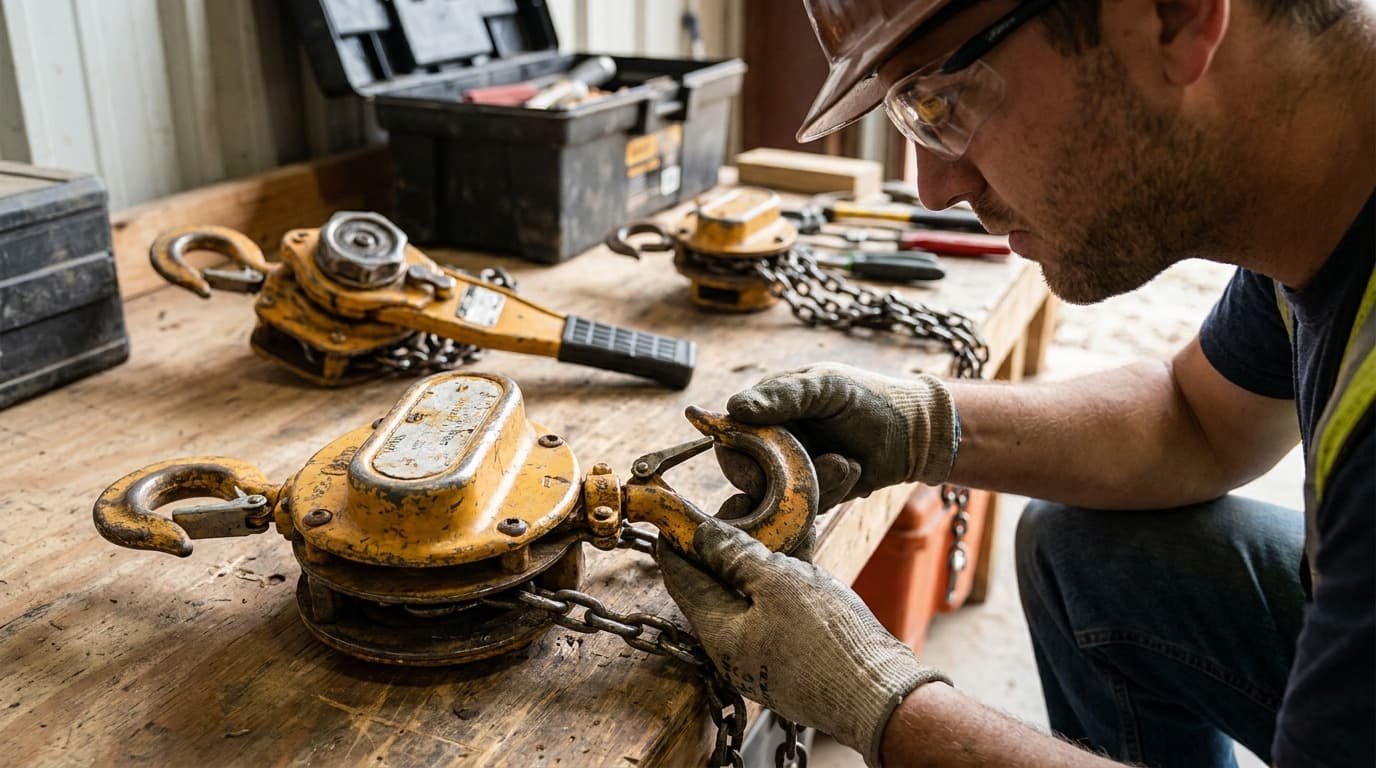
That reframes the frequent inspection before use: you are not just looking for dirt and obvious breaks, you are reading the tool for the marks of past abuse. On the hooks: opening, cracks, twist, a latch missing, bent or that will not close. On the load chain: stretched, worn, gouged, nicked or corroded links, and any link that is bent or does not articulate freely (a seized chain). On the hoist body: cracks, distortion, a bent lever, and a brake that shows any evidence of slipping — tested by taking a load slightly and confirming it holds without creeping. Any of these takes the hoist out of service now, not at the end of the shift.
Where the duty sits#
Chain hoists sit across OSHA construction rules and the ASME consensus standards the manufacturers build to.
Under OSHA, 1926.251(a)(1) requires rigging equipment — which includes the hoist and its rigging — to be inspected prior to use on each shift and as necessary during use, with defective equipment removed from service. 1926.251(b) governs alloy steel chain used for lifting: welded alloy chain slings need permanently affixed identification stating size, grade, rated capacity and manufacturer; whenever wear at any point of a chain link exceeds the manufacturer's allowable, the assembly is removed from service; and makeshift or "job or shop" hooks and links formed from bolts or rods must not be used — a homemade attachment has no rated capacity. 1926.251(f) governs hooks generally: follow the manufacturer's rated loads, and any hook with no manufacturer data must be proof-tested to twice the intended safe working load before first use. Overhead hoists in general are addressed at 1926.554, which requires that the safe working load shown on the hoist not be exceeded and that hooks match the manufacturer's recommendations.
The operating detail comes from the ASME B30 standards the tools are certified to: B30.16 for hand-chain and powered overhead hoists, B30.21 for lever hoists. These carry the one-person-power principle, the no-cheater-bar and no-side-load rules, the free-chaining prohibition under load, and the frequent/periodic inspection scheme. Manufacturers proof-test to 125% of rated capacity and certify to B30.16 or B30.21 — which is exactly why exceeding the marked capacity, or driving past it with a cheater bar, leaves the certified margin behind. On federal contract work, EM 385-1-1 carries its own hoist inspection, rated-capacity and operator requirements, generally at least as strict; where the manufacturer's manual or the contract is stricter, it governs. And for overhead lifting specifically, the hoist and its attachments should be alloy chain and rated components — not proof coil or hardware-store chain, which is not made for overhead lifting.
What can go wrong?#
- A cheater bar is slipped over the lever to move a load that would not move with normal effort, overloading the hoist silently.
- Two people pull a hand chain, or one person yanks it, defeating the one-person overload gauge.
- The free-chaining knob is pulled under load and the load drops.
- The hoist is used to drag or pull a load sideways, applying force it was never designed to carry.
- The hoist's own load chain is wrapped around the load or used as a choker.
- A bent hook or stretched chain is treated as cosmetic wear and kept in service, when it is evidence of a past overload.
- The brake slips and the load creeps, and the hoist is used anyway.
- A makeshift hook or a chain not rated for overhead lifting is used, with no real rated capacity behind it.
How do we manage this properly?#
- Size the hoist to the load first — never a cheater bar, never a second person on the chain; if it won't move with normal effort, get a bigger hoist or change the plan.
- Treat one person's normal effort as the overload gauge; the resistance is the tool telling you the load is too heavy.
- Never pull the free-chaining knob under load, and keep a firm grip through the full lever stroke to avoid fly-back.
- Lift straight down — load hanging free and centered under the hook; no side-pulling, dragging or angle lifting.
- Never use the hoist's load chain as a sling or wrap it around the load.
- Inspect before use for evidence of overload — opened hooks, bent handles, stretched or seized chain, a slipping brake — and remove from service on any of them, immediately.
- Use only alloy chain and rated components for overhead lifting; no makeshift hooks or unrated chain.
- Confirm the hoist's rated capacity is marked and legible, and that the load is genuinely below it.
Before you start#
- Confirm the load weight and that it is genuinely under the hoist's marked rated capacity.
- Confirm no cheater bar or second person is needed — and if it seems to be, stop and re-plan.
- Confirm the hoist has been inspected this shift: hooks, latches, load chain, brake, lever or hand chain.
- Confirm no hook is opened, no chain link is stretched or seized, and the brake holds without creeping.
- Confirm the load will hang free and centered under the hook, with no side-pull.
- Confirm you will not touch the free-chaining knob once a load is on.
- Confirm the chain and attachments are alloy and rated for overhead lifting.
- On federal work, confirm the EM 385-1-1 hoist and rated-capacity requirements are met.
Talk it over#
- On the hoist we are using, what is its rated capacity, and how does it compare to today's load?
- If a load will not move with a normal pull, what does that tell us — and what is the wrong response?
- Where is the free-chaining knob on this lever hoist, and what happens if it is pulled under load?
- Have you ever seen a hook that had opened up or a stretched chain? What did that tell you about its past?
The bottom line#
A manual chain hoist is designed to be operated by one person's normal effort, and that is a built-in overload gauge, not just a convenience. When the load will not move with a normal pull, the tool is not failing — it is telling you the load is at or beyond its rating, and the cheater bar (or a second person on the chain) does not add capacity; it silences that warning and drives the same rated gears, brake, chain and hooks past what they can survive, which is why the manufacturers call needing more than normal effort a sure sign of overloading. Two misuses fail without warning: pulling the free-chaining knob under load disengages what is holding the load and drops it, and side-loading — dragging, pulling horizontally, or lifting at an angle — applies forces the hoist was never built for, so the load must hang free and centered under the hook, and the hoist's load chain is never a sling. The tool is built to tell on itself: hooks and handles are designed to bend or stretch when overloaded, so an opened hook, a bent handle or a stretched chain is not cosmetic wear but evidence of a past overload — read the frequent inspection that way, and remove the hoist on any opened hook, stretched or seized chain, or a brake that creeps. The duties run through 1926.251(a) (inspect each shift, remove defective), 1926.251(b) (alloy chain identification, wear-based removal, no makeshift hooks), 1926.251(f) and 1926.554 (rated loads, hooks to manufacturer spec), and the ASME B30.16 / B30.21 standards the tools are certified to at 125% proof test. Use only alloy chain and rated components for overhead lifting. The test for any manual hoist is one question: if this load needs more than one person's normal effort to move, is the honest answer a bigger hoist — or is someone about to reach for a pipe?
Frequently asked questions about chain hoist safety#
Why can't I use a cheater bar on a lever hoist?
Because a manual hoist is designed to reach its rated capacity at one person's normal effort — that resistance is a built-in overload gauge. A cheater bar does not add capacity; the gears, brake, chain and hooks are still rated for the same load. It just adds enough force to drive them past their rating while you still feel comfortable, which is why needing more than normal effort is a sure sign you are overloading the hoist.
What does it mean if the load won't move with normal effort?
It means the load is at or beyond the hoist's rated capacity. That is the tool doing its job. The correct response is to stop and get a higher-capacity hoist or change the lift plan — not to add a cheater bar, a second person, or a harder yank, all of which override the warning rather than solving it.
What is free-chaining, and why is it dangerous under load?
Free-chaining is pulling the load chain through the lever hoist quickly to take up slack, using a knob that disengages the mechanism — it is a setup function meant for use with no load. Pulling or turning that knob while a load is applied disengages what is holding the load, and the load drops. Every lever-hoist manual lists it as a never-do-under-load item.
Can I use a chain hoist to pull a load sideways?
No. A chain hoist is built to lift straight down with the load hanging free and centered under the hook. Side-pulling, dragging or lifting at an angle applies forces it was never designed to carry, and the angle multiplies them — a load within the vertical rating can exceed it once angle and sling tension are added. Use equipment made for horizontal pulling instead.
Is a slightly bent hook still usable?
No. Hooks and handles are designed to bend or stretch when overloaded, so a bent hook or opened throat is physical evidence that the tool was loaded past its rating at some point. It is not cosmetic wear — it is a record of an overload, and the next lift would start from already-compromised metal. Remove it from service.
How often do I inspect a chain hoist?
The operator performs a frequent inspection before use — checking hooks, latches, load chain, brake, and the lever or hand chain — and the equipment gets periodic inspections on a schedule set by its service, documented. OSHA also requires rigging equipment to be inspected prior to use on each shift and removed from service if defective. Anything that shows overload evidence or a slipping brake comes out immediately.
What chain is safe for overhead lifting?
Only alloy steel chain and rated components made for overhead lifting, with permanently affixed identification stating size, grade, rated capacity and manufacturer. Proof coil, hardware-store chain, and makeshift hooks or links formed from bolts or rods must never be used overhead — they have no rated capacity behind them.
Download the chain hoist safety toolbox talk PDF#
Get this chain hoist safety toolbox talk as a print-ready PDF — available in English, Spanish, Portuguese, and Turkish. Print it, hand it to the crew, and collect signatures on the included attendance sheet.
Download the PDF — free account required. New members get 3 free downloads.
Related toolbox talks#
Sources#
- OSHA, 29 CFR 1926.251 — Rigging equipment for material handling: https://www.ecfr.gov/current/title-29/subtitle-B/chapter-XVII/part-1926/subpart-H/section-1926.251
- OSHA, 29 CFR 1926.554 — Overhead hoists: https://www.ecfr.gov/current/title-29/subtitle-B/chapter-XVII/part-1926/subpart-N/section-1926.554
- OSHA, Guidance on Safe Sling Use — Alloy Steel Chain Slings: https://www.osha.gov/safe-sling-use/alloy
This talk is general awareness guidance for training purposes. It does not replace your employer's rigging program, the hoist manufacturer's manual, ASME B30.16 or B30.21, or a competent or qualified person's inspection duties, and it is not legal advice. Where the manufacturer's instruction or a contract sets a specific limit, that limit governs.
Written by FieldSafetyTalk's safety professional — a CSP, ASP, CHST and OSHA Authorized Outreach Trainer with 14+ years of international construction safety experience across federal, heavy civil, and industrial projects.