Conveyor Safety
Updated 2026-08-06
In this bundle Vehicle Safety
Print-ready PDF
Download this talk as a print-ready PDF, available in 4 languages.
Most machine hazards have a place. A saw has a blade, a press has a point of operation, a grinder has a wheel — you guard the spot and you keep clear of it. A conveyor is not like that. The dangerous part is not a point you can stand away from; it is a moving line that runs the whole length of the belt, and every roller, pulley, and drum along it is another place the belt turns and pulls inward. This Conveyor Safety Toolbox Talk (Safety Talk / Tailgate Talk) is about why a conveyor is a hazard you work beside rather than at, why it draws you in instead of striking you, and why the controls that matter — the stop you can reach from anywhere, and locking it out before you reach in — are built around that difference.
Here is the distinction that carries this whole talk: a conveyor has no single dangerous point to guard — the nip runs the entire length of the belt, so the hazard is not a place you can stand clear of but a line you work beside, and it never stops reaching for what comes near it. A nip point is where the belt meets a roller or pulley and the two surfaces pull together and inward. On a conveyor there is not one of these; there is one at every roller, every drive pulley, every tail and take-up, all the way down. And they are all doing the same thing continuously: turning, drawing in, waiting for something to touch the moving surface. You cannot guard your way to a single safe point, because there is no single point — which is why conveyor safety is about the whole length: guarded nip points where people work, a stop reachable from anywhere along it, and never putting a hand near a running belt.
Where the boundary of this talk sits#
The machine guarding talk owns guarding moving parts in general. The lockout/tagout talk owns isolating energy for maintenance. The pinch points talk owns caught-between hazards broadly. This talk owns what is specific to conveyors — the continuous nip along the length, the drawing-in hazard, the length-long emergency stop, and the jam-clearing trap. Where the question is how to lock out the conveyor for maintenance, that is the lockout/tagout talk; this one owns why a conveyor is different from a machine you work at a single point.
The belt draws you in — it does not strike you#
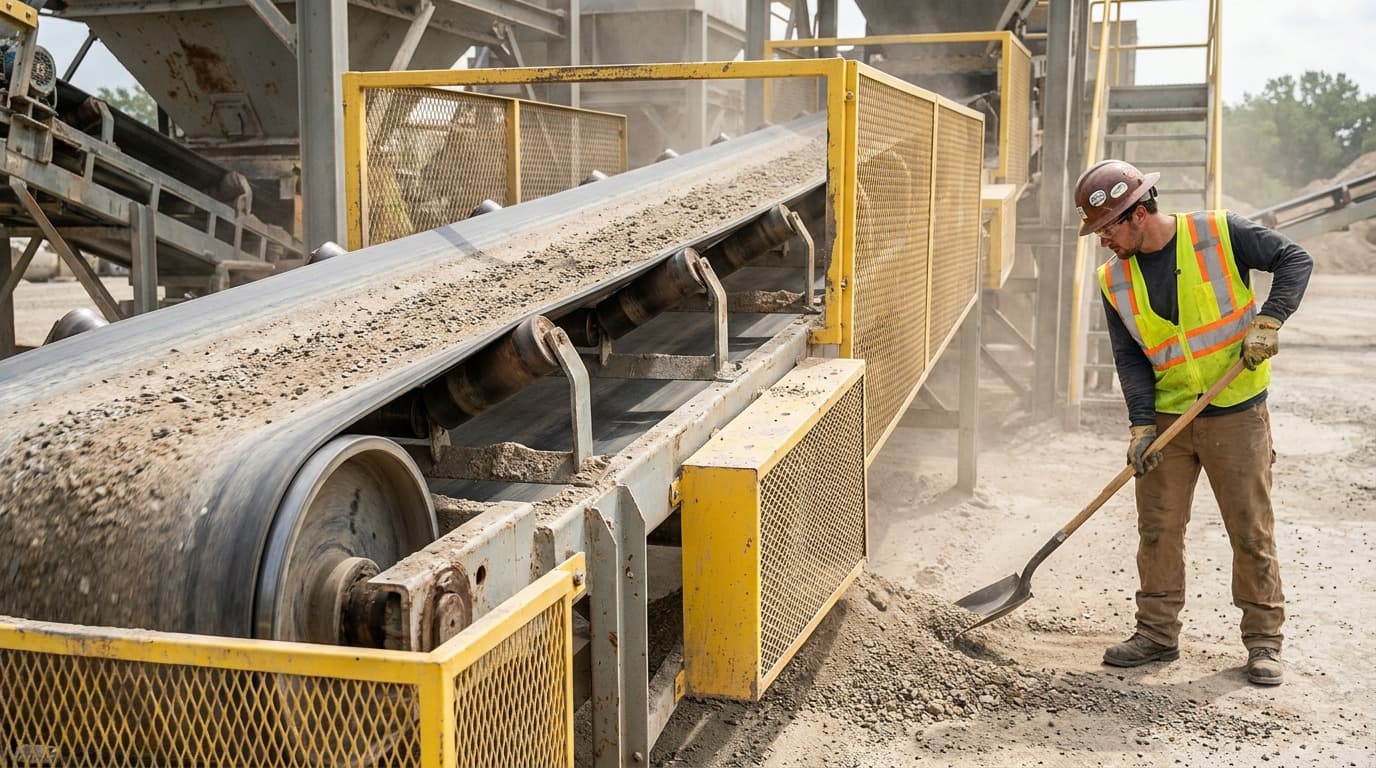
This is the second thing that makes a conveyor different, and it changes how injuries happen. A struck-by hazard hits you: contact is an impact, and then it is over. A conveyor nip does the opposite — it draws you in. A glove, a sleeve, a pull-cord on a jacket, a rag, or a strand of hair that touches a moving belt near a roller does not just get bumped; it gets caught and pulled into the nip, and whatever it is attached to follows. A hand follows a glove. An arm follows a sleeve. This happens in a fraction of a second, faster than you can pull back, because the belt is moving and you are not. That is why the rules around a running conveyor are so strict about what can come near it: no loose clothing, no dangling sleeves or drawstrings, no jewelry, no gloves near the moving belt, long hair tied back. The thing that gets caught first is small; the thing that follows it is you.
Never clear a jam on a running conveyor#
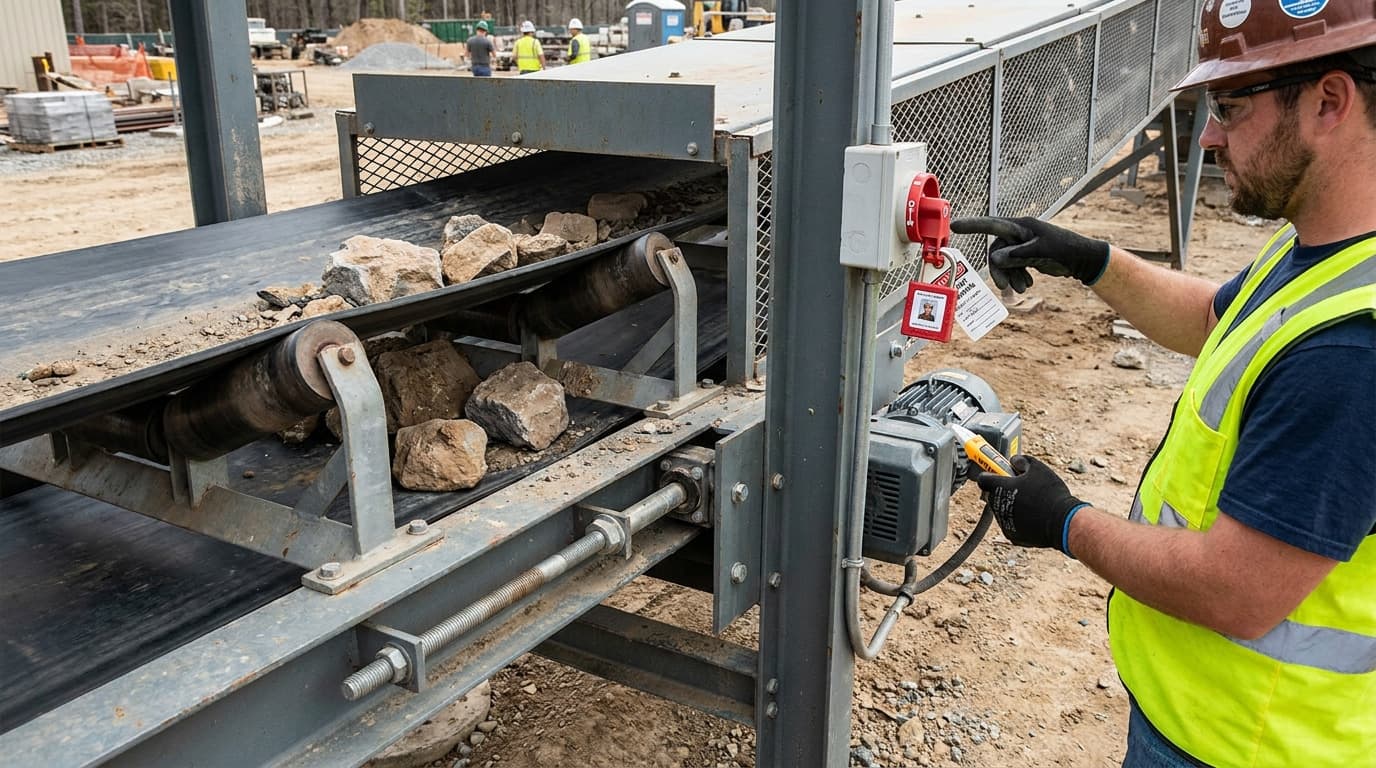
Almost every serious conveyor injury shares a story: the belt jammed or a piece of material got stuck, and someone reached in to clear it while it was still running. It is the most natural thing in the world — the jam is right there, the fix takes a second — and it is the way conveyors take hands and arms. A conveyor that is jammed is still energized, and the instant the obstruction clears, the belt lurches back into motion with your hand in the nip. Clearing a jam, freeing material, or reaching past a guard means the conveyor is locked out and tagged out first — the energy isolated, the stored energy released, the start control under your lock. The conveyor standard says this in so many words: conveyors must be locked out or otherwise rendered inoperable, and tagged out with a "Do Not Operate" tag during repairs and when operation is hazardous to employees performing maintenance work. That "Do Not Operate" tag is not paperwork; it is the thing standing between the belt and a restart while your hand is in it. There is no version of reaching into a running conveyor that is quick enough to be safe. If it is running, your hands stay out; if your hands must go in, it is not running and it cannot start.
The stop you can reach from anywhere#
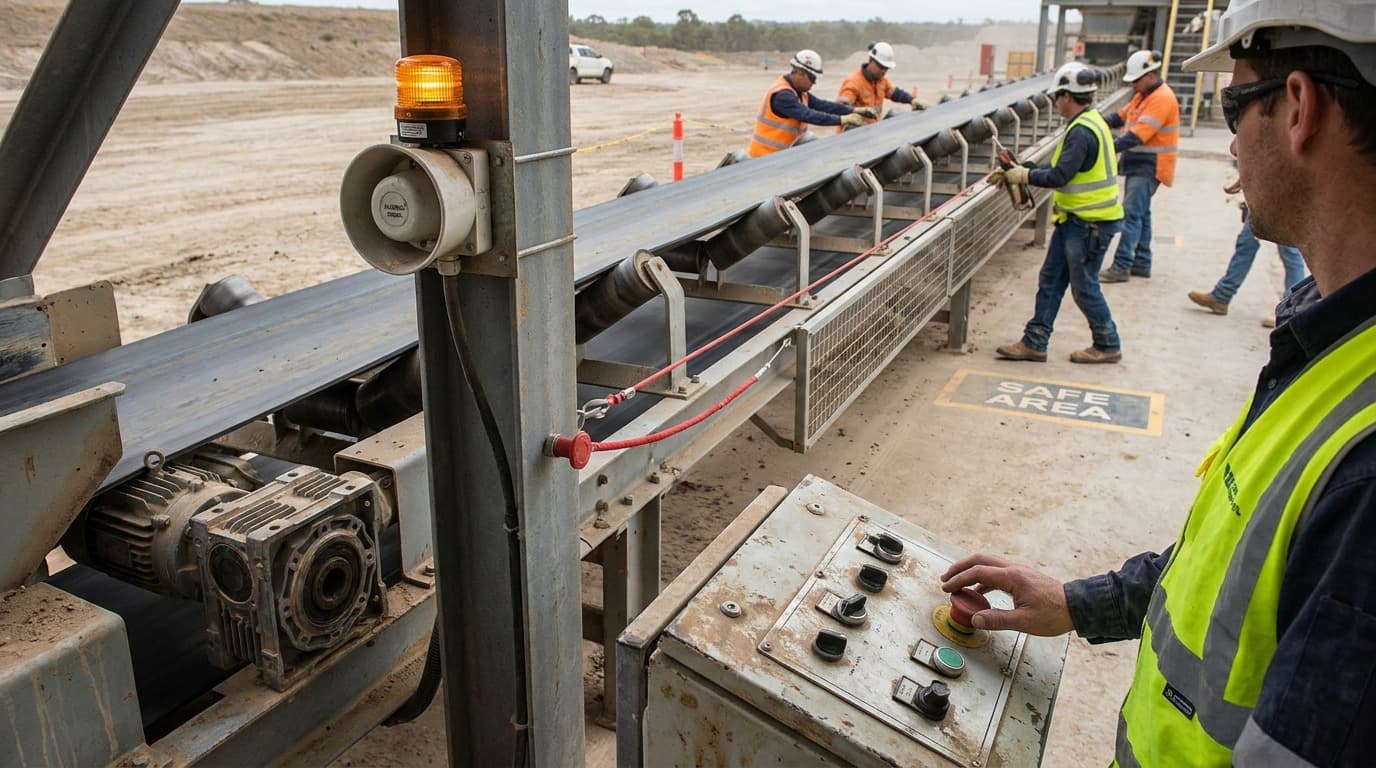
Because the hazard runs the whole length, a stop button back at the control panel is not enough — if you are caught fifty feet down the line, a stop you cannot reach does nothing. This is why conveyors are built with an emergency stop that works along the entire length: a pull-cord that runs beside the belt so the conveyor can be stopped from any position, and emergency-stop devices placed so they can be actuated wherever people work. Two things about that stop matter. First, it has to be reachable and unobstructed — a pull-cord blocked by stacked material or a guard is a stop that is not there when you need it. Second, an emergency stop is arranged so the conveyor cannot simply restart when the button is released — it has to be reset deliberately, so that whatever caused the stop is dealt with before the belt moves again. Know where the nearest stop is for the stretch of conveyor you are working near, before you need it.
The warning before it starts#
A conveyor is often long, often runs through areas where people cannot see the whole line, and often starts from a remote panel. So a person working down the line may have no idea the belt is about to move — which is why conveyor systems carry an audible warning signal that sounds immediately before startup. That signal is not a formality; it is the one moment of notice a worker down the line gets to clear hands, tools, and body from the belt before it moves. When you hear it, treat it as exactly that: the belt is about to run, get clear. And a conveyor started from a remote point must also have a way to stop the motor at the motor location, so that isolation is possible where the drive actually is.
Where the duty sits#
Conveyors have their own construction standard. 1926.555 requires a means to stop the motor at the operator's station and an audible warning signal sounded immediately before startup; where the operator's station is remote, stopping provisions at the motor location too; emergency stop switches arranged so the conveyor cannot restart until the switch is manually reset; screw conveyors guarded against contact with turning flights; and guards to protect employees who must work below a conveyor that passes over work areas. It also carries its own lockout requirement in 1926.555(a)(7): conveyors shall be locked out or otherwise rendered inoperable, and tagged out with a "Do Not Operate" tag during repairs and when operation is hazardous to employees performing maintenance work — a conveyor-specific mandate in the same standard, not just a reference to the general rule. And it adopts ANSI B20.1, the Safety Code for Conveyors, for design, inspection, maintenance, and operation. The general hazardous-energy standard, 1910.147 lockout/tagout, supplies the full isolation procedure that (a)(7) points to — the conveyor isolated and its start control locked before anyone reaches in. (OSHA does recognize a narrow minor-servicing exception for frequent, routine jam-clearing during normal production, where alternative measures such as putting a local disconnect in the off position may be used in place of full lockout — but that is a defined exception with its own conditions, not a license to reach into a running belt.) Behind these, 1926.21(b)(2) requires training and the General Duty Clause, Section 5(a)(1) covers recognized caught-in hazards. On federal contract work, EM 385-1-1 carries machinery and guarding provisions. Where a manufacturer's manual or site procedure sets specific requirements, those govern.
What can go wrong?#
- A worker reaches in to clear a jam or free material while the conveyor is running.
- Loose clothing, a sleeve, a drawstring, gloves, or hair contacts the moving belt and is drawn in.
- A hand or arm follows the caught item into a nip point at a roller or pulley.
- The emergency pull-cord is blocked by stacked material and cannot be reached when needed.
- Someone works down the line unaware the belt is about to start from a remote panel.
- A guard was removed for maintenance and the conveyor was not locked out first.
- A worker crosses over or under a conveyor at an unguarded point and is struck by falling material.
- The audible warning sounds and a worker does not treat it as "clear the belt now."
How do we manage this properly?#
- Treat the nip as running the whole length — there is no single safe point, so stay clear of the belt.
- Never clear a jam or reach past a guard on a running conveyor — lock out and tag out first.
- No loose clothing, sleeves, drawstrings, gloves, jewelry, or loose hair near the moving belt.
- Know where the nearest emergency stop / pull-cord is before you work near that stretch.
- Keep pull-cords and stop devices reachable and unobstructed along the length.
- Treat the audible startup warning as "the belt is about to move — get clear."
- Use guarded crossovers; never cross over or under a conveyor at an unguarded point.
- For any maintenance or guard removal, apply lockout/tagout and release stored energy.
Before you start#
- Confirm the crew knows the nip runs the whole length, not just at one point.
- Confirm no one clears jams or reaches past guards while the conveyor runs.
- Confirm clothing, gloves, and hair are secured away from the belt.
- Confirm the location of the nearest emergency stop or pull-cord for each work area.
- Confirm pull-cords and stops are reachable and unobstructed.
- Confirm the audible startup warning is working and the crew knows what it means.
- Confirm lockout/tagout is planned for any maintenance, jam, or guard removal.
- On federal work, confirm the EM 385-1-1 machinery provisions apply.
Talk it over#
- Where's the nearest pull-cord or emergency stop for the conveyor you work near?
- What's the temptation to reach in on this line, and what stops you from doing it?
- What are you wearing that could get caught in a moving belt?
- When you hear the startup warning, what do you do in that second?
The bottom line#
A conveyor has no single dangerous point to guard — the nip runs the entire length of the belt, so the hazard is not a place you can stand clear of but a line you work beside, and it never stops reaching for what comes near it. Unlike a saw or a press with one point of operation, a conveyor has a nip at every roller and pulley down its whole length, all turning and drawing inward continuously. And it does not strike you — it draws you in: a glove, sleeve, drawstring, or strand of hair that touches the moving belt is pulled into the nip, and your hand, arm, or body follows in a fraction of a second, which is why nothing loose goes near a running belt. The injury that repeats is clearing a jam on a running conveyor — so freeing material or reaching past a guard means the conveyor is locked out and tagged out first, never reached into while it can move. Because the hazard runs the length, the emergency stop runs the length too — a pull-cord reachable from any position, kept unobstructed, arranged so the belt cannot restart until it is deliberately reset — and the audible warning before startup is the one second of notice a worker down the line gets to clear the belt. The duty runs through 1926.555 (startup warning, length-long stop, guarding, ANSI B20.1) — including 1926.555(a)(7), the conveyor's own "Do Not Operate" lockout rule for repairs and maintenance — backed by 1910.147 for the full isolation procedure, with 5(a)(1) behind. The test for any worker near a conveyor is one question: if your glove caught the belt this second, is there anything loose on you that would pull your hand in — and could you reach a stop before it did?
Frequently asked questions about conveyor safety#
Why is a conveyor different from other machines?
Because the hazard is not at a single point. A saw or press has one point of operation you guard and keep clear of; a conveyor has a nip point — where the belt meets a roller or pulley and pulls inward — at every roller and pulley along its entire length. There is no one place to stand clear of, so conveyor safety is about the whole line: guarded nip points where people work, an emergency stop reachable from any position, and never putting anything near the moving belt. The length is the hazard.
What does "the belt draws you in" mean?
It means a conveyor nip is a caught-in, drawing-in hazard, not a struck-by impact. When something touches the moving belt near a roller — a glove, a sleeve, a drawstring, a rag, hair — it does not just get bumped; it gets caught and pulled into the nip, and whatever it is attached to follows. A hand follows a glove, an arm follows a sleeve, and it happens faster than you can pull back because the belt is moving and you are not. That is why nothing loose goes near a running conveyor.
Can I quickly clear a jam if I'm careful?
No. Reaching into a running conveyor to clear a jam is how conveyors take hands and arms, and being careful does not change it. A jammed conveyor is still energized, and the instant the obstruction frees, the belt lurches back into motion with your hand in the nip. Clearing a jam, freeing material, or reaching past a guard means the conveyor is locked out and tagged out first, with stored energy released and the start control under your lock. There is no version of reaching into a running conveyor that is quick enough to be safe.
Where are the emergency stops on a conveyor?
Because the hazard runs the whole length, the stop does too. Conveyors are built with a pull-cord that runs beside the belt so the conveyor can be stopped from any position along it, plus emergency-stop devices placed where people work. Two things matter: the pull-cord must be reachable and unobstructed — not blocked by stacked material or a guard — and the stop is arranged so the conveyor cannot restart until it is deliberately reset. Know where the nearest one is for the stretch you work near before you need it.
What is the audible warning before startup for?
A conveyor is often long and started from a remote panel, so a worker down the line may not know the belt is about to move. The audible warning signal that sounds immediately before startup is required precisely so they get that notice — it is the one moment to clear hands, tools, and body from the belt before it runs. Treat it as exactly that: when you hear it, the belt is about to move, so get clear. It is not a formality; it is a safety control doing its job.
Do I need to lock out a conveyor to work on it?
Yes, for anything that puts you in the danger zone — clearing a jam, maintenance, or removing a guard. Lockout/tagout isolates the conveyor from its energy sources and puts the start control under your personal lock, so it cannot start while you are reached in. You also release or restrain stored energy, such as a tensioned take-up or material that could shift. This talk covers why conveyors are different; the lockout/tagout talk covers the isolation procedure in full. The rule is simple: if your hands go in, it is locked out and cannot move.
Download the conveyor safety toolbox talk PDF#
Get this conveyor safety toolbox talk as a print-ready PDF — available in English, Spanish, Portuguese, and Turkish. Print it, hand it to the crew, and collect signatures on the included attendance sheet.
Download the PDF — free account required. New members get 3 free downloads.
Related toolbox talks#
Sources#
- OSHA, Conveyors — 1926.555 (stop control and audible warning before startup; emergency stop must be manually reset; guarding; (a)(7) lock out / "Do Not Operate" tag for repairs and maintenance; ANSI B20.1): https://www.osha.gov/laws-regs/regulations/standardnumber/1926/1926.555
- Cornell Legal Information Institute, 29 CFR 1926.555 — Conveyors (full text of the general requirements): https://www.law.cornell.edu/cfr/text/29/1926.555
- OSHA, The Control of Hazardous Energy (Lockout/Tagout) — 1910.147 (isolation before maintenance, jam-clearing, or guard removal): https://www.osha.gov/laws-regs/regulations/standardnumber/1910/1910.147
This talk is general awareness guidance for training purposes. It does not replace your employer's machinery or lockout/tagout program, the OSHA conveyor and hazardous-energy standards, the OSH Act General Duty Clause, ANSI B20.1, the manufacturer's manual, or a competent person's duties, and it is not legal advice. Where a manufacturer's manual or site procedure sets a stricter requirement, that requirement governs.
Written by FieldSafetyTalk's safety professional — a CSP, ASP, CHST and OSHA Authorized Outreach Trainer with 14+ years of international construction safety experience across federal, heavy civil, and industrial projects.