Hot Work
Updated 2026-07-24
In this bundle Fire, Hot Work & Emergency
Print-ready PDF
Download this talk as a print-ready PDF, available in 4 languages.
The fire you start today will probably not be in the room you are standing in. It will be behind the wall you are cutting, or a floor below through a gap you did not look at, or in a void you did not know existed — and it will not announce itself for an hour. This hot work talk is about a hazard that travels, hides, and waits.
Here is the distinction that carries this whole talk: nearly every other hazard on this site does its damage where you are, when it happens. Hot work is the opposite. The spark leaves, the slag falls, the heat conducts through steel and masonry into something you cannot see, and the consequence arrives after the crew has packed up and gone home. That delay is the entire reason hot work is controlled the way it is.
Thirty-five feet, and why it is not enough#
The number everyone knows comes from OSHA's general industry welding standard, and it is worth quoting exactly. Under 1910.252(a), where practicable, all combustibles shall be relocated at least 35 feet (10.7 m) from the work site. Where relocation is impracticable, combustibles shall be protected with flameproofed covers or otherwise shielded with guards or curtains.
The construction standard, 1926.352, gets to the same place by a different route:
- (a) When practical, the object being welded, cut, or heated shall be moved to a designated safe location — and if it cannot readily be moved, all movable fire hazards in the vicinity shall be taken to a safe place or otherwise protected.
- (b) If the object cannot be moved and the fire hazards cannot be removed, positive means shall be taken to confine the heat, sparks, and slag, and to protect the immovable hazards from them.
- (c) No welding, cutting, or heating shall be done where the application of flammable paints, the presence of other flammable compounds, or heavy dust concentrations creates a hazard.
- (d) Suitable fire extinguishing equipment shall be immediately available in the work area and maintained in a state of readiness for instant use.
Now the part crews get wrong. Thirty-five feet is a clearance distance, not a safety guarantee. Read the fire watch triggers in 1910.252(a) and notice that three of the four have nothing to do with material inside the radius:
- appreciable combustible material closer than 35 feet to the point of operation;
- appreciable combustibles more than 35 feet away but easily ignited by sparks;
- wall or floor openings within a 35-foot radius exposing combustible material in adjacent areas, including concealed spaces in walls or floors;
- combustible materials adjacent to the opposite side of metal partitions, walls, ceilings, or roofs, likely to be ignited by conduction or radiation.
Sparks fall, roll, bounce, and go through gaps. A clean 35-foot circle on the floor means nothing if there is a penetration in that circle leading somewhere else.
The side of the wall you cannot see#
This is the provision most worth memorising, and almost nobody quotes it.
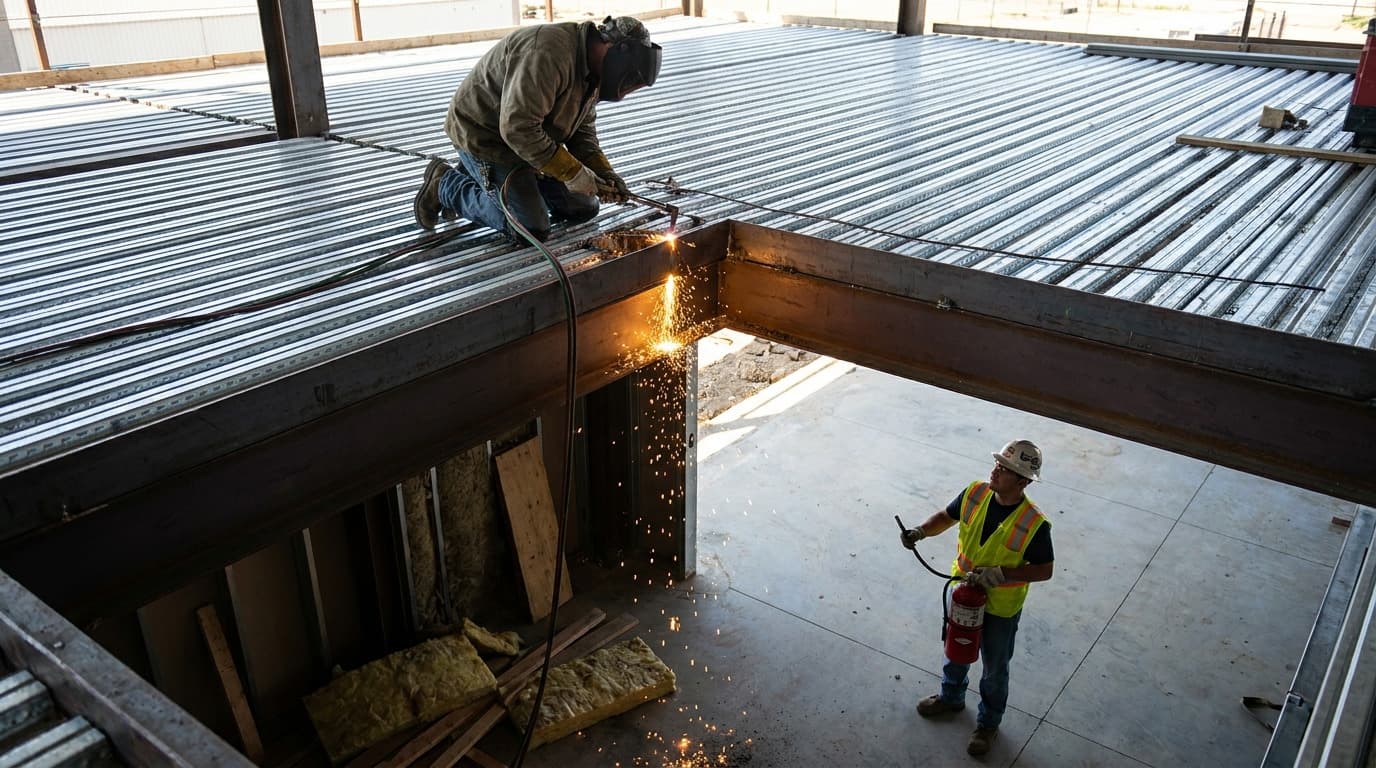
1926.352(f): when welding, cutting, or heating is performed on walls, floors, and ceilings, since direct penetration of sparks or heat transfer may introduce a fire hazard to an adjacent area, the same precautions shall be taken on the opposite side as are taken on the side on which the welding is being performed.
The same precautions. Not a glance. Not a note. Everything you did on your side — clearing combustibles, wetting down, covers, an extinguisher, a watcher — is required on the far side too.
Two mechanisms are named there and both matter:
Direct penetration. Sparks and molten slag find the gap. Service penetrations, cable trays, ductwork, gaps at the top of block walls, unsealed floor openings — a spark that drops through a half-inch hole lands in a place nobody is looking.
Heat transfer. You do not need a spark at all. Steel and masonry conduct. Cutting on one face of a member can raise the temperature enough on the other face to ignite what is pressed against it — insulation, timber packing, cladding, stored material. This is why 1910.252(a) lists combustibles adjacent to the opposite side of metal partitions as a fire watch trigger in their own right.
How long is the fire watch?#
Ask a crew this and you will get numbers: thirty minutes, an hour, whatever the permit says. OSHA gives no number at all, and what it gives instead is more demanding.
1926.352(e): when the operation is such that normal fire prevention precautions are not sufficient, additional personnel shall be assigned to guard against fire while the actual welding, cutting, or heating operation is being performed, and for a sufficient period of time after completion of the work to ensure that no possibility of fire exists.
Read the test. Not a duration — an outcome. A sufficient period of time to ensure that no possibility of fire exists. If the work involved a concealed void, a wall you could not see behind, or material that smoulders slowly, then the sufficient period is longer than the number on the form.
NFPA 51B, the consensus standard for fire prevention during welding, cutting and other hot work, is where fixed durations live, and the 2019 edition specifically added definitions distinguishing fire watch from fire monitoring and separated their requirements. Read the durations from the current edition and from your site's own permit system rather than from memory — this is an area where practice has changed and old training persists. The specific change worth knowing: the 2019 edition requires that a fire watch be maintained for 1 hour after completion of hot work operations (NFPA 51B, 5.6.1.1), which doubled the 30 minutes carried in earlier editions. So the thirty minutes most crews quote is now two things at once — a general industry figure from 1910.252, and a superseded NFPA figure. Where NFPA 51B is adopted by your authority having jurisdiction, your insurer, or your contract, the hour is the operative number, and the permit-authorising individual can extend it further on a hazard assessment. What does not change is OSHA's test: long enough that no possibility of fire exists.
And 1926.352(g) closes the gap people forget: in enclosed spaces, the gas supply to the torch must be positively shut off outside the enclosed space whenever the torch is not in use or is left unattended for a substantial period — the standard names the lunch break specifically.
What can go wrong#
The spark that travelled. Falling sparks and slag carry much further than horizontal ones, and roll when they land. Height multiplies the radius.
Openings inside the radius. Floor penetrations, drains, deck gaps, cable trays, and unsealed service holes — each one a route into a space nobody is watching.
The far side of the wall. Covered above. It is the single most common serious hot work fire on construction sites.
Concealed voids. Wall cavities, suspended ceilings, raised floors, insulation behind cladding. A smouldering fire in a void has time, oxygen, and no observer.
Slow-smouldering material. Insulation, sawdust, rags, cardboard, and packaging can smoulder for a long time before flaming — which is precisely why the watch outlasts the work.
Fire watch in name only. Someone nominated who is also welding, fetching, or on their phone; who has no extinguisher; who does not know how to raise the alarm; or who leaves with the crew.
Extinguisher present but not ready. 1926.352(d) says immediately available and maintained in a state of readiness for instant use — not in the truck, not blocked, not out of date.
Flammable atmospheres and residues. Freshly applied paints and coatings, solvent vapour, and heavy dust. Under (c) that is a stop condition, not a precaution to manage.
Cutting into or on a container. Anything that has held flammable or unknown contents is a separate, far more serious problem than general hot work.
Torch left live at a break. Named explicitly in (g), and it is a real fire and asphyxiation route in enclosed spaces.
The last cut of the day. Work finishes, the crew leaves, and the watch period gets shortened to zero because everyone wants to go home. The fire starts an hour later in an empty building.
How do we control hot work?#
Move the work, not the fire protection. 1926.352(a) puts relocating the object first for a reason. A cutting bay away from combustibles removes the problem instead of managing it.
Clear 35 feet — then look up, down, and through. Openings, penetrations, voids, drains, and the floor below. The circle is the start of the assessment, not the whole of it.
Do the far side properly. Physically go to the other side of the wall, floor, or ceiling. Clear it, cover it, wet it, and post someone if the standard's conditions are met. Same precautions, both sides.
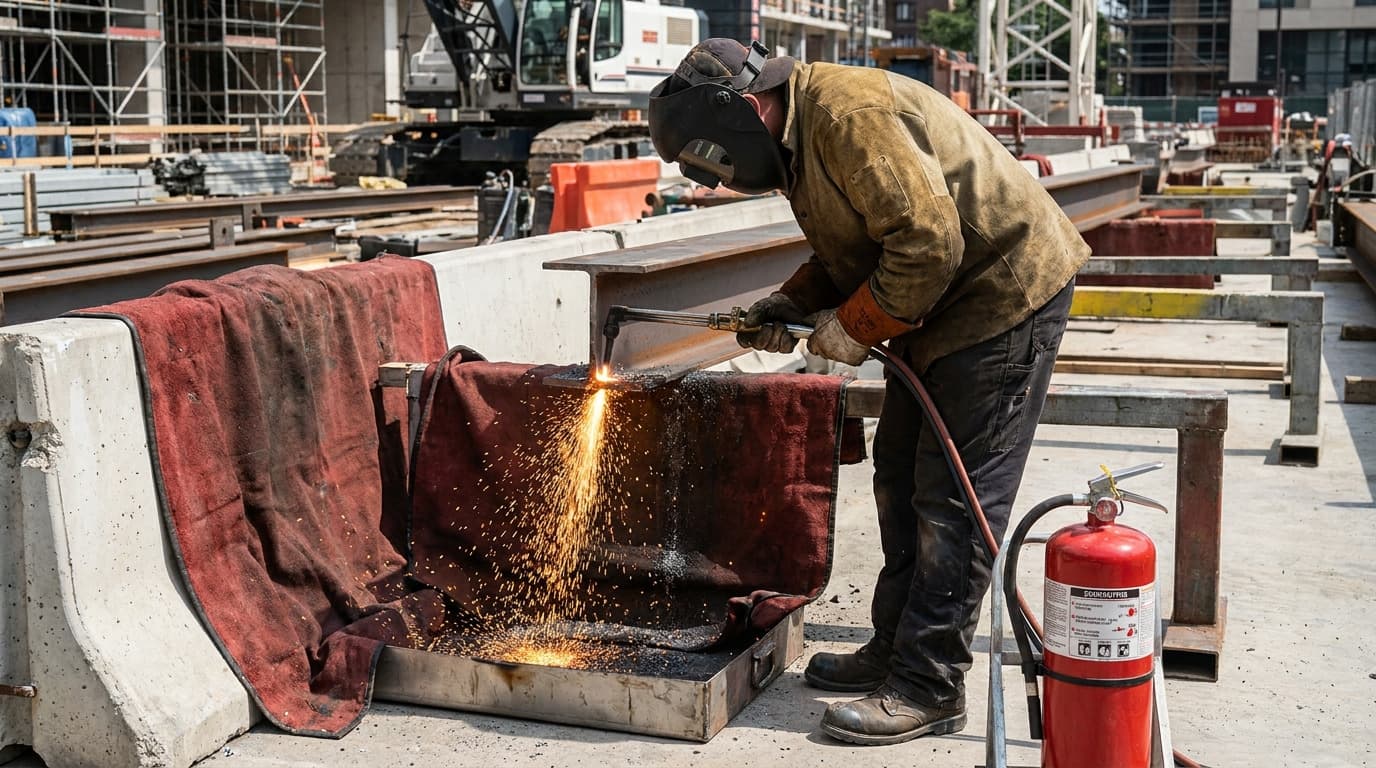
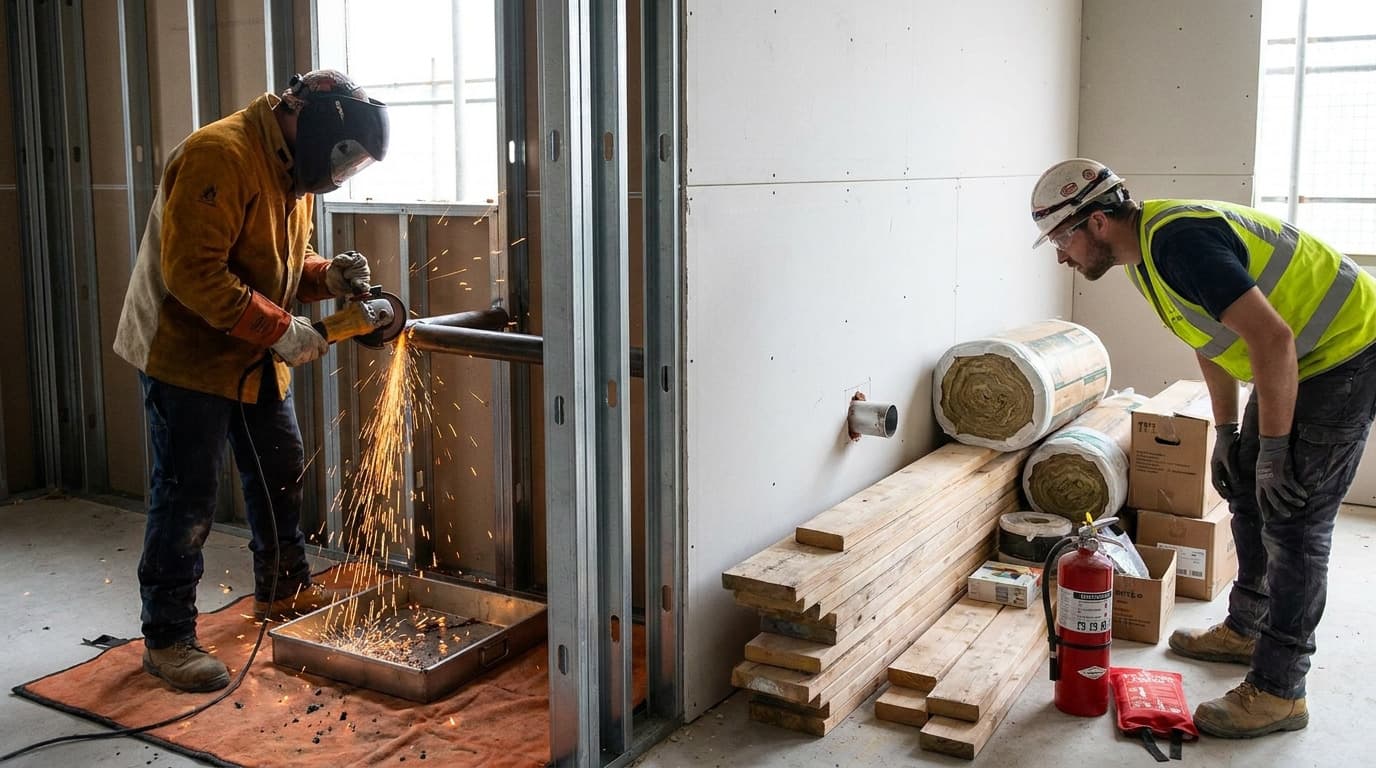
Cover and confine. Fire blankets, welding curtains, and non-combustible shielding to catch sparks and slag where combustibles cannot be moved — the "positive means" (b) requires.
Stop for flammables. Fresh coatings, solvents, heavy dust — under (c) hot work does not proceed.
Put the extinguisher in reach and check it. Immediately available, ready for instant use, and the person watching must know how to use it.
Give the fire watch nothing else to do. No welding, no fetching, no phone, no leaving early. They need an extinguisher, a way to raise the alarm, and line of sight to the areas that matter — including, where relevant, the far side.
Set the watch by the hazard, not by habit. Use the durations in your permit system and the current edition of NFPA 51B as a floor, and apply OSHA's test on top: long enough that no possibility of fire exists. Voids and concealed spaces mean longer.
Shut the gas off outside enclosed spaces at every break, per (g).
Walk it back before you leave. A final check of the work area, the far side, the level below, and anywhere sparks could have reached — by someone, in person, at the end.
On USACE and NAVFAC projects, EM 385-1-1 applies, along with any site hot work permit system, and is more prescriptive in several places.
Before you start#
- Can this object be moved to a designated safe location instead? Ask first.
- Clear combustibles to at least 35 feet (10.7 m), or shield what cannot be moved.
- Check for openings, penetrations, drains, and gaps inside that radius — and what is below them.
- Go to the opposite side of the wall, floor, or ceiling and apply the same precautions there.
- Check for concealed voids, cavities, suspended ceilings, and raised floors in the area.
- Confirm no flammable paints, compounds, or heavy dust are present.
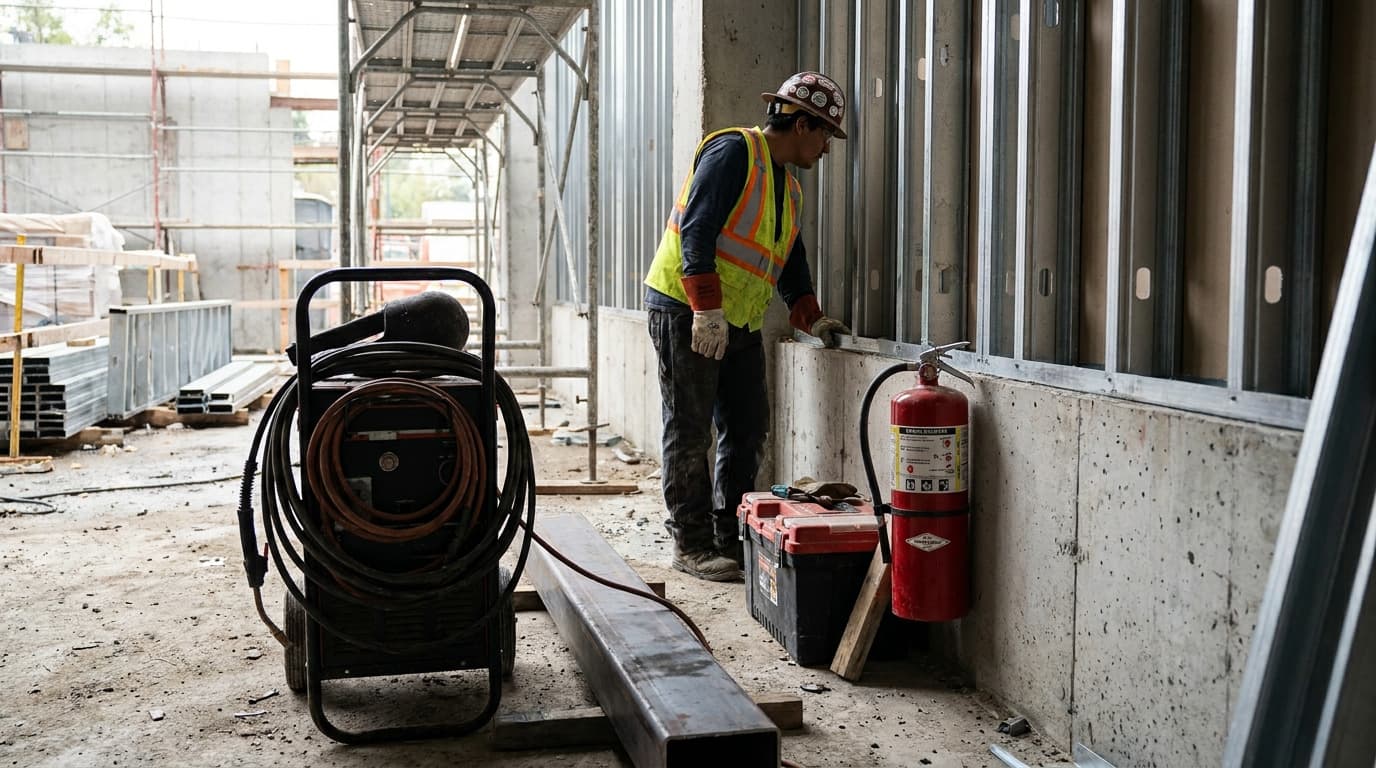
- Confirm suitable extinguishing equipment is in the work area and ready for instant use.
- Name the fire watch, confirm they have no other duties, and confirm they can raise the alarm.
- Agree the watch duration against the hazard, not just the form.
- Confirm the torch gas will be shut off outside any enclosed space at breaks.
Talk it over#
- What is directly on the other side of the surface you are about to cut? Has anyone been round to look?
- If a spark drops through that opening, where does it land, and who is watching that place?
- We are stopping at four o'clock. Who is still here at five, and why?
The bottom line#
Hot work is dangerous because the consequence is displaced in space and delayed in time. Clear combustibles to 35 feet (10.7 m) under 1910.252(a), and treat that circle as the beginning of the assessment rather than the end — openings, voids, and the level below all sit inside the hazard. 1926.352(f) requires the same precautions on the opposite side of any wall, floor, or ceiling you work on, because sparks penetrate and heat conducts. Keep extinguishing equipment ready for instant use under (d), stop entirely for flammable coatings or heavy dust under (c), and shut the gas off outside enclosed spaces at every break under (g). And on the fire watch, remember that OSHA gives no duration — it requires a sufficient period after the work to ensure that no possibility of fire exists. That is an outcome, and on a job with concealed voids it is longer than whatever is printed on the form.
Frequently asked questions about hot work#
What is the 35-foot rule for hot work?
Under 29 CFR 1910.252(a), where practicable all combustibles shall be relocated at least 35 feet (10.7 m) from the work site, and where relocation is impracticable they must be protected with flameproofed covers or otherwise shielded. In construction, 1926.352(a) and (b) require the object to be moved to a safe location where practical, movable fire hazards to be removed or protected, and — where neither is possible — positive means to confine the heat, sparks, and slag.
How long must a fire watch stay after hot work finishes?
OSHA does not specify a number. 29 CFR 1926.352(e) requires additional personnel to guard against fire during the work and for a sufficient period of time after completion of the work to ensure that no possibility of fire exists. That is an outcome test rather than a clock. Fixed durations come from NFPA 51B and from your site's hot work permit system — and the 2019 edition of NFPA 51B added definitions distinguishing fire watch from fire monitoring, so check the current edition rather than relying on remembered figures. The current figure is 1 hour: NFPA 51B (2019), 5.6.1.1, requires a fire watch to be maintained for 1 hour after completion of hot work, doubling the 30 minutes in earlier editions. Note that the familiar 30 minutes is the general industry requirement in 1910.252 — it is not the construction rule, and it is no longer the NFPA figure either.
Do I need to protect the other side of a wall I am cutting?
Yes. 29 CFR 1926.352(f) states that when welding, cutting, or heating is performed on walls, floors, and ceilings, the same precautions shall be taken on the opposite side as on the working side — because direct penetration of sparks or heat transfer may introduce a fire hazard to the adjacent area. 1910.252(a) reinforces this by listing combustibles adjacent to the opposite side of metal partitions, walls, ceilings, or roofs, likely to be ignited by conduction or radiation, as a condition requiring a fire watch.
When must hot work simply not proceed?
Under 29 CFR 1926.352(c), no welding, cutting, or heating shall be done where the application of flammable paints, the presence of other flammable compounds, or heavy dust concentrations creates a hazard. That is a prohibition rather than a risk to be managed with extra care.
What does "immediately available" mean for fire extinguishers?
29 CFR 1926.352(d) requires suitable fire extinguishing equipment to be immediately available in the work area and maintained in a state of readiness for instant use. An extinguisher in a vehicle, behind stored material, or without a current inspection does not satisfy that. The person on fire watch also needs to know how to use it.
What conditions require a dedicated fire watch?
1910.252(a) requires fire watchers wherever welding or cutting is performed in locations where other than a minor fire might develop, or where any of these apply: appreciable combustible material closer than 35 feet to the point of operation; appreciable combustibles more than 35 feet away but easily ignited by sparks; wall or floor openings within a 35-foot radius exposing combustible material in adjacent areas, including concealed spaces in walls or floors; or combustible materials on the opposite side of metal partitions, walls, ceilings, or roofs likely to be ignited by conduction or radiation.
What has to happen to the torch during breaks?
Under 29 CFR 1926.352(g), to eliminate fire in enclosed spaces from gas escaping through leaking or improperly closed torch valves, the gas supply to the torch must be positively shut off at a point outside the enclosed space whenever the torch is not to be used or is left unattended for a substantial period — the standard names the lunch period specifically.
Download the hot work toolbox talk PDF#
Get this hot work toolbox talk as a print-ready PDF — available in English, Spanish, Portuguese, and Turkish. Print it, hand it to the crew, and collect signatures on the included attendance sheet.
Download the PDF — free account required. New members get 3 free downloads.
Related toolbox talks#
Sources#
- OSHA, 29 CFR 1926.352 — Fire prevention: https://www.osha.gov/laws-regs/regulations/standardnumber/1926/1926.352
- OSHA, 29 CFR 1910.252 — General requirements (welding, cutting, and brazing): https://www.osha.gov/laws-regs/regulations/standardnumber/1910/1910.252
- NFPA, NFPA 51B — Standard for Fire Prevention During Welding, Cutting, and Other Hot Work