Leading Edge Work
Updated 2026-07-24
In this bundle Fall Protection & Heights
Print-ready PDF
Download this talk as a print-ready PDF, available in 4 languages.
Every other fall hazard on this site is where you left it. The stair opening was in that spot yesterday and will be tomorrow. The roof edge has not moved since the steel went up. A leading edge is the only fall hazard on a construction site that travels — it advances with every sheet of decking, every panel, every pour, sometimes several feet in an hour. Protection that is correct at 8 a.m. can be forty feet behind the hazard by lunch. This Leading Edge Work Toolbox Talk (Safety Talk / Tailgate Talk) is about a hazard that moves faster than the controls usually do.
Here is the distinction that carries the whole talk: with a fixed edge, you protect it once and it stays protected. With a leading edge, protection is not an installation — it is a process that has to keep pace. And because keeping pace is genuinely hard, leading edge work is one of only three activities in all of Subpart M where OSHA even entertains the idea of working without conventional fall protection. That exception is real. It is also far narrower than most crews believe, and the standard puts the burden of proving it squarely on the employer.
The definition that expires#
Start with the words, because the definition contains a trap that catches experienced crews.
29 CFR 1926.500(b) defines a leading edge as the edge of a floor, roof, or formwork for a floor or other walking/working surface (such as the deck) which changes location as additional floor, roof, decking, or formwork sections are placed, formed, or constructed. Then it adds one more sentence, and this is the one to memorise:
A leading edge is considered to be an "unprotected side and edge" during periods when it is not actively and continuously under construction.
Read that again. The special status is conditional and temporary. An edge is a "leading edge" only while work on it is actively and continuously progressing. The moment the crew breaks for lunch, waits on a crane pick, shuts down for weather, or knocks off for the day, that edge stops being a leading edge and becomes an ordinary unprotected side or edge — governed by 1926.501(b)(1), with the full conventional fall protection duty and none of the alternatives.
This is where sites get cited. The alternative measures — controlled access zones, safety monitors, a fall protection plan — are tied to active leading edge work. They do not cover the deck at 12:15 p.m. They do not cover the following morning before the crew restarts. An edge left open overnight is not a leading edge; it is just an open edge.
What the standard requires#
- Workers building the edge — 1926.501(b)(2)(i). Each employee constructing a leading edge 6 feet (1.8 m) or more above lower levels shall be protected by guardrail systems, safety net systems, or personal fall arrest systems. Exception: where the employer can demonstrate it is infeasible or creates a greater hazard to use those systems, the employer shall develop and implement a fall protection plan meeting 1926.502(k).
- Everyone else on that deck — 1926.501(b)(2)(ii). Each employee on a walking/working surface 6 feet or more above a lower level where leading edges are under construction but who is not engaged in the leading edge work must also be protected by guardrail, safety net, or personal fall arrest. If guardrails are chosen and a controlled access zone has already been established for the leading edge work, the control line may be used in lieu of a guardrail along the edge that parallels the leading edge. Note what this paragraph does: the exception in (b)(2)(i) belongs to the people building the edge. It does not extend to the labourer carrying material across the same deck.
And now the provision that decides most disputes. 1926.501(b)(2) carries a Note in the regulation itself:
There is a presumption that it is feasible and will not create a greater hazard to implement at least one of the above-listed fall protection systems. Accordingly, the employer has the burden of establishing that it is appropriate to implement a fall protection plan which complies with § 1926.502(k) for a particular workplace situation, in lieu of implementing any of those systems.
That is a burden of proof written into a safety standard. The default assumption is that conventional fall protection works. If you want to work without it, you do not have to be inconvenienced by guardrails — you have to establish that they cannot be used here.
And "infeasible" does not mean difficult. 1926.500(b) defines it: impossible to perform the construction work using a conventional fall protection system, or technologically impossible to use any one of these systems to provide fall protection. Impossible. Not slower, not costlier, not awkward. That is the bar the presumption has to be beaten with.
The 1926.502(k) fall protection plan#
If the bar is genuinely met, the plan route opens — and it is a real document, not a form.
- Available for three activities only. Leading edge work, precast concrete erection, and residential construction — 1926.501(b)(2), (b)(12), and (b)(13). Nothing else in Subpart M gets this option.
- (k)(1) The plan shall be prepared by a qualified person and developed specifically for the site where the work is performed, and kept up to date. A generic company plan pulled from a binder does not satisfy this.
- (k)(2) Any changes must be approved by a qualified person.
- (k)(8) Where no other alternative measure has been implemented, the employer shall implement a safety monitoring system conforming to 1926.502(h) — which requires a competent person designated to monitor.
- Appendix E to Subpart M gives OSHA's non-mandatory sample plan and shows the elements any plan must address. Worth reading before writing one; note its sample limits one safety monitor to six workers, which is illustrative rather than a regulatory cap.
Controlled access zones — 1926.502(g)#
Where a controlled access zone is used to control access to leading edge work, the geometry is specified:
- The zone is defined by a control line or other means restricting access.
- Control lines shall be erected not less than 6 feet (1.8 m) nor more than 25 feet (7.7 m) from the unprotected or leading edge — except when erecting precast concrete members, where the range is not less than 6 feet nor more than 60 feet (18 m) or half the length of the member being erected, whichever is less.
- The control line shall extend the entire length of the unprotected or leading edge and be approximately parallel to it.
- Where guardrails are already in place but must be removed for leading edge work, only the portion necessary to accomplish that day's work shall be removed.
That last one is the practical control most often ignored: you take out the rail you need for today, not the rail for the whole elevation.
On USACE and NAVFAC projects, EM 385-1-1 applies and is more restrictive than Subpart M in several places — do not assume the (k) plan route transfers onto a federal job.
What can go wrong#
Protection that stops moving. Anchors, nets, and rails installed for where the edge was this morning. The work advanced; the controls did not. This is the defining failure of the topic.
Treating the (k) plan as a permission slip. A plan copied from another job, unsigned by a qualified person, or written once and never updated. Under (k)(1) it must be site-specific and current, and under the Note the employer carries the burden of proving the plan was appropriate at all.
"Infeasible" used to mean inconvenient. Guardrails slow the pick. Nets take a day to hang. Neither of those is impossible, and neither meets 1926.500(b).
The lunch-break gap. The single most common citation pattern in this topic. Work stops, the edge reverts to an unprotected side and edge under the definition, and the controlled access zone is no longer the applicable control.
Extending the exception to bystanders. The pipefitter, the welder, the labourer moving stock across the deck are covered by (b)(2)(ii), not by the leading edge exception. They need conventional protection.
Control lines at the wrong distance. Closer than 6 feet or further than 25 feet from the edge fails 1926.502(g), and on precast the range is different again. A line set by eye is usually wrong.
Removing more guardrail than today needs. Stripping an entire elevation of rail because it will all come out eventually.
Anchors that cannot keep up. As the deck advances, tie-off points get further away, lanyards get longer, swing potential grows, and someone starts improvising. Anchorage still has to satisfy 1926.502(d)(15).
Sharp new edges. A leading edge is freshly cut steel, decking, or formwork — exactly the surfaces that destroy a lifeline under load. Standard self-retracting lifelines are not built to be dragged over an edge; edge-rated devices exist for this and are not interchangeable with ordinary ones.
Nobody watching the monitor. Where a safety monitoring system is the control, it fails quietly when the competent person is given a second job, loses line of sight, or ends up supervising too many people.
How do we control leading edge work?#
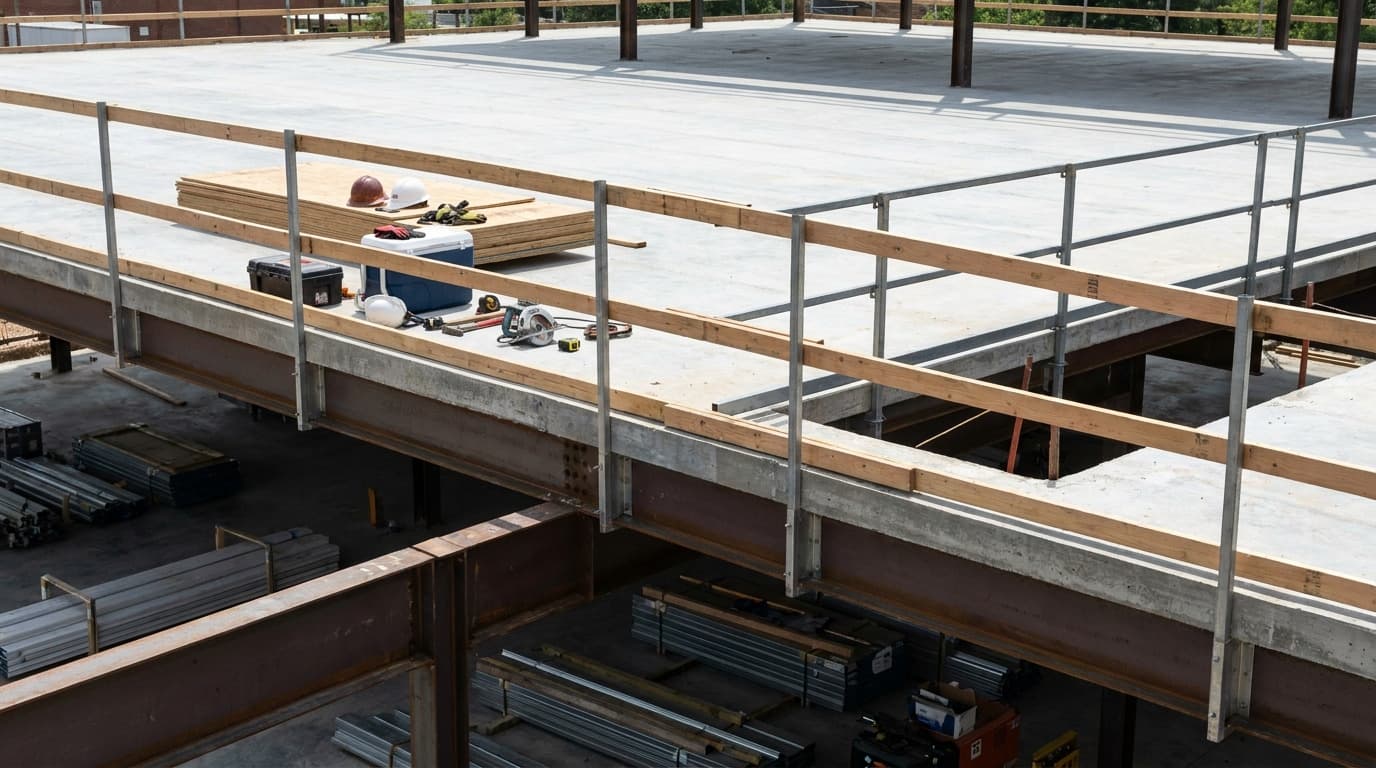
Start from the presumption, not the exception. Ask first how guardrails, nets, or personal fall arrest can be made to work here. The standard says they are presumed feasible, so that has to be the opening position rather than the fallback.
Move the protection with the edge, on a schedule. Assign it. Whoever advances the deck advances the controls, and the interval is defined — not "when we get to it."
Install perimeter guardrail behind the advancing edge as you go, so completed deck is conventionally protected and the exposed zone shrinks to the working face only.
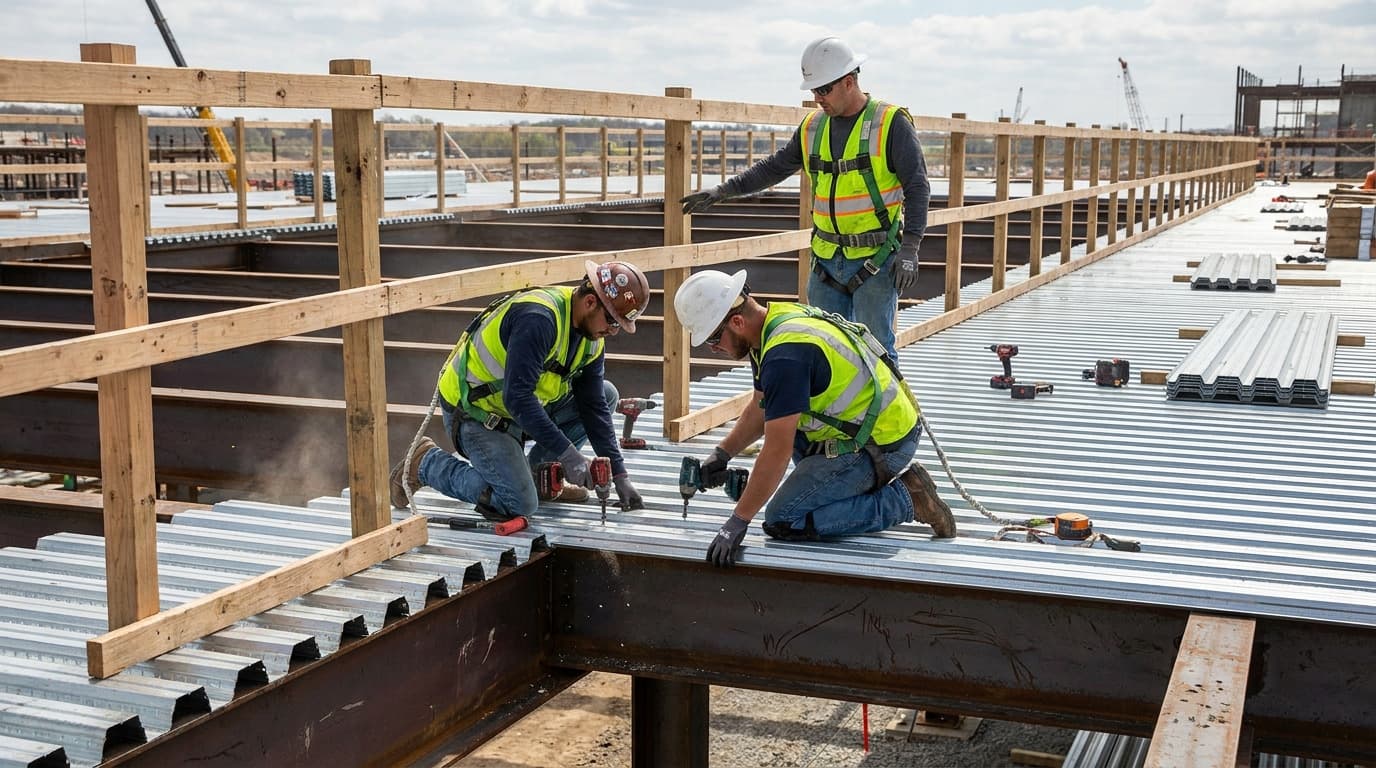
If you need a (k) plan, get a qualified person to write it for this site. Documented reasons why conventional protection is infeasible or creates a greater hazard, the alternative measures, the locations classified as controlled access zones, and roles assigned by name. Then keep it current.
Set control lines by measurement. Between 6 and 25 feet from the edge for leading edge work; the precast range differs. Full length of the edge, approximately parallel.
Restrict the zone to the people who belong in it, and give everyone else on the deck conventional protection under (b)(2)(ii).
Remove only the guardrail today's work requires.
Use edge-rated equipment at the edge, and protect any line that will bear on new steel or decking.
Close the edge out before every break and at the end of every shift. The moment work stops the definition changes, so the control has to change with it. Build that into the routine rather than leaving it to whoever is last down.
Re-brief when the edge moves significantly, because the anchors, the swing path, the clearance below, and the control line position have all changed with it.
Before you start#
- Confirm where the leading edge is right now, and where it will be by the end of the shift.
- Confirm what protects the people building the edge, and separately what protects everyone else on the deck.
- If a (k) plan is in use, confirm it is site-specific, current, and prepared by a qualified person.
- Confirm control lines are between 6 and 25 feet from the edge, full length, approximately parallel.
- Confirm only the guardrail needed for today's work has been removed.
- Confirm who the safety monitor is, that they have no other duties, and that they can see everyone.
- Confirm anchor points will still be usable when the edge has advanced.
- Confirm you are using edge-rated equipment where a line could bear on the edge.
- Confirm what happens to this edge at lunch and at the end of shift, and who does it.
- Confirm the clearance below the edge, which changes as the structure changes.
Talk it over#
- Where will this edge be in four hours — and what will be protecting it then?
- When we break for lunch, this stops being a leading edge and becomes an ordinary unprotected edge. What changes about how it is guarded?
- If someone asked you to prove that guardrails are impossible here, not just awkward, what would you say?
The bottom line#
A leading edge is the only fall hazard that moves, and 1926.500(b) says it is only a leading edge while work is actively and continuously progressing — the rest of the time it is an ordinary unprotected side and edge with the full duty attached. Workers building the edge need guardrails, nets, or personal fall arrest under 1926.501(b)(2)(i); everyone else on that deck needs the same under (b)(2)(ii). The 1926.502(k) fall protection plan exists, but the standard states there is a presumption that conventional protection is feasible and puts the burden on the employer to establish otherwise — and 1926.500(b) defines infeasible as impossible, not difficult. So advance the protection with the edge, guardrail behind the working face as you go, measure your control lines, remove only the rail today needs, and close the edge out before every break.
Frequently asked questions about leading edge work#
What is a leading edge under OSHA?
29 CFR 1926.500(b) defines a leading edge as the edge of a floor, roof, or formwork for a floor or other walking/working surface which changes location as additional floor, roof, decking, or formwork sections are placed, formed, or constructed. Critically, the same definition states that a leading edge is considered an "unprotected side and edge" during periods when it is not actively and continuously under construction.
Does a leading edge stop being a leading edge?
Yes — whenever active, continuous work on it stops. At a break, waiting on a pick, during a weather shutdown, or at the end of the shift, the edge reverts to an ordinary unprotected side or edge under 1926.501(b)(1), and the alternatives tied to leading edge work no longer apply. This is one of the most common enforcement findings in leading edge work.
What fall protection is required for leading edge work?
Under 1926.501(b)(2)(i), each employee constructing a leading edge 6 feet (1.8 m) or more above lower levels must be protected by a guardrail system, safety net system, or personal fall arrest system. Only where the employer can demonstrate it is infeasible or creates a greater hazard may a 1926.502(k) fall protection plan be used instead.
Can I use a fall protection plan instead of guardrails or a harness?
Only rarely, and the burden is on the employer. The Note to 1926.501(b)(2) states there is a presumption that it is feasible and will not create a greater hazard to use at least one conventional system, and that the employer has the burden of establishing that a 1926.502(k) plan is appropriate instead. The plan option exists only for leading edge work, precast concrete erection, and residential construction.
What does OSHA mean by "infeasible"?
29 CFR 1926.500(b) defines infeasible as meaning that it is impossible to perform the construction work using a conventional fall protection system, or that it is technologically impossible to use any one of those systems to provide fall protection. Difficulty, cost, and inconvenience do not meet this definition.
How far from the edge should a control line be?
Under 1926.502(g), control lines for a controlled access zone must be erected not less than 6 feet (1.8 m) nor more than 25 feet (7.7 m) from the unprotected or leading edge — except when erecting precast concrete members, where the distance is not less than 6 feet nor more than 60 feet (18 m) or half the length of the member being erected, whichever is less. The line must run the entire length of the edge and be approximately parallel to it.
Do workers who are not building the edge need fall protection?
Yes. 1926.501(b)(2)(ii) requires each employee on a walking/working surface 6 feet or more above a lower level where leading edges are under construction but who is not engaged in that work to be protected by a guardrail system, safety net system, or personal fall arrest system. Where guardrails are chosen and a controlled access zone already exists for the leading edge work, the control line may be used in lieu of a guardrail along the edge that parallels the leading edge.
Download the leading edge work toolbox talk PDF#
Get this leading edge toolbox talk as a print-ready PDF — available in English, Spanish, Portuguese, and Turkish. Print it, hand it to the crew, and collect signatures on the included attendance sheet.
Download the PDF — free account required. New members get 3 free downloads.
Related toolbox talks#
Sources#
- OSHA, 29 CFR 1926.500 — Scope, application, and definitions: https://www.osha.gov/laws-regs/regulations/standardnumber/1926/1926.500
- OSHA, 29 CFR 1926.501 — Duty to have fall protection: https://www.osha.gov/laws-regs/regulations/standardnumber/1926/1926.501
- OSHA, 29 CFR 1926.502 — Fall protection systems criteria and practices: https://www.osha.gov/laws-regs/regulations/standardnumber/1926/1926.502
- OSHA, 1926 Subpart M Appendix E — Sample Fall Protection Plan: https://www.osha.gov/laws-regs/regulations/standardnumber/1926/1926SubpartMAppE
Written by FieldSafetyTalk's safety professional — a CSP, ASP, CHST and OSHA Authorized Outreach Trainer with 14+ years of international construction safety experience across federal, heavy civil, and industrial projects.