Language Barriers
Updated 2026-08-06
In this bundle Jobsite Fundamentals & Compliance
Print-ready PDF
Download this talk as a print-ready PDF, available in 4 languages.
Every crew has watched it happen. The supervisor runs through the plan, asks "everyone good?", gets a row of nods, and the tools come out. On a crew that shares one language those nods carry some information; on a crew that does not, they may carry almost none — and the nod is identical either way. This language barriers talk is about the difference between delivering a safety message and confirming it was received, and about what OSHA actually requires when the crew does not all speak the same language.
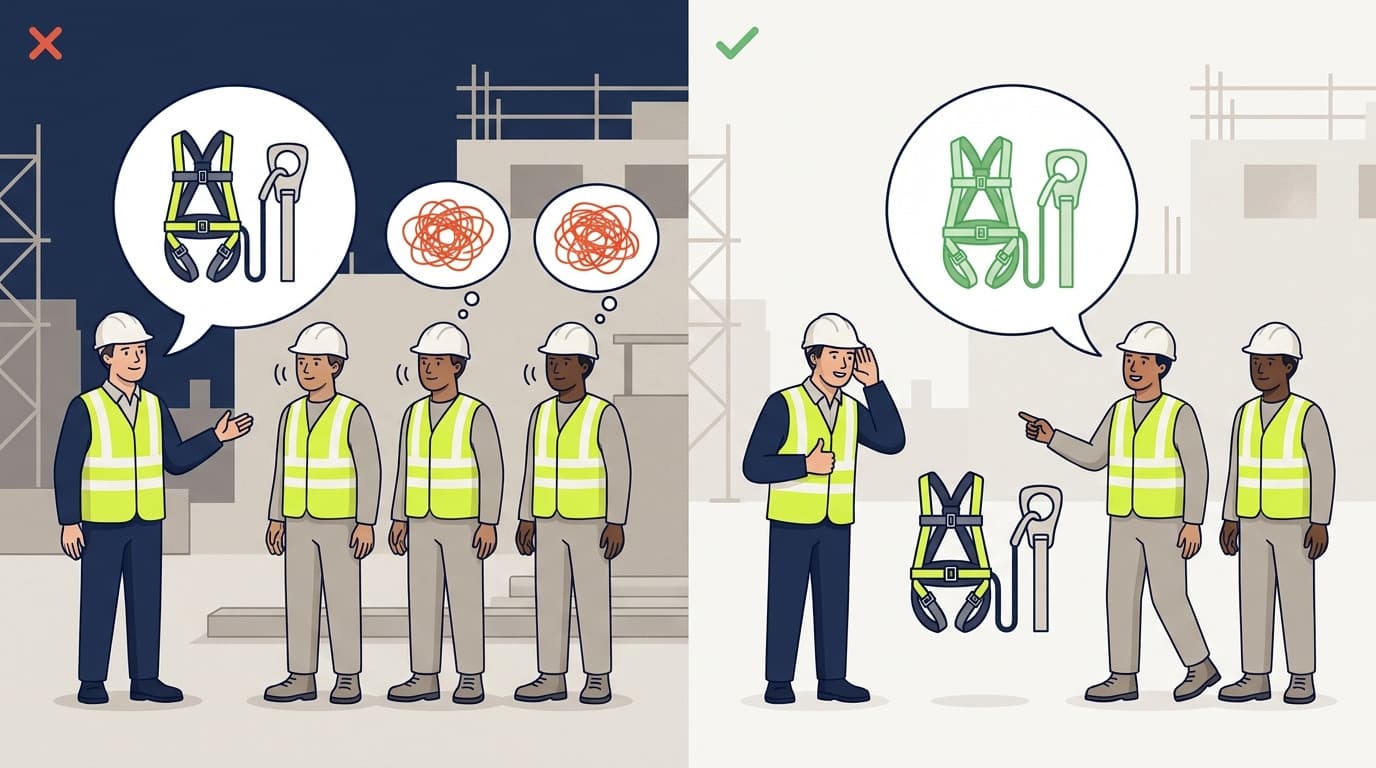
Here is the distinction that carries this whole talk: a safety briefing is not finished when it has been said. It is finished when it has been understood — and understanding is not something you can see, so you have to make it produce evidence. A nod, a signature and "any questions?" met with silence are all compatible with a worker who followed every word and a worker who followed none of it. They look identical from the front of the room. The only way to tell the two apart is to ask for something back — a word repeated, a step described, a hazard pointed to — because comprehension is invisible until you make it do something.
Where the boundary of this talk sits#
The isolation and remote work talk owns language isolation — being the only speaker of your language on a crew, and the mental-health cost of never having a real conversation all day. The hazard communication talk owns chemical labels, safety data sheets and the written HazCom program, including how information reaches other employers on a multi-employer site. The situational awareness talk owns what one person perceives while the work runs. This talk owns briefing comprehension: whether a spoken or written safety instruction actually landed, and what you do to find out before the work starts — the crossing point between a message sent and a message received, in any language.
What OSHA actually requires — and it is not English#
There is a widespread belief on American sites that workers must be able to take safety instruction in English. OSHA has answered that question directly, and the answer is no.
In a 2010 letter of interpretation on English-language proficiency at construction sites, OSHA was asked whether employers must ensure employees can communicate in English so they understand training and coordinate safely. The answer: there are no OSHA construction standards that specifically require that such information be conveyed and understood in English. On the coordination point crews worry about most, the letter states the obligation "would be met by any system in which that communication could reliably occur; there is no OSHA requirement that the communication system be based on the English language."
So the standard is not a language. It is reliable communication, by whatever system achieves it. That reframes the whole problem. The question on a mixed-language crew is not "does everyone speak English?" It is "is there a system here through which a safety message reliably reaches every person?" — and if the answer is no, the site has a compliance gap regardless of which languages are or are not spoken.
The duty underneath it: instruct means make understood#
Where does that come from? The training standard for construction, 29 CFR 1926.21(b)(2), requires the employer to instruct each employee in the recognition and avoidance of unsafe conditions and the regulations applicable to his work environment. The word doing the work is "instruct."
OSHA's Training Standards Policy Statement of 28 April 2010 defines it: regardless of the precise regulatory wording, the terms "train" and "instruct" and their synonyms mean to present information in a manner that employees receiving it are capable of understanding. The statement is blunt about what that takes in practice: if an employee does not comprehend English, instruction must be in a language they can understand; if their vocabulary is limited, the training must account for it; and if employees are not literate, telling them to read training materials will not satisfy the obligation.
Comprehension is not a courtesy on top of training — it is what "train" means. A session delivered but not understood has not discharged 1926.21(b)(2), however complete the slides or however many signatures are on the sheet. The policy adds a test OSHA's inspectors use: if an employer already gives ordinary work instructions in a language other than English, it is expected to deliver safety training the same way. You cannot run the job in one language and claim the safety briefing only works in another.
Why the nod is not evidence#
If comprehension is the requirement, the nod is the problem, because nodding is the cheapest possible response and it satisfies the room without satisfying the standard.
There are several reasons a worker nods without understanding, and none is carelessness. Nodding is socially safe: it ends the attention on you and lets the group move on. Admitting in front of the crew, in a language you are still working in, that you did not follow the briefing is a public cost most people will pay a lot to avoid. "Any questions?" makes it worse — it puts the burden on the least confident person to volunteer, in the moment, that they are lost. Silence after it is the most ambiguous data a supervisor can collect: equally consistent with total understanding and total confusion.
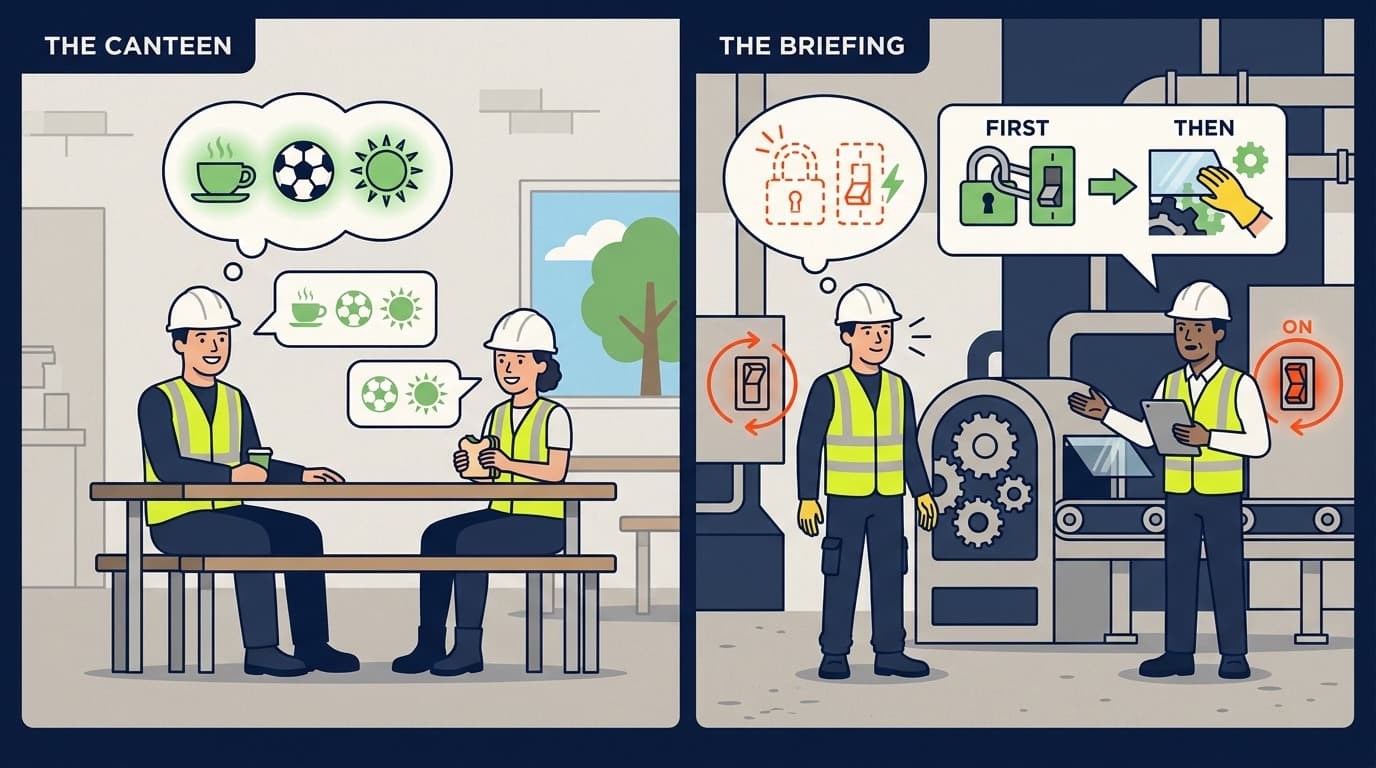
There is also a trap in partial fluency. A worker who handles the canteen conversation easily can still miss the conditional buried in a safety instruction — the unless, the only if, the before you. Social fluency and safety-critical comprehension are different skills, and the first hides the absence of the second. The most dangerous briefing is not the one to a crew that clearly speaks no English — that gets an interpreter — it is the one to a crew that speaks just enough to nod.
Make comprehension produce evidence: teach-back#
The fix is not to ask harder whether people understood. It is to stop asking, and to have them show you. The method has a name in healthcare, where it is used precisely because a misunderstood instruction can kill someone: teach-back. Instead of "do you understand?", you ask the person to tell you, in their own words, what they are going to do, or to point to the hazard, or to describe the step.
This works for a plain reason. "Do you understand?" tests willingness to say yes; "tell me what you're going to do" tests understanding. The first anyone can answer; the second only someone who actually followed the instruction. It also moves the social cost to the right place — a wrong teach-back is corrected quietly in the moment instead of surfacing as an incident an hour later. It must not feel like an exam: framed as "let me make sure I explained that right," it puts the burden on the briefing, not the worker.
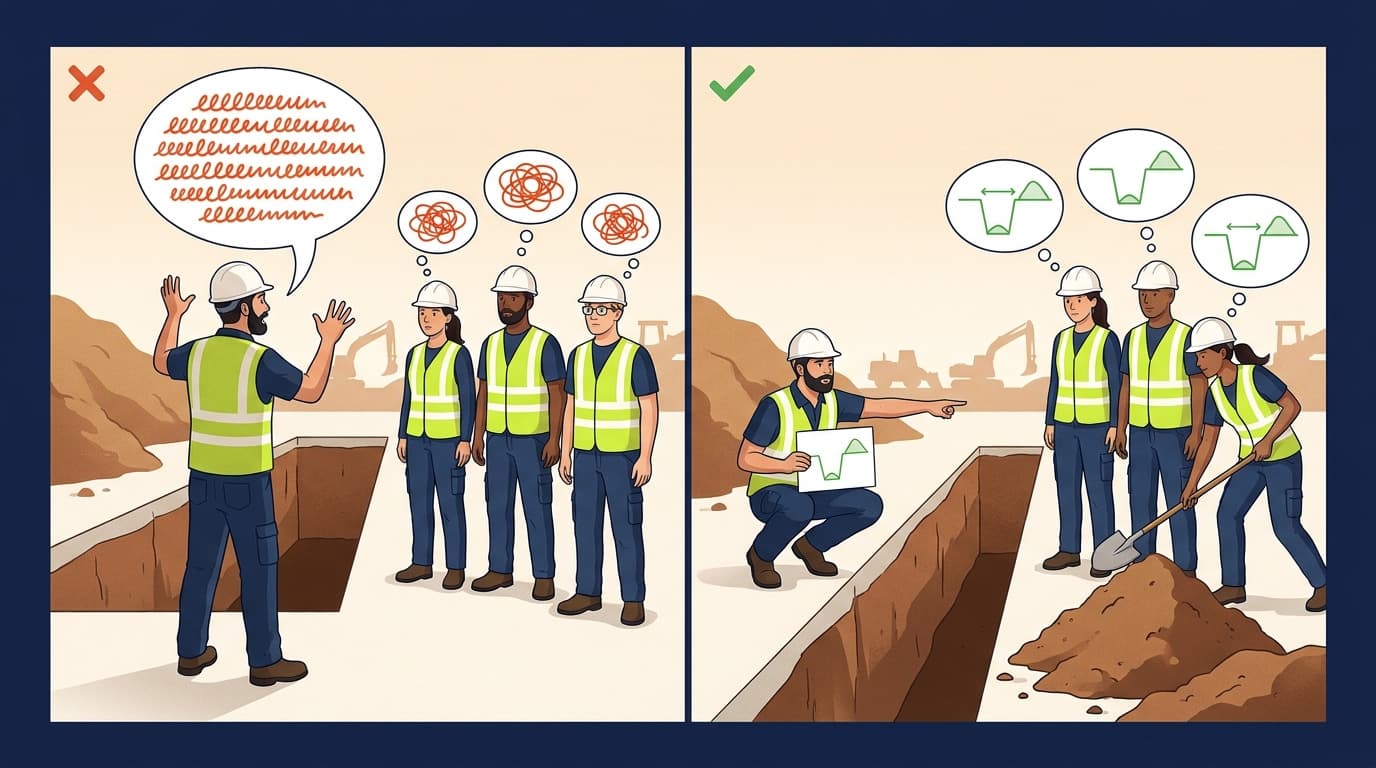
The same logic drives the other controls. A bilingual crew member who relays meaning — not just word-for-word, but the unless and the only if — is worth more than any translated document, and the role should be named, not assumed. Diagrams, photographs and physical demonstration carry a hazard across a language gap that a paragraph cannot. And where a real interpreter is needed, EM 385-1-1 on federal work requires one: on worksites with non-English-speaking workers, a person fluent in the languages spoken and in English on site when work or training is performed, to interpret and translate as needed — the same standard requiring safety documents, signs and tags in a language the employees understand.
Where the duty sits#
There is no single OSHA standard titled "language." The duty is assembled from several places, and it is stronger than most sites assume.
1926.21(b)(2) carries the core duty to instruct, which OSHA's policy defines as presenting information in a manner employees can understand. 1926.20(b)(4) permits only employees qualified by training or experience to operate equipment and machinery — training that was not understood qualifies no one. Hazard-specific standards inherit the duty: 1926.503(a)(1) requires a fall-protection program that enables each employee to recognize the hazards, a comprehension outcome, not an attendance one; 1926.59, incorporating HazCom, requires chemical training that OSHA interpretations going back decades say must be given in a language the employee comprehends. And Section 5(a)(1) turns on recognized hazards — one a worker was "briefed" on but did not understand is not, in any real sense, controlled.
On federal contract work the requirement is explicit rather than inferred. EM 385-1-1 requires safety programs, documents, signs and tags to be communicated to employees in a language that they understand, and requires an on-site interpreter where non-English-speaking workers are present during work or training. There is no room there to treat comprehension as optional.
What can go wrong?#
- A one-language briefing reaches a crew that only partly shares it, and the gaps are hidden by nods.
- "Any questions?" meets silence, and the silence is read as understanding.
- A worker with good social English misses the conditional in a safety instruction — the unless, the only if.
- A capable bilingual worker is used as an interpreter with no warning and relays words without meaning.
- Written procedures are handed to a worker who cannot read them, in any language, and a signature is collected anyway.
- The crew changes and the new arrival is handed the plan rather than walked through it.
- A translated document is treated as proof of comprehension when nobody checked it was read or understood.
How do we manage this properly?#
- Replace "do you understand?" with teach-back: have a worker tell you the step, or point to the hazard, in their own words.
- Frame it as checking your own explanation — "let me make sure I explained that right" — so the burden sits on the briefing.
- Identify who shares which language before the briefing, not during it.
- Name your interpreter in advance and brief them to relay meaning, conditionals included, not just words.
- Use diagrams, photos and demonstration for anything that can be shown rather than only said.
- Never treat a signature as evidence of understanding; it records attendance, not comprehension.
- Walk anyone who arrived since the last briefing through it, and teach-back with them too.
- On federal work, confirm the interpreter and translated documents EM 385-1-1 requires are present.
Before you start#
- Confirm which languages are actually spoken on this crew today, not which ones you assume.
- Confirm you have a reliable way to reach every person with a safety message — a person, not just a document.
- Confirm your interpreter, if you need one, knows they are interpreting and understands the work.
- Confirm the key hazards can be shown as well as said.
- Confirm nobody is being handed a written procedure they cannot read.
- Confirm you will check comprehension by teach-back, not by "any questions?"
- Confirm anyone new to the crew has been walked through the plan, not just given it.
- On federal work, confirm the language provisions of EM 385-1-1 are met.
Talk it over#
- When the supervisor asks "everyone good?", what does a nod actually tell us here?
- Who on this crew could reliably explain a hazard to whom, if it mattered right now?
- Has anyone here ever nodded through a briefing they did not fully follow? Why is that easier than asking?
- What is one hazard on this job we could show instead of describe?
The bottom line#
A safety briefing is finished when it is understood, not when it is said — and understanding is invisible until you make it produce evidence. The nod, the signature and the silence after "any questions?" are all equally consistent with a worker who followed everything and one who followed nothing. OSHA has settled the language question directly: its 2010 interpretation states there is no OSHA construction standard requiring safety information to be conveyed and understood in English, and that the coordination duty is met by "any system in which that communication could reliably occur" — the standard is reliable communication, not a language. The root duty is 1926.21(b)(2)'s requirement to instruct, which OSHA's Training Standards Policy Statement defines as presenting information in a manner employees are capable of understanding — spelling out that instruction must be in a language the employee understands, must account for limited vocabulary, and cannot be satisfied by handing reading material to workers who are not literate. So the fix is not to ask harder whether people understood; it is to stop asking and have them show you, through teach-back — "tell me what you're going to do," which tests understanding, where "do you understand?" only tests willingness to say yes. Watch the partial-fluency trap: social fluency and safety-critical comprehension are different skills, and the most dangerous briefing is to a crew that speaks just enough to nod. Support it with named interpreters who relay meaning and not just words, with diagrams and demonstration, and — on federal work — with the EM 385-1-1 requirements for an on-site interpreter and documents, signs and tags in a language employees understand. The duty runs through 1926.21(b)(2), 1926.20(b)(4), 1926.503(a)(1), 1926.59 and 5(a)(1): a hazard a worker was briefed on but did not understand is not a hazard the employer has controlled.
Frequently asked questions about language barriers#
Does OSHA require workers to understand safety instructions in English?
No. OSHA's 2010 letter of interpretation states there are no construction standards requiring that safety information be conveyed and understood in English, and that the duty to communicate for safety is met by any system in which communication can reliably occur. The requirement is reliable communication, not English.
If a worker signs the training sheet, is that proof they understood?
No. A signature records that someone attended, not that they comprehended. OSHA's Training Standards Policy Statement defines "instruct" and "train" as presenting information in a manner employees can understand — an outcome a signature does not evidence. Confirm comprehension with teach-back instead.
What is teach-back?
Instead of asking "do you understand?", you ask the worker to tell you in their own words what they are going to do, or to point to the hazard. It works because "do you understand?" only tests willingness to say yes, while "tell me what you're going to do" tests actual understanding. Frame it as checking your own explanation so it does not feel like an exam.
Can I use a bilingual worker as an interpreter?
Yes, and it is often the best option — but name the role in advance and brief them to relay meaning, including the conditionals like unless and only if, not just to translate words. Someone reused as an interpreter with no warning tends to give a word-for-word version that loses the safety-critical part.
Isn't a translated document enough?
A translated document helps, but it is not proof of comprehension — nobody has checked that it was read or understood, and it does nothing for a worker who cannot read in any language. OSHA's policy is explicit that telling non-literate employees to read materials does not satisfy the training duty. Use documents to support a spoken, checked briefing, not to replace it.
A worker speaks good conversational English. Isn't that enough for safety instructions?
Not necessarily. Social fluency and safety-critical comprehension are different skills. A worker who handles everyday conversation easily can still miss the conditional buried in a safety instruction. That is the partial-fluency trap, and it is more dangerous than an obvious language gap because it does not prompt anyone to get an interpreter.
What does EM 385-1-1 require on federal jobs?
More than the OSHA baseline. It requires safety programs, documents, signs and tags to be communicated in a language employees understand, and requires that worksites with non-English-speaking workers have a person fluent in the languages spoken and in English on site when work or training is being performed, to interpret and translate as needed.
Download the language barriers toolbox talk PDF#
Get this language barriers toolbox talk as a print-ready PDF — available in English, Spanish, Portuguese, and Turkish. Print it, hand it to the crew, and collect signatures on the included attendance sheet.
Download the PDF — free account required. New members get 3 free downloads.
Related toolbox talks#
Sources#
- OSHA, Letter of Interpretation — English language proficiency at construction sites (26 Jul 2010): https://www.osha.gov/laws-regs/standardinterpretations/2010-07-26
- OSHA, Training Standards Policy Statement (28 Apr 2010): https://www.osha.gov/laws-regs/standardinterpretations/2010-04-28
- OSHA, 29 CFR 1926.21 — Safety training and education: https://www.ecfr.gov/current/title-29/subtitle-B/chapter-XVII/part-1926/subpart-C/section-1926.21
This talk is general awareness guidance for training purposes. It does not replace your employer's training program, contract requirements or any standard's specific training provisions, and it is not legal advice. Where a contract or a specific standard sets a language or interpreter requirement, that requirement governs.