Working at Night
Updated 2026-08-01
In this bundle Jobsite Fundamentals & Compliance
Print-ready PDF
Download this talk as a print-ready PDF, available in 4 languages.
Night work gets treated as day work with lamps on. Same crew, same task, same method statement, just darker — so the tailgate covers the same ground it covered in June and everybody gets on with it. But almost nothing about the risk profile is the same, and the part that changes most is the one nobody discusses: how visible the crew is to the people driving past. This working at night talk is about that.
Here is the distinction that carries this whole talk: at night, more light does not mean more visible — a work zone bright enough to work in can be bright enough to stop a driver seeing the person standing in it. Research on nighttime work zone lighting puts it bluntly: to make workers visible, many work zones are paradoxically over-illuminated, creating harmful levels of glare. The approaching driver's eyes are dark-adapted. Point a bank of floodlights at them and you have not lit the crew up — you have put a wall of light between the driver and the crew.
Where the boundary of this talk sits#
Illumination levels — 1926.56 and the Table D-3 minimums — belong to the eye strain talk, which owns that table. The lighting installation itself, and why it quietly fails, belongs to the temporary lighting talk in this same pair. Fatigue, circadian lows and the impairment equivalence of hours awake belong to the fatigue management talk. Site security and the unoccupied site belong to the site security talk. This talk owns the night shift as an operating condition: who can see whom, and what the traffic is doing.
The numbers say this is a traffic problem#
Night construction is mostly road and infrastructure work, and the data is unambiguous about where the deaths come from.
In 2023, approximately half of all fatal work zone crashes occurred at night — FHWA's figure, and the reason it runs a national initiative specifically on nighttime work zone safety. Over a longer window, between 2011 and 2020, 1,260 workers were killed in road construction zones — an average of 126 a year.
And the underlying road risk is worse after dark for everybody: the nighttime fatality rate on US roadways is around three times the daytime rate.
So the hazard that dominates night work is not the work. It is the traffic going past it.
Lighter traffic is the dangerous kind#
This is the part that inverts most people's intuition, and it explains why night work does not deliver the safety you would expect from an empty road.
Night work is chosen because there is less traffic — that is the whole point, and it is a mobility decision rather than a safety one. But lighter traffic volumes lead to higher speeds, and FHWA reports that speeding was a factor in more than 30% of fatal work zone crashes in 2023.
Add the driver population. At night a higher proportion of drivers are fatigued or impaired, which raises the chance of a vehicle entering the work zone at all.
Put those together and the trade is visible: you removed the congestion that was slowing everybody down, and kept the same crew standing beside the same lane. Fewer vehicles, each arriving faster, driven by people less able to react.
Why over-lighting makes it worse#
Take the anchor apart, because the fix is not "less light" — it is aimed light.
A driver approaching at night is dark-adapted. Their eyes are working at the low end of their range, which is exactly what makes headlights adequate. Introduce a very bright source in that field of view and two things happen at once: disability glare scatters light inside the eye and reduces the contrast of everything near it, and the eye partially re-adapts to the bright source, losing sensitivity to everything dimmer — which includes the worker in front of it.
The worker is not backlit into visibility. They are silhouetted into invisibility, or washed out entirely.
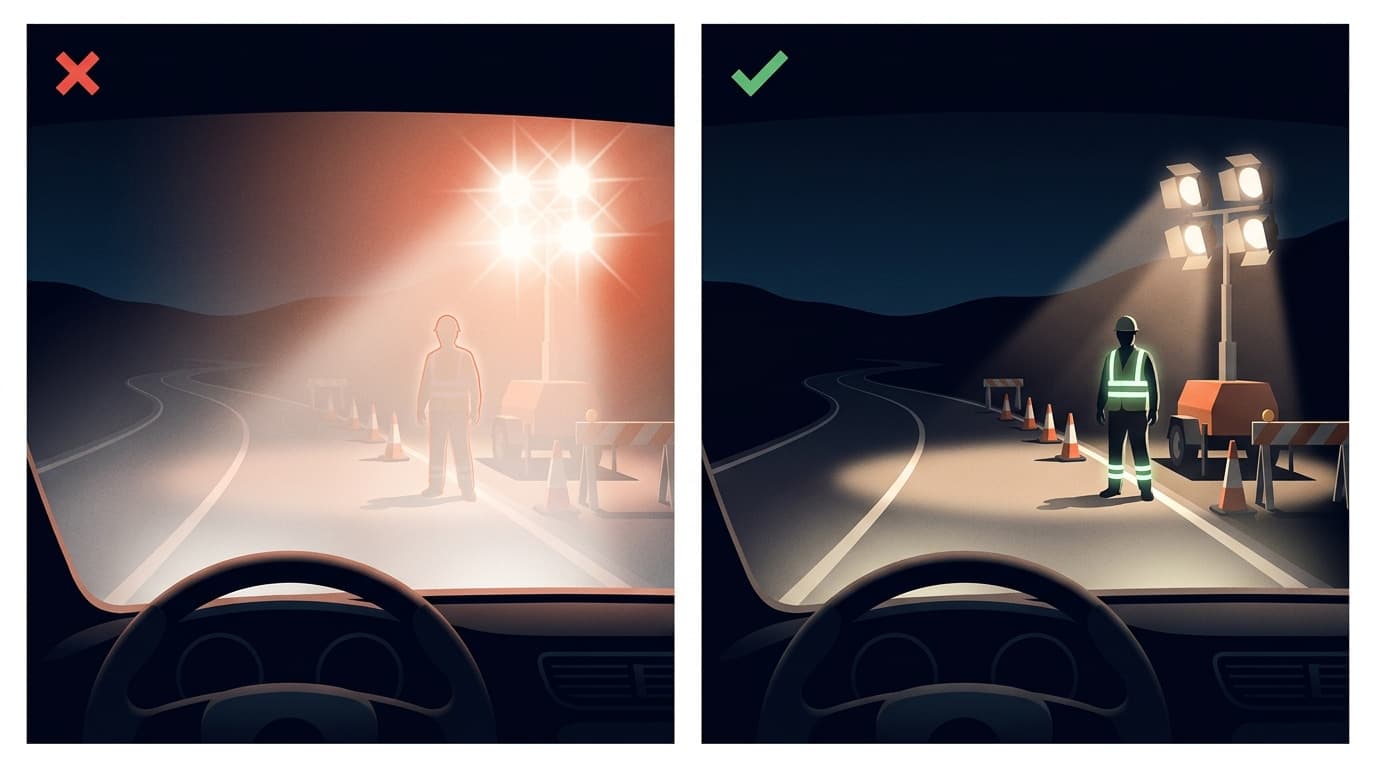
That is why lighting a night work zone is an aiming problem rather than a wattage problem: light the work surface, not the traffic, keep sources out of the approaching driver's line of sight, use shields and cut-off fittings, and check the effect from the driver's seat, approaching at road speed, rather than from inside the work area.
The rest of what changes after dark#
Depth and speed judgement degrade. Distance and closing speed are harder to judge at night for everybody — crew and drivers alike. Steps, edges, kerbs, spoil and openings that were obvious at four in the afternoon are not obvious at four in the morning.
Your own plant becomes a glare source. Machine work lights, generator floodlights and vehicle headlights on site blind the people around them just as effectively as they blind drivers. The banksman looking into a machine's work lights cannot see the machine's tracks.
Colour goes. Under low light and many temporary sources, colour discrimination drops — which matters because a lot of site marking, signage and services identification depends on colour.
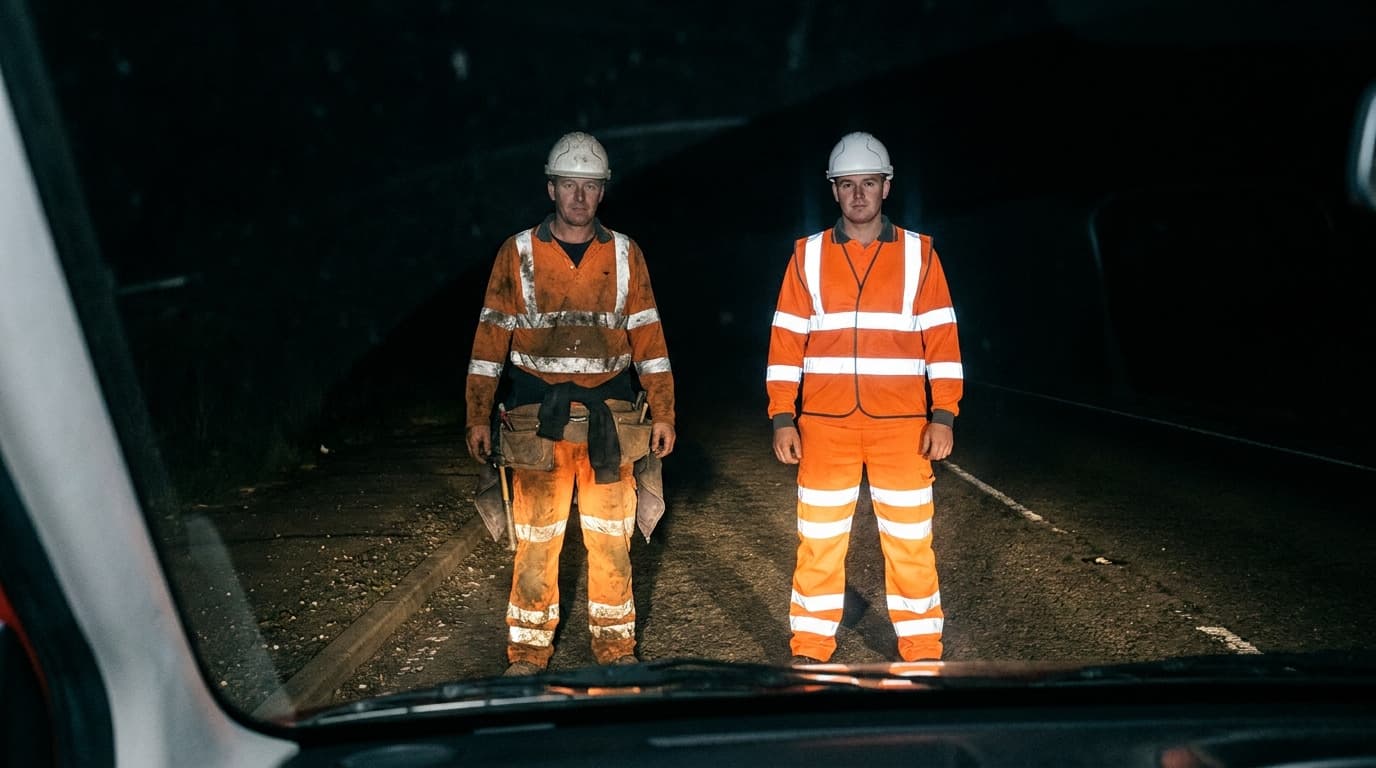
High-visibility apparel does the heavy lifting. In daylight it is fluorescent material that works; at night it is the retroreflective material, which only works when a light is shining roughly along the observer's line of sight — i.e. from headlights. Dirty, faded or covered high-vis is a real loss at night in a way it is not at noon. Under ANSI/ISEA 107 the classes and background/retroreflective areas are specified — a consensus standard, not an OSHA rule.
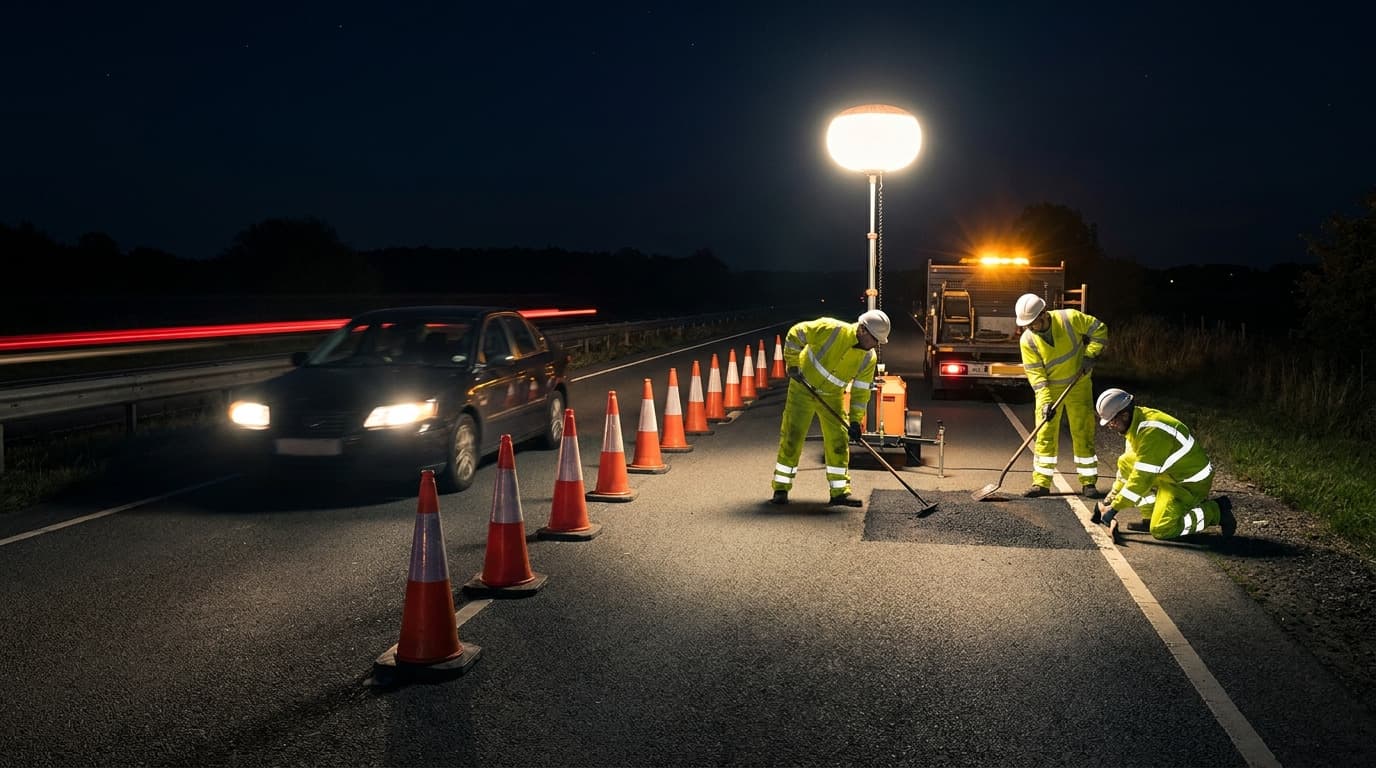
The site gets quieter and smaller. Fewer crews, fewer supervisors, fewer bystanders to notice something wrong, and a longer emergency response.
The window closes at dawn#
Night work almost always exists inside a hard external constraint — a lane closure, a possession, a shutdown, an agreed noise window — and that constraint has an end time that cannot be extended.
That is a distinctive pressure profile and it is worth naming out loud, because it is the thing that produces the rushed final hour: the crew is tired, the light is failing in a different way as dawn arrives, the closure has to be handed back, and the last task is the one done fastest.
Plan the shift so that the work that most needs care is not the work that lands at the end of the window. Build the demobilisation and hand-back into the programme as a task with its own time, not as whatever fits in the gap.
Where the duty sits#
There is no OSHA night work standard. Say so plainly.
1926.56 sets minimum illumination for construction areas, and the eye strain talk covers that table in detail. 1926.200 to 1926.203 cover signs, signals and barricades — with 1926.201 dealing with traffic control signalling and flaggers, which for highway work is the operative area. 1926.21(b)(2) requires the employer to instruct each employee in the recognition and avoidance of unsafe conditions, and a night shift is a different set of conditions from the day shift that was briefed. And Section 5(a)(1) applies to recognised hazards not covered by a specific standard.
Note also that on highway work the controlling document is usually the MUTCD and the agency's own traffic control plan, which carry the enforceable detail — and ANSI/ISEA 107 governs high-visibility apparel as a consensus standard.
What can go wrong?#
Treating the night shift as the day shift with lamps, and briefing it the same way.
Aiming floodlights toward approaching traffic, blinding the drivers you need to see your crew.
Adding more light to solve a visibility complaint, when the problem is glare rather than level.
Assuming lighter traffic is safer traffic, when it is faster traffic.
Never checking the lighting from the driver's approach, only from inside the work area.
Wearing dirty, faded or covered high-vis, which loses far more at night than in daylight.
Letting the most demanding task land in the last hour of a closure that cannot be extended.
Running plant work lights into the eyes of your own banksman.
How do we manage this properly?#
Light the work, not the road. Aim, shield and cut off — and position sources so they are not in the approaching driver's field of view.
Inspect the lighting from the driver's seat, approaching at road speed, before the shift settles. That check takes five minutes and finds what no walk-round will.
Treat a glare complaint as a design problem, not a request for more lamps.
Issue and enforce clean, current high-visibility apparel, and check the retroreflective bands are not obscured by tool belts, harnesses or dirt.
Brief the night shift separately, on the conditions it will actually meet, not on the day method statement.
Plan the hand-back as a task with its own allocated time, so the closure window is not absorbed by the work.
Fix the crew's own glare sources — machine work lights, generators, vehicle headlights on site — with the same aiming discipline used on the traffic side.
Keep exclusion between people and plant tighter than by day, because both the operator's and the banksman's visual range has shrunk.
Confirm the emergency route and response time for the night, which is not the daytime figure.
Before you start#
- Confirm the lighting has been checked from the approaching driver's viewpoint, at road speed.
- Confirm no light source is aimed into oncoming traffic or into plant operators' eyes.
- Confirm every person on foot has clean, current high-visibility apparel with unobscured bands.
- Confirm the traffic control plan for tonight and who is responsible for it.
- Confirm the closure window's end time and what has to happen before it.
- Confirm the demobilisation and hand-back have their own allocated time.
- Confirm the emergency route and expected response time for the night shift.
- Confirm who the banksman is and that they are not working into a light source.
Talk it over#
- Has anyone driven our approach at night to see what a driver actually sees?
- What is going to be left to do in the last hour of the window tonight?
- Whose work light is shining into someone else's eyes right now?
- If somebody was hurt at the far end of this zone at 3 a.m., how long until help arrived?
The bottom line#
At night, more light does not mean more visible — a work zone bright enough to work in can be bright enough to stop a driver seeing the person standing in it. Research on nighttime work zone lighting finds that many zones are paradoxically over-illuminated, creating harmful levels of glare: the approaching driver is dark-adapted, and a bright source in their field of view produces disability glare that reduces the contrast of everything near it while their eyes partially re-adapt away from dimmer things — including the worker. The scale confirms the hazard is the traffic and not the task: FHWA reports that in 2023 approximately half of all fatal work zone crashes occurred at night, 1,260 workers were killed in road construction zones between 2011 and 2020 — about 126 a year — and the nighttime fatality rate on US roadways is roughly three times the daytime rate. The intuition to break is that quiet roads are safe roads: night work exists because there is less traffic, which is a mobility decision, but lighter volumes produce higher speeds and speeding was a factor in more than 30% of fatal work zone crashes in 2023, with a higher share of fatigued or impaired drivers on top. So the fix is aiming, not wattage — light the work surface, not the traffic, shield and cut off sources, and check the effect from the driver's seat at road speed. Everything else after dark shifts too: depth and closing-speed judgement degrade, your own plant work lights blind your own banksman, colour discrimination drops, and high-visibility apparel switches from fluorescent to retroreflective performance — so dirt, fading and covered bands cost far more at night, with classes set by ANSI/ISEA 107, a consensus standard rather than an OSHA rule. Finally, night work sits inside a window that closes at dawn and cannot be extended, which is what produces the rushed final hour — so plan the hand-back as a task with its own time. On duties, there is no OSHA night work standard: 1926.56 sets illumination minimums (covered in the eye strain talk), 1926.200–203 cover signs, signals and barricades with 1926.201 on traffic control and flaggers, 1926.21(b)(2) requires instruction in the conditions actually faced, and 5(a)(1) covers the rest — while on highway work the MUTCD and the agency traffic control plan carry the enforceable detail.
Frequently asked questions about working at night#
If we add more lights, won't the crew be more visible to drivers?
Often the opposite. Research on nighttime work zones finds many are paradoxically over-illuminated, creating harmful levels of glare. An approaching driver is dark-adapted; a bright source in their view causes disability glare, scattering light inside the eye and cutting the contrast of everything near it, while their eyes re-adapt away from dimmer objects — such as your crew. The answer is aiming and shielding, not more wattage: light the work surface, keep sources out of the driver's line of sight.
Isn't night work safer because the road is quieter?
That is the assumption night work is sold on, and the data does not support it. Night work is chosen to reduce daytime congestion — a mobility decision. But lighter traffic volumes lead to higher speeds, and FHWA reports speeding was a factor in more than 30% of fatal work zone crashes in 2023, with a higher proportion of fatigued or impaired drivers after dark. In 2023 approximately half of all fatal work zone crashes occurred at night.
How do we check whether our lighting is actually working?
Drive the approach at road speed and look. That single check finds what no walk-round inside the work area ever will, because the problem only exists from the driver's viewpoint. Look for sources directly in the line of sight, for a wall of light with nothing resolvable behind it, and for workers who disappear as you get closer. Then aim, shield or relocate — and check again.
Does high-visibility apparel work differently at night?
Yes, and this catches people out. In daylight the fluorescent background material does the work; at night it is the retroreflective material, which only returns light when a source is roughly along the observer's line of sight — in practice, headlights. That makes dirt, fading, and bands covered by tool belts or harnesses far more costly after dark than at noon. Classes and material areas are set by ANSI/ISEA 107, a consensus standard rather than an OSHA rule.
What else changes on a night shift besides the light level?
Depth and closing-speed judgement degrade for crew and drivers alike, so edges, kerbs, spoil and openings that were obvious in daylight are not. Colour discrimination drops, which affects marking and services identification. Your own plant becomes a glare source — a banksman looking into a machine's work lights cannot see its tracks. And the site is smaller and quieter: fewer supervisors, fewer bystanders to notice something wrong, and a longer emergency response.
Why does the end of the shift keep going wrong?
Because night work almost always sits inside a closure, possession or shutdown window that ends at a fixed time and cannot be extended. The crew is tired, the hand-back is non-negotiable, and the last task gets done fastest. The countermeasure is scheduling rather than exhortation: do not let the work that most needs care land in the final hour, and plan demobilisation and hand-back as a task with its own allocated time.
Is there an OSHA standard for night work?
There is no OSHA night work standard. 1926.56 sets minimum illumination for construction areas — that table is covered in the eye strain talk. 1926.200 to 1926.203 cover signs, signals and barricades, with 1926.201 dealing with traffic control and flaggers. 1926.21(b)(2) requires instruction in recognising and avoiding unsafe conditions, and a night shift presents different conditions from the day shift. Section 5(a)(1) covers recognised hazards otherwise unaddressed. On highway work, the MUTCD and the agency's traffic control plan usually carry the enforceable detail.
Download the working at night toolbox talk PDF#
Get this working at night toolbox talk as a print-ready PDF — available in English, Spanish, Portuguese, and Turkish. Print it, hand it to the crew, and collect signatures on the included attendance sheet.
Download the PDF — free account required. New members get 3 free downloads.
Related toolbox talks#
Sources#
- FHWA, EDC-8: Advancing Nighttime Work Zone Safety: https://www.fhwa.dot.gov/innovation/everydaycounts/edc_8/nighttime_work_zone_safety.cfm
- Iowa State InTrans, The Effect of Nighttime Lighting Systems on Workers' Visibility and Safety: https://www.intrans.iastate.edu/wp-content/uploads/2025/12/effect_of_nighttime_lighting_systems_w_cvr.pdf
- FHWA, Work Zone Worker Safety: https://ops.fhwa.dot.gov/wz/workersafety/index.htm
This talk is general awareness guidance for training purposes. It does not replace the traffic control plan for your site, which is the controlling document for work zone layout, signage and worker protection, and which must be prepared and applied by competent people.