Safe Driving in Rain & Fog
Updated 2026-07-28
In this bundle Jobsite Fundamentals & Compliance
Print-ready PDF
Download this talk as a print-ready PDF, available in 4 languages.
Driving is the part of construction work that nobody counts as construction work. It happens before the shift and after it, in your own vehicle or a company pickup, and no permit covers it. It is also, across the industry, one of the largest single categories of occupational fatality — and the conditions that cause most of it are rain and reduced visibility, which arrive with a forecast. This Safe Driving in Rain & Fog Toolbox Talk (Safety Talk / Tailgate Talk) is about the drive.
Here is the distinction that carries this whole talk: in poor visibility, your speed is set by what you can see, not by the sign. The posted limit describes a dry road with clear sightlines. It is a maximum for the best conditions, never a target for the worst. If you cannot stop within the distance you can see, you are travelling too fast regardless of what the sign says — and that is true at 30 as easily as at 70.
The rule that says stop — 49 CFR 392.14#
There is a driving rule that explicitly requires stopping, and almost nobody in construction has read it:
Extreme caution in the operation of a commercial motor vehicle shall be exercised when hazardous conditions, such as those caused by snow, ice, sleet, fog, mist, rain, dust, or smoke, adversely affect visibility or traction. Speed shall be reduced when such conditions exist. If conditions become sufficiently dangerous, the operation of the commercial motor vehicle shall be discontinued and shall not be resumed until the commercial motor vehicle can be safely operated.
Three duties in one paragraph: extreme caution, speed shall be reduced, and — the unusual one — operation shall be discontinued and not resumed until it can be done safely. Very few rules anywhere in transport or construction contain an explicit stop.
But be clear about who it binds. Part 392 is a Federal Motor Carrier Safety Administration rule and it applies to commercial motor vehicles. It does not, by its own terms, govern a foreman in a pickup or a worker in their own car. If your site runs tippers, mixers, low-loaders or anything else meeting the CMV definition, it applies directly. For everybody else it is the clearest available statement of recognised good practice — and a sensible site adopts it as policy rather than waiting to find out whether it was compulsory.
For construction vehicles generally, the duties sit in 1926.601: a service braking system and parking brake maintained in operable condition, at least two headlights and two taillights whenever visibility conditions warrant additional light, and brake lights operable regardless of light conditions. Behind all of it, Section 5(a)(1) and its recognised hazards — and a forecast turns a hazard into a recognised one.
What water actually does#
Stopping distance grows, and it grows twice. Wet roads reduce tyre grip, and reduced grip lengthens the braking distance — while your thinking distance stays the same. That is why the safe following gap in the wet is substantially longer than the one that felt fine yesterday, and why the two-second rule is a dry-road rule.
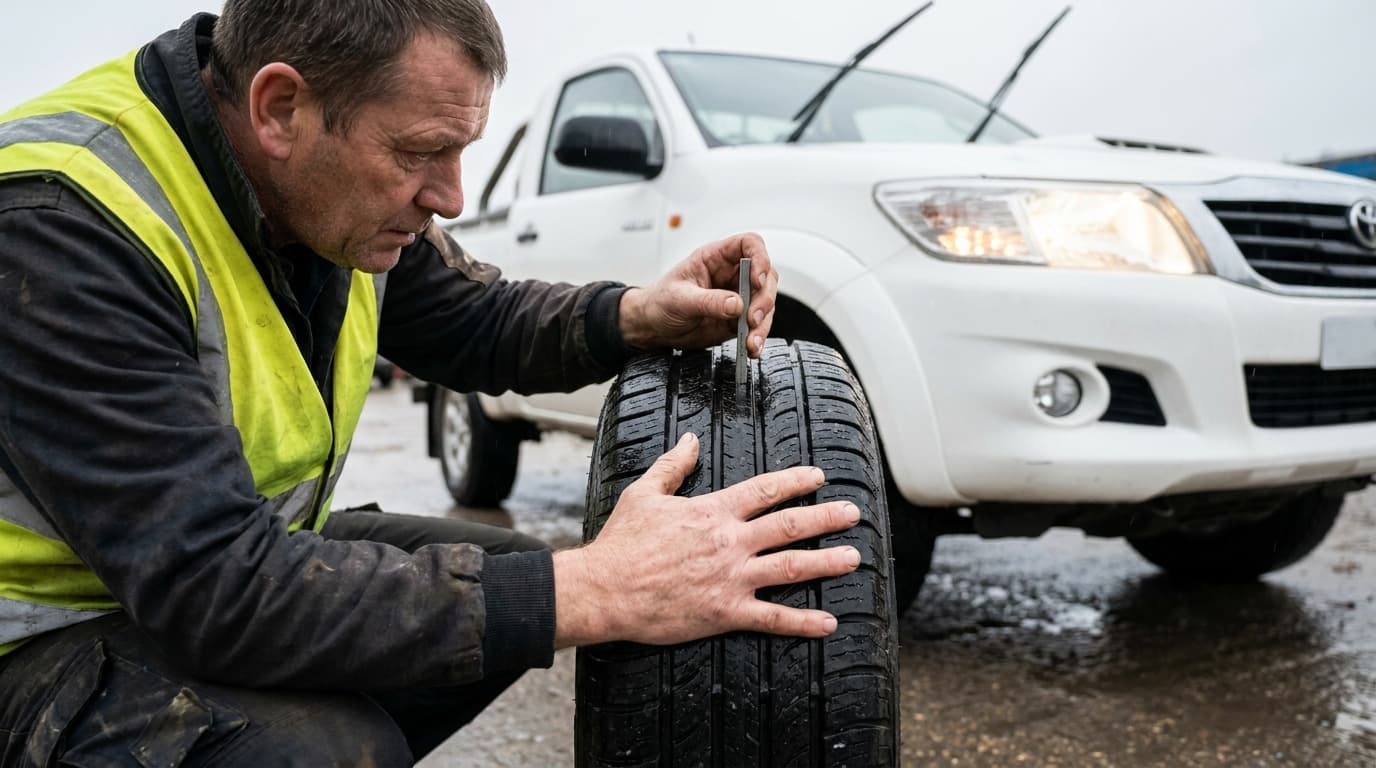
Hydroplaning. Above a certain speed, the tyre cannot clear the water in front of it and rides up onto a film. Steering and braking then do nothing at all, because nothing is touching the road. Three things decide when it happens: speed, water depth, and tread depth. You control the first directly and the third at the depot.
The first rain is the worst rain. A dry spell leaves oil, rubber and dust on the surface; light rain lifts it into a film without washing it away. The most slippery moment on any road is the beginning of a shower after a dry week, not the middle of a downpour.
Standing water pulls. Water at the edge or in a rut will drag the vehicle towards it, and braking hard while one side is in water is how vehicles end up facing the wrong way.
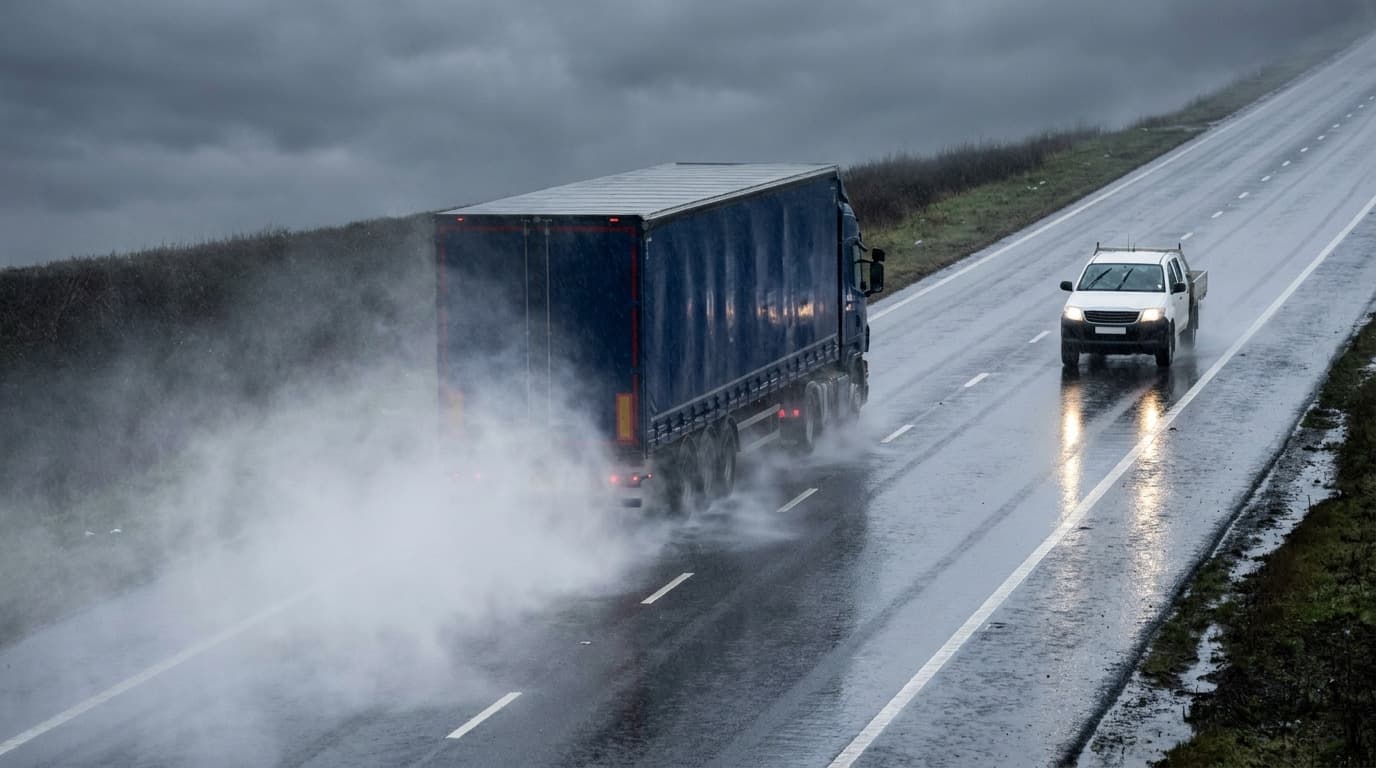
Spray removes everybody's vision. Following a truck in heavy rain means driving in a cloud you cannot see through, and the gap that protects you is the same gap that gets you out of the spray.
What fog actually does#
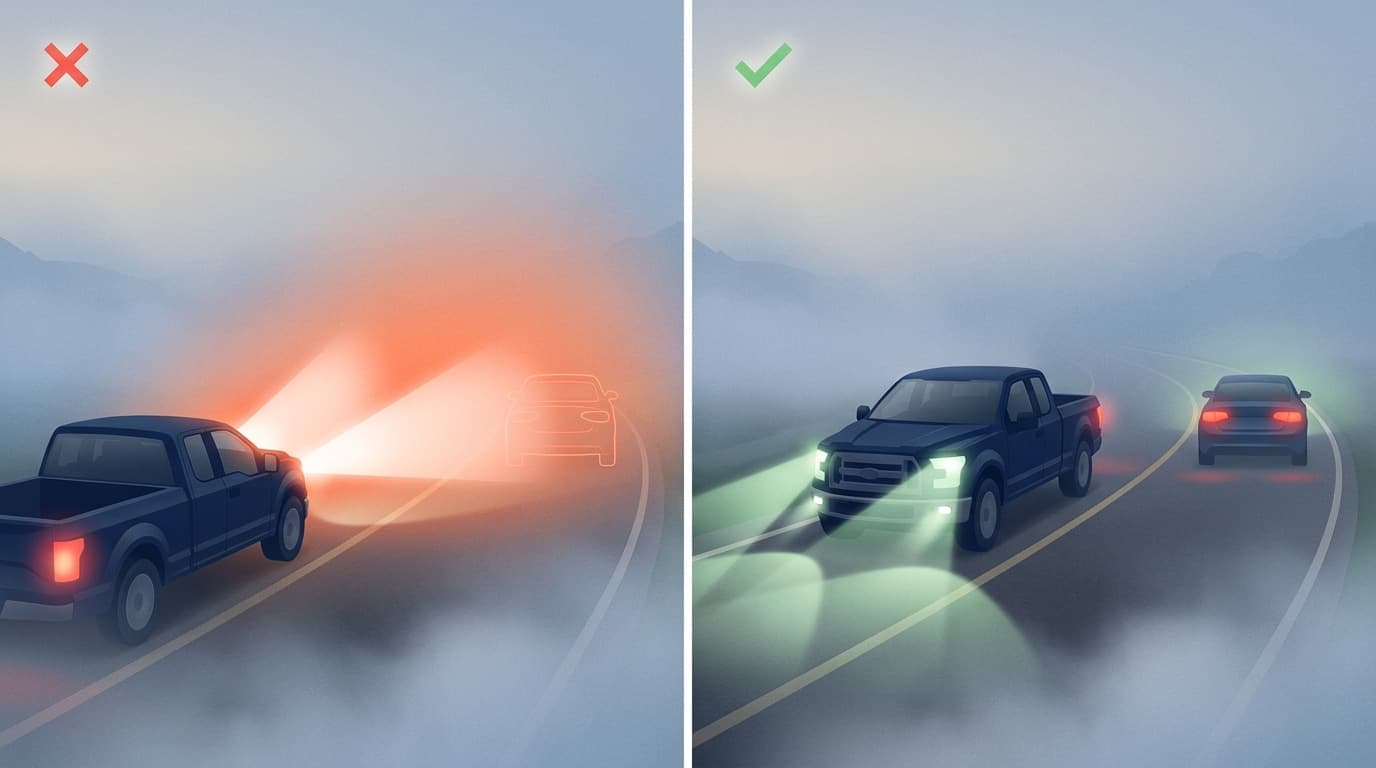
Fog defeats headlights, and high beams make it worse. Light scatters off the droplets and reflects back, so main beam produces a wall of glare rather than reach. Dipped headlights — and fog lights if fitted — are correct. This is the most common and most confidently made mistake in fog.
Fog is not uniform. It sits in hollows, over water and in cuttings, and it can go from a hundred metres of visibility to ten in a single dip. Speed set for the clear stretch is lethal in the patch.
Speed feels lower than it is. With no visual reference passing the window, drivers consistently underestimate their speed in fog. Look at the speedometer rather than trusting the sensation.
You disappear too. Daytime running lights often leave the rear of the vehicle unlit, so a car in fog can be invisible from behind. Switch on properly rather than relying on automatic lights.
Never stop in a live lane. If visibility becomes unworkable, leave the carriageway entirely and get well clear before stopping — a stationary vehicle in fog is what the next driver hits.
What can go wrong?#
Keeping to the posted limit because it is the limit, in conditions it was never set for.
Yesterday's following distance on today's wet road.
High beams in fog, which reduce the driver's own visibility.
Braking hard in standing water or through a rut on one side.
Bald or under-inflated tyres, which decide when hydroplaning starts.
Worn wipers and a dirty windscreen, which turn oncoming lights into a starburst.
Driving into fog at clear-stretch speed and finding a queue.
Stopping on the hard shoulder in fog rather than getting properly clear.
Scheduling that makes arriving on time worth more than arriving.
How do we manage this properly?#
Set the speed by sight distance. The rule is simple: be able to stop within what you can see. In fog that may mean 30 km/h on a road posted far higher.
Double the gap in the wet, and more in fog. It costs seconds over a journey and is the single most effective thing available to a driver.
Dipped headlights in rain, spray and fog. Never main beam in fog. Use fog lights if fitted, and switch them off when visibility returns.
Check tyres and wipers before the wet season, not during it. Tread depth is the variable you cannot adjust at the wheel.
Slow before the water, not in it, and hold a straight line through standing water without harsh braking or steering.
Brake earlier and more gently. Smooth inputs preserve the grip you have left.
Treat the first ten minutes of rain as the most dangerous, because of the oil film.
Adopt 392.14 as site policy whatever you drive: reduce speed, and stop when conditions become sufficiently dangerous — parked somewhere safe, not on a shoulder.
Fix the schedule. If a delivery window makes stopping expensive, the driver will not stop. That decision is made in an office, not a cab.
Before you start#
- Confirm the forecast for the whole journey, not just for here.
- Confirm tyre condition and pressures, and that wipers and washers work.
- Confirm all lights work, including brake lights and rear lights.
- Confirm your windscreen and mirrors are clean inside and out.
- Confirm what speed you will actually travel at, and that it is set by visibility.
- Confirm the following distance you intend to keep in the wet.
- Confirm where you would pull off and stop if conditions became unworkable.
- Confirm nobody is expecting you at a time that requires you not to stop.
Talk it over#
- What speed would you drive at if you could only see fifty metres?
- When did you last check your tyre tread?
- Has anyone here used high beams in fog? Did it help?
- If you had to stop in fog on the way here, where would you have gone?
The bottom line#
In poor visibility your speed is set by what you can see, not by the sign. 49 CFR 392.14 requires extreme caution where snow, ice, sleet, fog, mist, rain, dust or smoke adversely affect visibility or traction, requires that speed shall be reduced, and provides that if conditions become sufficiently dangerous the operation shall be discontinued and shall not be resumed until the vehicle can be safely operated — a rare explicit stop-driving duty. Note its scope: Part 392 is an FMCSA rule binding commercial motor vehicles, so for a pickup or a private car it is recognised good practice rather than direct law, and a sensible employer adopts it as policy. For construction vehicles, 1926.601 requires operable service and parking brakes, at least two headlights and two taillights when visibility warrants, and brake lights operable regardless of light conditions, with Section 5(a)(1) behind it. Physically: wet roads lengthen braking while thinking distance stays the same; hydroplaning is decided by speed, water depth and tread depth; the first rain after a dry spell is the most slippery; and high beams in fog reduce your own visibility.
Frequently asked questions about driving in rain and fog#
Is there a rule that requires stopping in bad weather?
Yes. 49 CFR 392.14 requires extreme caution when hazardous conditions caused by snow, ice, sleet, fog, mist, rain, dust or smoke adversely affect visibility or traction, requires that speed shall be reduced, and provides that if conditions become sufficiently dangerous, operation shall be discontinued and shall not be resumed until the vehicle can be safely operated.
Does that rule apply to a pickup truck?
Not by its own terms. Part 392 is a Federal Motor Carrier Safety Administration regulation applying to commercial motor vehicles — so it binds tippers, mixers and low-loaders meeting the CMV definition, but not a foreman's pickup or a worker's own car. For those it is the clearest statement of recognised good practice, and adopting it as site policy is the sensible course.
Should I use high beams in fog?
No. Light from main beam scatters off the water droplets and reflects back at you, producing glare rather than reach — so high beams actively reduce your visibility in fog. Use dipped headlights, plus fog lights if fitted, and switch fog lights off once visibility returns.
What causes hydroplaning?
Three things together: speed, water depth and tread depth. Above a certain speed the tyre cannot clear the water ahead of it and rides up onto a film, at which point steering and braking do nothing because nothing is touching the road. Speed is the factor you control at the wheel; tread depth is decided before you set off.
Why is light rain sometimes worse than heavy rain?
Because of what it lifts. A dry spell leaves oil, rubber and dust on the road surface, and light rain floats that into a film without washing it away — so the first ten minutes of a shower after a dry week is typically the most slippery the road will be, more so than the middle of a downpour.
How much following distance should I leave in the wet?
Substantially more than in the dry — at least double, and more again in fog or spray. Wet roads lengthen braking distance while your reaction time stays the same, so the gap that felt adequate yesterday is not adequate today. The gap is also what gets you out of the spray behind a truck.
Where should I stop if visibility becomes unworkable?
Completely off the carriageway, and well clear. A vehicle stopped on a hard shoulder or verge in fog is what the next driver drives into, so leave the road entirely — a services area, a side road or a yard — before stopping. Keep lights on and stay aware of traffic while you wait.
Download the safe driving in rain and fog toolbox talk PDF#
Get this safe driving toolbox talk as a print-ready PDF — available in English, Spanish, Portuguese, and Turkish. Print it, hand it to the crew, and collect signatures on the included attendance sheet.
Download the PDF — free account required. New members get 3 free downloads.
Related toolbox talks#
Sources#
- FMCSA, 49 CFR 392.14 — Hazardous conditions; extreme caution: https://www.ecfr.gov/current/title-49/subtitle-B/chapter-III/subchapter-B/part-392
- OSHA, 29 CFR 1926.601 — Motor vehicles: https://www.osha.gov/laws-regs/regulations/standardnumber/1926/1926.601
Written by FieldSafetyTalk's safety professional — a CSP, ASP, CHST and OSHA Authorized Outreach Trainer with 14+ years of international construction safety experience across federal, heavy civil, and industrial projects.