Incident Reporting
Updated 2026-08-06
In this bundle Jobsite Fundamentals & Compliance
Working in California? See the Cal/OSHA edition → California (Cal/OSHA)
Print-ready PDF
Download this talk as a print-ready PDF, available in 4 languages.
Most people think incident reporting is about honesty — telling the truth about what happened after something goes wrong. That is part of it, but it misses what the rule is actually built around, and it misses the reason reporting matters so much in the first place. OSHA's incident reporting requirement does not just say "don't lie" and it does not just say "don't punish people for reporting." It regulates the reporting procedure itself, and it makes a procedure that discourages people from reporting a violation on its own — separate from any lie, and separate from any obvious act of retaliation. This Incident Reporting Toolbox Talk (Safety Talk / Tailgate Talk) is about why the system you report into matters as much as the honesty of the person reporting, and why the incident nobody hears about is the most dangerous one on the site.
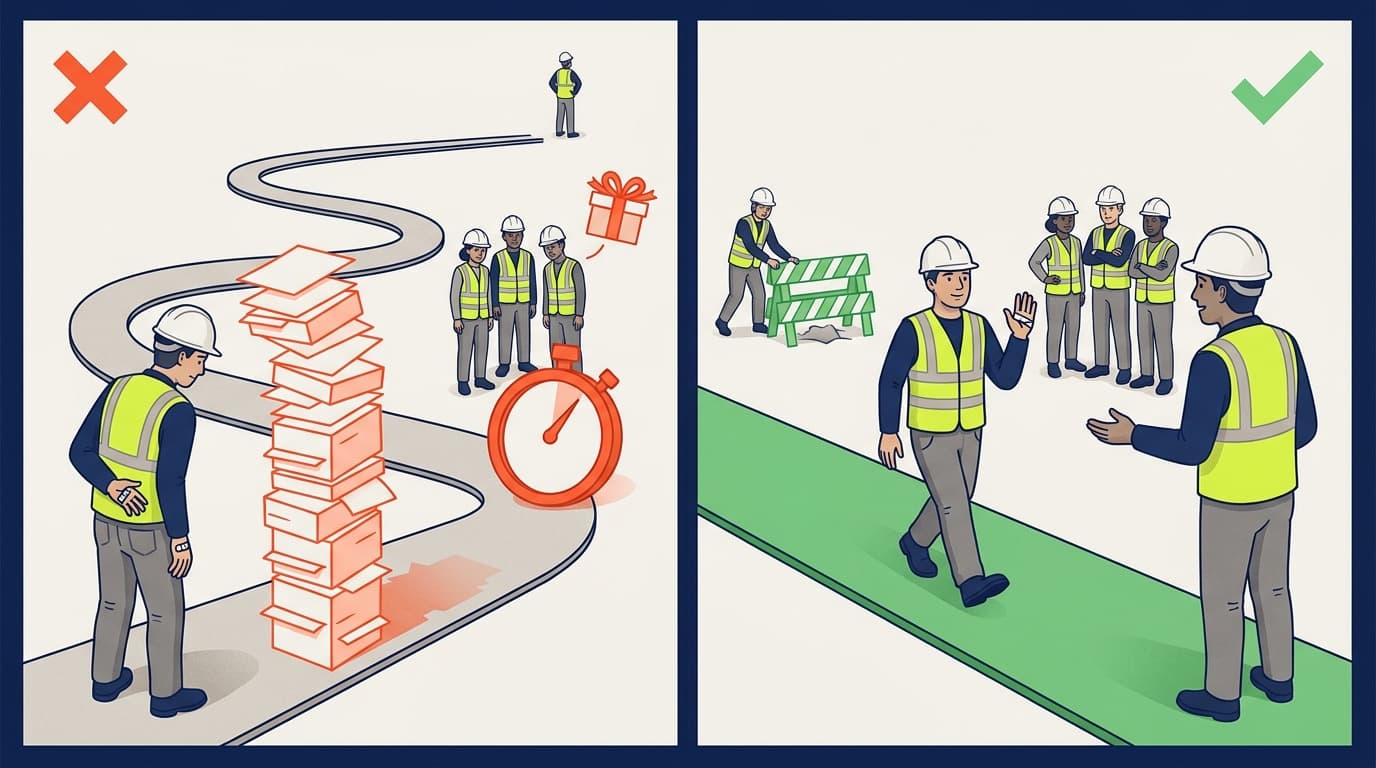
Here is the distinction that carries this whole talk: incident reporting isn't mainly about honesty after something goes wrong — OSHA regulates the reporting procedure itself, and a procedure that quietly discourages people from reporting is a violation even when nobody lied and nobody was openly punished, because the injury you never hear about is the warning the whole crew never gets. Think about how under-reporting actually happens. It is rarely a worker looking a supervisor in the eye and lying about an injury. It is far more often the system quietly making reporting the harder choice: a policy that punishes the whole crew when someone reports an injury, a reporting process so slow or complicated that people give up, a safety-bonus program that everyone loses the moment one person reports. Nobody lied. Nobody was fired. But the injury data goes dark, and the next person walks into the same hazard with no warning. OSHA's rule targets exactly that — it says the procedure must not deter reporting — so the job is not only to be honest and not retaliate, but to build a system where reporting is the easy, safe, obvious thing to do.
Where the boundary of this talk sits#
Incident reporting connects to several other talks, and this one owns the reporting duty itself. The near-miss reporting talk owns the specific case of the close call that did no harm. The stop-work authority talk owns the right to halt work before an incident happens. The emergency response talk owns what you do in the minutes after a serious injury. This talk owns the reporting procedure and the protection around it: the employer's duty to have a reasonable procedure that does not discourage reporting, the prohibition on retaliating against anyone who reports, and the reason reporting every incident and near-miss matters — so the whole crew gets the warning. Where the focus is the near-miss specifically, the pre-incident stop, or the emergency response, those talks own the detail; this one owns the act of reporting and the system that either invites it or quietly kills it.
The procedure itself has to be reasonable#
The first duty is one people rarely think about: the reporting procedure must be reasonable. OSHA's recordkeeping rule requires the employer to establish a reasonable procedure for employees to report work-related injuries and illnesses promptly and accurately — and it explicitly states that a procedure is not reasonable if it would deter or discourage a reasonable employee from accurately reporting. This is a real, citable requirement, not a suggestion. A procedure can fail this test without anyone intending harm: a rule that requires reporting within an unreasonably short window, a process that makes a worker jump through so many hoops they give up, or a requirement to report in a way that is humiliating or burdensome can all deter reporting. OSHA's interpretation gives the practical line: a policy that says report as soon as practicable, such as the same or next business day, is reasonable, while one that punishes a worker for not reporting an injury they could not reasonably have known about right away is not. The point is that the employer owns the quality of the reporting system, and a system that discourages reporting is itself the violation.
Retaliation is prohibited — and it's broader than firing#
The second duty is the one most people do know about, but its scope is wider than they think. It is prohibited to retaliate against an employee for reporting a work-related injury or illness. This has long been the case under Section 11(c) of the OSH Act, and the recordkeeping rule makes it explicit and directly citable. The part that surprises people is how broad "adverse action" is. It is not just firing, demotion, or suspension. Any employer action that would discourage a reasonable employee from reporting counts — including giving an employee disciplinary "points" that could add up to future consequences, or running a safety incentive program structured so that reporting an injury costs the worker or the whole crew a bonus. Post-incident drug testing, blanket discipline, and incentive programs are not automatically prohibited — but if the real reason for an adverse action is that the person reported, it is retaliation. The test OSHA applies is whether the employer took the adverse action because the employee reported, and whether that action would deter a reasonable person from reporting in the future.
A near-miss is a free lesson#
Underneath both duties is the reason reporting matters at all, and it is easiest to see in the near-miss — the incident where something went wrong but nobody got hurt. It is tempting to treat a near-miss as a non-event: no injury, no harm, nothing to write up, back to work. But a near-miss is a free lesson. The same failure that almost hurt someone today — the unguarded edge nobody fell off, the load that swung but hit no one, the energized line nobody touched — is still there, and the next time the outcome may not be lucky. A near-miss reported is a hazard the crew can fix before it collects. A near-miss unreported is a warning thrown away, and the injury it predicts arrives later with no one having learned anything. This is why a strong reporting culture treats near-misses as valuable, not embarrassing: every one that gets surfaced is an injury that got prevented, and every one that gets buried is an injury waiting to happen.
Report promptly, accurately, and completely#
When an incident or near-miss does happen, the reporting itself has a few simple standards. Report promptly — as soon as practicable, generally the same or next day — so the hazard can be addressed before it catches someone else and so the details are still fresh and accurate. Report accurately and completely — what happened, where, when, who was involved, and what conditions contributed — because a report that leaves out the real cause cannot prevent the next incident. Report the near-misses too, not just the injuries, because they are the cheapest lessons available. And know your own site's procedure: who to tell, how, and within what time, so that when something happens you are not figuring out the process in the moment. The recordkeeping side — the OSHA 300 Log, the 301 Incident Report, and the serious events that must be reported directly to OSHA within set timeframes — is the employer's responsibility, but it depends entirely on the worker-level reporting happening first. If the incident never gets reported up, none of the rest can work.
Where the duty sits#
The reporting-procedure and anti-retaliation requirements live in OSHA's recordkeeping rule at 1904.35 — Employee involvement. The reasonable-procedure requirement is 1904.35(b)(1)(i), which states that the employer must establish a reasonable procedure for reporting and that a procedure is not reasonable if it would deter or discourage a reasonable employee from accurately reporting. The requirement to inform employees of the procedure and of their right to report free from retaliation is 1904.35(b)(1)(ii)–(iii), and it can be met in part by posting the current OSHA Job Safety and Health — It's the Law worker-rights poster. The prohibition on retaliation is 1904.35(b)(1)(iv), which incorporates the long-standing anti-retaliation protection of Section 11(c) of the OSH Act into the recordkeeping rule and makes it directly citable. OSHA's October 19, 2016 interpretive memo explains the practical tests — that reasonable means not unduly burdensome, that same-or-next-day reporting is reasonable, and that discipline, drug testing, and incentive programs are judged by whether the real reason for an adverse action was the report. Serious events carry direct reporting duties to OSHA under 1904.39. The General Duty Clause, Section 5(a)(1) and training under 1926.21(b)(2) apply throughout. Where your employer's written procedure sets a specific requirement, follow it — as long as it does not discourage reporting.
What can go wrong?#
- A worker doesn't report an injury because the whole crew loses a safety bonus when someone does.
- A reporting process is so slow or complicated that people give up and stay quiet.
- A near-miss goes unreported, and the same hazard injures someone the next week.
- A worker is disciplined with "points" for reporting, and everyone quietly learns not to report.
- An injury is reported late, the details are fuzzy, and the real cause is never found.
- A report leaves out the contributing conditions, so the next incident isn't prevented.
- Post-incident discipline is really punishment for reporting, and reporting dries up.
- A serious event isn't reported to OSHA within the required timeframe.
How do we manage this properly?#
- Treat the reporting procedure as something that must make reporting easy — not a hurdle.
- Never retaliate — and understand adverse action includes points systems and bonus-killing incentives.
- Report every near-miss — it's a free lesson and an injury prevented.
- Report promptly — same or next day — so the hazard gets fixed and details stay accurate.
- Report accurately and completely — what, where, when, who, and the contributing conditions.
- Know your site's procedure — who to tell, how, and within what time — before you need it.
- Make sure the crew knows they can report free from retaliation, and mean it.
- Escalate serious events so they reach OSHA within the required timeframe.
Before you start#
- Confirm everyone knows how to report an injury, illness, or near-miss on this site.
- Confirm everyone knows who to report to and within what timeframe.
- Confirm the crew understands they can report free from retaliation.
- Confirm the reporting process is genuinely easy to use — not a deterrent.
- Confirm near-misses are welcomed, not treated as embarrassing or punishable.
- Confirm no incentive or discipline policy on this job quietly penalizes reporting.
- Confirm who handles the OSHA 300 Log and the serious-event reporting to OSHA.
- Confirm the crew knows a reported near-miss is a hazard fixed before it collects.
Talk it over#
- Does everyone here actually know how to report an injury or a near-miss on this job?
- Is there anything about how we report — timing, paperwork, who to tell — that makes people not bother?
- Has anyone seen a near-miss lately that we should be fixing before it hurts someone?
- Does anyone worry that reporting could cost them or the crew something — and if so, how do we fix that?


The bottom line#
Incident reporting isn't mainly about honesty after something goes wrong — OSHA regulates the reporting procedure itself, and a procedure that quietly discourages people from reporting is a violation even when nobody lied and nobody was openly punished, because the injury you never hear about is the warning the whole crew never gets. There are two duties: the procedure must be reasonable under 1904.35(b)(1)(i) — prompt, accurate, and not so burdensome it deters reporting — and retaliation is prohibited under 1904.35(b)(1)(iv) and Section 11(c), where adverse action is broad enough to include a points system or a bonus-killing incentive program, not just firing. Underneath both is the reason it all matters: a near-miss is a free lesson, and every one reported is an injury prevented, while every one buried is an injury waiting to happen. So report promptly, accurately, and completely — the injuries and the near-misses — and build a system where doing so is the easy, safe choice. The question to carry is not "did everyone tell the truth?" It is: is there anything about how we report that would make a reasonable person on this crew decide to stay quiet — and if so, that's the thing we fix.
Frequently asked questions about incident reporting#
Isn't incident reporting just about being honest?
Honesty matters, but the rule is built around something bigger: the reporting procedure itself. OSHA's requirement is not only that workers tell the truth and that employers don't punish them — it is that the employer must have a reasonable procedure that does not deter or discourage a reasonable employee from reporting. That means under-reporting is usually not a story about dishonesty at all. It is a story about a system that makes reporting the harder choice: a burdensome process, a bonus everyone loses when someone reports, a discipline policy that quietly penalizes it. Nobody has to lie for the injury data to go dark; the system just has to make silence easier than reporting. So while honesty is necessary, it is not sufficient — the employer owns the quality of the reporting system, and a system that discourages reporting is a violation on its own, independent of whether anyone was dishonest.
What makes a reporting procedure "unreasonable"?
A procedure is unreasonable, in OSHA's words, if it would deter or discourage a reasonable employee from accurately reporting a workplace injury or illness. In practice that covers anything that makes reporting unduly burdensome or risky. A requirement to report within an unreasonably short window — so a worker is punished for an injury they could not have known about right away — is unreasonable. A process so slow, complicated, or humiliating that people give up is unreasonable. OSHA's interpretation gives a helpful benchmark on the reasonable side: a policy asking workers to report as soon as practicable, such as the same or next business day, is reasonable. The key idea is that the procedure is judged by its effect on reporting, not by the employer's intent. Even a well-meaning rule can be unreasonable if it predictably discourages people from reporting, and that makes it citable regardless of whether anyone meant to suppress reports.
Does "retaliation" only mean getting fired?
No, and this is the part that surprises people most. Retaliation for reporting a work-related injury or illness is prohibited under Section 11(c) of the OSH Act and, explicitly, under the recordkeeping rule — and "adverse action" is much broader than termination. It includes obvious things like firing, demotion, and suspension, but it also includes subtler actions: giving an employee disciplinary "points" that could add up to future consequences, or running a safety incentive program structured so that a report costs the worker or the whole crew a bonus. Anything that would discourage a reasonable employee from reporting can count. Post-incident drug testing, discipline, and incentive programs are not banned outright — but if the real reason behind an adverse action is that the person reported, it is retaliation. OSHA's test is whether the employer took the action because of the report and whether it would deter a reasonable person from reporting in the future.
Why should we bother reporting near-misses if nobody got hurt?
Because a near-miss is a free lesson, and it is the cheapest safety information you will ever get. The whole point of a near-miss is that a real failure happened — an edge someone almost fell off, a load that swung but missed, an energized line nobody happened to touch — and this time luck covered the gap. But the hazard is still there. The next time the same failure occurs, the outcome may not be lucky. A near-miss that gets reported is a hazard the crew can fix before it ever collects on the injury it is predicting. A near-miss that gets buried is that warning thrown away, and the injury arrives later with nobody having learned a thing. This is why a healthy reporting culture treats near-misses as valuable rather than embarrassing: every one that surfaces is an injury prevented for essentially no cost, and encouraging them is one of the highest-leverage things a crew can do.
How quickly and how completely should an incident be reported?
Report promptly — as soon as practicable, generally the same or the next day — and report accurately and completely. Prompt reporting does two things: it lets the hazard be addressed before it catches someone else, and it captures the details while they are still fresh and accurate. Complete reporting means covering what happened, where, when, who was involved, and — critically — what conditions contributed, because a report that omits the real cause cannot prevent the next incident. Report the near-misses on the same standard, not just the injuries. And know your own site's procedure ahead of time: who to tell, how, and within what timeframe, so that when something happens you are following a known process rather than improvising. The formal recordkeeping — the OSHA 300 Log, the 301 Incident Report, and the serious events that must go directly to OSHA within set timeframes — is the employer's responsibility, but all of it depends on the worker-level report happening first and happening well.
What has to be reported directly to OSHA, versus just recorded internally?
Most work-related injuries and illnesses are recorded internally on the employer's OSHA logs rather than reported directly to OSHA, but the most serious events carry a direct reporting duty with tight deadlines. Under the reporting rule, a work-related fatality must be reported to OSHA within eight hours, and a work-related inpatient hospitalization, amputation, or loss of an eye must be reported within twenty-four hours. Those direct reports go to OSHA through its established channels and are separate from the routine internal recordkeeping on the 300 Log and 301 Incident Report. The exact scope and deadlines are the employer's responsibility to know and meet, and this talk is not the place to work out which category a specific event falls into — that is what your employer's written procedure and safety staff are for. The worker-level point is simpler and comes first: report the event up promptly and completely, because the employer cannot meet any of these obligations, internal or direct-to-OSHA, if the incident never gets reported in the first place.
Download the incident reporting toolbox talk PDF#
Get this incident reporting toolbox talk as a print-ready PDF — available in English, Spanish, Portuguese, and Turkish. Print it, hand it to the crew, and collect signatures on the included attendance sheet.
Download the PDF — free account required. New members get 3 free downloads.
Related toolbox talks#
Sources#
- OSHA, Employee involvement — 29 CFR 1904.35 (the employer must establish a reasonable procedure for employees to report work-related injuries and illnesses promptly and accurately; a procedure is not reasonable if it would deter or discourage a reasonable employee from accurately reporting; prohibition on retaliation at 1904.35(b)(1)(iv)): https://www.osha.gov/laws-regs/regulations/standardnumber/1904/1904.35
- OSHA, Interpretation of 1904.35(b)(1)(i) and (iv) (Oct 19, 2016) (a reporting procedure is reasonable if it is not unduly burdensome and would not deter a reasonable employee from reporting; same-or-next-business-day reporting is reasonable; discipline, post-incident drug testing, and incentive programs are judged by whether the adverse action was taken because the employee reported): https://www.osha.gov/memos/2016-10-19/interpretation-190435b1i-and-iv
- OSHA, Section 11(c) of the OSH Act and Recordkeeping modernization guidance (Section 11(c) already prohibits retaliation for reporting; 1904.35(b)(1)(iv) incorporates that prohibition into the recordkeeping rule so OSHA can cite employers who retaliate and thereby discourage accurate reporting): https://www.osha.gov/recordkeeping/modernization-guidance
This talk is general awareness guidance for training purposes. It does not replace your employer's injury and illness reporting procedure, OSHA's recordkeeping rule at Part 1904, Section 11(c) of the OSH Act, or your safety staff's guidance on what must be recorded or reported, and it is not legal advice. Where your employer's written procedure sets a specific requirement, follow it — provided it does not deter or discourage reporting.
Written by FieldSafetyTalk's safety professional — a CSP, ASP, CHST and OSHA Authorized Outreach Trainer with 14+ years of international construction safety experience across federal, heavy civil, and industrial projects.