Stacking and Storing Materials
Updated 2026-08-06
In this bundle Manual Handling & Body Mechanics
Print-ready PDF
Download this talk as a print-ready PDF, available in 4 languages.
Most jobsite hazards are things that go wrong — a machine malfunctions, a surface gives way, a step is missed. A stack is different. A stack is a hazard you build deliberately, carefully, with your own hands, and then walk away from and leave standing over people's heads for hours or days. Every pile of material on a site is potential energy waiting for a trigger, and the only thing between a neat stack and a collapse is whether it was built to resist the forces that are constantly, patiently trying to pull it down. This stacking and storing materials talk is about building piles that stay built — because the moment a stack goes over, the material that was under control becomes a struck-by and crush hazard nobody was ready for.
Here is the distinction that carries this whole talk: a stack is the one hazard you build on purpose — and every stacking rule is the same instruction: keep the base wider than the forces trying to tip it. Read through the storage rules and they can look like a scattered list of numbers — brick to this height, block tapered that way, bags cross-keyed every so many. But they are all one idea. A vertical pile of loose units wants to slide, roll, or topple, and the taller and more sheer its face, the harder it pulls. So the rules all do the same thing in different forms: they widen the base relative to the top, tie the units together so they act as one, or stop the pieces from rolling out — anything that keeps the pile's tendency to fall smaller than its tendency to stand. Once you see that single instruction, the specific numbers stop being arbitrary and start being obvious.
Where the boundary of this talk sits#
The manual handling and proper lifting talks own the injury from lifting a load with your body. The heavy timber talk owns the specific hazard of large, heavy wood members and how they roll. The housekeeping talk owns the general order of the site. This talk owns the general discipline of stacking and storing materials so they stay stable: the geometry of a stack, the securing of tiers, the height limits, and matching the securing method to how the material fails. Where the question is lifting technique, that is the lifting talk; where it is heavy timber specifically, that is the heavy timber talk; this one owns the stack itself, whatever the material.
The one idea, in the specific rules#
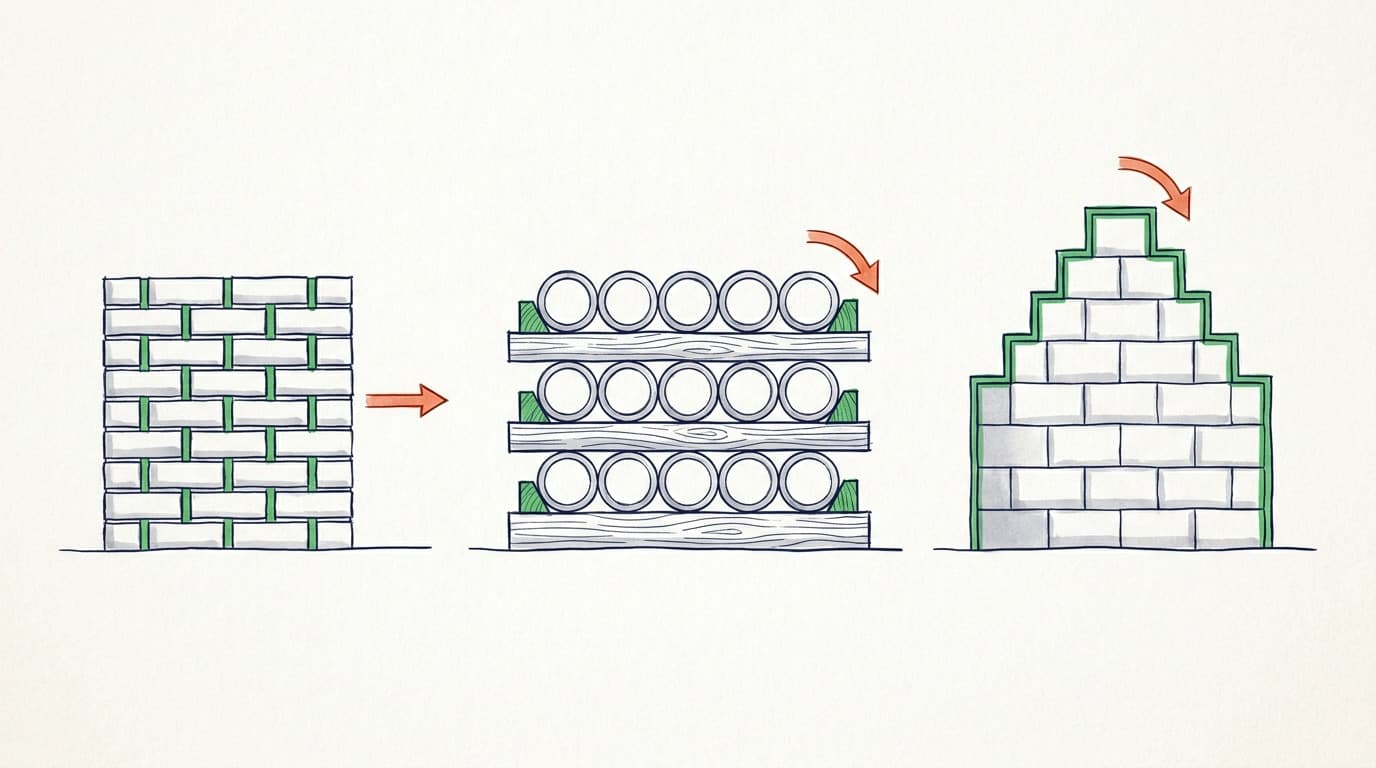
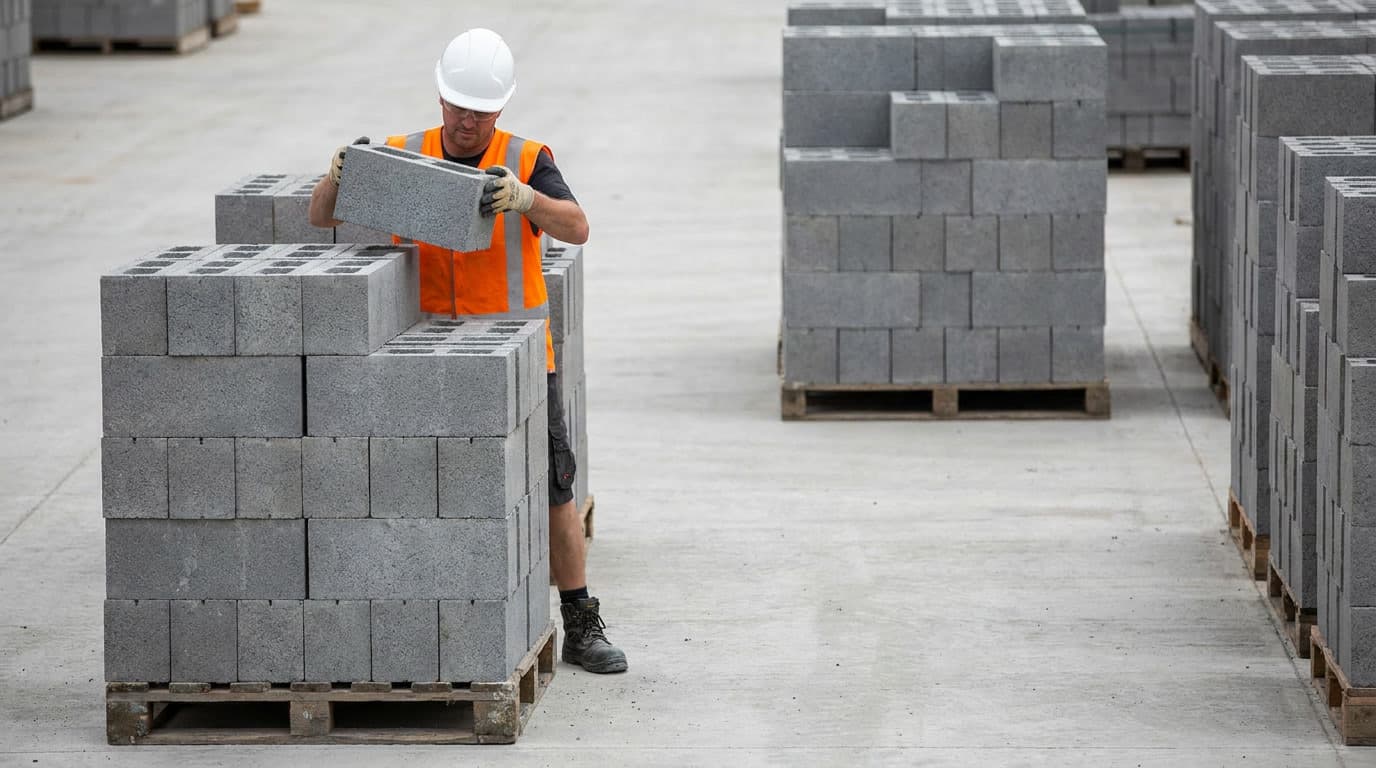
The general requirement sets the goal: all materials stored in tiers must be stacked, racked, blocked, interlocked, or otherwise secured to prevent sliding, falling, or collapse. Everything else is that goal applied to a particular material. Loose brick may not be stacked more than seven feet high, and once a loose brick stack reaches four feet it must be tapered back two inches for every foot of height above that level — the taper widens the base under the growing top so the stack cannot topple forward. Masonry block stacked higher than six feet must be tapered back one-half block per tier above the six-foot level, the same principle for a different unit. Bagged materials must be stacked by stepping back the layers and cross-keying the bags at least every ten bags high, which ties the pile together so it behaves as one mass instead of loose bags. Lumber must be stable and self-supporting on level, solid sills, capped at twenty feet, or sixteen if handled by hand. Each of these is the same instruction — keep the base wider and the units tied — shaped to the material in front of you.
Match the securing to how it fails#
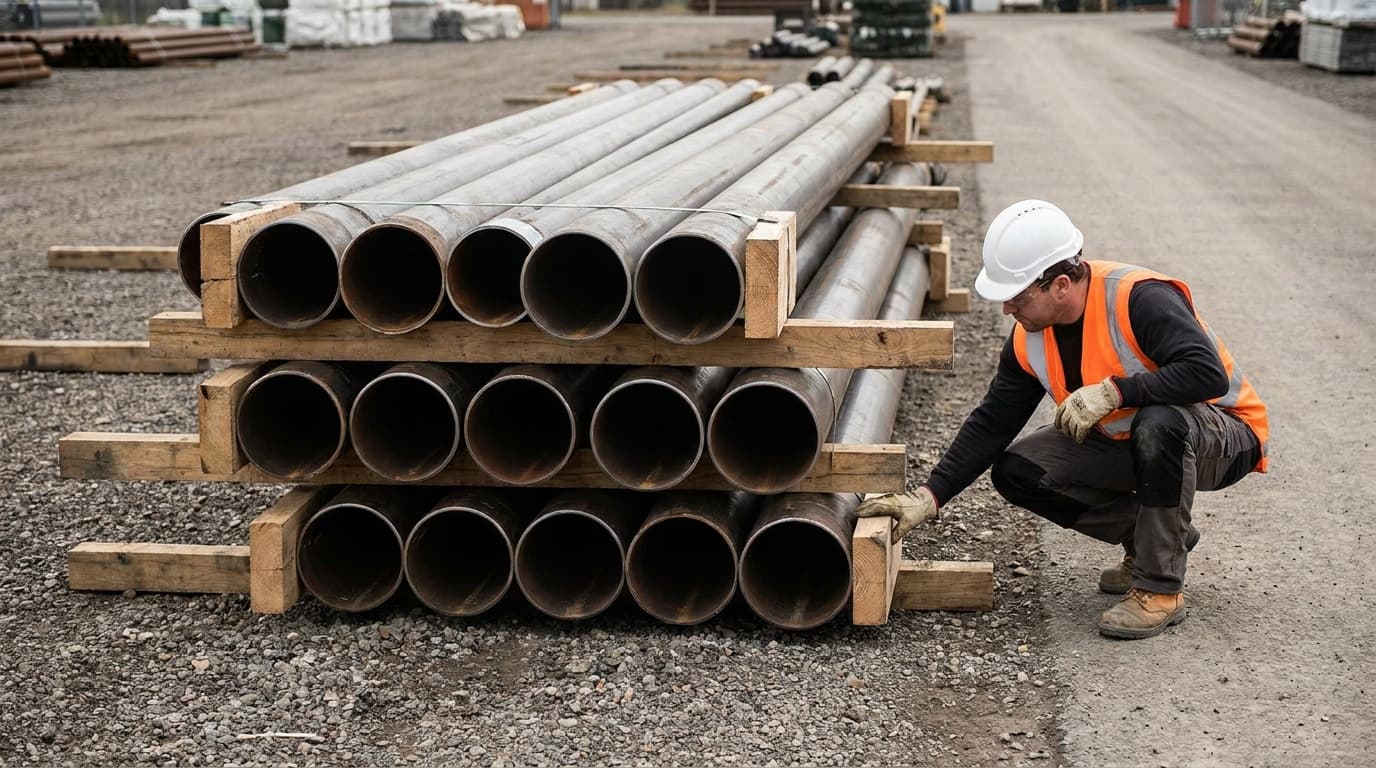
This is the second half of the idea, and it is what "just stack it neatly" misses. Different materials fail in different ways, and the standard matches the control to the failure. Flat, stable units — bricks, blocks, boxes — tend to slide and shear, so they are interlocked and cross-keyed so the layers grip each other. Round and cylindrical materials — pipe, poles, drums on their sides — tend to roll, so they are blocked and chocked at the base of every tier to stop the roll before it starts, and structural steel, poles, and other cylindrical materials must be stacked and blocked to prevent spreading or tilting. Tall, sheer faces tend to topple, so they are tapered and height-limited. Drums and barrels stacked on end get dunnage — planks or pallets — between tiers to make a firm, flat surface, and are chocked on each side when stacked more than one tier high. The point is that neat is not the same as secure: a tidy pile of round stock with nothing blocking it is one bump away from rolling, and matching the method to the failure mode is what actually holds the stack.
The floor, the aisles, and the space around the stack#
A stack does not exist in isolation, and two of the most-missed requirements are about its surroundings. First, the floor: the weight of stored materials on floors within buildings and structures must not exceed the maximum safe load limits, and those limits must be posted — a stack that is stable in itself can still overload the structure holding it up, and concentrated heavy material in a small footprint is exactly how that happens. Second, the aisles and passageways: they must be kept clear to allow the free and safe movement of material handling equipment and workers, and kept in good repair. Material creeping into an aisle turns a clear path into a pinch point between a stack and a moving forklift. And materials should not be stored on scaffolds or runways beyond what is needed for immediate operations, because those structures are not designed to be storage racks. The stack, the floor under it, and the space around it are one system.
Building it and taking it down#
Two moments carry most of the risk: building the stack up and pulling it back down. Going up, the base tier does the most work and deserves the most care — level, solid support, the heaviest and most stable units low, nothing built on a soft or uneven foundation that will let one corner settle and start a lean. Coming down, the danger is removing material from the wrong place: pulling from the bottom or the middle of a pile undermines everything above it, so material comes off the top first, in reverse of how it went on. A stack that was safe to build can become unsafe the instant someone pulls a unit out of the base to save a few steps. And a competent person should inspect stored materials and correct anything that has started to lean, settle, or shift, because a stack that looks fine today has all the time in the world to move.
Where the duty sits#
The stacking and storage requirements live in 1926.250, the general storage standard: the requirement to secure tiered materials against sliding, falling, or collapse; the brick and block height and taper rules; the bag cross-keying rule; the lumber stacking rules; the blocking of cylindrical materials; the floor load limits; and the clear-aisle requirement. OSHA has also clarified that palleted units which are adequately banded or shrink-wrapped for shipping can qualify as "otherwise secured," so the taper rules are not the only compliant method — the test is always whether the method actually prevents sliding, falling, or collapse. The general duties to train workers and protect against recognized hazards run through 1926.21(b)(2) and the General Duty Clause, Section 5(a)(1), and an unstable stack near workers is a recognized hazard. Where a site storage plan or an engineered racking system sets specific requirements, those govern.
What can go wrong?#
- A stack is built too high or too sheer and topples forward onto a worker.
- Round stock or pipe isn't blocked, and it rolls off the pile.
- Bags aren't cross-keyed, and the pile slumps and slides apart.
- Material is pulled from the bottom or middle, undermining everything above.
- A heavy stack overloads a floor that wasn't rated for the concentrated weight.
- Material creeps into an aisle and creates a pinch point with a forklift.
- A stack is built on soft or uneven ground, settles, leans, and collapses.
- Materials are piled on a scaffold or runway not designed to hold them.
How do we manage this properly?#
- Build every stack so the base is wider and more stable than the top.
- Match the method to the material: interlock flat units, block round ones, taper tall faces.
- Respect the height limits — brick to seven feet, lumber to twenty (sixteen by hand).
- Taper brick above four feet and block above six feet so the base carries the top.
- Cross-key bagged material every ten bags so the pile acts as one.
- Check the floor load limit — heavy stacks concentrate weight in a small footprint.
- Keep aisles and passageways clear, and don't store on scaffolds or runways.
- Take material off the top first — never pull from the bottom or middle.
Before you start#
- Confirm the ground or floor is level, solid, and rated for the load.
- Confirm you know the height limit for the material you're stacking.
- Confirm round or cylindrical stock will be blocked or chocked at each tier.
- Confirm bagged material will be stepped back and cross-keyed.
- Confirm the stack won't creep into an aisle or block a passageway.
- Confirm heavy material isn't concentrated beyond the floor's posted limit.
- Confirm the plan to take material off the top, not the bottom.
- Confirm someone will inspect standing stacks for lean, settle, or shift.
Talk it over#
- Where on this site is material stacked, and is any of it leaning or creeping into a path?
- What's the tallest stack here, and is its base wide enough to carry it?
- When you take material off a pile, do you work from the top or grab the easiest piece?
- Which stacks on this site are round stock that should be blocked — and are they?
The bottom line#
A stack is the one hazard you build on purpose — and every stacking rule is the same instruction: keep the base wider than the forces trying to tip it. The storage standard can read as a scattered list, but it is one idea in many forms: a loose pile wants to slide, roll, or topple, and the rules widen the base, tie the units together, or stop the roll so the pile's tendency to fall stays smaller than its tendency to stand. That is why 1926.250 caps brick at seven feet and tapers it above four, tapers block above six, cross-keys bags every ten, blocks cylindrical material against rolling, and requires every tier to be secured against sliding, falling, or collapse — and the second half of the idea is that the control matches the failure: flat units interlock, round units block, tall faces taper. The stack is one system with the floor beneath it and the aisle beside it — respect the posted load limit and keep passageways clear — and it is most dangerous while being built or taken down, so build from a solid base up and take material off the top first. Banding or shrink-wrap can secure a palleted unit as well as a taper does; the test is always whether the method prevents collapse. The question to carry is simple: if everyone walked away right now, would this stack still be standing tomorrow — and is its base wider than whatever is trying to tip it over?
Frequently asked questions about stacking and storing materials#
Why is a stack such a serious hazard?
Because it is a hazard you build on purpose and then leave standing over people. Unlike most jobsite dangers, which are things going wrong, a stack is deliberately assembled potential energy — material lifted up and held there, constantly pulled on by gravity. As long as it was built to resist sliding, rolling, and toppling, it stays put; the moment it wasn't, or the moment someone undermines it, the material that was under control becomes a struck-by and crush hazard falling on whoever is nearby. OSHA treats falling materials and collapsing stacks as a leading preventable cause of serious injury, which is why the storage rules are so specific about how a pile must be built.
What are the height limits for stacking?
They depend on the material. Loose brick may not be stacked more than seven feet high, and once a loose brick stack reaches four feet it must be tapered back two inches for every foot above that level. Masonry block stacked higher than six feet must be tapered back one-half block per tier above six feet. Lumber must not exceed twenty feet, or sixteen feet if it is handled manually. Beyond these specific numbers, the general rule is that any tiered material must be limited in height and secured so it is stable and cannot slide or collapse — height is one of the main things that turns a stable pile into an unstable one, which is why the limits and tapers exist.
What does "taper the stack" actually do?
It widens the base relative to the top so the stack cannot topple forward. As a stack of loose units gets taller, its center of gravity rises and a sheer vertical face becomes easy to tip. Tapering — stepping the stack back as it goes up, two inches per foot for brick above four feet, one-half block per tier for masonry above six feet — keeps the base broad under the growing top so the weight stays inside the footprint. It is the physical expression of the whole principle: keep the base wider than the forces trying to tip the pile. A vertical, untapered face at those heights is exactly what the rule is preventing.
Why does the securing method depend on the material?
Because different materials fail in different ways, and a control that stops one failure does nothing for another. Flat units like bricks, blocks, and boxes tend to slide and shear, so they are interlocked and cross-keyed to grip each other. Round and cylindrical materials — pipe, poles, drums on their sides — tend to roll, so they are blocked and chocked to stop the roll. Tall, sheer faces tend to topple, so they are tapered and height-limited. "Stack it neatly" misses this: a tidy pile of round stock with nothing blocking it is one bump from rolling off. Matching the method to the way the material fails is what actually holds the stack together.
Does the floor under a stack matter?
Yes, and it is one of the most-missed requirements. The weight of stored materials on a floor within a building or structure must not exceed the maximum safe load limits, and those limits must be posted. A stack can be perfectly stable in itself and still overload the structure holding it up, especially when heavy material is concentrated in a small footprint — which is exactly what a dense stack does. The stack and the floor are one system: building a stable pile on a floor that can't carry the load just moves the collapse from the stack to the structure. Check the posted load limit before concentrating heavy material.
How should material be taken down from a stack?
From the top, in reverse of how it went up. The most common way a stack that was safe to build becomes dangerous is someone pulling material from the bottom or the middle to save a few steps, which undermines everything above and can bring the pile down. Material comes off the top first, working down evenly, so the stack stays stable as it shrinks. This is also why a competent person should inspect standing stacks — a pile that was built correctly can start to lean, settle, or shift over time, and catching that before it collapses is part of keeping the stack safe for its whole life, not just the moment it was built.
Download the stacking and storing materials toolbox talk PDF#
Get this stacking and storing materials toolbox talk as a print-ready PDF — available in English, Spanish, Portuguese, and Turkish. Print it, hand it to the crew, and collect signatures on the included attendance sheet.
Download the PDF — free account required. New members get 3 free downloads.
Related toolbox talks#
Sources#
- OSHA, General requirements for storage — 29 CFR 1926.250 (all tiered materials stacked, racked, blocked, interlocked, or otherwise secured to prevent sliding, falling, or collapse; brick stacks not more than 7 feet and tapered back 2 inches per foot above 4 feet; masonry block tapered one-half block per tier above 6 feet; bagged materials cross-keyed every 10 bags; lumber stacked stable and self-supporting; cylindrical materials blocked; floor safe load limits posted; aisles kept clear): https://www.osha.gov/laws-regs/regulations/standardnumber/1926/1926.250
- OSHA, Interpretation on banded and shrink-wrapped brick and block (2008-02-06) (palleted units adequately banded or shrink-wrapped for shipping can qualify as "otherwise secured to prevent sliding, falling, or collapse"): https://www.osha.gov/laws-regs/standardinterpretations/2008-02-06
- OSHA, Training requirements — 29 CFR 1926.21(b)(2) (employer must instruct each employee in the recognition and avoidance of unsafe conditions, the general duty under which safe stacking and storage sits): https://www.osha.gov/laws-regs/regulations/standardnumber/1926/1926.21
This talk is general awareness guidance for training purposes. It does not replace your employer's material storage procedures, the OSHA storage standard, the OSH Act General Duty Clause, an engineered racking system's requirements, or a competent person's duties, and it is not legal advice. Where a site storage plan or a manufacturer's racking instruction sets a specific requirement, that requirement governs.