Abrasive Wheels
Updated 2026-07-28
In this bundle Tools & Machinery
Print-ready PDF
Download this talk as a print-ready PDF, available in 4 languages.
An abrasive wheel is a piece of bonded grit spinning fast enough that it stores real energy, and it is the only tool on most sites that can come apart while working exactly as intended. That is why the standard for it is unusually specific — and why almost every requirement in it is a number that a worn machine slowly drifts away from. This Abrasive Wheels Toolbox Talk (Safety Talk / Tailgate Talk) is about those numbers and about what the guard is actually there to do.
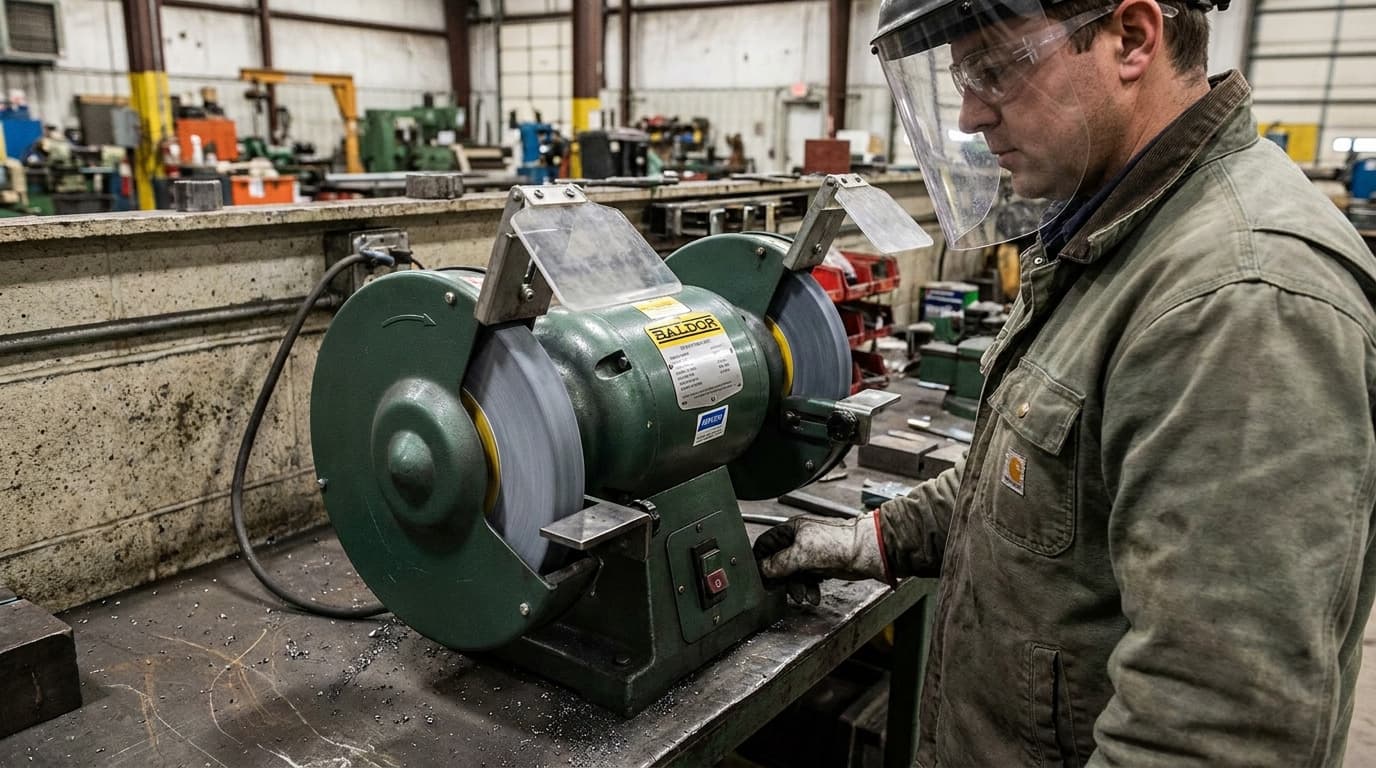
Here is the distinction that carries this whole talk: the guard on a grinder is not there to keep your hand out — it is there to catch the wheel. The standard says so directly: the guard and its fastenings must be strong enough to retain fragments of the wheel in case of accidental breakage. A guard that is loose, cracked, missing fastenings or fitted from another machine may still block your hand and still fail the only test the regulation sets for it.
What the guard has to do — 1926.303(b)#
Under 1926.303(b), all grinding machines must be equipped with safety guards, with narrow exceptions — including wheels 2 inches or less in diameter securely mounted on the end of a steel mandrel, and cases where the wheel is entirely within the work being ground.
Then the requirements that matter:
- (b)(5) — guards shall be so mounted as to maintain proper alignment with the wheel, and the guard and its fastenings shall be of sufficient strength to retain fragments of the wheel in case of accidental breakage. Maximum angular exposure of the wheel periphery and sides shall not exceed 180°.
- (b)(6) — where safety flanges are required, they shall be used only with wheels designed to fit the flanges, and only flanges of a type and design assembled so as to ensure the pieces of the wheel will be retained in case of breakage.
- (b)(7) — all abrasive wheels shall be closely inspected and ring-tested before mounting to ensure they are free from cracks or defects.
- (b)(8) — grinding wheels shall fit freely on the spindle and shall not be forced on, and the spindle nut shall be tightened only enough to hold the wheel in place.
That last one surprises people. Over-tightening a spindle nut is not extra safety; it stresses the wheel. And a wheel forced onto a spindle it does not fit is already damaged before it turns.
The ring test in (b)(7) is thirty seconds of work: with the wheel dry and clean, suspended on a pin or finger through the hole, tap it gently with a non-metallic implement about 45° either side of vertical, then rotate 45° and repeat. A sound wheel gives a clear ring; a cracked one gives a dull, dead note. It does not work on plugged, wet or resin-loaded wheels — but it is a mandatory step before mounting, not an optional one.
Two gaps everybody confuses#
Both are small, both are on the same machine, and they do completely different jobs.
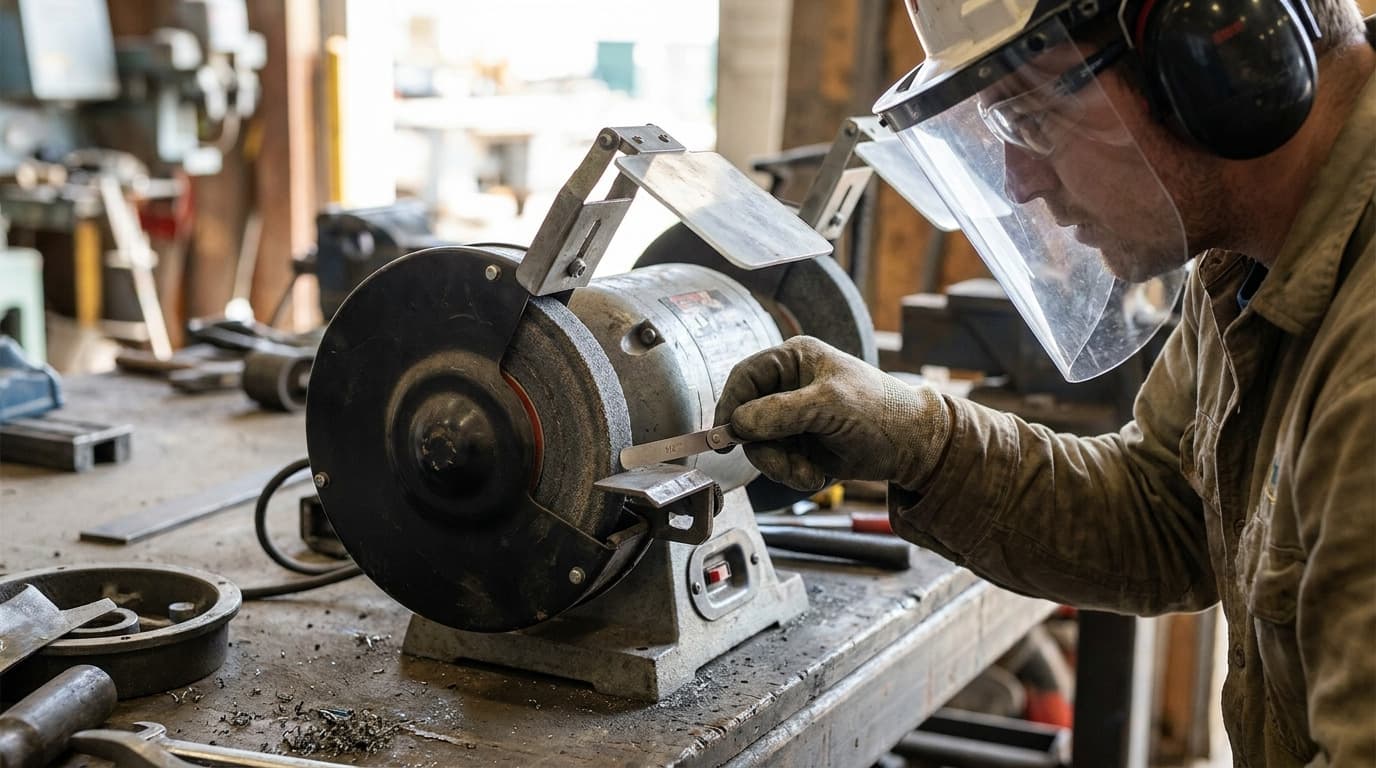
The work rest gap — 1/8 inch (0.3175 cm). Under 1926.303(c)(2), floor and bench-mounted grinders must have work rests that are rigidly supported and readily adjustable, kept at a distance not to exceed one-eighth inch from the surface of the wheel. 1926.303(e) repeats it for offhand grinding and adds the reasons and the rules: the maximum opening of 1/8 inch (0.3175 cm) exists to prevent the work from being jammed between the wheel and the rest, which may cause wheel breakage; the rest must be securely clamped after each adjustment; and the adjustment shall not be made with the wheel in motion.
The tongue guard gap — 1/4 inch (0.635 cm). Under 1926.300(b)(7), the distance between the wheel periphery and the adjustable tongue — or the end of the peripheral member at the top — shall never exceed 1/4 inch (0.635 cm).
Two gaps, two failure modes. The work rest gap is about the work being dragged into the wheel and bursting it. The tongue gap is about a fragment escaping upward out of the top of the guard when it does burst. Both open up as the wheel wears down, which means both are maintenance items on every single wheel change and periodically in between — not a one-off setup.
Angular exposure — how much wheel you are allowed to see#
1926.303(c)(1) puts numbers on the opening in the guard for floor stand and bench mounted wheels used for external grinding:
- Maximum angular exposure of the periphery and sides: not more than 90°.
- Where the work requires contact with the wheel below the horizontal plane of the spindle: not more than 125°.
- In either case, the exposure shall begin not more than 65° above the horizontal plane of the spindle.
- Safety guards shall be strong enough to withstand the effect of a bursting wheel.
(c)(3) requires cup type wheels used for external grinding to be protected by a revolving cup guard or a band type guard in accordance with ANSI B7.1-1970, and 1926.303(d) requires all abrasive wheels and tools to meet the other applicable requirements of that same standard — the safety code for the use, care and protection of abrasive wheels.
What can go wrong?#
The wheel is over-speeded. The single most dangerous error: a wheel whose maximum rated speed is below the machine's spindle speed. Nothing about the fit tells you; only the wheel marking and the machine plate do.
The wheel was dropped. A knock during transport or storage can crack a wheel invisibly — which is precisely why the ring test is required before mounting rather than after a problem appears.
The work rest is left where it was. The wheel wears, the gap grows past 1/8 inch (0.3175 cm), and the workpiece eventually gets pulled into the space and jams.
The rest is adjusted with the wheel spinning. Explicitly prohibited in 1926.303(e), and one of the most common short cuts on any bench grinder.
The tongue guard is never touched. It came from the factory in one position and has stayed there through four wheels.
The guard is opened up "to see the work." Cutting the guard back past the angular limits removes exactly the material that was supposed to contain a burst.
Side grinding on a wheel not made for it. Type 1 wheels are made for peripheral grinding; loading the side of one is a burst mechanism.
Nobody stands aside at start-up. The moments after power-on are when a defective wheel fails.
How do we do this properly?#
Match the ratings before anything else. The wheel's maximum rated speed must be at or above the machine's spindle RPM, and the wheel must be the right type, size and bore for the machine.
Ring-test every wheel before mounting. Dry, clean, suspended, tapped with a non-metallic implement — and if the note is dull, the wheel is scrap, not a spare.
Mount it properly. Free fit on the spindle, never forced, correct blotters and matching flanges, spindle nut tightened only enough to hold the wheel.
Set both gaps at every wheel change. Work rest to 1/8 inch (0.3175 cm) and securely clamped, tongue guard to no more than 1/4 inch (0.635 cm) — with the machine off and the wheel stationary, every time.
Check the guard, not just its presence. Aligned, complete, all fastenings in place, exposure within the angular limits, and never modified to improve the view.
Stand aside and run it up. After mounting, let the wheel run at operating speed for a short period with everyone clear of the plane of rotation before bringing work to it.
Wear the face protection. Eye protection is a minimum and a face shield is the sensible addition — this is a tool that throws sparks, hot particles and, on a bad day, fragments.
Take a damaged wheel out of circulation. Chipped, cracked, dropped, wet, out of date or unmarked wheels are disposed of, not put back in the drawer.
Before you start#
- Confirm the wheel's maximum rated speed is at or above the machine's spindle speed.
- Confirm the wheel has been ring-tested and inspected before mounting.
- Confirm the wheel fits freely on the spindle and the nut is tightened only enough to hold it.
- Confirm the work rest gap does not exceed 1/8 inch (0.3175 cm) and is securely clamped.
- Confirm the tongue guard gap does not exceed 1/4 inch (0.635 cm).
- Confirm the guard is complete, aligned and unmodified, with all fastenings fitted.
- Confirm nobody is standing in the plane of the wheel when it is started.
- Confirm eye and face protection is on before the wheel turns.
Talk it over#
- When was the work rest on our bench grinder last adjusted, and by whom?
- Has anyone here ever ring-tested a wheel? What did a cracked one sound like?
- Where do we store wheels, and could one have been knocked or soaked?
- Who checks that a new wheel's speed rating matches the machine?
The bottom line#
The guard on a grinder exists to retain fragments of the wheel in case of accidental breakage — that is what 1926.303(b)(5) requires of it, along with proper alignment and a maximum angular exposure of 180°. Before mounting, (b)(7) requires every abrasive wheel to be closely inspected and ring-tested; (b)(8) requires it to fit freely with the spindle nut tightened only enough to hold it. Two gaps have to be set and reset as the wheel wears: the work rest at 1/8 inch (0.3175 cm), clamped, never adjusted with the wheel in motion, and the tongue guard at no more than 1/4 inch (0.635 cm) under 1926.300(b)(7). For floor and bench wheels, exposure is limited to 90°, or 125° where work requires contact below the spindle's horizontal plane, beginning no more than 65° above it. Every one of those numbers drifts as the wheel wears — which is why they are checked at every wheel change, not once.
Frequently asked questions about abrasive wheels#
What is the guard on a grinder actually for?
To contain a burst. 1926.303(b)(5) requires the guard to be mounted so as to maintain proper alignment with the wheel and requires the guard and its fastenings to be of sufficient strength to retain fragments of the wheel in case of accidental breakage, with maximum angular exposure of the periphery and sides not exceeding 180°.
What is the ring test and is it mandatory?
It is mandatory. 1926.303(b)(7) requires that all abrasive wheels be closely inspected and ring-tested before mounting to ensure they are free from cracks or defects. The wheel is suspended and tapped lightly with a non-metallic implement: a sound wheel rings clearly, a cracked one sounds dull. It does not work on wet, plugged or resin-loaded wheels, which must be assessed by other means.
How close should the work rest be to the wheel?
1926.303(c)(2) requires work rests on floor and bench-mounted grinders to be kept at a distance not to exceed one-eighth inch from the wheel surface, and 1926.303(e) repeats the maximum opening of 1/8 inch (0.3175 cm) — the purpose being to prevent the work from being jammed between wheel and rest, which may cause wheel breakage. The rest must be securely clamped after each adjustment, and the adjustment must not be made with the wheel in motion.
What is the tongue guard gap?
A separate requirement. 1926.300(b)(7) provides that the distance between the wheel periphery and the adjustable tongue, or the end of the peripheral member at the top, shall never exceed 1/4 inch (0.635 cm). It stops fragments escaping out of the top of the guard, and it needs resetting as the wheel wears down.
How much of the wheel may be exposed?
For floor stand and bench mounted wheels used for external grinding, 1926.303(c)(1) limits maximum angular exposure of the periphery and sides to 90°, or 125° where the work requires contact with the wheel below the horizontal plane of the spindle. In either case the exposure must begin not more than 65° above the horizontal plane of the spindle, and the guard must be strong enough to withstand a bursting wheel.
Are there wheels that do not need a guard?
A few narrow cases. Under 1926.303(b), exceptions include wheels 2 inches or less in diameter that are securely mounted on the end of a steel mandrel, and situations where the wheel is entirely within the work being ground. These are exceptions to a general requirement, not a general permission.
Why does over-tightening the spindle nut matter?
Because it stresses the wheel. 1926.303(b)(8) requires grinding wheels to fit freely on the spindle and not be forced on, with the spindle nut tightened only enough to hold the wheel in place. A forced fit or an over-tightened nut can put a wheel under load before it has even started turning.
Download the abrasive wheels toolbox talk PDF#
Get this abrasive wheels toolbox talk as a print-ready PDF — available in English, Spanish, Portuguese, and Turkish. Print it, hand it to the crew, and collect signatures on the included attendance sheet.
Download the PDF — free account required. New members get 3 free downloads.
Related toolbox talks#
Sources#
- OSHA, 29 CFR 1926.303 — Abrasive wheels and tools: https://www.osha.gov/laws-regs/regulations/standardnumber/1926/1926.303
- OSHA, 29 CFR 1926.300 — General requirements (Subpart I, Tools — Hand and Power): https://www.osha.gov/laws-regs/regulations/standardnumber/1926/1926.300
Written by FieldSafetyTalk's safety professional — a CSP, ASP, CHST and OSHA Authorized Outreach Trainer with 14+ years of international construction safety experience across federal, heavy civil, and industrial projects.