Skylight Hazards
Updated 2026-07-24
In this bundle Fall Protection & Heights
Print-ready PDF
Download this talk as a print-ready PDF, available in 4 languages.
OSHA never wrote a skylight rule. Look for one and you will not find it. What you find instead is the word "skylight" sitting in parentheses inside the rule about holes — three separate times, in 1926.501(b)(4)(i), (ii), and (iii). That placement is the whole talk. A skylight is not a feature of the roof that happens to be fragile. In the eyes of the standard, it is a hole in the roof that somebody put a lens in. This Skylight Hazards Toolbox Talk (Safety Talk / Tailgate Talk) is about the gap between how a roof looks and what it legally is.
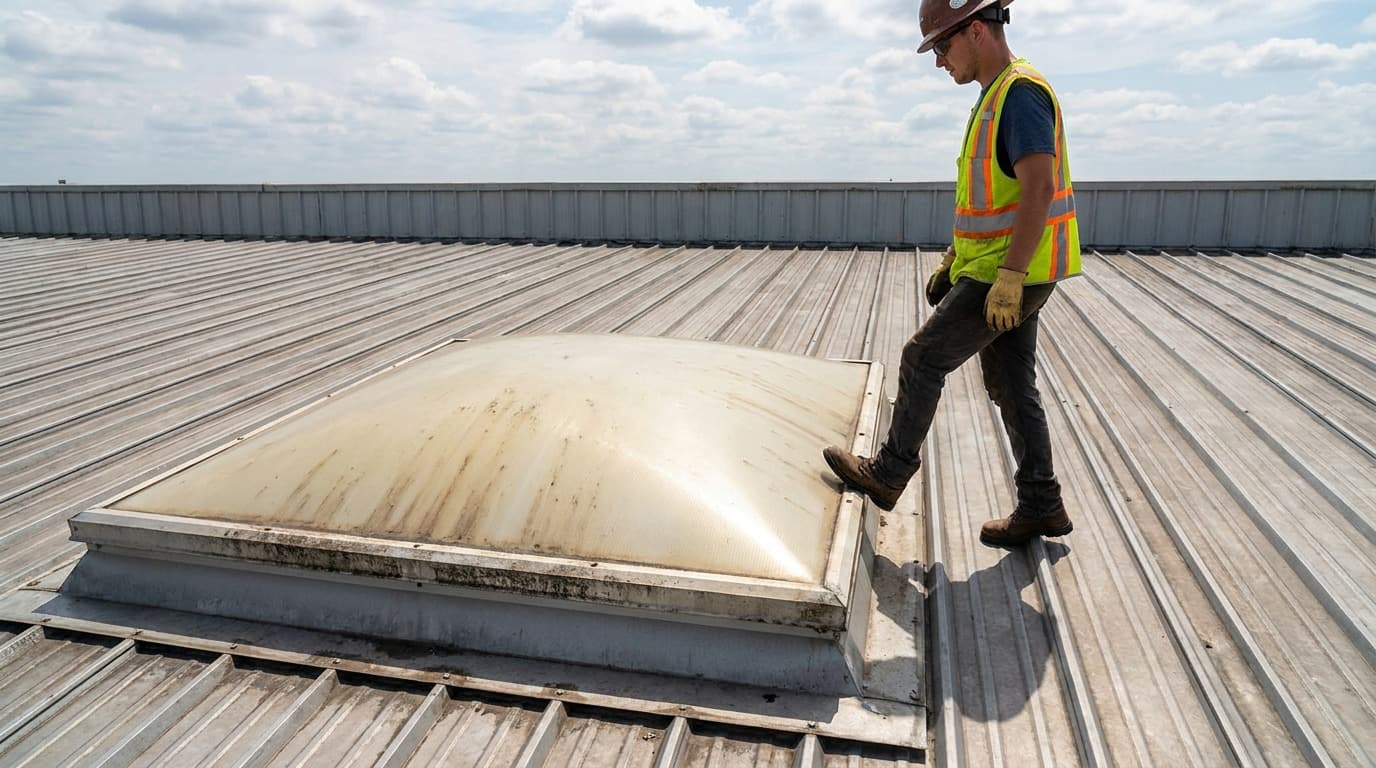
Here is the distinction that carries it: every other fall hazard on a roof announces itself. An open edge is visibly an edge. A floor opening is visibly an opening. A skylight is the only fall hazard on a jobsite that has been deliberately engineered to look like part of the surface — and then left to weather until it looks like an ordinary panel. It is a hole that has been camouflaged, at eye level, by design.
Why a skylight is legally a hole#
There is no clean national dataset isolating skylight falls — they are recorded inside broader fall-to-lower-level categories, so treat any specific number you see quoted with suspicion. What is precise, and more useful, is the regulatory language.
29 CFR 1926.500(b) defines the term: a hole means a gap or void 2 inches (5.1 cm) or more in its least dimension, in a floor, roof, or other walking/working surface. Two inches. That threshold exists because OSHA is concerned not only with gaps big enough to fall through, but with gaps that can catch a boot.
29 CFR 1926.501(b)(4) then sets three duties, and each one names skylights explicitly:
- (b)(4)(i) — Each employee on walking/working surfaces shall be protected from falling through holes (including skylights) more than 6 feet (1.8 m) above lower levels, by personal fall arrest systems, covers, or guardrail systems erected around such holes.
- (b)(4)(ii) — Each employee on a walking/working surface shall be protected from tripping in or stepping into or through holes (including skylights) by covers.
- (b)(4)(iii) — Each employee shall be protected from objects falling through holes (including skylights) by covers.
Now read (b)(4)(ii) again, because it contains the part almost nobody knows. It has no height threshold. The six-foot trigger belongs to (b)(4)(i) only. The duty to protect against stepping into or through a hole applies regardless of the drop, and OSHA has confirmed this in interpretation: the provision does not specify a minimum depth. On top of that, a personal fall arrest system does not satisfy (b)(4)(ii) — a harness does not stop you stepping into a hole. That duty is discharged by a cover, or by a guardrail around the hole. So on a low roof where a harness might feel like enough, it is not the right control and it is not the required one.
The cover criteria a skylight dome was never built to meet#
If a skylight is a hole, the obvious question is whether the dome over it counts as the cover. 29 CFR 1926.502(i) answers that, and the answer is almost always no:
- (i)(1) Covers in roadways and vehicular aisles must support, without failure, at least twice the maximum axle load of the largest vehicle expected to cross them.
- (i)(2) All other covers must support, without failure, at least twice the weight of employees, equipment, and materials that may be imposed on the cover at any one time.
- (i)(3) All covers must be secured when installed, so as to prevent accidental displacement by wind, equipment, or employees.
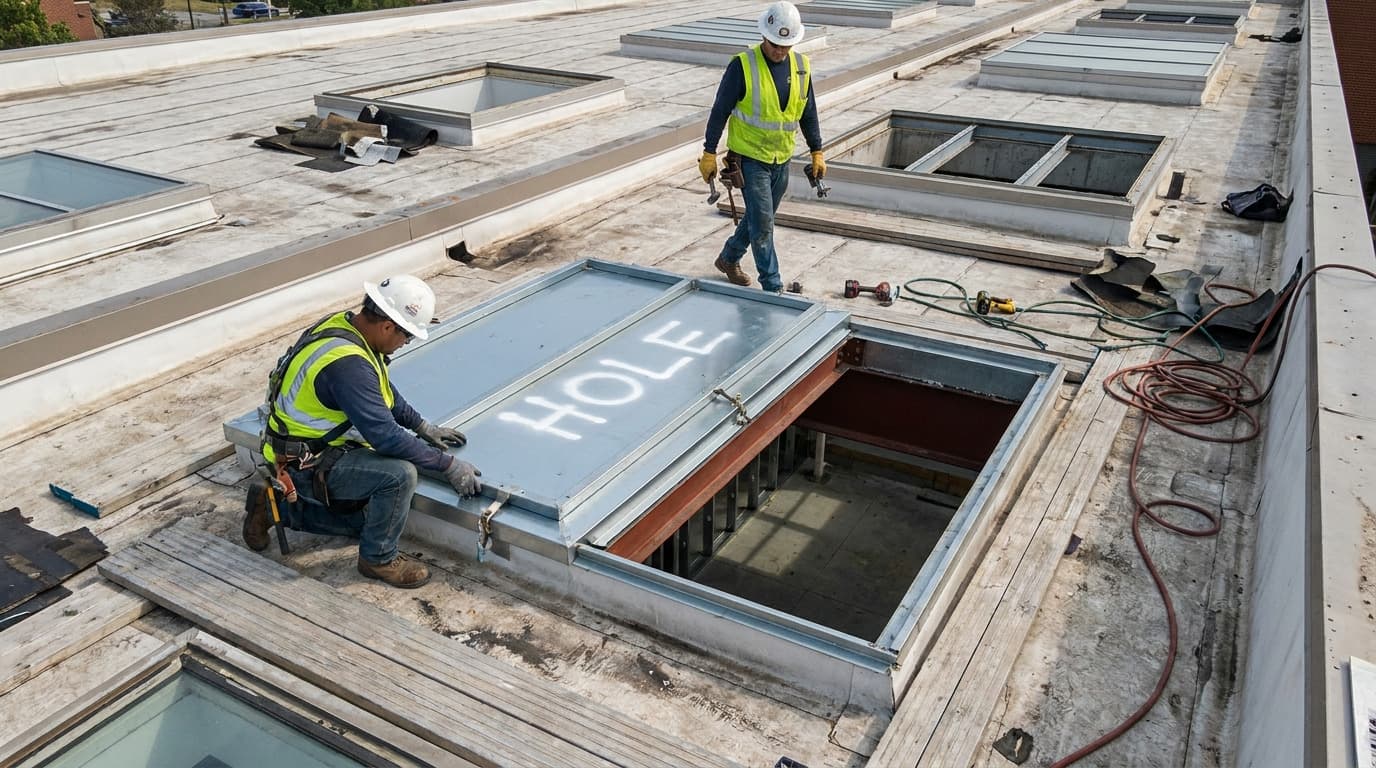
- (i)(4) All covers must be color coded, or marked with the word "HOLE" or "COVER", to provide warning of the hazard.
Hold a skylight up against that list. It was designed to shed rain and admit daylight. Its structural brief was wind uplift and snow load spread across a frame — not a concentrated human body, and certainly not twice one. Nobody proof-tested it as a walking surface, no manufacturer rated it as a cover, and the acrylic or polycarbonate dome has been sitting in ultraviolet light losing impact strength every year since it was installed.
Then compare it against (i)(4). A compliant cover must be marked to warn you. A skylight does the opposite: it is transparent by design, and after a few years of dirt, algae, and chalking it reads as just another slightly different panel in the roof. The standard requires the hazard to advertise itself. The skylight conceals it.
That is the entire mismatch in one line. An unprotected skylight is a hole with a lid that looks like a floor and is rated for neither.
OSHA skylight requirements (29 CFR 1926 Subpart M)#
- Falling through — 1926.501(b)(4)(i). Over 6 feet: personal fall arrest, covers, or guardrails around the hole.
- Stepping or tripping into — 1926.501(b)(4)(ii). Any height, no threshold: covers (or guardrails around the hole). A harness does not discharge this duty.
- Objects falling through — 1926.501(b)(4)(iii). Covers. Remember there are people underneath a skylight, usually at a workstation, usually with no idea anyone is on the roof.
- Definition of a hole — 1926.500(b). A gap or void 2 inches or more in its least dimension in a floor, roof, or other walking/working surface. A missing or removed skylight panel is unambiguously a hole.
- Cover criteria — 1926.502(i)(1)–(4). Twice the imposed load, secured against displacement, and color coded or marked HOLE or COVER.
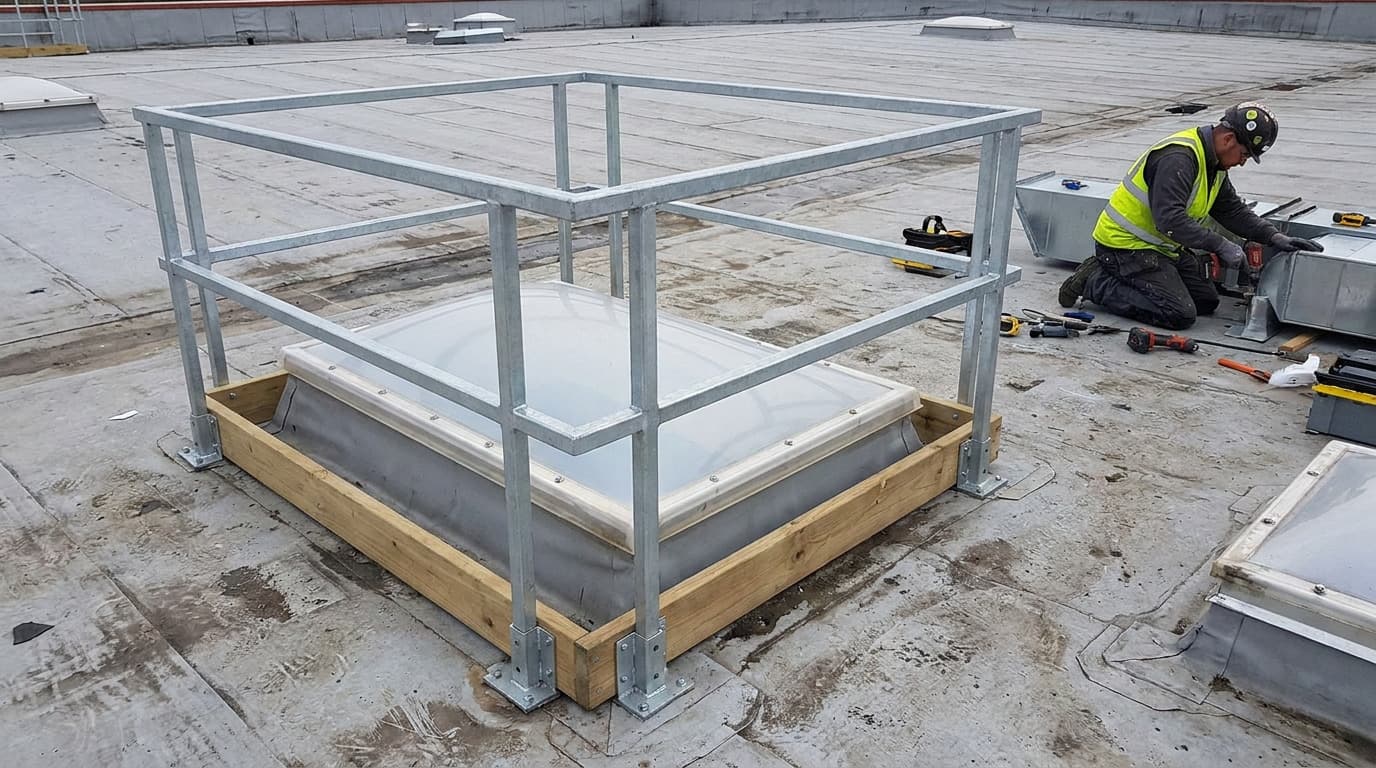
- Guardrail criteria — 1926.502(b). If you guard the skylight instead of covering it, the guardrail must meet the full Subpart M criteria — it is not a token barrier.
- Anchorage — 1926.502(d)(15). If personal fall arrest is the chosen control on a roof, the anchorage still has to be independent of any platform-supporting anchorage and rated accordingly. Roofs are exactly where improvised anchors appear.
- Training — 1926.503(a)(2). A competent person must train each employee to recognise fall hazards. A hazard that looks like a floor is precisely the kind that requires being taught, not noticed.
On USACE and NAVFAC projects, EM 385-1-1 applies and is more prescriptive on roof openings, covers, and marking in several places.
What can go wrong#
Stepping backwards. The dominant pattern in skylight incidents, and it is not carelessness. A worker walking forward scans the path ahead. A worker pulling a hose, dragging a panel, carrying a sheet of material, or backing up while sighting a line is not looking at their feet at all. The skylight does not need to be hidden; it only needs to be behind them.
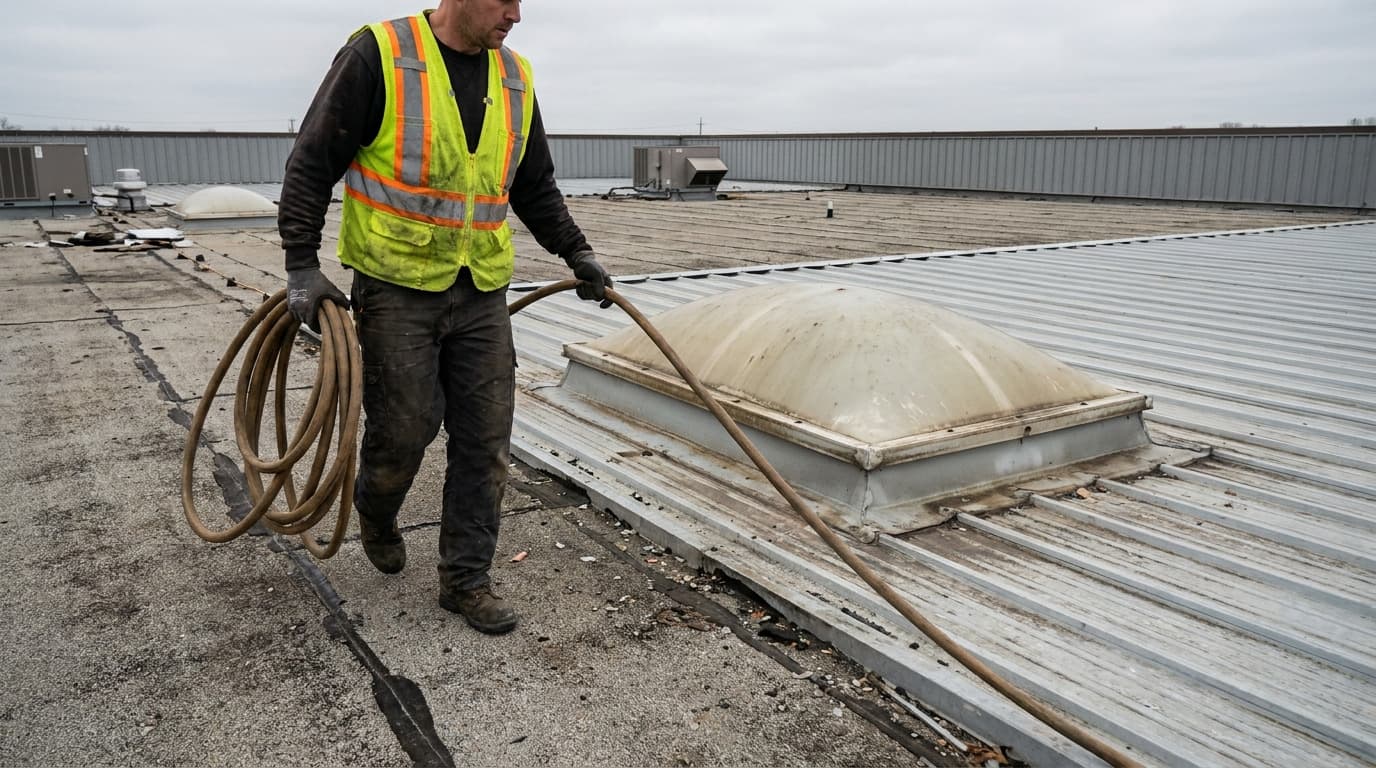
Kneeling, sitting, or setting a load on it. A skylight will often take a hand or a knee for a moment, which is exactly what makes it dangerous — it teaches people it is solid right up until it is not.
Assuming the dome is the cover. Covered above, and worth repeating on site: unless the unit was specifically manufactured and rated as a fall protection cover or fitted with a compliant screen, it is not one.
Degraded plastic. Acrylic and polycarbonate lose impact resistance with ultraviolet exposure. A twenty-year-old dome is not the product that was installed. There is no inspection sticker on it and no way to judge it by eye.
Painted over, tarred over, or covered with debris. On a re-roof, skylights get coated, papered, or buried under insulation and stock. The hazard does not go away when it stops being visible — it gets worse, because now it looks structurally continuous with the roof.
Snow, ponding water, and low sun. Anything that flattens the visual difference between the dome and the deck removes the last cue a worker had.
Removed panels during the work. The moment a skylight is taken out for replacement, the roof has an open hole in it, and it is often left that way "for a minute" while somebody fetches the new unit.
Nobody warned the people below. (b)(4)(iii) exists for a reason. Tools, fasteners, and offcuts go through a broken skylight onto whoever is working underneath.
The short-drop trap. A skylight over a mezzanine, a canopy, or a low bay is under six feet to the level below, so (b)(4)(i) does not bite — and crews conclude nothing is required. (b)(4)(ii) still applies, at any height, and needs a cover or guardrail rather than a harness.
The one-task exemption that does not exist. "We're only up here for ten minutes" changes nothing in the standard. Most skylight falls happen during short, unplanned tasks: an inspection, a survey, a single repair.
How do we control skylight hazards?#
Find and count them before anyone goes up. Walk the roof plan first. Know how many skylights there are, where they are, and what condition they are in — before the crew is standing among them.
Guard, cover, or screen every one — physically. The reliable controls are guardrails meeting 1926.502(b) around each unit, a rated fall protection cover, or a manufactured skylight screen. These work whether or not anyone is paying attention, which is the entire point.
If you use a cover, make it a real one. Capable of supporting at least twice the weight of employees, equipment and materials imposed at any one time under (i)(2), secured against displacement under (i)(3), and color coded or marked HOLE or COVER under (i)(4). A sheet of plywood laid loose over a skylight satisfies none of the three.
Do not rely on a harness alone where (b)(4)(ii) applies. For the stepping-into hazard the standard wants a cover or guardrail. Personal fall arrest is a legitimate control under (b)(4)(i) for the falling-through hazard over six feet, but it does not substitute for the other.
Mark them so they read as hazards. High-visibility paint on the curb, cones, barrier tape at distance, or a marked cover. Anything that makes the skylight look like what it is instead of what it resembles.
Treat every removed panel as an open hole immediately. Cover it or guard it the moment it comes out — not when the replacement arrives.
Protect the people underneath. Barricade or clear the area below before roof work starts, per the (b)(4)(iii) objects-falling duty.
Include skylights in the pre-task plan by name and number, so the control assigned to each one is a decision on paper rather than a judgement made while carrying something heavy.
Brief every visitor to the roof, every time. Inspectors, surveyors, HVAC technicians, and antenna crews are the people most likely to be on a roof without knowing where its holes are, and least likely to have been at the toolbox talk.
Before you start#
- Confirm the number and location of every skylight on this roof from the plan, before going up.
- Confirm each one is guarded, covered with a rated cover, or fitted with a screen.
- Confirm any cover supports at least twice the imposed load, is secured, and is marked HOLE or COVER.
- Confirm you are not relying on a harness alone where the duty is to protect against stepping into a hole.
- Check for skylights that have been painted, tarred, snowed over, or buried under stock.
- Confirm any removed panel is covered or guarded right now, not later.
- Confirm the area below is barricaded or cleared.
- Confirm your anchor points, if using fall arrest, are rated and independent.
- Confirm anyone else coming onto this roof today gets told where the skylights are.
- Look behind you before you step backwards, every time.
Talk it over#
- How many skylights are on this roof? Can anyone say the number without going to look?
- If you were dragging a hose backwards across this roof right now, where would you end up?
- Who is working directly underneath us — and do they know we are up here?
The bottom line#
OSHA classifies a skylight as a hole: the word appears in parentheses inside 1926.501(b)(4)(i), (ii), and (iii), and 1926.500(b) defines a hole as a gap or void 2 inches or more in its least dimension in a floor, roof, or other walking/working surface. The dome over it is not a cover, because 1926.502(i) requires a cover to support twice the weight imposed on it, to be secured, and to be color coded or marked HOLE or COVER — and a skylight was built to shed rain, has been losing impact strength in the sun ever since, and is transparent by design rather than marked. Guard it, fit a rated cover or screen, mark it so it looks like the hazard it is, and remember that the duty to protect against stepping into a hole under (b)(4)(ii) has no height threshold and is not satisfied by a harness.
Frequently asked questions about skylight safety#
Does OSHA have a specific skylight standard?
Not a separate one. Skylights are regulated as holes under 29 CFR 1926.501(b)(4), where the word "skylight" appears in parentheses in each of the three subparagraphs — (i) falling through, (ii) tripping in or stepping into or through, and (iii) objects falling through. 1926.500(b) defines a hole as a gap or void 2 inches (5.1 cm) or more in its least dimension in a floor, roof, or other walking/working surface.
Does a skylight dome count as a hole cover?
Almost never. Under 29 CFR 1926.502(i)(2), a cover must be capable of supporting, without failure, at least twice the weight of employees, equipment, and materials that may be imposed on it at any one time; under (i)(3) it must be secured against accidental displacement; and under (i)(4) it must be color coded or marked with the word "HOLE" or "COVER." A standard skylight dome was designed for weather, not for load, is not marked, and loses impact strength through ultraviolet exposure over its life. Unless a unit is specifically manufactured and rated as a fall protection cover, or fitted with a compliant screen, it does not meet these criteria.
What height triggers skylight fall protection?
Two different duties with two different triggers. 1926.501(b)(4)(i) applies to falling through holes more than 6 feet (1.8 m) above lower levels, and permits personal fall arrest systems, covers, or guardrails. 1926.501(b)(4)(ii) — protection from tripping in or stepping into or through a hole — has no minimum height, and OSHA has confirmed in interpretation that the provision does not specify a minimum depth.
Can I just wear a harness instead of covering a skylight?
Not for every duty. A personal fall arrest system is an accepted control under (b)(4)(i) for the falling-through hazard above 6 feet. But it does not satisfy (b)(4)(ii), because a harness does not prevent a worker stepping into a hole — that duty requires a cover, or a guardrail erected around the hole. If fall arrest is used, the anchorage must still meet 1926.502(d)(15).
What has to be done about people working below a skylight?
1926.501(b)(4)(iii) requires that employees be protected from objects falling through holes (including skylights) by covers. In practice that means covering the opening and barricading or clearing the area beneath the work before roof work begins — anything dropped through a broken skylight lands on whoever is underneath, usually without warning.
Why are skylights so easy to step through?
Because they are the only fall hazard on a roof deliberately designed to blend into the surface. An unprotected edge and an open floor opening both look like hazards. A skylight is transparent by design and, once weathered with dirt, algae and chalking, reads as another roof panel. The most common incident pattern is a worker stepping or walking backwards while dragging a hose, carrying material, or sighting a line — the skylight does not have to be hidden, it only has to be behind them.
Do old skylights get more dangerous over time?
Yes. Acrylic and polycarbonate lose impact resistance with prolonged ultraviolet exposure, so an aged dome is not the product that was originally installed and cannot be judged by eye. There is no inspection marking on a skylight to tell you what it will still hold — which is why the control has to be a guardrail, rated cover, or screen rather than any assumption about the dome itself.
Download the skylight hazards toolbox talk PDF#
Get this skylight safety toolbox talk as a print-ready PDF — available in English, Spanish, Portuguese, and Turkish. Print it, hand it to the crew, and collect signatures on the included attendance sheet.
Download the PDF — free account required. New members get 3 free downloads.
Related toolbox talks#
Sources#
- OSHA, 29 CFR 1926.501 — Duty to have fall protection: https://www.osha.gov/laws-regs/regulations/standardnumber/1926/1926.501
- OSHA, 29 CFR 1926.502 — Fall protection systems criteria and practices: https://www.osha.gov/laws-regs/regulations/standardnumber/1926/1926.502
- OSHA, Clarification of fall protection requirements for open holes on a construction site, Letter of Interpretation, November 17, 1998: https://www.osha.gov/laws-regs/standardinterpretations/1998-11-17
- OSHA, Clarification if a depression constitutes a hole or unprotected side/edge, Letter of Interpretation, September 30, 2004: https://www.osha.gov/laws-regs/standardinterpretations/2004-09-30-0
Written by FieldSafetyTalk's safety professional — a CSP, ASP, CHST and OSHA Authorized Outreach Trainer with 14+ years of international construction safety experience across federal, heavy civil, and industrial projects.