Lithium-Ion Battery Safety General Industry
Updated 2026-09-02
In this bundle Fire, Hot Work & Emergency
Print-ready PDF
Download this talk as a print-ready PDF, available in 4 languages.
Ask a crew what makes a lithium-ion battery dangerous and most will point at the moment it catches fire — the swollen pack on the charger, the tool that bursts into flame in someone's hand. That is the moment you see, but it is almost never the moment the problem started. This lithium-ion battery safety talk is about the gap between where the fire starts and where it was seeded — because with these batteries, the safe outcome is bought stages earlier, not in the response.
Where the boundary of this talk sits#
This talk owns the working life of the lithium-ion batteries you carry and charge — cordless tool packs, phones and radios, survey gear, and the chargers that feed them. It covers selection, charging, storage, damage inspection, and disposal, plus what to do when a battery starts to fail. It does not try to cover large stationary energy-storage systems or electric-vehicle traction packs, which are their own engineered world with their own standards; when a talk touches battery charging stations, hot work, or flammable storage, that is where those live, and the related talks below point to them.
The anchor#
Here is the idea to hold onto: what burns in a lithium-ion battery was never really the battery doing something new — it is the enormous amount of energy packed into a tiny space finally coming out the wrong way, and once a cell goes into thermal runaway it makes its own oxygen and its own heat, so you cannot smother it and you cannot cool it fast enough by the time you smell it; which means every safe battery is safe because of what happened to it earlier — the charger it was matched to, the drop it did not take, the heat it was not left in, the swelling someone caught — and the lifecycle is not paperwork, it is the whole defense: you cannot inspect a fire back out of a battery once it starts.
What thermal runaway actually is#
A lithium-ion cell stores a remarkable amount of energy in a very small package, held apart by a separator thinner than a sheet of paper. When a cell is damaged, overcharged, overheated, or built with a defect, that separator can fail and the cell begins to short internally. The short makes heat, the heat damages more of the cell, and the damage makes more heat — a self-feeding loop called thermal runaway. Once it starts, the cell breaks down its own materials and releases oxygen as part of the reaction, which is why a lithium-ion fire behaves unlike almost anything else on a jobsite: it does not need air from the room to keep burning, so covering it or closing the lid does not starve it. It also vents flammable, toxic gas before and during the fire, and packs with many cells can cascade, one cell setting off the next.
The practical meaning is blunt. A lithium-ion fire is very hard to stop once runaway spreads, and a pack that looks out can reignite — so a trained worker may knock down an incipient-stage fire with an ABC extinguisher if the site's emergency plan says to, but the moment it grows past that, the job is to evacuate and call for help, not to keep fighting. That is why this talk spends its time upstream, where you still have control.
Selection: the battery and charger are one system#
The first place safety is won or lost is the pairing. A lithium-ion battery and its charger are designed as a matched system, with the charging electronics and the battery's internal protection expecting each other. Use only the manufacturer's battery, charger, and adapters for the tool, and do not mix a fast aftermarket charger with a pack it was never validated for. Counterfeit and no-name packs are a documented source of fires precisely because they skip the internal protection circuit that stops overcharge and over-temperature. Look for recognized testing-lab listing marks — the cell is tested to UL 1642 and the finished pack to UL 2054 (which in turn requires UL 1642 cells inside) — a listing is not a guarantee, but its absence on a cheap replacement is a warning.
Charging: the highest-risk hour#
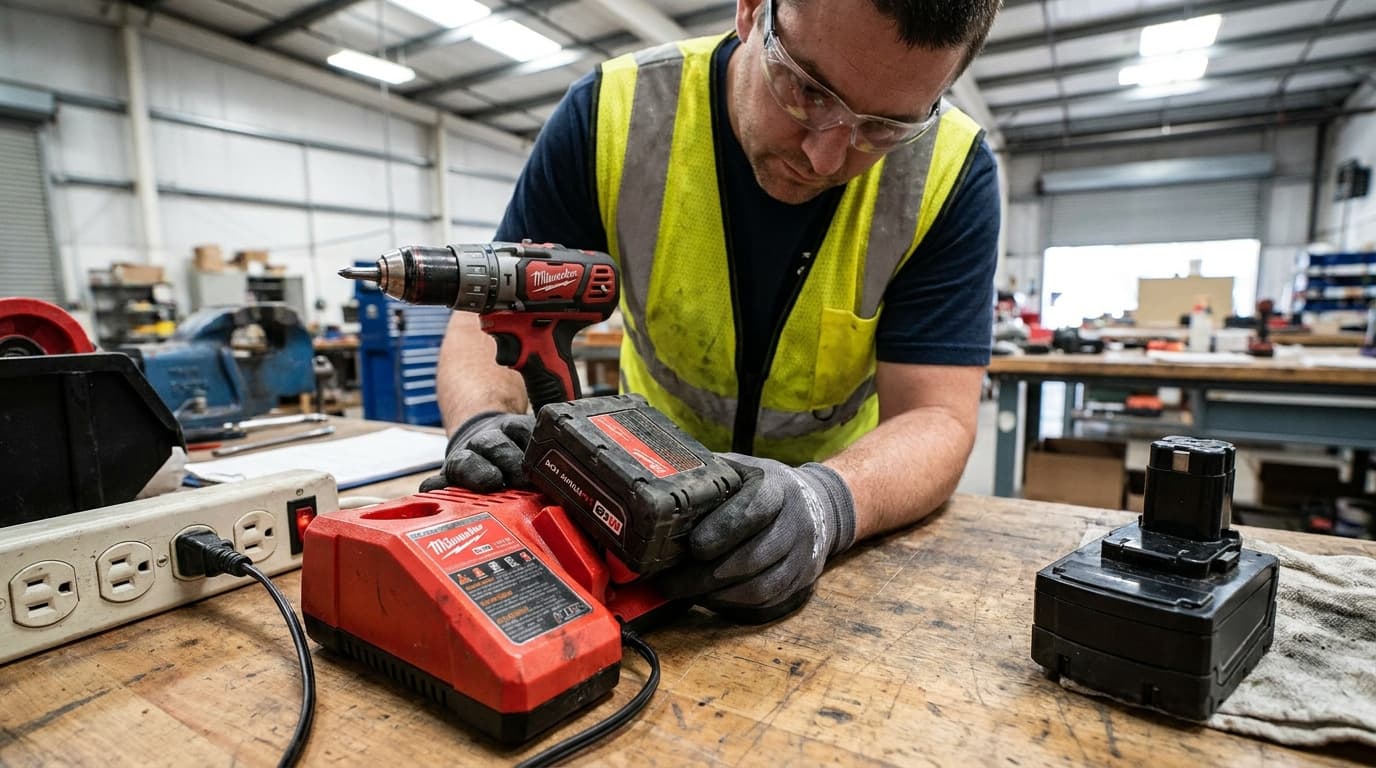
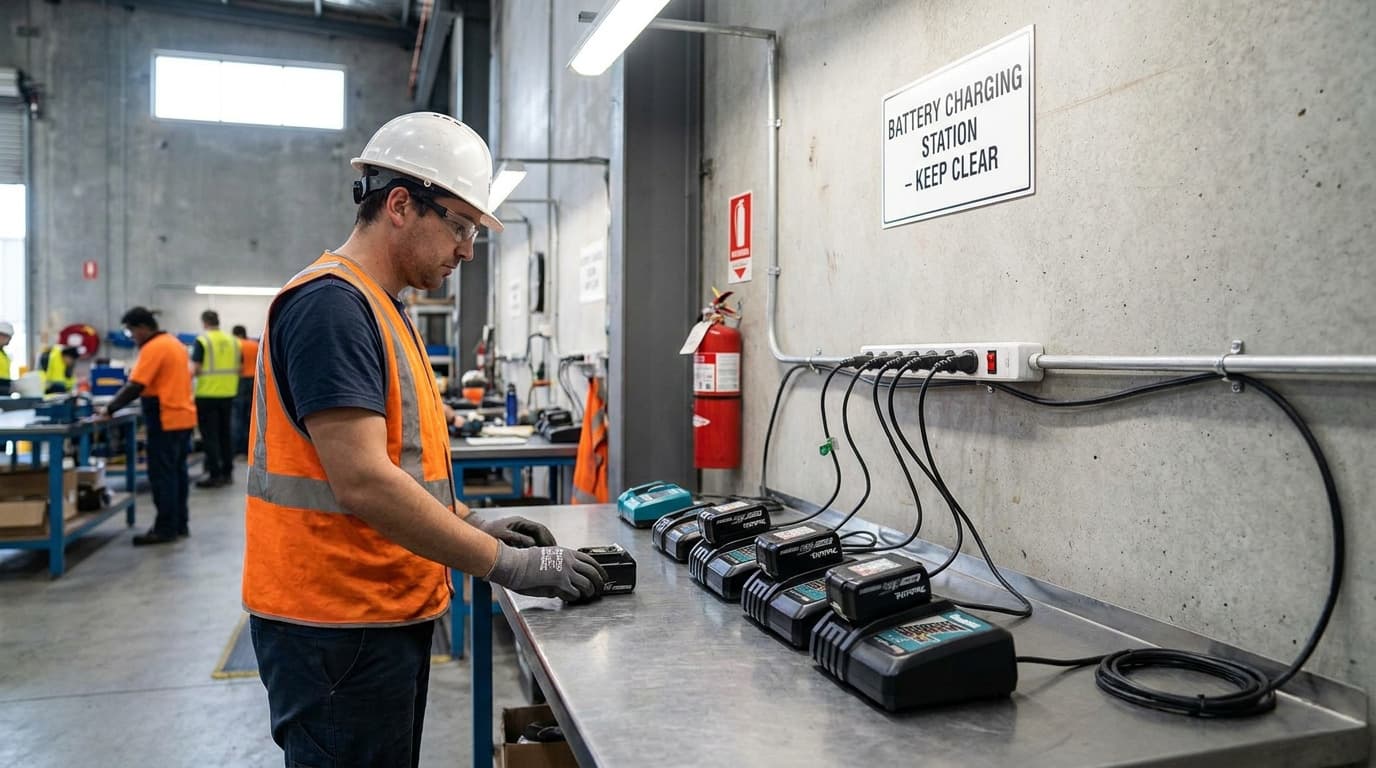
Most lithium-ion fires happen during or shortly after charging, so this is where the controls concentrate. Charge on a hard, non-combustible surface, never on a bed, a pile of rags, cardboard, or a truck seat. Keep charging away from combustibles and exits, in an area where a failure would be seen and would not block escape. Do not charge unattended overnight where no one would notice a vent or a smell. Do not charge a battery that is hot from use or from the sun — let it come back to room temperature first. And do not leave packs on the charger indefinitely "topping up"; pull them when charged. In general industry, where powered-industrial-truck and larger storage batteries are charged, OSHA's charging provisions at 1910.178(g) and storage-battery rules at 1910.305(j)(7) set the baseline for designated charging areas, ventilation, and protection from damage — the same principles scale down to the tool packs on your bench.
Storage: heat and damage are the enemies#
Between uses, lithium-ion batteries want to be cool, dry, and protected. Heat is the quiet killer: a pack left in a closed truck or a sunny window can reach temperatures that degrade the cell and set up a later failure, so the battery that vents on Thursday may have been cooked on Monday. Store packs away from direct sun and heat sources, off the ground, and not loose in a bag where terminals can short against tools, screws, or other batteries — a shorted terminal is an ignition source. Keep them out of freezing conditions too, and never store a damaged or suspect battery with good ones. For quantities beyond a few packs, keep the storage area clear of combustibles and consider the separation and detection principles that fire codes such as NFPA 855 apply to larger installations.
Inspection: catching the failure before the fire#
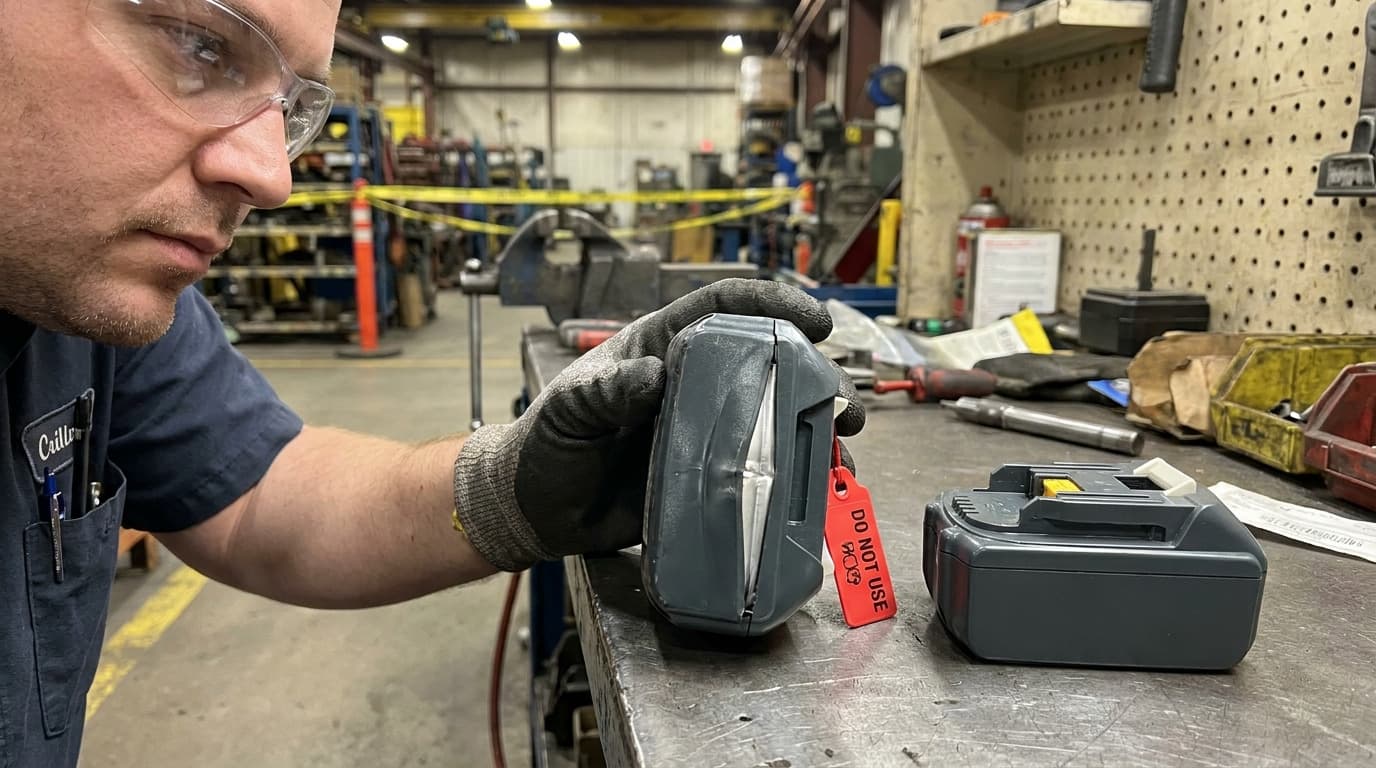
This is the step that turns the lifecycle into a defense. Before charging and before use, look and feel: a healthy pack is the right shape, cool or slightly warm, and undamaged. Pull any battery from service immediately if it shows swelling or bulging (the single most important warning sign — it means gas is building inside), cracks, dents, or a punctured case, leaking or a chemical/sweet solvent smell, discoloration or corrosion at the terminals, heat you cannot explain, or a pack that will not hold a charge or drains abnormally fast. A dropped battery gets inspected before it goes back on the charger, because impact damage is often invisible from the outside. When a battery fails inspection, it does not go back in the bin with the others — it is isolated and handled as damaged.
Damaged batteries and disposal: still dangerous at the end#
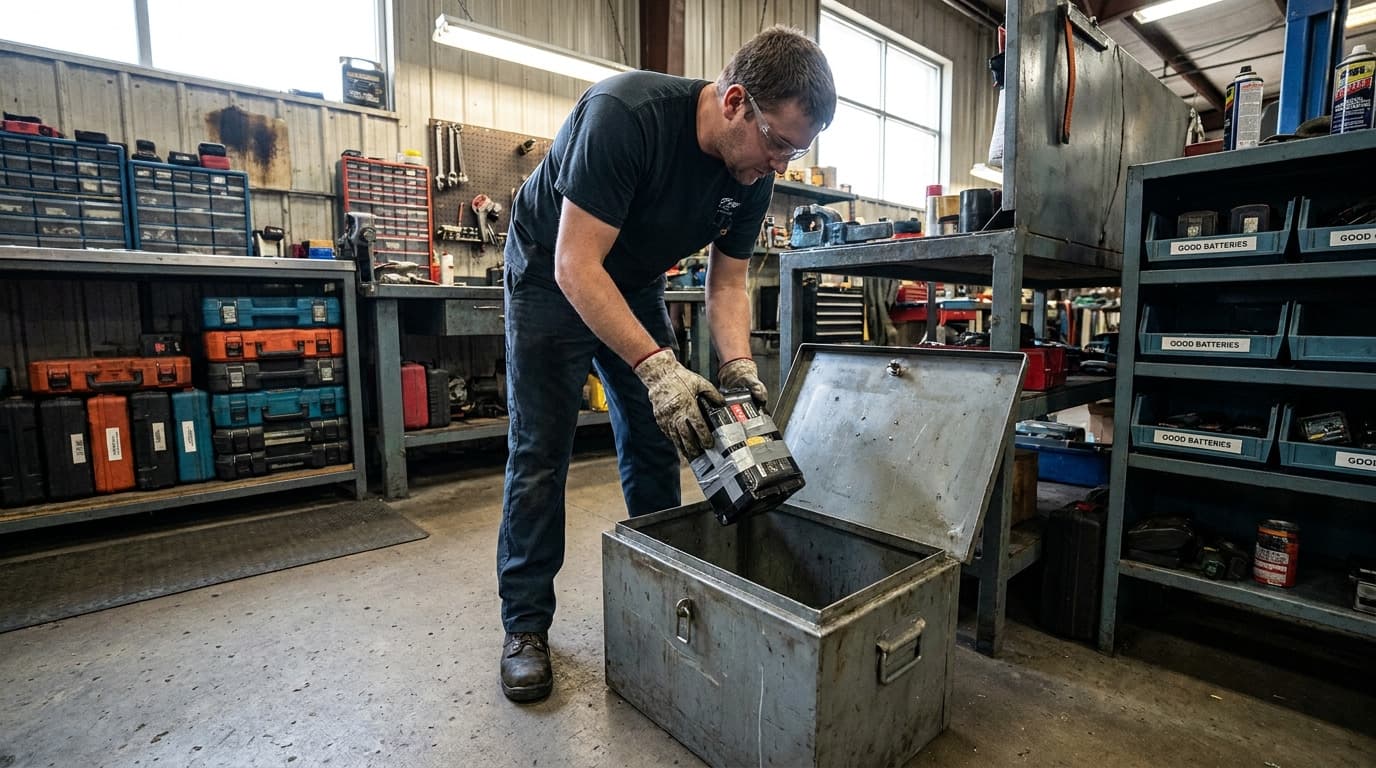
A battery does not become safe because you have decided to throw it away — a damaged or spent lithium-ion pack still holds energy and still vents if it fails. Never put lithium-ion batteries in ordinary trash or scrap, where they get crushed, punctured, or shorted against metal; crushed batteries in waste streams are a growing cause of truck and facility fires. Isolate a damaged pack in a non-combustible container, away from combustibles and people, and follow your employer's procedure for recycling or hazardous-waste handling. Disposal and transport of lithium batteries are regulated outside OSHA — by EPA as universal or hazardous waste and by DOT/PHMSA under 49 CFR 171–180 for shipping — so damaged packs going off site follow those rules, not the regular bin.
Where the duty sits#
Here is the part that surprises people: there is no OSHA standard written specifically for lithium-ion batteries. OSHA says so directly in its own guidance. That does not mean there is no duty — it means the duty runs through the General Duty Clause, Section 5(a)(1) of the OSH Act, which requires the employer to keep the workplace free of recognized hazards likely to cause death or serious harm, together with whichever general standards apply to the specific hazard: hazard communication (1910.1200), fire extinguishers and fire prevention (1910.157), PPE (1910.132), and the battery-charging and storage-battery provisions (1910.178(g), 1910.305(j)(7)). One nuance worth knowing under HazCom: an intact battery is usually treated as an "article" and is exempt from labeling — but that exemption ends when the battery is damaged and the chemistry can escape, which is exactly when the hazard is real. Alongside OSHA, consensus standards like NFPA 855 and the UL listings carry the engineering detail, and adopted fire codes may impose more. Where requirements differ, get direction from the responsible safety or code authority rather than assuming which one governs.
What can go wrong?#
- A tool pack is charged overnight on a workbench covered in sawdust and rags; it vents and ignites the surface with no one there to catch it.
- A worker uses a cheap online replacement battery that lacks a protection circuit; it overcharges and enters thermal runaway.
- A pack is dropped down a stairwell, looks fine, and goes back on the charger; the hidden internal damage fails hours later.
- Batteries are left loose in a gang box with screws and blades; a shorted terminal starts a fire in a closed container.
- A swollen battery is "finished up" for one more task instead of being pulled, and fails in use.
- Spent packs are tossed in the metal scrap bin; one is crushed and ignites the whole container.
- A battery baked all afternoon on a truck dashboard is put straight on the charger and fails that evening.
How do we manage this properly?#
- Match the system — only the manufacturer's battery, charger, and adapter for the tool; no counterfeit or unlisted packs.
- Charge with control — non-combustible surface, away from combustibles and exits, not on a hot battery, not unattended long-term, pulled when charged.
- Store cool and protected — out of hot vehicles and direct sun, terminals protected, damaged packs separated from good ones.
- Inspect every time — before charge and before use; swelling, cracks, leaks, heat, or a dropped pack means out of service now.
- Isolate and route damaged packs — non-combustible container, away from people and combustibles, into recycling or hazardous-waste handling, never the trash.
- Plan the response — everyone knows a lithium fire is an evacuate-and-call event, not a fight-it event, and knows where the exits and alarms are.
Before you start#
Confirm the tools and their chargers are a matched, listed set. Know where batteries are charged and stored on this site and that the area is clear of combustibles. Know how a damaged or swollen battery is isolated and where it goes. Confirm workers can recognize the warning signs and know that a lithium-ion fire means get out and call, not fight. Check that SDSs for the batteries in use are available for when a pack is damaged.
Talk it over#
- Where do we charge tool batteries on this site, and is that spot clear of combustibles and away from the exit?
- Has anyone seen a swollen or hot pack? What did we do with it — and was that the right call?
- Do we all use the manufacturer's chargers, or have cheap replacements crept in?
- If a battery caught fire in the gang box right now, what would we actually do in the first thirty seconds?
- Where do spent and damaged batteries go when we are done with them?
The bottom line#
A lithium-ion battery holds a lot of energy in a small space, and once it goes into thermal runaway it makes its own oxygen and its own heat — which is why it is so hard to put out and can reignite after it looks dead. A trained worker may tackle an incipient-stage fire with an ABC extinguisher under the site's emergency plan, but once it grows the fight is lost, so the real defense is upstream. That is why the whole defense lives earlier: match the battery to its charger, charge it with control, store it cool and protected, inspect it before every charge and use, and route damaged packs to proper disposal instead of the bin. There is no lithium-specific OSHA rule; the duty runs through the General Duty Clause and the general standards for charging, HazCom, fire, and PPE. You cannot inspect a fire back out of a battery once it starts — so the safe outcome is the one you built into every stage before it.
Frequently asked questions about lithium-ion battery safety#
Why can't I just put out a lithium-ion battery fire with an extinguisher or a lid?
Because a cell in thermal runaway makes its own oxygen as it breaks down, so it does not need air from the room to keep burning — smothering it or closing a lid does not starve it, and it can reignite after it appears out. OSHA's own guidance is that an ABC dry-chemical extinguisher is appropriate for a lithium-ion fire (a Class D extinguisher is for lithium-metal, which is different), and plenty of water can cool adjacent cells. So a trained worker may put out or hold back an incipient-stage fire with an ABC extinguisher if the site's emergency action plan authorizes it — but a developed pack fire that is venting hard or reigniting is beyond that point, and then the plan is raise the alarm, evacuate, and let the fire service handle it. That is exactly why this talk puts most of its weight on preventing runaway in the first place.
A battery in one of our tools is a little swollen but still works. Can we finish the shift with it?
No. Swelling is the single clearest warning that a cell is failing and building gas inside — it is the sign that comes before venting and fire. A swollen pack is removed from service immediately, isolated in a non-combustible container away from people and combustibles, and routed to proper disposal. "It still works" is not reassurance; a swollen battery can fail under the load of the next cut. There is no safe way to keep using it.
Are the cheap replacement batteries online really that different?
Often, yes, and it is not about brand snobbery — it is about the protection circuit. A legitimate pack contains electronics that stop it from overcharging, over-discharging, and overheating, and it has been tested to a recognized standard (cells to UL 1642, packs to UL 2054). Counterfeit and no-name packs frequently skip or fake that protection to hit a price, which is why they show up repeatedly in fire investigations. A listing mark is not an absolute guarantee, but its absence on a bargain pack is a real warning. Use the manufacturer's battery and charger for the tool.
Is it true that leaving a battery in a hot truck can cause a fire days later?
It can set one up. Heat degrades the cell and can damage the separator inside without any outward sign, so a battery that cooked on a dashboard or in a closed truck may vent or ignite later, during a charge or a use that would otherwise have been fine. That delay is exactly why the lifecycle framing matters: the fire on Thursday can be seeded by the heat on Monday. Keep batteries out of hot vehicles and direct sun, and let a hot pack cool to room temperature before charging it.
Does OSHA have a lithium-ion battery standard we have to follow?
Not a specific one — OSHA states plainly that there is no lithium-ion-specific standard. The obligation runs through the General Duty Clause, Section 5(a)(1), which requires employers to protect workers from recognized serious hazards, together with the general standards that apply to the pieces of the hazard: hazard communication, fire extinguishers and fire prevention, PPE, and battery charging and storage. Consensus standards like NFPA 855 and the UL listings carry the detailed engineering, and your local fire code may add requirements. The absence of a single rule does not lower the duty; it means several rules and the General Duty Clause apply together.
How should we get rid of dead or damaged lithium-ion batteries?
Never in the regular trash or the metal scrap bin — batteries there get crushed or shorted and start fires in trucks and transfer stations. Isolate a damaged or spent pack in a non-combustible container, keep it away from combustibles and people, and follow your employer's recycling or hazardous-waste procedure. Disposal and shipping of lithium batteries are regulated by EPA (as universal or hazardous waste) and by DOT/PHMSA under 49 CFR 171–180 for transport, so damaged packs leaving the site follow those rules. Many suppliers and big-box stores also take back tool batteries for recycling.
What PPE or first aid matters if a battery leaks or vents?
A venting or leaking lithium-ion battery can release flammable and toxic gases and a corrosive electrolyte, so the first move is distance and ventilation, not close inspection. Avoid breathing the vapor, get upwind and get others clear, and treat the area as you would a chemical release. For electrolyte on skin or in the eyes, flush with water and seek medical attention, and check the battery's SDS for the specifics — remember the HazCom "article" exemption ends once the battery is damaged, so that SDS information is exactly what you need at that moment. Gloves and eye protection are the baseline when handling a damaged pack for isolation.
Download the lithium-ion battery toolbox talk PDF#
Download this Lithium-Ion Battery Safety Toolbox Talk as a printable PDF in English, Spanish, Portuguese, and Turkish for your next tailgate meeting, and pair it with the inspection habit it describes.
Related toolbox talks#
Sources#
- OSHA, Lithium-Ion Battery Safety (OSHA publication 4480) — OSHA's own guidance stating there is no lithium-ion-specific standard and that the General Duty Clause and applicable general industry standards apply: https://www.osha.gov/sites/default/files/publications/OSHA4480.pdf
- OSHA, 29 CFR 1910.178(g) — changing and charging storage batteries and 1910.305(j)(7) — storage batteries (designated charging areas, ventilation, protection from damage; the baseline OSHA charging provisions that scale down to tool packs): https://www.osha.gov/laws-regs/regulations/standardnumber/1910/1910.178
- NFPA 855, Standard for the Installation of Stationary Energy Storage Systems, UL 1642 (cell) / UL 2054 (pack) battery listings, and DOT/PHMSA 49 CFR 171–180 for transport of lithium batteries as hazardous materials (the consensus and transport framework that carries the engineering and disposal detail OSHA's general standards do not): https://www.phmsa.dot.gov/lithiumbatteries