Working Around Heavy Timber
Updated 2026-08-06
In this bundle Manual Handling & Body Mechanics
Print-ready PDF
Download this talk as a print-ready PDF, available in 4 languages.
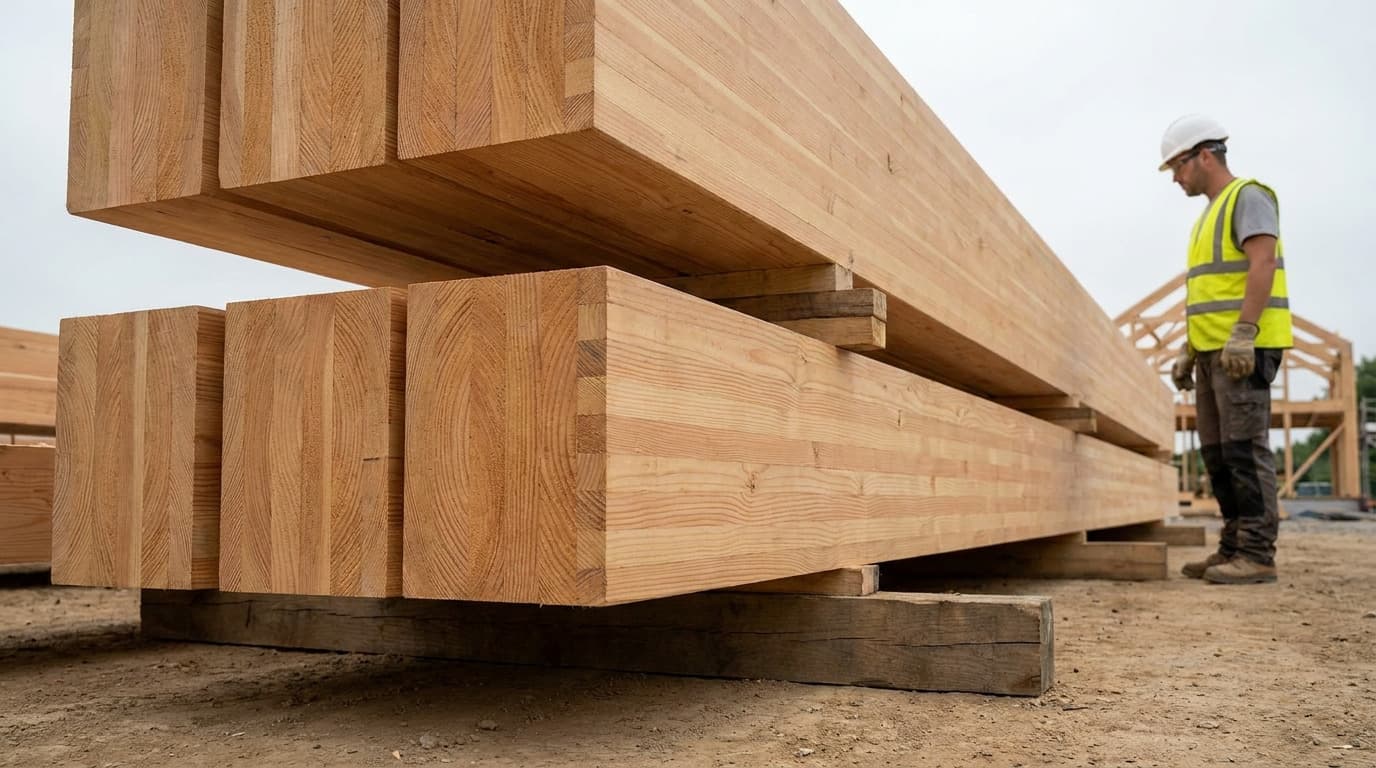
There is a particular kind of danger that comes from a material looking more harmless than it is, and heavy timber is the clearest example on a jobsite. A steel beam announces its weight — nobody stands under one or leans a shoulder against a stack of them without thinking. But a heavy timber member, a glulam beam or a squared post or a round timber pile, reads as "just wood," and wood is what we picture as light: two-by-fours, plywood, framing lumber a person carries one-handed. So people stand next to a heavy timber, rest against a stack of them, or reach across a pile in a way they never would with steel — and that timber can weigh as much as the steel it replaced, and unlike the steel, it can roll. This Working Around Heavy Timber Toolbox Talk (Safety Talk / Tailgate Talk) is about the specific hazard of being near large, heavy wood members: why they don't look as dangerous as they are, and why the way they move is what hurts people.
Here is the distinction that carries this whole talk: heavy timber is the one heavy material that doesn't look heavy — a glulam beam or a timber pile weighs as much as steel but reads as "just wood," so people stand where they'd never stand near a steel member, and it rolls when steel would sit still. Both halves of that matter. The weight is the reason a shifting or falling timber crushes; the "just wood" perception is the reason a worker is standing in the wrong place when it does; and the rolling is the reason it moves at all. A large timber member is often round or irregular — a pole, a pile, a log, or even a squared beam with enough curve or imbalance to turn — and its default behavior, when a support shifts or a band is cut, is to roll or shift rather than sit still. That is why the hazard is not "wood is heavy" alone; it is a heavy thing that moves, near people who think it won't.
Where the boundary of this talk sits#
The manual handling and proper lifting talks own the injury from lifting a load with your body — the back, the technique, the team lift. The general stacking and storing talk owns the broad rules for material piles. The crane lifting talk owns hoisting. This talk owns the specific hazard of heavy timber as a material: its deceptive weight, its tendency to roll, and standing clear of it when it is stacked, moved, or landed. Where the question is how to lift with your body, that is the lifting talk; where it is a general storage pile, that is the stacking talk; this one owns what makes a heavy timber member different from the steel or the framing lumber around it.
Why timber rolls when steel sits still#
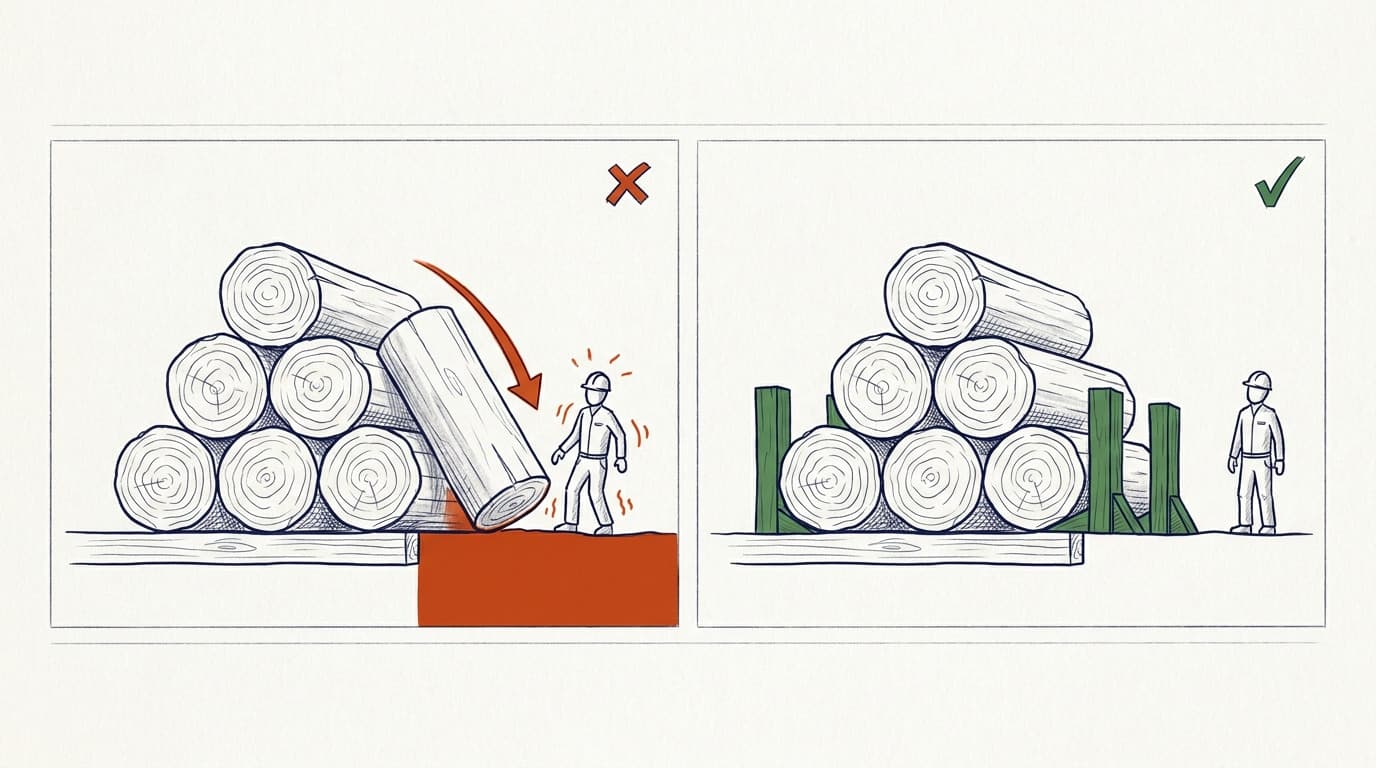
This is the mechanical heart of the talk. OSHA's storage rules treat different materials differently based on how they fail, and heavy timber falls on the "rolling" side. Flat, stable materials — a steel plate, a banded and shrink-wrapped unit of dimensional lumber on a pallet — are secured largely by their own arrangement and stay put when set down. But round and irregular materials behave differently, and OSHA groups them accordingly: poles, pipe, bar stock, and other cylindrical materials must, unless racked, be stacked and blocked so as to prevent spreading or tilting. A round timber pile, a pole, or a log sits squarely in that category, and even a squared glulam beam or heavy post can carry enough imbalance to turn when its support moves. The lesson is that a heavy timber member is not a thing that sits where you put it — it is a thing that will roll off a stack, off a set of sills, or out of a sling if it is not blocked, chocked, or racked to stop it. Treating timber like a flat steel plate, assuming it will stay, is how the roll catches someone standing where they thought was safe.
Stacking heavy timber so it stays put#
Because the hazard is movement, the controls are all about stability. OSHA's lumber storage requirements set the baseline: lumber must be stacked on level and solidly supported sills, and stacked so as to be stable and self-supporting, and materials stored in tiers must be stacked, racked, blocked, interlocked, or otherwise secured to prevent sliding, falling, or collapse. For heavy timber, the sills matter more than for light lumber, because the weight concentrates the load — an uneven or soft sill lets one end settle, and a settling stack of heavy members starts to lean and then to roll. Round timber especially needs blocking or racking at the edges of every tier, because nothing in the shape of a round member stops it from rolling once the pile shifts. And the floor itself is part of the calculation: the weight of stored materials cannot exceed the floor's safe load limits, and a stack of heavy timber concentrates a great deal of weight in a small footprint. The whole point is to build a stack that has no reason to move, so that no one is depending on being clear of it when it does.
Standing clear when timber is handled or landed#
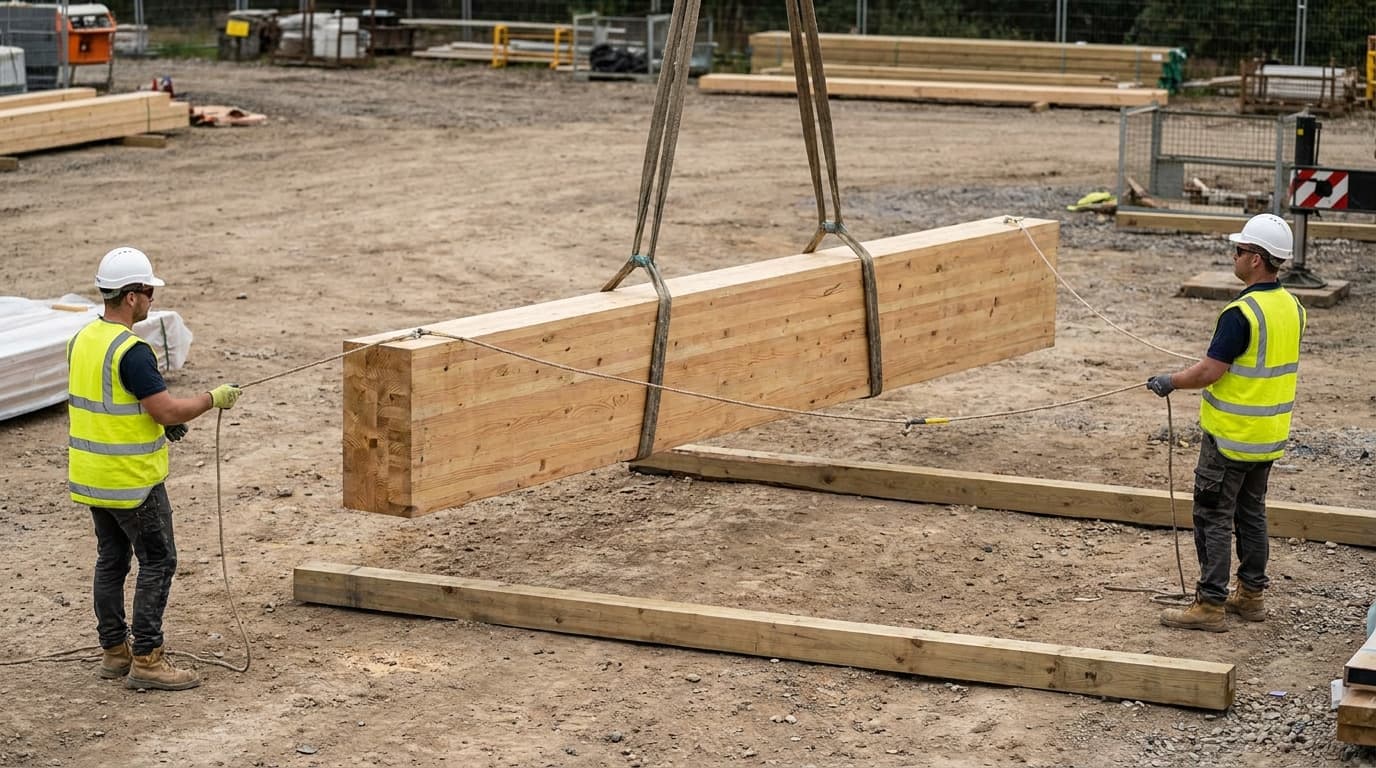
The other half of the exposure is when the timber is being moved — hoisted by crane, carried by equipment, or landed into place. A heavy timber member on a sling can rotate or swing, and a round one can roll in the sling if it is not choked correctly. When it is being landed, the crew guiding it into place is close to a heavy, movable object, and the moment of setting it down — when it transfers from the sling to its supports — is when it can shift or roll if the supports are not ready and level. The rule is the same one that governs any suspended or moving load: keep out of the path it would take if it moved, not just the spot it is in now. For heavy timber, that path includes the direction it would roll, which is not always obvious with an irregular member. Where timber is rigged and hoisted, the rigging talk and the crane talk govern the lift itself; this talk's point is that the people around the timber have to plan for its movement, because its weight makes any movement dangerous and its shape makes movement likely.
Where the duty sits#
There is no OSHA standard specifically about heavy timber; the requirements are assembled from the materials handling and storage rules and the general duties. Storage and stacking run through 1926.250 — the requirement to secure tiered materials against sliding, falling, or collapse; the lumber requirements for level sills and stable, self-supporting stacks; the requirement that cylindrical materials like poles be blocked against rolling; and the floor load limits. When timber is hoisted, the rigging requirements at 1926.251 apply to the slings and hardware. The general duties to train workers and protect against recognized hazards run through 1926.21(b)(2) and the General Duty Clause, Section 5(a)(1), and a heavy member left free to roll near workers is a recognized hazard. Mass timber construction — engineered members like glulam and cross-laminated timber — is growing quickly, putting large, heavy wood members on sites where crews are used to thinking of wood as light, which makes the deceptive-weight point more relevant, not less.
What can go wrong?#
- A worker stands next to a heavy timber the way they'd stand near framing lumber, and it rolls onto them.
- A round timber pile or pole isn't blocked, and it rolls off the stack.
- A heavy timber stack is built on uneven or soft sills, settles, leans, and collapses.
- A member rolls in the sling during a lift because it wasn't choked correctly.
- Timber is landed onto supports that aren't level or ready, and it shifts on release.
- The floor is overloaded by a heavy timber stack concentrated in a small footprint.
- A worker guides a landing timber from the direction it would roll, not clear of it.
- Timber is treated like a stable steel plate and left unblocked because "it's just wood."
How do we manage this properly?#
- Respect the real weight — a heavy timber member weighs like the steel it replaced, not like framing lumber.
- Block or rack round timber (poles, piles, logs) at every tier so it can't roll.
- Stack on level, solidly supported sills so the pile stays stable and self-supporting.
- Secure tiered material against sliding, falling, or collapse — interlock, block, or band.
- Check the floor load limit — heavy timber concentrates a lot of weight in a small footprint.
- When timber is hoisted, choke round members correctly so they can't roll in the sling.
- Land timber onto level, ready supports, and stand clear of where it would roll on release.
- Plan for the direction it would move, not just where it sits — irregular members roll unpredictably.
Before you start#
- Confirm heavy timber stacks are on level, solid sills, stable and self-supporting.
- Confirm round timber (poles, piles, logs) is blocked or racked against rolling at every tier.
- Confirm the floor or ground can carry the concentrated weight of the stack.
- Confirm no one is working or resting against a heavy timber stack.
- Confirm timber being hoisted is choked so it can't rotate or roll in the sling.
- Confirm landing supports are level and ready before a member is set down.
- Confirm the crew guiding a landing timber stands clear of its roll path.
- Confirm everyone understands a heavy timber member is a heavy, movable object, not "just wood."
Talk it over#
- Where on this site is heavy timber stacked, and is the round stock blocked against rolling?
- Have you ever caught yourself standing near heavy timber the way you would near light lumber?
- When we land a timber member, which way would it roll if the supports weren't ready?
- What tells you a timber stack is stable enough to work next to — and what would tell you it isn't?
The bottom line#
Heavy timber is the one heavy material that doesn't look heavy — a glulam beam or a timber pile weighs as much as steel but reads as "just wood," so people stand where they'd never stand near a steel member, and it rolls when steel would sit still. The weight is why a shifting timber crushes; the "just wood" perception is why a worker is in the wrong place when it does; and the rolling is the reason it moves at all. OSHA's storage rules capture this by treating round and irregular materials differently: poles and cylindrical materials must be blocked against rolling under 1926.250, lumber must be stacked on level sills, stable and self-supporting, tiered material must be secured against sliding, falling, or collapse, and floor load limits must be respected — because a heavy timber member is not a thing that sits where you put it, it is a thing that rolls off a stack or out of a sling unless something stops it. When timber is hoisted, choke round members so they can't roll, land them onto level, ready supports, and stand clear of the direction they would move, not just the spot they occupy. With mass timber putting more large engineered members on sites every year, the deceptive-weight trap is spreading to crews used to thinking of wood as light. The test is one question: would you stand where you're standing if that timber were the steel beam it weighs as much as — and is it blocked so it can't roll into you?
Frequently asked questions about working around heavy timber#
Why is heavy timber more dangerous than it looks?
Because wood reads as light. Our mental picture of wood is framing lumber, plywood, two-by-fours — things a person carries one-handed. A heavy timber member like a glulam beam, a squared post, or a round timber pile can weigh as much as the steel member it replaces, but it does not look that way, so people stand next to it, lean against a stack of it, or reach across a pile in ways they never would with steel. The danger is the combination: the weight makes a shifting member capable of crushing, and the "just wood" perception puts a worker in the wrong place when it shifts. Respecting the real weight — treating a heavy timber like the steel it weighs as much as — is the first control.
Why does timber roll when other materials don't?
Because heavy timber is often round or irregular, and round things roll. OSHA's storage rules recognize this by grouping poles and cylindrical materials with the things that must be blocked against rolling, separate from flat, stable materials that stay where they are set. A round timber pile, a pole, or a log has nothing in its shape to stop it from rolling once the pile shifts or a support moves, and even a squared glulam beam can carry enough imbalance to turn. A flat steel plate or a banded unit of dimensional lumber on a pallet sits still when you set it down; a round timber member does not. That is why blocking, chocking, and racking matter so much more for heavy timber than for flat materials.
How should heavy timber be stacked?
On level, solidly supported sills, so the stack is stable and self-supporting, with tiered material secured against sliding, falling, or collapse. For heavy timber the sills matter more than for light lumber, because the concentrated weight will find any weak or uneven spot — one end settles, the stack leans, and then it rolls. Round timber needs blocking or racking at the edges of every tier, because nothing in its shape stops it from rolling. And the floor or ground has to be able to carry the load: a stack of heavy timber concentrates a lot of weight in a small footprint, and stored materials cannot exceed the floor's safe load limits. The goal is a stack with no reason to move.
What's the hazard when heavy timber is being lifted or landed?
Movement near a heavy object. On a sling, a heavy timber member can rotate or swing, and a round one can roll within the sling if it is not choked correctly. When it is landed, the crew guiding it is close to a heavy, movable object, and the moment of set-down — when the load transfers from the sling to its supports — is when it can shift or roll if the supports are not level and ready. The rule is to stay clear of the path the member would take if it moved, which for an irregular timber includes the direction it would roll. The lift itself is governed by the rigging and crane rules; this talk's point is that everyone around the timber must plan for its movement.
Is there an OSHA standard just for heavy timber?
No. The requirements are assembled from the materials handling and storage rules and the general duties. Storage and stacking come from the general storage requirements — securing tiered materials, the lumber stacking rules, blocking cylindrical materials against rolling, and floor load limits. Rigging comes from the rigging-equipment rules when timber is hoisted. And the general duty to train workers and protect against recognized hazards applies throughout. There is no single "heavy timber" rule, but a heavy member left free to roll near workers is a recognized hazard, and the storage and rigging standards give the specific controls.
Does mass timber construction change any of this?
It makes it more relevant. Mass timber — engineered members like glulam and cross-laminated timber — is growing quickly, and it puts large, heavy wood members on sites where crews are used to thinking of wood as light. A CLT panel or a glulam beam is a heavy structural member that behaves like the heavy thing it is, not like framing lumber, so the deceptive-weight trap and the rolling hazard both apply. The controls are the same — respect the weight, block against rolling, stack on solid sills, plan for movement during lifts — but the point needs making more often, because more crews are handling heavy timber who did not grow up around it. This talk is about the struck-by and crush hazards of the material; fire ratings and structural design of mass timber are separate subjects.
Download the working around heavy timber toolbox talk PDF#
Get this working around heavy timber toolbox talk as a print-ready PDF — available in English, Spanish, Portuguese, and Turkish. Print it, hand it to the crew, and collect signatures on the included attendance sheet.
Download the PDF — free account required. New members get 3 free downloads.
Related toolbox talks#
Sources#
- OSHA, General requirements for storage — 29 CFR 1926.250 (materials in tiers secured against sliding, falling, or collapse; lumber stacked on level, solidly supported sills, stable and self-supporting; poles and other cylindrical materials blocked to prevent spreading or tilting; floor safe load limits): https://www.osha.gov/laws-regs/regulations/standardnumber/1926/1926.250
- OSHA, Rigging equipment for material handling — 29 CFR 1926.251 (slings and rigging hardware requirements that apply when heavy timber is hoisted): https://www.osha.gov/laws-regs/regulations/standardnumber/1926/1926.251
- OSHA, Training requirements — 29 CFR 1926.21(b)(2) (employer must instruct each employee in the recognition and avoidance of unsafe conditions, the general duty under which safe work around heavy materials sits): https://www.osha.gov/laws-regs/regulations/standardnumber/1926/1926.21
This talk is general awareness guidance for training purposes. It does not replace your employer's material handling and storage procedures, the OSHA storage and rigging standards, the OSH Act General Duty Clause, or a competent person's duties, and it is not legal advice. Where a site material-handling plan or an engineered stacking or rigging procedure sets a specific requirement, that requirement governs.
Written by FieldSafetyTalk's safety professional — a CSP, ASP, CHST and OSHA Authorized Outreach Trainer with 14+ years of international construction safety experience across federal, heavy civil, and industrial projects.