Millwork Safety for Construction
Updated 2026-08-06
In this bundle Tools & Machinery
Print-ready PDF
Download this talk as a print-ready PDF, available in 4 languages.
Most jobsite injuries come from something going wrong — a failure, a slip, a hazard nobody saw coming. Millwork machines injure people in the opposite way, and that is what makes them so easy to underestimate. A table saw, a jointer, a shaper, a planer, a router — these hurt people when everything is working exactly as it is supposed to. There is no malfunction involved. For the machine to cut at all, the blade or cutterhead has to be exposed at the point of operation, and you have to feed the wood into it by hand. The cutting edge is not hidden away behind a fault waiting to happen; it is right there, spinning, doing its job, every single time you make a cut. That is the reality this talk is built around. This millwork safety for construction talk is about the machines and hand tools of finished-wood work on the jobsite — doors, trim, casework, cabinetry, moldings, paneling — and why the danger in them is not the exception but the everyday operation.
Here is the distinction that carries this whole talk: a millwork machine doesn't hurt you when something goes wrong — it hurts you when everything is working exactly as designed, because the blade or cutterhead has to be exposed at the point of operation for the machine to cut at all, and you have to feed the wood into it by hand; so the guard, the spreader, the anti-kickback fingers, and the push stick aren't there for a malfunction — they're there for the normal cut, standing between your hands and a cutting edge that never stops being exposed. Sit with what that means for how you work. You cannot wait for a warning sign, because there isn't one — the saw that takes a finger is running perfectly the instant before, during, and after. The protection has to be in place for the ordinary cut, every time, because the ordinary cut is the hazard. This is why on woodworking machines the guards, the spreaders, the anti-kickback fingers, and the push sticks are not optional add-ons for risky jobs; they are the baseline that lets you feed wood past an exposed blade with your hands nearby and keep them. Take them away, or work around them, and nothing at all stands between your hand and the edge.
Where the boundary of this talk sits#
Millwork touches several other talks, and this one owns the finished-wood machines and the way they cut. The machine guarding talk owns the general principles of guarding any machine — the point of operation, power transmission, the hierarchy of guard types. The hand and power tools talk owns the broad family of tools and their general safe use. The combustible dust talk owns the explosion physics of accumulated fine dust across all industries. This talk owns millwork specifically: why the point of operation on a woodworking machine has to stay exposed, why kickback is the signature injury and a dull blade its biggest cause, how the spreader and anti-kickback fingers and push stick work together, and the two hazards that outlive the cut — wood dust and the finishes. Where the focus is guarding theory, tools in general, or dust explosions in the abstract, those talks own the detail; this one owns the saw, the jointer, the shaper, and the router in front of you, and the specific way finished-wood work puts your hands near a spinning edge.
Kickback is the signature injury — and a dull blade is its biggest cause#
If there is one word every millwork worker needs to carry, it is kickback. Kickback is when the spinning blade catches the stock and hurls it back toward you — or, just as dangerous, drags your hand forward into the blade — faster than any human reflex can respond. It is the classic table-saw and ripsaw injury, and it happens in a fraction of a second. Here is the part that feels backwards and matters most: the single biggest driver of kickback is not carelessness or speed — it is a dull, badly set, or wrong blade. A sharp blade sized for the cut slices cleanly and lets the wood move through. A dull blade cannot cut cleanly, so it has to be forced; it binds in the cut, the spinning teeth grab the pinched wood, and the stored energy throws it. This is so well understood that OSHA wrote the fix directly into the standard: a dull, badly set, improperly filed, or improperly tensioned saw must be removed from service immediately — before it begins to cause the material to stick, jam, or kick back. The tool getting more dangerous as it wears is the trap. Keeping blades sharp, correctly set, and matched to the cut — a ripping blade for ripping, not a crosscut blade — is not about clean work; it is the first and biggest defense against the injury that defines this trade.
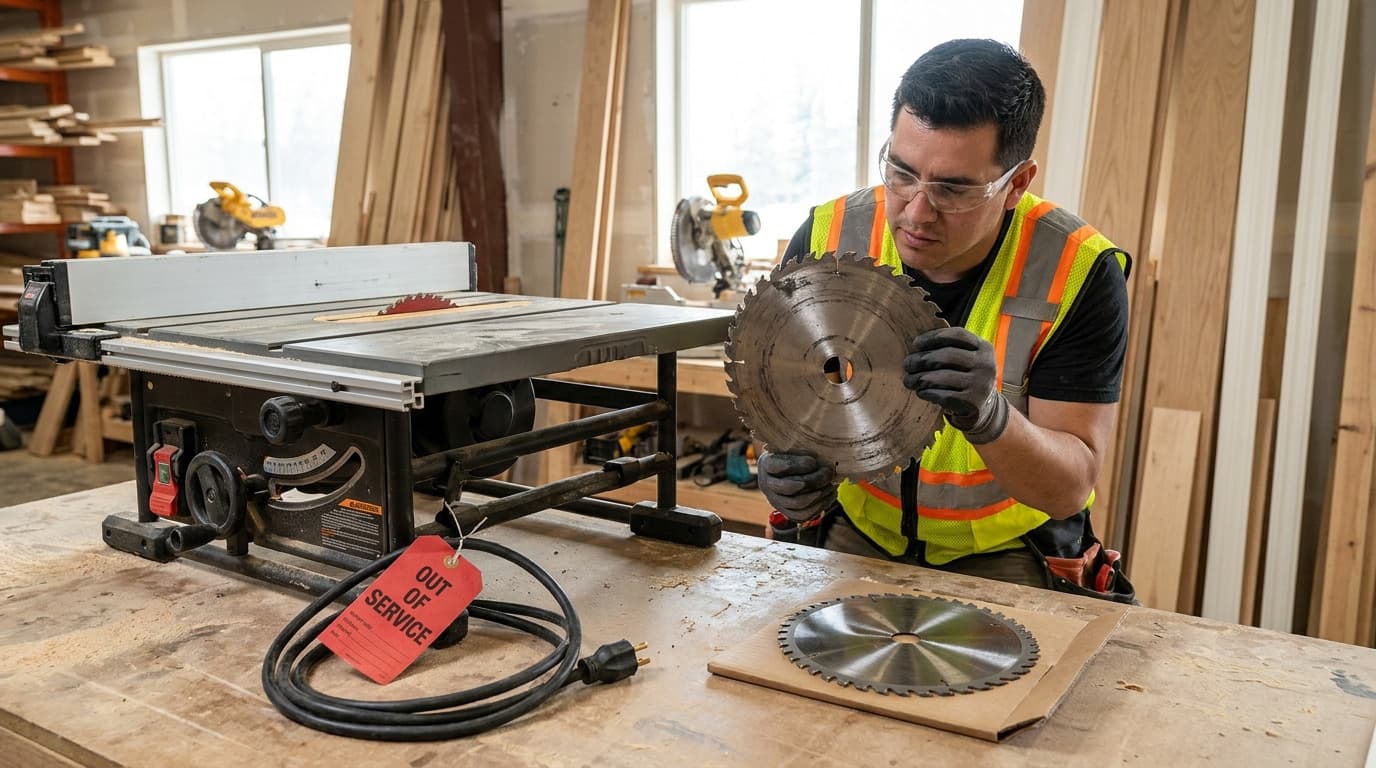
The anti-kickback system: spreader, fingers, and guard#
Because kickback is the signature hazard, woodworking saws carry a purpose-built system to fight it, and every part of it has to be present and working. The self-adjusting hood guard covers the part of the blade above the table and rides down onto the stock, adjusting to its thickness, so the exposed blade above the cut is shielded and it rises only as much as the wood requires. The spreader — the vertical plate that sits behind the blade, in line with it — holds the kerf open after the wood passes the blade, so the two sides cannot squeeze back together and pinch the blade, which is exactly what triggers kickback. The anti-kickback fingers, or pawls, are angled teeth that ride on top of the stock and let it move forward but bite in and hold if the wood starts to travel backward, catching a kickback before it launches. These three work as a set: the guard shields the exposed blade, the spreader prevents the pinch, and the fingers arrest the throw. Removing or disabling any one of them — because it is in the way, because the last operator took it off for a dado and never put it back — takes a piece out of the system built specifically to stop the injury this trade is known for. Before you make a cut, the guard, the spreader, and the anti-kickback fingers should all be in place and functioning.
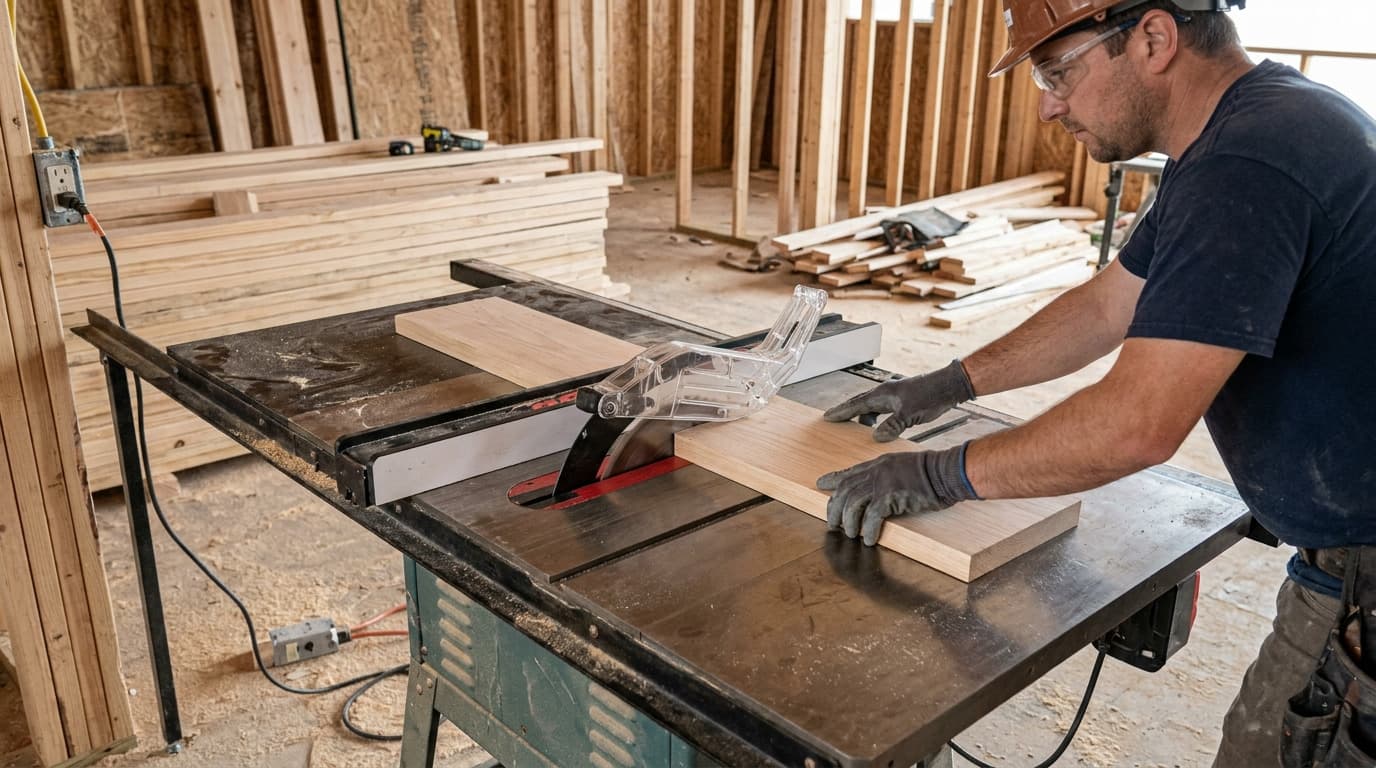
Keep your hands out of the line — push sticks and featherboards#
The last layer is the simplest and the one most within your direct control: keep your hands out of the path of the blade and out of the line of a kickback. Feeding small or narrow stock by hand puts your fingers close to the point of operation, so use a push stick — a notched strip of wood or a purpose-made block — to push the last of the stock past the blade, keeping your hand well back. Featherboards and jigs hold the stock down and against the fence so you are not using your hands to do it right next to the blade, and they are how you keep control during operations like rabbeting and dadoing where the standard guard has to come off — OSHA specifically calls for combs, featherboards, or suitable jigs when the guard cannot be used. Stand to the side of the blade, not directly behind it, so you are out of the line if the stock does kick back. Never reach over or behind a running blade to clear a cutoff or pull scrap — wait until it stops. And support long stock on both the infeed and outfeed sides so it does not tip, bind, or drop, because a piece that binds is a piece that can kick. None of this is complicated, but all of it depends on doing it every time, because the blade is exposed every time.
The two hazards that outlive the cut: dust and finishes#
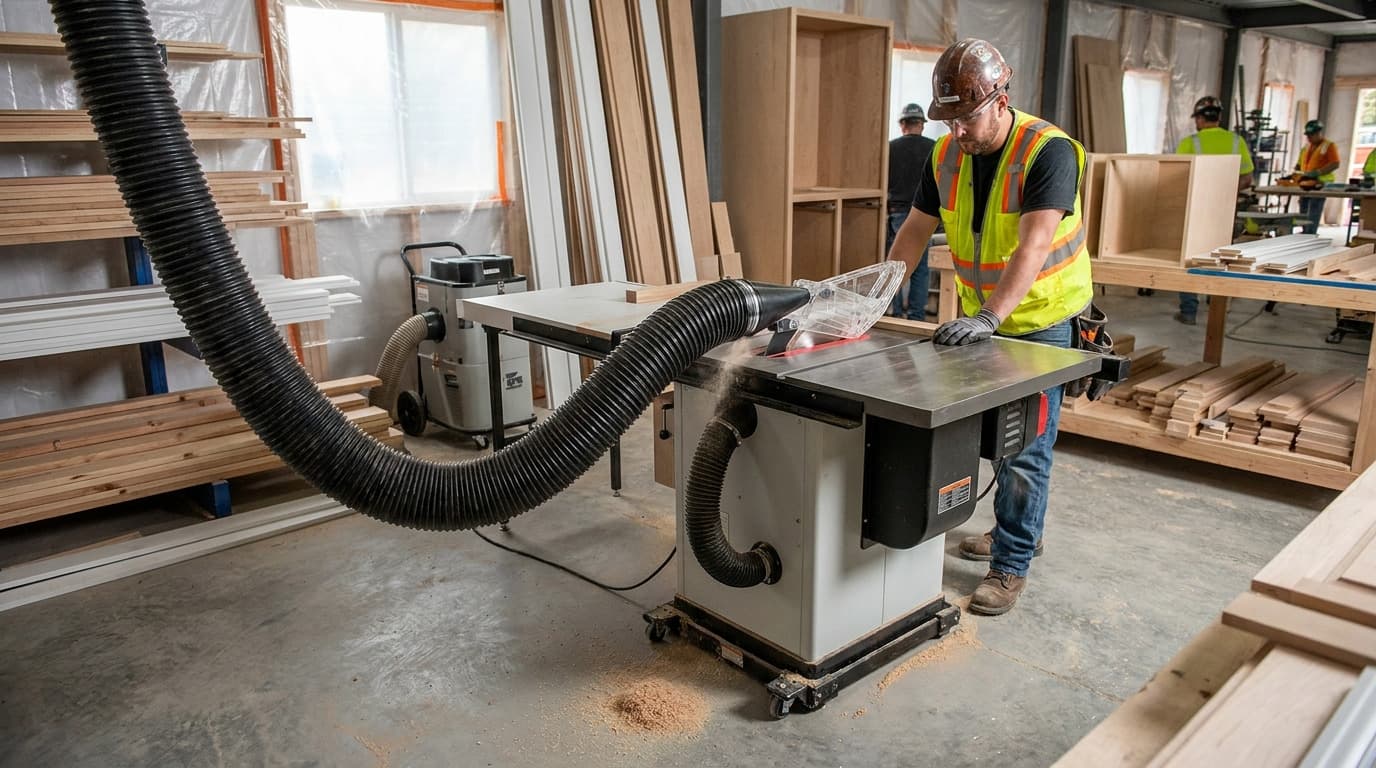
Millwork has two hazards that are not about the moment of cutting at all, and both are easy to underrate because they build up over time. The first is wood dust, and it is dangerous in two completely different ways. As a health hazard, the fine dust from sawing, routing, and especially sanding becomes airborne, and breathing it over time causes respiratory problems and irritation; certain hardwood dusts carry more serious risks. The control is local exhaust ventilation at the machine — pulling the dust away at the source — plus respiratory protection where needed. As a fire and explosion hazard, that same fine wood dust is combustible: it ignites far more easily than solid lumber, and when it accumulates on rafters, ledges, and hidden surfaces and then gets disturbed into a cloud near an ignition source, it can explode. This is why dust collection and housekeeping are safety-critical, not just tidiness, and why the fire codes address it directly. The second hazard is the finishes — the stains, lacquers, solvents, adhesives, and oil finishes that millwork uses constantly. Many are flammable, their vapors can travel to an ignition source, and they carry their own health hazards, so they fall under hazard communication and flammable-liquid handling: know the safety data sheet, control the vapors, keep them away from ignition, and store them properly.
Where the duty sits#
On a construction site, millwork tools are governed by 1926 Subpart I — Tools, Hand and Power, not the general-industry machinery rules. The specific standard is 1926.304 — Woodworking tools, and it sets out concrete requirements: 1926.304(a) requires every fixed power-driven woodworking tool to have a disconnect switch that can be locked or tagged in the off position; 1926.304(b) requires operating speeds to be marked on large or high-speed circular saw blades; 1926.304(c) requires self-feed devices where the work permits and guarding of feed rolls and moving parts; 1926.304(d) requires portable power-driven circular saws to have upper and lower guards, with the lower guard automatically and instantly returning to the covering position when the tool is withdrawn; and 1926.304(e) ties personal protective equipment to Subpart E. Critically, 1926.304(f) — "other requirements" — provides that all woodworking tools and machinery shall meet the applicable requirements of ANSI O1.1-1961, Safety Code for Woodworking Machinery, which is how the detailed hand-fed-saw provisions reach the jobsite. Over the top of that sits 1926.300 — General requirements: 1926.300(a) requires all tools to be maintained in safe condition; 1926.300(b)(1) requires guards when a tool is designed for them; 1926.300(b)(2) requires power-transmission parts — belts, gears, shafts, pulleys, and the like — to be guarded; and 1926.300(b)(4) is the point-of-operation duty, with 1926.300(b)(4)(ii) requiring that the point of operation of machines whose operation exposes an employee to injury be guarded, and 1926.300(b)(4)(iii) requiring special hand tools for placing and removing material to keep the operator's hands out of the danger zone. The detailed woodworking-machine hazards and controls — the hood guard, spreader, and anti-kickback fingers, and the practice of pulling a dull, badly set, improperly filed, or improperly tensioned saw from service before it can stick, jam, or kick back — are described in OSHA's general-industry woodworking standard 1910.213 and its Woodworking eTool, which are valuable guidance on how to satisfy these requirements; on a construction site the enforceable path is 1926.304(f)'s incorporation of ANSI O1.1-1961 together with the point-of-operation duty of 1926.300(b)(4), rather than 1910.213 applying as the construction standard itself. Power-transmission parts fall under 1926.307, and servicing and blade changes under lockout/tagout. Wood dust as a health hazard runs through the construction air-contaminant and respiratory-protection rules; as a combustible-dust hazard it is addressed by NFPA 664 (and the broader NFPA 652/654) and OSHA's Combustible Dust National Emphasis Program. Finishes fall under the construction flammable-liquid rules of 1926.152 and hazard communication at 1926.59. The program duties of 1926.20 and 1926.21(b)(2) apply throughout. Where a tool's manufacturer, a specific standard, or your employer's program sets a requirement, that requirement governs.
What can go wrong?#
- A worker feeds stock past an exposed blade with a guard, spreader, or anti-kickback fingers removed and never replaced.
- A dull or wrong blade binds in the cut, and the stock kicks back into the operator faster than they can react.
- Someone reaches over a running blade to clear a cutoff and contacts the spinning teeth.
- Small stock is fed by hand instead of with a push stick, and a hand slips into the point of operation.
- A jointer or shaper cutterhead catches a hand feeding stock without a guard or push block.
- Fine wood dust accumulates on rafters and ledges, gets disturbed into a cloud, and ignites or explodes.
- Airborne sanding dust is breathed day after day with no local exhaust, causing respiratory harm.
- Flammable finish vapors reach an ignition source, or a solvent's health hazards are ignored.
How do we manage this properly?#
- Treat the exposed blade as the normal condition — guards and devices are for every cut, not emergencies.
- Keep blades sharp, correctly set, and matched to the cut — a dull saw must be pulled from service.
- Keep the anti-kickback system intact — self-adjusting guard, spreader, and anti-kickback fingers all in place.
- Use push sticks, featherboards, and jigs for small stock and when the guard has to come off.
- Stand to the side of the blade, out of the kickback line, and never reach over a running blade.
- Support long stock on both ends so it can't tip, bind, or drop into a kickback.
- Run local exhaust and keep dust from accumulating — it's a respiratory hazard and an explosion hazard.
- Handle finishes by their SDS — control vapors, keep them from ignition, store them properly.
Before you start#
- Confirm the blade or cutterhead is sharp, correctly set, and the right type for the cut.
- Confirm the self-adjusting guard, spreader, and anti-kickback fingers are all in place and working.
- Confirm push sticks, featherboards, or jigs are on hand for small stock and guard-off operations.
- Confirm long stock has infeed and outfeed support.
- Confirm you know where to stand to be out of the kickback line.
- Confirm local exhaust and dust collection are running and dust isn't accumulating.
- Confirm the finishes in use have SDSs and vapors are controlled away from ignition.
- Confirm the machine can be locked out before any blade change or servicing.
Talk it over#
- Is every guard, spreader, and anti-kickback finger on our saws actually in place right now — or did one come off for a dado and never go back?
- When was the last time our blades were sharpened or replaced, and would we catch a dull one before it kicks?
- Do we reach for a push stick on small stock automatically, or only when we remember?
- Is dust accumulating anywhere in this shop that we've stopped noticing?
The bottom line#
A millwork machine doesn't hurt you when something goes wrong — it hurts you when everything is working exactly as designed, because the blade or cutterhead has to be exposed at the point of operation for the machine to cut at all, and you have to feed the wood into it by hand; so the guard, the spreader, the anti-kickback fingers, and the push stick aren't there for a malfunction — they're there for the normal cut, standing between your hands and a cutting edge that never stops being exposed. The signature injury is kickback, and its biggest cause is the one that feels backwards — a dull, badly set, or wrong blade that binds and hurls the stock, which is why OSHA requires a dull saw pulled from service before it starts to kick. The defense stacks in three layers: keep the blade sharp and correct, keep the anti-kickback system intact — self-adjusting guard, spreader, and fingers — and keep your hands out of the line with push sticks, featherboards, and good position. Two more hazards outlive the cut: wood dust, both a respiratory hazard and a combustible-dust explosion hazard, and the finishes, flammable and covered by hazard communication. On a construction site it all rests on 1926.304 and 1926.300 — with 1926.304(f) incorporating ANSI O1.1-1961 and 1926.300(b)(4) carrying the point-of-operation duty — while OSHA's general-industry 1910.213 and its Woodworking eTool give the detailed hood, spreader, anti-kickback, and dull-blade guidance behind them. The question to carry is not "did something break?" — nothing has to. It is: is the protection in place for this ordinary cut, right now, standing between my hands and a blade that is exposed every single time?
Frequently asked questions about millwork safety#
Why can't the blade just be fully guarded like other machines?
Because a woodworking machine has to make contact between the cutting edge and the wood you feed into it, and that contact happens at the point of operation — the exact spot where the blade meets the stock. Unlike a fully enclosed machine that does its work behind a barrier, a table saw, jointer, shaper, or router needs an exposed cutting edge to cut, and you have to guide the wood into that edge by hand. So the point of operation can never be sealed off completely the way power-transmission parts like belts and pulleys can be. That is precisely why the guarding on these machines is different: a self-adjusting hood guard that rides on the stock and covers only as much of the blade as the cut allows, combined with spreaders, anti-kickback devices, push sticks, and featherboards. The goal is not to eliminate the exposed edge — that would stop the machine from cutting — but to keep your hands away from it and to control the wood so the blade behaves predictably. Understanding this is the key to the whole trade: the exposed blade is a permanent condition of the work, so the protections have to be in place for every ordinary cut.
What exactly is kickback and why is it so dangerous?
Kickback is when a spinning saw blade catches the workpiece and violently throws it back toward the operator, or drags the operator's hand forward into the blade, in a fraction of a second. It is the classic and most feared woodworking injury, most associated with table saws and ripsaws, and it is dangerous for three reasons. First, it is faster than human reaction time — by the time you perceive it, it has already happened. Second, the thrown stock can strike the operator with serious force, and the same event that throws the wood can pull a hand into the blade. Third, it often happens during a completely ordinary cut, with no warning, because its causes are built into how the wood behaves in the blade. Kickback happens when the wood pinches or binds the blade — when the cut closes back on the blade, when stock is fed against the rotation, when a piece isn't supported and drops or twists, or, most commonly, when a dull blade forces the wood to bind. Because it is fast, forceful, and ordinary, the defense is entirely preventive: sharp correct blades, spreaders and anti-kickback fingers, proper support, and standing out of the line.
How can a dull blade be more dangerous than a sharp one?
It feels backwards, but it is one of the most important facts in woodworking safety: a dull blade is far more dangerous than a sharp one, and it is the single biggest cause of kickback. A sharp blade, correctly set and matched to the cut, slices cleanly through the wood and lets the stock move smoothly past it. A dull blade cannot slice cleanly, so the wood has to be forced through, and it binds against the blade instead of cutting. When the spinning teeth grab that pinched, bound wood, the stored energy is released as a kickback — the stock is hurled back at the operator. A dull blade also tempts the operator to push harder, bringing more force and less control to a cut that is already going wrong. OSHA understood this well enough to write it directly into the standard: a dull, badly set, improperly filed, or improperly tensioned saw has to be removed from service immediately, before it starts causing the wood to stick, jam, or kick back. So keeping blades sharp and properly maintained is not a matter of clean cuts or productivity — it is the first line of defense against the injury that defines the trade, and using a dull blade "just to finish the piece" is exactly how people get hurt.
When is it okay to remove the guard for a cut like a dado?
Only when the operation genuinely cannot be done with the standard guard in place, and only when you replace that protection with an equivalent — never by simply working with an exposed blade and nothing else. Certain operations, like rabbeting and dadoing, physically prevent the normal self-adjusting hood guard from being used because the cut doesn't pass all the way through the stock. OSHA addresses this directly: when the guard cannot be used, you must provide combs, featherboards, or suitable jigs to hold and control the stock so your hands stay away from the point of operation. In other words, removing the guard for a specific operation does not mean removing the protection — it means switching to a different method of keeping hands clear and controlling the wood. Two failures are common and dangerous here. The first is doing the guard-off operation with bare hands and no featherboard or jig at all. The second is finishing the dado and then never putting the standard guard back on for the next ordinary cut — so the next person, or the next piece, meets a saw that should be guarded and isn't. The rule is simple: guard off only when necessary, protection replaced with jigs and featherboards, and the guard back on the moment the operation is done.
Is wood dust really a serious hazard, or just messy?
It is a serious hazard in two entirely separate ways, and treating it as mere mess is a real mistake. First, as a health hazard: the fine dust produced by sawing, routing, and especially sanding becomes airborne and is breathed in, and over time this causes respiratory irritation and problems; some hardwood dusts carry more serious long-term risks. The control is local exhaust ventilation that captures the dust at the machine where it is generated, backed by respiratory protection where needed. Second, as a fire and explosion hazard: fine wood dust is combustible and ignites far more easily than solid wood. When it accumulates on rafters, ledges, ductwork, and hidden surfaces — often far from where it was created — and is then disturbed into a suspended cloud near an ignition source, it can deflagrate or explode. This is not a theoretical risk; it is why fire codes like NFPA 664 specifically address woodworking dust, and why OSHA runs a Combustible Dust National Emphasis Program. So dust collection and housekeeping in a millwork shop are safety-critical work, not cleanup for appearance. Keeping dust captured at the source and preventing accumulation protects both the lungs of the people in the shop and the shop itself from fire and explosion.
What do I need to watch for with stains, lacquers, and adhesives?
The finishes and adhesives that millwork uses constantly — stains, lacquers, varnishes, solvents, oil finishes, and glues — carry two kinds of hazard that are easy to overlook because they are so routine. The first is flammability: many are flammable or combustible liquids, and their vapors are often heavier than air, so they can travel along surfaces to an ignition source some distance away and flash back. That means controlling vapors with ventilation, keeping these products away from ignition sources, and storing them properly in approved containers and cabinets rather than leaving them open near the work. The second is the health hazard: many finishes and solvents release vapors that are harmful to breathe and can irritate skin and eyes, so they require good ventilation and the right protective equipment. Both hazards are managed through hazard communication — knowing the safety data sheet for each product, understanding what it tells you about flammability, health effects, and protective measures, and following it. In a shop that also generates combustible dust, the combination of flammable finishes and fine dust is especially worth respecting, which is why finishes and their vapors are kept segregated from ignition sources and dust accumulations. Treating a can of lacquer or a jug of solvent as an ordinary supply, rather than a flammable chemical with a data sheet, is how finish-related fires and exposures happen.
Download the millwork safety toolbox talk PDF#
Get this millwork safety toolbox talk as a print-ready PDF — available in English, Spanish, Portuguese, and Turkish. Print it, hand it to the crew, and collect signatures on the included attendance sheet.
Download the PDF — free account required. New members get 3 free downloads.
Related toolbox talks#
Sources#
- OSHA, Woodworking tools — 29 CFR 1926.304 (the construction woodworking-tool standard: disconnect switches lockable or taggable off at (a); marked speeds at (b); self-feed and feed-roll guarding at (c); upper and lower guards on portable circular saws with the lower guard automatically returning to cover at (d); PPE per Subpart E at (e); and at (f), all woodworking tools and machinery must meet ANSI O1.1-1961, Safety Code for Woodworking Machinery): https://www.osha.gov/laws-regs/regulations/standardnumber/1926/1926.304
- OSHA, General requirements — 29 CFR 1926.300 (construction hand- and power-tool umbrella: tools maintained in safe condition at (a); guards required when a tool is designed for them at (b)(1); power-transmission guarding at (b)(2); point-of-operation guarding at (b)(4), with (b)(4)(ii) requiring the point of operation of machines whose operation exposes an employee to injury to be guarded and (b)(4)(iii) requiring special hand tools to keep the operator's hands out of the danger zone; OSHA's general-industry standard 1910.213 and its Woodworking eTool provide detailed hood, spreader, anti-kickback, and dull-blade guidance but are resources rather than the construction standard itself): https://www.osha.gov/laws-regs/regulations/standardnumber/1926/1926.300
- OSHA, Woodworking eTool — Fire and Explosion; Wood Dust overview and Combustible Dust NEP; NFPA 664 (fine wood dust is combustible, ignites more easily than solid lumber, and can explode when accumulated and disturbed near an ignition source; local exhaust ventilation, dust collection, and housekeeping are required controls; finishes, solvents, and adhesives are flammable and covered by spray-finishing and hazard-communication requirements): https://www.osha.gov/etools/woodworking/safety-hazards/fire-explosion
This talk is general awareness guidance for training purposes. It does not replace your employer's machine-safety program, OSHA 1926 Subpart I (1926.304 and 1926.300), the tool manufacturer's instructions, the applicable fire codes, or your safety staff's guidance, and it is not legal advice. Where a tool's manufacturer, a specific standard, or your employer's program sets a requirement, that requirement governs.