Fall Rescue and Suspension Trauma
Updated 2026-07-24
In this bundle Fall Protection & Heights
Print-ready PDF
Download this talk as a print-ready PDF, available in 4 languages.
The system worked. That is the part nobody expects. The anchor held, the lanyard deployed exactly as designed, the arresting force stayed inside the limits, and a worker who would otherwise be dead is alive and hanging six metres below the deck. And now a second emergency has started, with its own clock, and the fall protection equipment that just saved this person's life is the thing creating it. This fall rescue and suspension trauma talk is about the only PPE on this site whose successful operation produces a new, time-limited emergency.
Here is the distinction that carries this whole talk: every other fall protection control is judged by whether it works. This one is judged by what happens in the minutes afterwards. A crew can do everything right — anchor, clearance, inspection, tie-off — and still lose the worker, because the plan ended at the moment of arrest. Hanging motionless in a harness is not a stable holding position. It is a deteriorating medical situation, and the person in it usually cannot fix it themselves.
How long does a suspended worker have?#
There is no reliable count of deaths from suspension alone; these are recorded inside broader fall categories. But OSHA has published a figure, and it is the number that should set the shape of your plan.
OSHA's Safety and Health Information Bulletin on Suspension Trauma and Orthostatic Intolerance states that research indicates suspension in a fall arrest device can result in unconsciousness, followed by death, in less than 30 minutes (SHIB 03-24-2004, updated 2011).
One caveat matters, and it makes the point sharper rather than softer. In OSHA's own reference list, that figure traces to a training handout rather than a peer-reviewed study, and the bulletin itself is advisory — not a standard. So treat "under 30 minutes" as a warning about how fast this moves, not as a budget you are allowed to spend. The legal duty in 1926.502(d)(20) is not thirty minutes. It is prompt, and OSHA's first listed recommendation is to rescue suspended workers as quickly as possible.
Now put that against what the standard actually requires. 29 CFR 1926.502(d)(20) says the employer must provide for prompt rescue of employees in the event of a fall, or assure that employees are able to rescue themselves. That is the whole provision. It does not define "prompt," it sets no time limit, and OSHA confirmed in a 2003 letter of interpretation that (d)(20) does not require a written rescue plan or a preplanning meeting.
So the regulation creates a duty with no stated clock, sitting against a hazard whose clock OSHA itself measures in minutes. The gap between those two is where people die — and it is almost always filled with the same assumption: someone will call 911.
OSHA has addressed what "prompt" means. In a letter to Charles Hill dated August 14, 2000, quoted again in the 2003 interpretation, the agency stated that the particular hazard (d)(20) addresses is being suspended by the fall arrest system after a fall, and that while a worker can be suspended more safely in a harness than in a body belt, the word "prompt" requires that rescue be performed quickly — in time to prevent serious injury. The same letter acknowledges that feasible options are more limited in remote locations, and that what compliance requires depends on the circumstances. What it does not do is give you permission to have no capability at all.
And although no written plan is required, the 2003 letter adds a footnote worth reading twice: as a practical matter, an employer will need to make some preparations to enable it to meet the rescue requirement. You are not obliged to write it down. You are obliged to be able to do it.
The post-rescue advice most crews were taught has changed#
This is the part of the talk that will surprise experienced people, and it matters because the outdated version is still everywhere.
For years, standard training said: never lay a rescued worker flat. Keep them sitting upright, knees bent, in the "W" position for a period before allowing them horizontal — the theory being that oxygen-poor, toxin-laden blood returning suddenly from the legs would stop the heart. This was called reflow syndrome, or rescue death.
OSHA's bulletin was updated in 2011, and that instruction is no longer in it. The current text says rescue procedures should include ensuring that a worker receives standard trauma resuscitation once rescued, keeping the airway open if the worker is unconscious, obtaining first aid, monitoring the worker afterwards, and ensuring evaluation by a healthcare professional. The reason for the change is that systematic reviews of the medical literature have not found evidence supporting reflow syndrome, and the UK Health and Safety Executive's research review reached the same conclusion. There is also a practical objection: holding a patient upright can interfere with managing their airway, which is the thing that most reliably kills unconscious people.
Two things follow from this, and both matter more than the debate itself.
First, post-rescue treatment is a medical decision, not a crew decision. Your job is to get the worker down fast, keep the airway open, call for medical help, and tell responders how long the person was suspended. Positioning and treatment follow your organisation's current first aid protocol and the instructions of medical responders — not a remembered slide from a training course, in either direction.
Second, check what your own site materials say. If your rescue plan, your training deck, or your posted first aid card still instructs the crew to hold a rescued worker upright and prevent them lying flat, it is repeating guidance OSHA removed from its bulletin in 2011. That is worth raising with whoever owns the document.
OSHA rescue requirements (29 CFR 1926 Subpart M)#
- Prompt rescue — 1926.502(d)(20). The employer shall provide for prompt rescue of employees in the event of a fall or shall assure that employees are able to rescue themselves. Two routes, and if you are relying on the second one, the worker needs the equipment and training to actually do it.
- What "prompt" means. Not defined in the standard. Per OSHA's interpretation, rescue must be performed quickly enough to prevent serious injury. Feasibility varies with the worksite, but a reliable system must be in place to the extent feasible.
- No written plan required — but preparation is. The 2003 letter of interpretation confirms (d)(20) requires neither a written rescue plan nor a preplanning meeting, while noting that in practice the employer must make preparations to be able to meet the requirement.
- Equipment out of service afterwards — 1926.502(d)(19). Any system or component subjected to impact loading must be immediately removed from service and not used again until a competent person determines it is undamaged and suitable for reuse. The harness that just held someone is evidence and scrap, not inventory.
- Training — 1926.503(a)(2). Training is delivered by a competent person. OSHA's bulletin adds that workers who wear fall arrest equipment, and those who may perform rescue, should be trained in how suspension trauma occurs, the factors that raise risk, how to recognise the signs, and the rescue procedures and methods to reduce risk while suspended.
- The General Duty Clause — Section 5(a)(1). The bulletin states plainly that it is advisory and creates no new legal obligations — but also that employers can be cited under the General Duty Clause where a recognised hazard exists and reasonable steps are not taken to abate it.
On USACE and NAVFAC projects, EM 385-1-1 applies and is considerably more prescriptive about rescue planning and capability than Subpart M.
What can go wrong#
"We'll call 911." The most common rescue plan on any jobsite, and on most of them it is not a plan. Measure it honestly: dispatch, travel, site access, locating the worker, establishing their own fall protection, then reaching a person suspended in mid-air. Against a figure of under 30 minutes to unconsciousness and death, that arithmetic frequently does not close — and it is worse on remote, secured, or high-rise sites.
Nobody saw it happen. A lone worker at the far end of a deck. Suspension trauma progresses whether or not anyone knows about it, and an unconscious worker cannot call for help. Under the bulletin, unconscious workers and those with head injuries are particularly at risk.
The worker is conscious and says they are fine. They frequently are, at first. That is exactly what makes this hazard deceptive: the deterioration is internal and progressive, and the person reporting their own condition is the person whose brain is being deprived of oxygen.
The equipment holds them upright and still. This is the mechanism. Standing still causes some venous pooling in everyone; a soldier who faints on parade collapses horizontally and recovers, because gravity stops working against them. A worker in a harness cannot collapse horizontally. The harness maintains the exact posture that caused the problem, and the leg straps add compression on top.

Nobody has the equipment. Rescue needs hardware — a rescue or descent device, a pole, an aerial lift positioned and available, or a pre-rigged retrieval system. A plan that depends on equipment stored across the site, or on an aerial lift currently in use elsewhere, is a plan that expires the moment it is needed.
Nobody is trained. The rescuer becomes the second casualty. Improvised rescue at height, by people without training or their own fall protection, is how one incident becomes two.
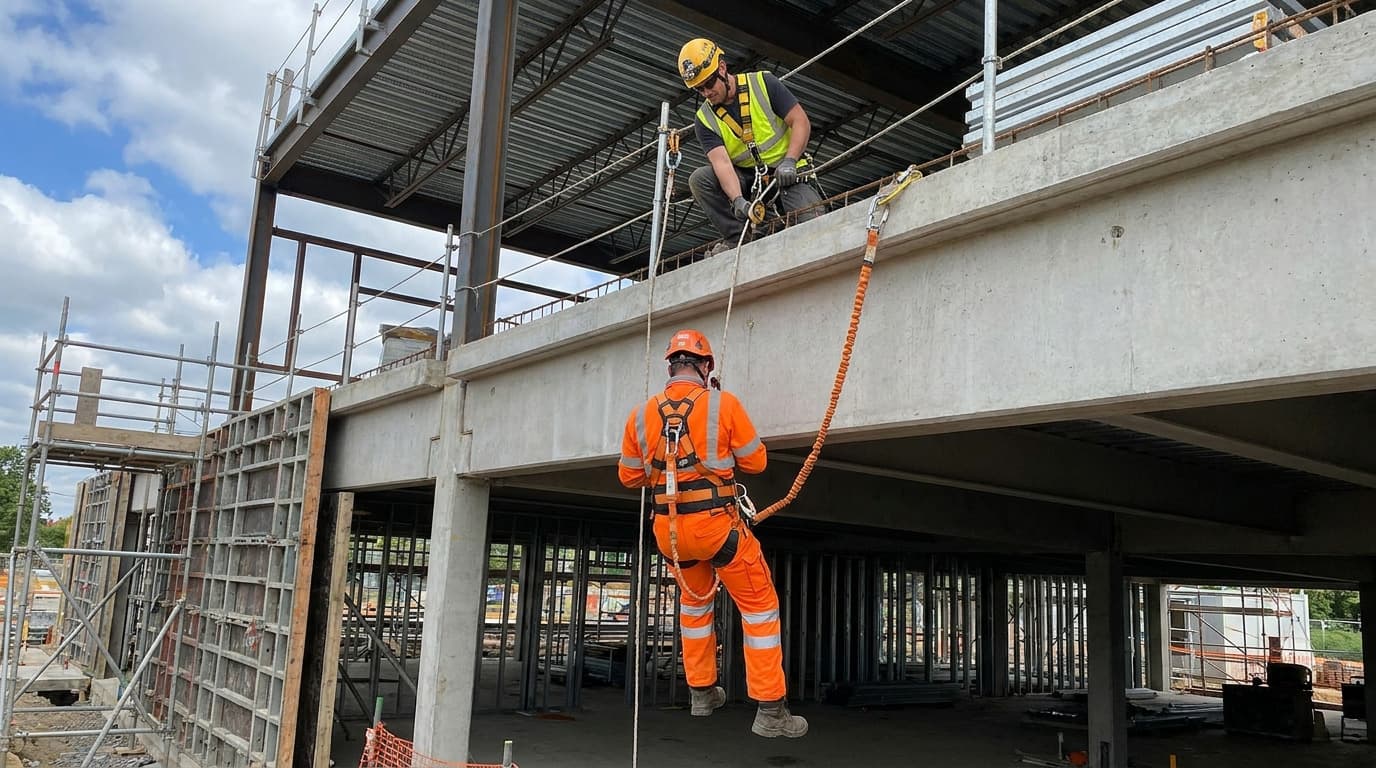
Delayed effects go unrecognised. The bulletin is explicit that possible delayed effects — kidney failure, which it notes is not unusual in these cases — are difficult to assess at the scene. A worker who walks away and goes home can deteriorate hours later. Medical evaluation is not optional because someone feels well.
The old positioning advice is applied on the ground. A crew holding an unconscious worker upright, following training that OSHA's own bulletin no longer supports, while the airway goes unmanaged.
The harness goes back on the rack. Impact-loaded equipment must come out of service immediately under (d)(19). After the adrenaline of a rescue, this is exactly the step that gets forgotten.
How do we prepare for rescue?#
Decide the rescue method before the work starts — for this location, today. Not a general policy. For this work position: who rescues, with what equipment, from where, and how long it will take. If nobody can answer that in a sentence, there is no rescue capability.
Time it honestly, and compare against the clock. Walk the route. Count the minutes to get a device to the location, position it, reach the worker, and lower them. Then make it shorter. Do not check it against thirty minutes and stop there — a rescue that takes twenty-five minutes is not a pass. If the number is not as small as you can practically make it, the work method needs to change — a different anchor, an aerial lift on standby, or elimination of the suspension risk entirely.
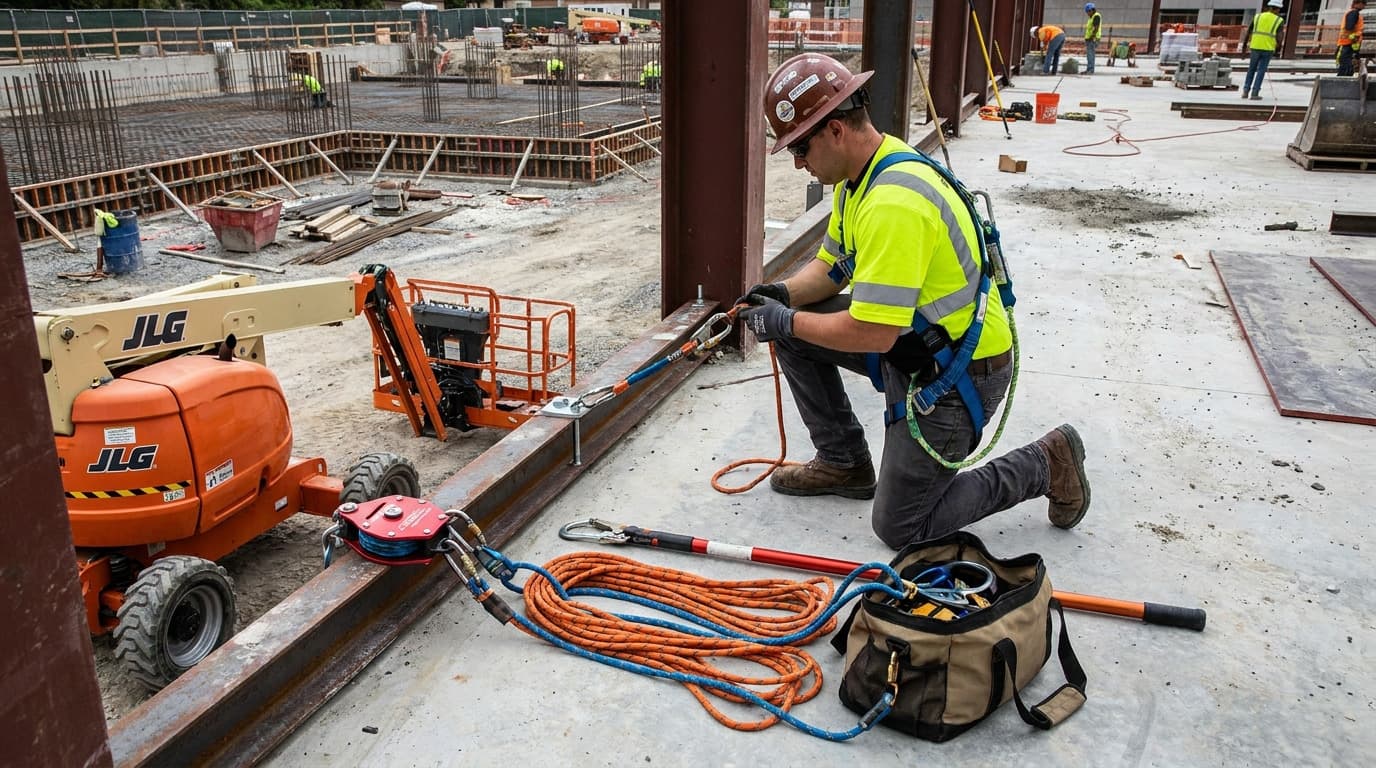
Have the equipment present and rigged, not stored. Rescue hardware that is not at the work location is not available. Where an aerial lift is the rescue method, it must be at the workface, powered, and not committed to production work.
Train the people who would actually do it. Rescuers need their own fall protection, their own training, and a route to the casualty that does not create a second suspended worker.
Fit and use suspension trauma relief straps. Deployable foot loops let a suspended worker take weight on their legs and restore some circulation. They cost very little, deploy in seconds, and buy time — which is the entire currency of this hazard.
Teach workers what to do while suspended. OSHA's bulletin recommends that if self-rescue is impossible or rescue cannot be prompt, workers should be trained to "pump" their legs frequently to activate the muscles and reduce venous pooling, and that footholds can be used to relieve pressure, delay symptoms, and support that muscle pumping.
Never leave a suspended worker unobserved. The bulletin calls for continuous monitoring for signs and symptoms. Someone stays with them, talking to them, watching for the changes below.
Know the signs. From the bulletin: faintness, breathlessness, sweating, paleness, hot flashes, increased heart rate, nausea, dizziness, unusually low heart rate, unusually low blood pressure, and "greying" or loss of vision. Know the risk factors too: inability to move the legs, pain, injuries from the fall, fatigue, dehydration, hypothermia, shock, blood loss, and cardiovascular or respiratory disease.
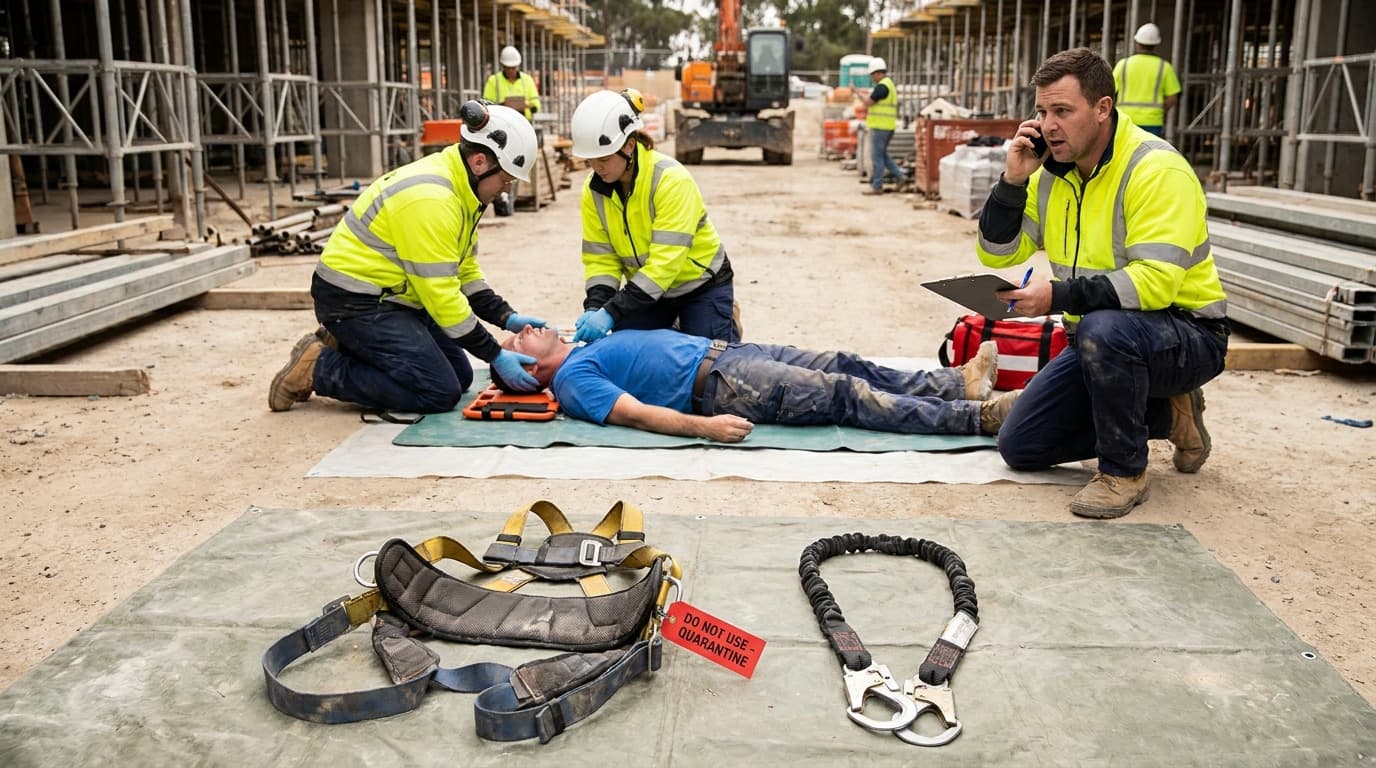
Once down: airway, medical help, and hand over the timeline. Keep the airway open if the worker is unconscious, get first aid and professional medical evaluation, and tell responders exactly how long the person was suspended. Follow your current first aid protocol and the direction of medical responders on positioning and treatment.
Insist on medical evaluation even for a worker who feels fine, because of the delayed effects the bulletin describes.
Quarantine the equipment. Under (d)(19) it is out of service immediately, and only a competent person can determine otherwise. In practice, most manufacturers direct destruction.
Then run the incident investigation — why the fall happened at all is a separate and equally important question.
Before you start#
- Name the rescue method for this work position, today.
- Confirm the rescue equipment is at the workface, rigged and available — not in a store.
- Confirm at least one trained rescuer is on site now, with their own fall protection.
- Time the rescue honestly, then ask what would make it shorter — thirty minutes is a warning, not an allowance.
- Confirm nobody is working suspended-risk work alone or out of sight.
- Confirm harnesses are fitted with suspension trauma relief straps and workers know how to deploy them.
- Confirm workers have been trained to pump their legs and use footholds while awaiting rescue.
- Confirm your first aid protocol reflects the current OSHA bulletin, not the withdrawn positioning advice.
- Confirm someone can reach emergency medical services and direct them to the exact location.
- Confirm everyone knows impact-loaded equipment comes out of service immediately.
Talk it over#
- If someone on this crew fell and was left hanging right now, who would get them down — and how many minutes would it take, start to finish?
- Does the rescue equipment for that answer exist, and is it here?
- What does your site first aid card say about a rescued worker's position — and when was it last checked against OSHA's current bulletin?
The bottom line#
A fall arrest system that works leaves a worker hanging, and OSHA's bulletin states that research indicates this can lead to unconsciousness and death in under 30 minutes. 29 CFR 1926.502(d)(20) requires prompt rescue or assured self-rescue, without defining "prompt" and without requiring a written plan — but OSHA has confirmed that rescue must be quick enough to prevent serious injury, and that in practice an employer must prepare in order to meet the duty. So decide the method before the work starts, keep the equipment at the workface, train real rescuers, fit relief straps, teach leg pumping, and never leave a suspended worker unwatched. Once they are down: airway, medical help, and tell responders how long they hung. And check your own first aid guidance — if it still says hold a rescued worker upright and never lay them flat, it is repeating advice OSHA removed from its bulletin in 2011.
Frequently asked questions about fall rescue and suspension trauma#
How long can a worker safely hang in a harness?
There is no safe duration to plan around. OSHA's Safety and Health Information Bulletin (SHIB 03-24-2004, updated 2011) states that research indicates suspension in a fall arrest device can result in unconsciousness, followed by death, in less than 30 minutes. Onset varies widely with the worker's condition, injuries, harness fit, and whether they can move their legs — so this is a figure to plan against, not a countdown to rely on.
What does OSHA require for fall rescue?
29 CFR 1926.502(d)(20) requires the employer to provide for prompt rescue of employees in the event of a fall, or to assure that employees are able to rescue themselves. OSHA has not defined "prompt" in the standard, but stated in interpretation that rescue must be performed quickly — in time to prevent serious injury to the worker.
Does OSHA require a written rescue plan?
No. OSHA confirmed in a December 18, 2003 letter of interpretation that 1926.502(d)(20) does not require a written rescue plan or a preplanning meeting. The same letter notes, however, that as a practical matter an employer will need to make preparations in order to meet the rescue requirement — so the absence of a paperwork obligation is not an absence of a capability obligation.
What is suspension trauma?
Suspension trauma — also called orthostatic intolerance or harness hang syndrome — occurs when a worker is held upright and immobile in a harness after a fall. Blood pools in the legs because the leg muscles are not moving to pump it back, reducing circulating volume and the oxygen reaching the brain, kidneys and other organs. Unlike someone who faints while standing and collapses horizontally, a suspended worker cannot fall flat, so the harness maintains the posture causing the problem.
Should a rescued worker be kept upright rather than laid flat?
That instruction is no longer in OSHA's bulletin. The 2011 update states that rescue procedures should include ensuring the worker receives standard trauma resuscitation once rescued, keeping the airway open if unconscious, obtaining first aid, and ensuring evaluation by a healthcare professional. Systematic reviews of the medical literature have not found evidence supporting the "reflow syndrome" or "rescue death" theory behind the older advice. Post-rescue positioning and treatment are decisions for medical responders under your current first aid protocol — not something the crew should improvise from older training.
What should a suspended worker do while waiting for rescue?
OSHA's bulletin recommends that where self-rescue is impossible or rescue cannot be performed promptly, workers should be trained to "pump" their legs frequently to activate the muscles and reduce venous pooling, and that footholds can be used to relieve pressure, delay symptoms, and provide support for that muscle pumping. Suspension trauma relief straps built into the harness serve this purpose.
Can the harness be used again after a rescue?
No, not without a competent person's determination. Under 29 CFR 1926.502(d)(19), any personal fall arrest system or component subjected to impact loading must be immediately removed from service and must not be used again for employee protection until inspected and determined by a competent person to be undamaged and suitable for reuse. Most manufacturers instruct that impact-loaded equipment be destroyed rather than returned to service.
Download the fall rescue toolbox talk PDF#
Get this fall rescue and suspension trauma toolbox talk as a print-ready PDF — available in English, Spanish, Portuguese, and Turkish. Print it, hand it to the crew, and collect signatures on the included attendance sheet.
Download the PDF — free account required. New members get 3 free downloads.
Related toolbox talks#
Sources#
- OSHA, Suspension Trauma/Orthostatic Intolerance, Safety and Health Information Bulletin SHIB 03-24-2004, updated 2011: https://www.osha.gov/sites/default/files/publications/SHIB032404.pdf
- OSHA, 29 CFR 1926.502 — Fall protection systems criteria and practices: https://www.osha.gov/laws-regs/regulations/standardnumber/1926/1926.502
- OSHA, Clarification on several issues regarding OSHA's construction industry standards for fall protection, Letter of Interpretation, December 18, 2003: https://www.osha.gov/laws-regs/standardinterpretations/2003-12-18
- OSHA, Recommendations for preventing prolonged suspension in personal fall protection systems, Letter of Interpretation, September 8, 2004: https://www.osha.gov/laws-regs/standardinterpretations/2004-09-08
This talk summarises published regulatory and first aid guidance. It is not medical advice. Follow your site's emergency medical protocols and the direction of trained first aiders and emergency medical services.