Combustible Dust
Updated 2026-08-01
In this bundle Fire, Hot Work & Emergency
Print-ready PDF
Download this talk as a print-ready PDF, available in 4 languages.
This talk is not about breathing dust. Silica, wood dust and the health limits that go with them are covered elsewhere. This one is about the same material doing something completely different: detonating. Say that out loud at the start, because crews who have sat through a dust talk before will assume they know where this is going. This Combustible Dust Toolbox Talk (Safety Talk / Tailgate Talk) is an explosion talk, not a health talk.
Here is the distinction that carries this whole talk: the explosion that kills people is almost never the first one — the first one's job is to shake the fuel off the beams. A small deflagration inside a machine or a duct is survivable on its own. What it does is send a pressure wave through the building that lifts every gram of settled dust off floors, rafters, ductwork, cable trays and the tops of light fittings, turning a thin invisible layer into a fuel cloud filling the whole volume. Then that ignites. The dust you can see lying about is not the mess left over from the hazard. It is the hazard, stored.
Where the boundary of this talk sits#
The dust and silica talk owns the health side — the respirable crystalline silica standard, Table 1, the PEL and the action level. Static electricity as an ignition source, bonding versus grounding and the isolated-conductor mechanism belong to the static electricity talk. Hot work permits and the fire watch belong to the hot work talks. General site tidiness belongs to the housekeeping talk. This talk owns the explosion: the five conditions it needs, the accumulation threshold, and the secondary event.
What actually happened at Imperial Sugar#
The mechanism above is not a model. It is the investigated sequence of the worst combustible dust disaster in recent US history.
In February 2008 a confined explosion occurred inside an enclosed steel belt conveyor at a sugar refinery in Georgia. The primary event caused relatively manageable damage. But the pressure wave dislodged sugar dust that had accumulated throughout the buildings, and the secondary deflagrations that followed killed 14 workers and destroyed much of the facility.
The scale of the problem behind it is documented. The US Chemical Safety Board's 2006 study found 281 combustible dust incidents between 1980 and 2005, excluding grain facilities, which killed 119 workers and injured 718.
Five conditions, not three#
Everybody on site knows the fire triangle: fuel, oxygen, ignition. A dust explosion needs those three plus two more, and the two extra ones are what make housekeeping a life-safety control rather than a tidiness issue.
Fuel — combustible dust, finely divided.
Oxygen — present everywhere.
An ignition source — a spark, hot work, a hot bearing, friction, an electrical fault, static discharge.
Dispersion — the dust must be suspended in air in the right concentration. A pile on the floor will not explode. The same pile thrown into the air will.
Confinement — the cloud must be enclosed enough for pressure to build. A room, a duct, a hopper, a dust collector, a sheeted enclosure.
That is the dust pentagon, and the practical point is this: you cannot remove oxygen from a building, and you will never fully eliminate ignition sources on a construction site. Fuel and dispersion are the two you can actually control.
Dispersion does not need an explosion#
This is where construction gets caught, because most crews assume it takes a big event to lift the dust.
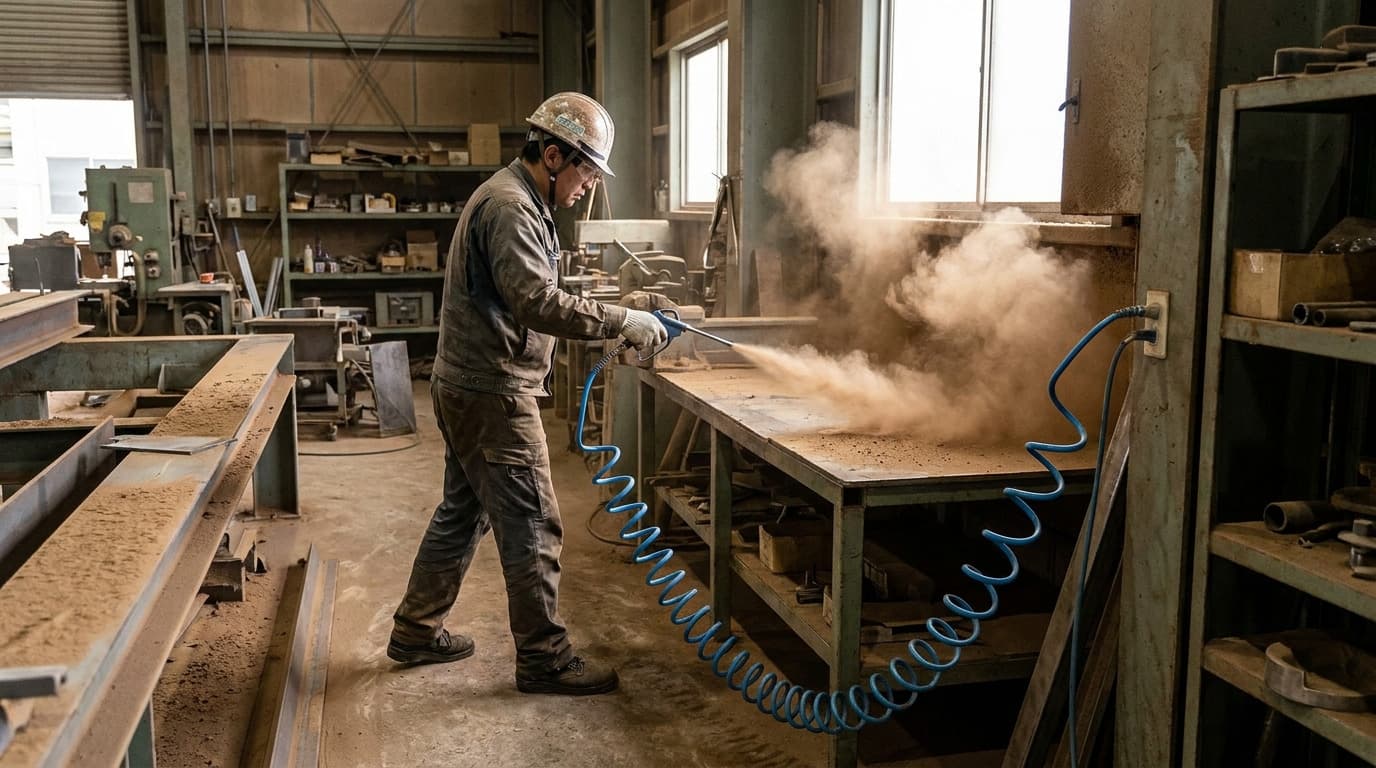
It does not. Anything that produces enough vibration or air movement will do it. A forklift striking a support column. A door slamming in a pressure change. Dropping a load. And most reliably of all, cleaning with compressed air, which is not cleaning at all — it is the dispersion step of the pentagon, performed deliberately. The compressed air talk covers the tool; the point here is what it does to a dust layer.
So a "small" ignition and an ordinary bump can meet in a way that nobody modelled.
The layer that counts#
Here is the number to write on the board.
Both NFPA guidance and OSHA's Combustible Dust National Emphasis Program treat a dust layer of 1/32 of an inch (0.8 mm), spread over just 5% of the floor area, as enough to pose a combustible dust hazard.
One thirty-second of an inch is roughly the thickness of a paperclip. It is a layer you can write your name in. It is not a layer anybody would stop work over.
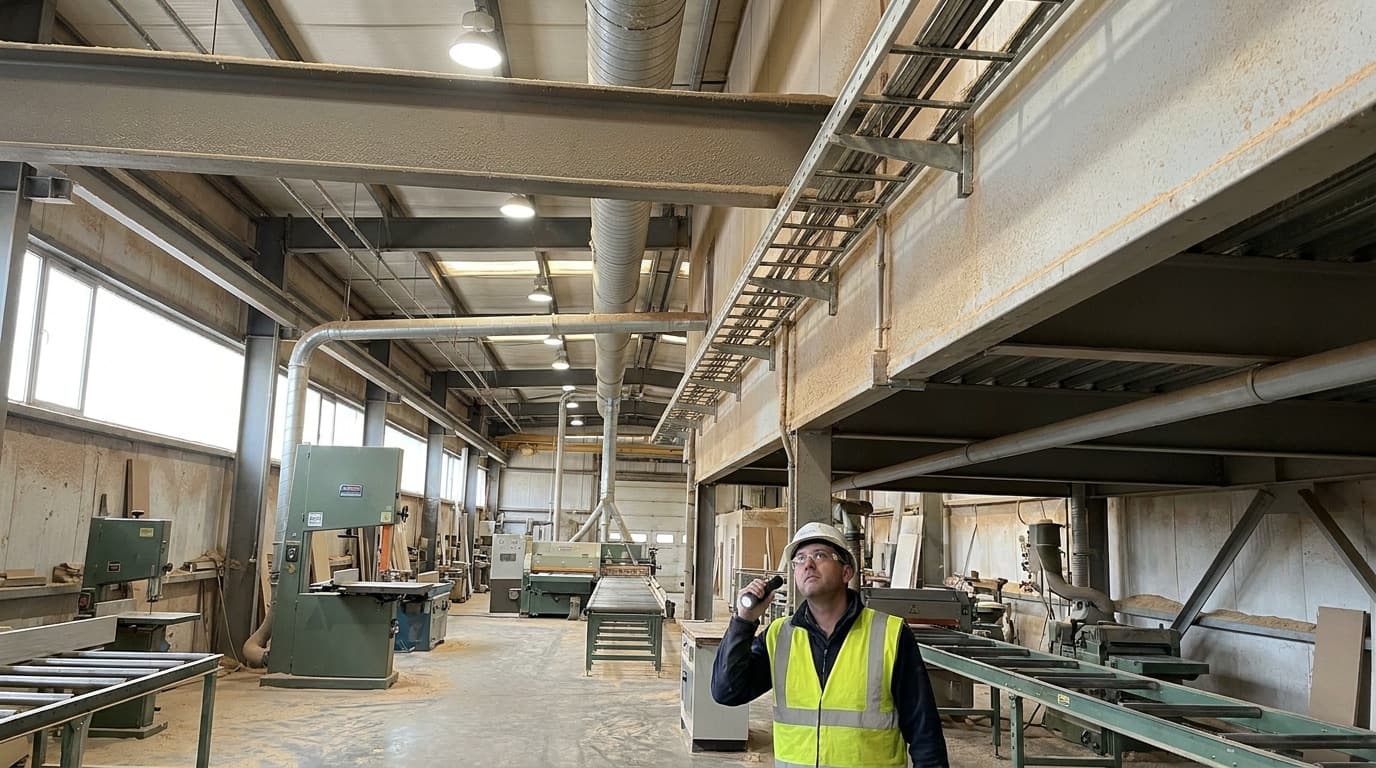
And the 5% is measured against floor area, but the dust is not only on the floor. Dust that settles on rafters, beams, ducts and pipework can account for the equivalent of another 10% of the building's floor area — which is precisely the inventory that a pressure wave gets to first, and precisely the inventory nobody cleans.
Look up. That is where the explosion is stored.
What counts as combustible dust on a construction site#
More than crews expect, and several of them are materials people think of as inert.
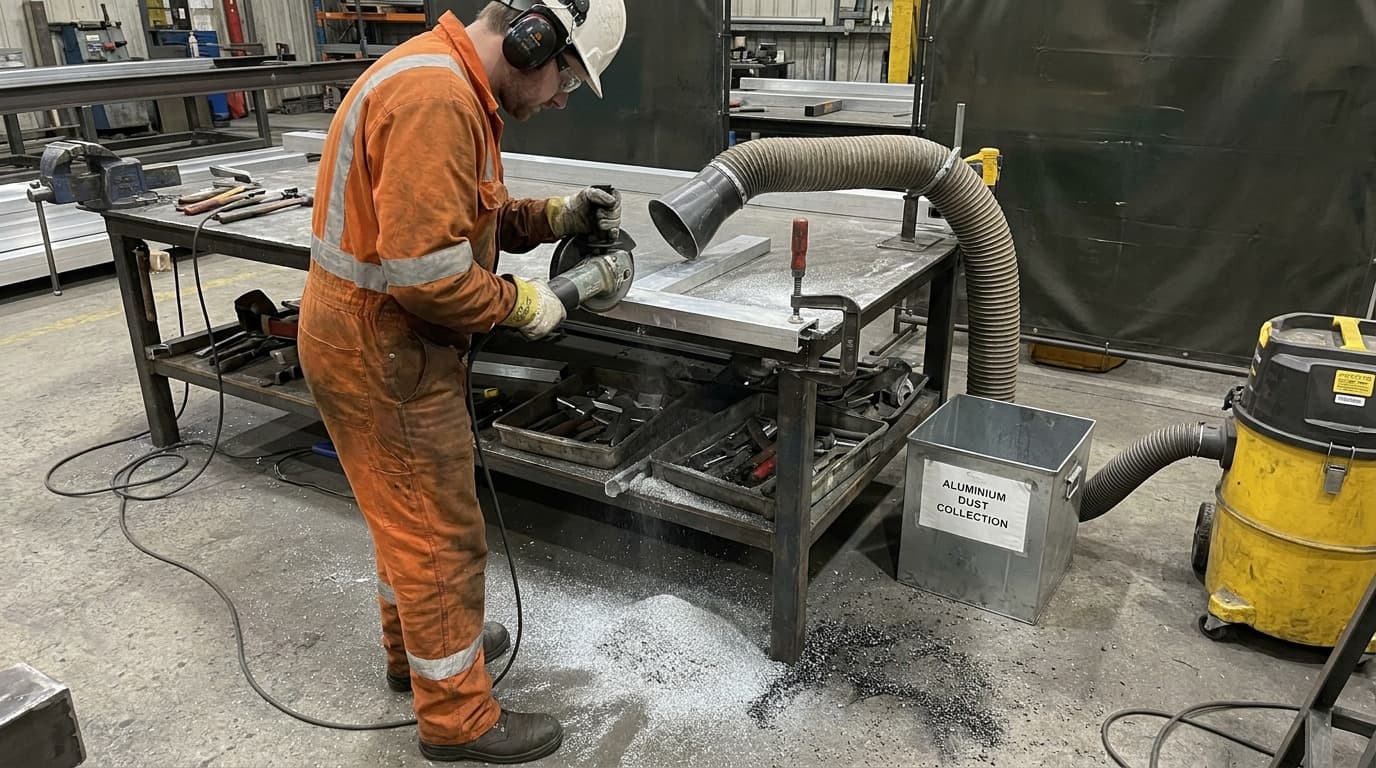
Wood dust from sanding, sawing and routing — the biggest one on most sites. Flour, sugar, starch and feed if you are working inside a food plant or a mill. Coal dust. Plastics, resins and composite dust from cutting and grinding. Rubber. Paper and textile fibres. And the one that surprises people: metals. Aluminium and magnesium are not flammable as solid stock, but as grinding dust they are extremely energetic. Aluminium dust plus sparks from steel is a serious hazard in its own right.
The general rule from the standards is about particle size and behaviour, not material identity: a solid becomes a combustible dust when it is divided finely enough to present a flash fire or explosion hazard when suspended in air. If it burns as a solid, assume it explodes as a dust until somebody proves otherwise.
Where the duty sits#
There is no OSHA combustible dust standard. Not for construction and not for general industry. Say that plainly, because it is the reason this hazard travels unmanaged.
The only dust-specific OSHA standard is 1910.272, grain handling facilities, which most construction work never touches. Everything else runs through: the Combustible Dust National Emphasis Program, which is an enforcement programme rather than a rule; the housekeeping duties at 1926.25 and material handling and storage at 1926.250; 1926.21(b)(2), requiring the employer to instruct each employee in recognising and avoiding unsafe conditions; and above all Section 5(a)(1) of the OSH Act, the General Duty Clause, which is how OSHA actually cites combustible dust — a recognised hazard likely to cause death or serious harm.
The consensus standard has just changed, and this catches people out. On 6 December 2024, NFPA 660, Standard for Combustible Dusts and Particulate Solids took effect, consolidating six previous standards — NFPA 61, 484, 652, 654, 655 and 664 — into one document. If your procedures, your specification or your training deck still cite NFPA 652 or NFPA 654, they are citing retired standards. The requirement they carried forward is the same: a facility handling combustible dust needs a documented Dust Hazard Analysis. NFPA is a consensus standard, not an OSHA rule — but it is what a General Duty Clause citation will be measured against.
What can go wrong?#
Treating dust as a housekeeping issue rather than as stored explosive fuel.
Cleaning only the floor, while the beams, ducts and cable trays keep their layer.
Blowing dust down with compressed air, which is the dispersion step performed on purpose.
Doing hot work in a dusty area without cleaning it first and without a permit that names the dust.
Grinding aluminium or magnesium and treating the dust as ordinary swarf.
Using an ordinary shop vacuum on combustible dust, which puts an ignition source and a confined dust cloud in the same box.
Sheeting an area for weather or dust control, and unintentionally supplying the confinement the pentagon needs.
Assuming a thin layer is fine because you can still see the floor through it.
How do we manage this properly?#
Name the dust before the work starts — what material, generated by what task, settling where.
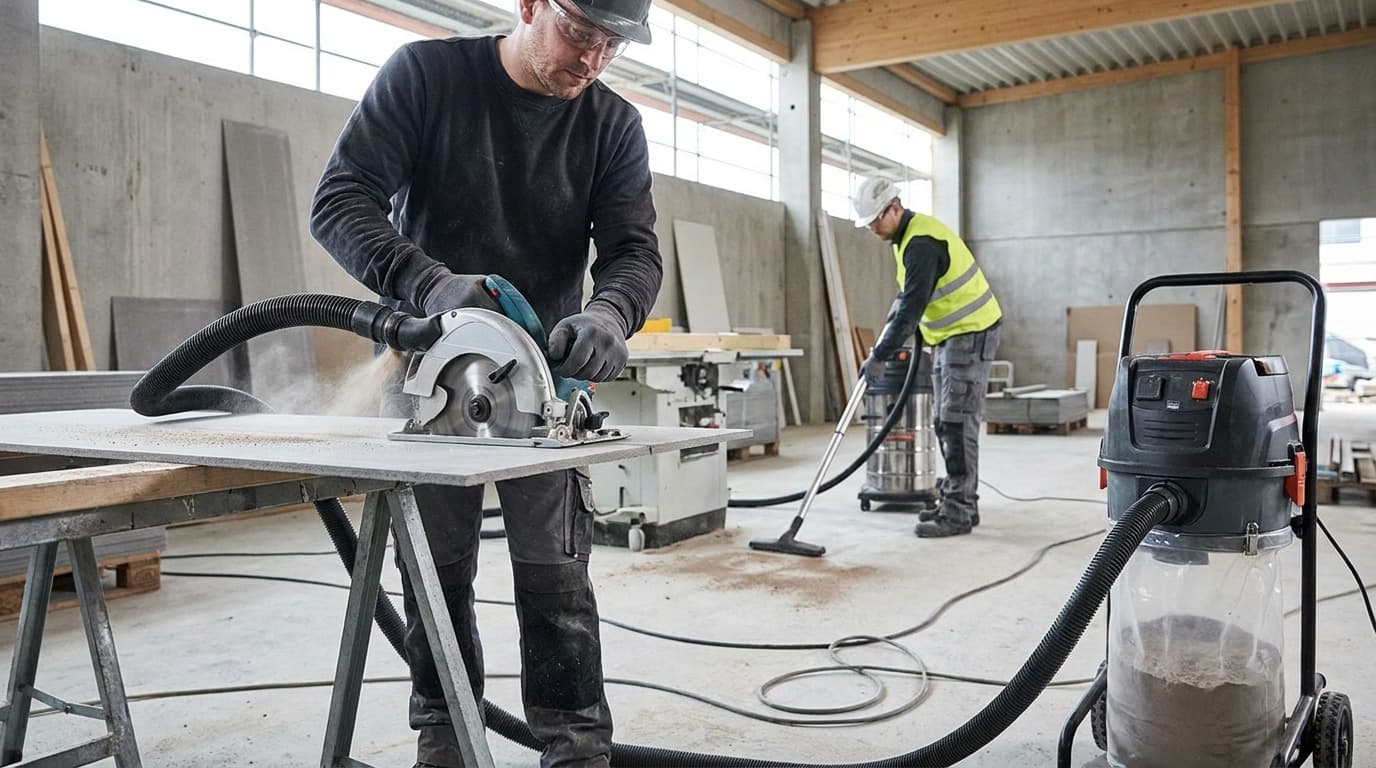
Control it at source. Extraction at the tool, wet methods, and enclosure keep dust out of the air and off the structure. This is the strongest control and it also does the health job at the same time.
Clean to a standard, on a schedule, and include the overhead. Beams, ducts, ledges, cable trays, tops of machinery and above suspended ceilings. If you only clean what you can see standing up, you are cleaning the wrong surfaces.
Never use compressed air to move dust, and never dry-sweep in a way that raises a cloud. Use vacuum equipment rated for combustible dust or wet methods.
Control ignition sources — hot work permits that explicitly account for the dust, electrical equipment suited to the area, control of static, and no smoking.
Treat sheeted and enclosed areas as higher risk, because you have just added confinement.
Handle metal dusts separately. Aluminium and magnesium are not swarf; keep them away from sparks, from water and from other dusts.
Escalate rather than absorb. A layer that keeps coming back is a control failure upstream, not a cleaning problem.
Before you start#
- Confirm what dust this task will generate and where it will settle.
- Confirm extraction, wet methods or enclosure are in place at the source.
- Confirm who is cleaning, how often, and whether overhead surfaces are on the list.
- Confirm the cleaning method is vacuum or wet, not compressed air or dry sweeping.
- Confirm any vacuum used is rated for combustible dust.
- Confirm no hot work is planned in the area until it has been cleaned.
- Confirm whether metal dusts are involved and are being kept separate.
- Confirm whether sheeting or enclosure has been added, and what that changes.
Talk it over#
- If you look up right now, what is sitting on the beams and ducts above us?
- What tasks here make the finest dust, and where does it end up?
- Has anyone here cleaned a work area with a compressed air line?
- Where in this building could a pressure wave travel to next?
The bottom line#
The explosion that kills people is almost never the first one — the first one's job is to shake the fuel off the beams. A small deflagration inside equipment sends a pressure wave that lifts settled dust off floors, rafters, ducts and cable trays into a cloud filling the building, and that is what detonates. At a Georgia sugar refinery in February 2008, a confined explosion inside an enclosed steel belt conveyor caused relatively manageable damage, and the secondary deflagrations it triggered killed 14 workers. The US Chemical Safety Board's 2006 study recorded 281 combustible dust incidents from 1980 to 2005 excluding grain, killing 119 workers and injuring 718. A dust explosion needs five conditions, not three: fuel, oxygen, ignition, dispersion and confinement — the dust pentagon — and since you cannot remove oxygen from a building or eliminate every ignition source, fuel and dispersion are the two you can control. Dispersion does not need an explosion: a forklift hitting a column, a dropped load, or cleaning with compressed air will do it. The threshold is startling: both NFPA guidance and OSHA's Combustible Dust National Emphasis Program treat a layer of 1/32 inch (0.8 mm) over just 5% of floor area as a combustible dust hazard — roughly the thickness of a paperclip — and dust settled on rafters, ducts and pipework can add the equivalent of another 10% of floor area, which is exactly what a pressure wave reaches first. Look up; that is where the explosion is stored. On site the fuels include wood dust, flour, sugar, starch, coal, plastics, resins, composites, rubber, paper and textile fibres, plus aluminium and magnesium, which are inert as solid stock and extremely energetic as grinding dust. There is no OSHA combustible dust standard — only 1910.272 for grain, the National Emphasis Program, housekeeping at 1926.25, storage at 1926.250, instruction at 1926.21(b)(2), and the General Duty Clause, Section 5(a)(1), which is how it is actually cited. And the consensus standard has changed: since 6 December 2024, NFPA 660 has consolidated NFPA 61, 484, 652, 654, 655 and 664 into one document, still requiring a documented Dust Hazard Analysis — consensus, not an OSHA rule, but it is the yardstick a citation is measured against.
Frequently asked questions about combustible dust#
Is this the same as the silica and dust health talk?
No, and the difference matters. That talk is about breathing dust — respirable crystalline silica, the permissible exposure limit and the controls that keep exposure down. This talk is about dust exploding. The same material can present both hazards, but the mechanisms, the controls and the consequences are different. A crew can be fully protected against inhalation and still be standing in an explosion hazard.
Why is the second explosion worse than the first?
Because the first one provides the dispersion. A primary deflagration inside a machine, duct or collector is usually confined and survivable, but its pressure wave lifts settled dust off every horizontal surface in the building — floors, beams, ducts, cable trays, light fittings — creating a fuel cloud far larger than the original. At the 2008 Georgia sugar refinery explosion the primary event caused manageable damage; the secondary deflagrations killed 14 workers.
How much dust is too much?
Far less than people assume. NFPA guidance and OSHA's Combustible Dust National Emphasis Program use a layer of 1/32 of an inch (0.8 mm) covering 5% of the floor area — about the thickness of a paperclip, a layer you can write your name in. And because dust on rafters, ducts and pipework can equal another 10% of floor area, the accumulation that matters is usually the one nobody can see from the ground.
What makes a dust explosion different from a fire?
Two extra conditions. A fire needs fuel, oxygen and ignition. A dust explosion also needs dispersion — the dust suspended in air at the right concentration — and confinement, so pressure can build. Together these five are the dust pentagon. A pile of dust on the floor will not explode; the same pile thrown into the air inside an enclosed space will.
Can compressed air be used to clean up dust?
No — it is the single worst method available, because blowing dust down is the dispersion step of the dust pentagon carried out deliberately. It converts a settled layer into exactly the suspended cloud the explosion needs. Use vacuum equipment rated for combustible dust, or wet methods, and avoid dry sweeping that raises a cloud.
Which materials on a construction site are combustible dusts?
More than expected: wood dust from sanding and sawing, flour, sugar, starch and feed in food plants, coal, plastics, resins and composites, rubber, and paper and textile fibres. The surprise is metals — aluminium and magnesium will not burn as solid stock but are highly energetic as grinding dust. The working rule is about fineness rather than material: if it burns as a solid, assume it explodes as a dust until proven otherwise.
Which standard applies — NFPA 652 or 654?
Neither any more, and this is a common error in older procedures. Since 6 December 2024, NFPA 660, Standard for Combustible Dusts and Particulate Solids, has consolidated NFPA 61, 484, 652, 654, 655 and 664 into a single document, carrying forward the requirement for a documented Dust Hazard Analysis. Note that NFPA is a consensus standard, not an OSHA rule — there is no OSHA combustible dust standard, and citations are normally issued under the General Duty Clause.
Download the combustible dust toolbox talk PDF#
Get this combustible dust toolbox talk as a print-ready PDF — available in English, Spanish, Portuguese, and Turkish. Print it, hand it to the crew, and collect signatures on the included attendance sheet.
Download the PDF — free account required. New members get 3 free downloads.
Related toolbox talks#
Sources#
- OSHA, Technical Manual Section IV Chapter 6 — Combustible Dusts: https://www.osha.gov/sites/default/files/otm_secIV_chap6.pdf
- NFPA, NFPA 660, Standard for Combustible Dusts and Particulate Solids: https://www.nfpa.org/codes-and-standards/nfpa-660-standard-development/660
- US Chemical Safety Board, Combustible Dust Hazard Study: https://www.csb.gov/
This talk is general awareness guidance for training purposes. It does not qualify anyone to carry out a Dust Hazard Analysis, to specify explosion protection, or to clean or work in an area with a known combustible dust hazard, all of which require specific competence. Where a combustible dust accumulation is found, stop and refer it to a competent person rather than cleaning it up on the spot.
Written by FieldSafetyTalk's safety professional — a CSP, ASP, CHST and OSHA Authorized Outreach Trainer with 14+ years of international construction safety experience across federal, heavy civil, and industrial projects.