Workplace Housekeeping
Updated 2026-07-23
In this bundle Jobsite Fundamentals & Compliance
Print-ready PDF
Download this talk as a print-ready PDF, available in 4 languages.
Housekeeping is the one safety requirement that gets treated as an aesthetic preference. Crews hear it as "tidy up," which sounds like something to do when the real work is finished. That framing is why it is one of OSHA's most consistently cited construction provisions. This workplace housekeeping talk is about the control that sounds like cleaning and functions like engineering.
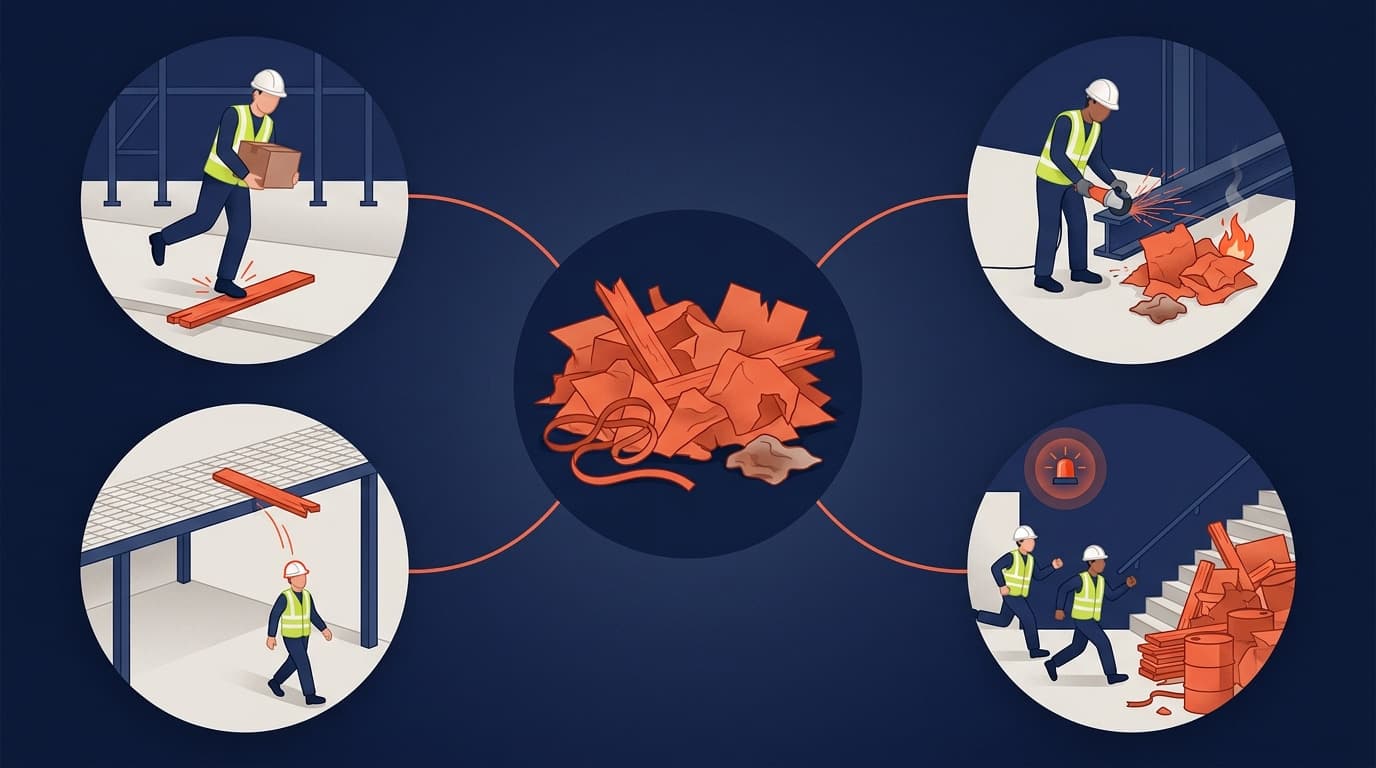
Here is the distinction that carries this whole talk: every other control on this site addresses one hazard. A guardrail stops falls. A lockout stops unexpected energization. A guard stops contact with a blade. Housekeeping is the only control that addresses four separate hazard families simultaneously — it removes trip hazards, it eliminates fuel for fire, it prevents objects from being knocked from height, and it keeps access and egress routes usable in an emergency. That is why 1926.25 is written as a safety standard rather than a cleanliness standard, and why "we'll clean up at the end of the shift" misses what the requirement is actually for.
Why does housekeeping matter on a construction site?#
The injury data makes the case better than any argument about tidiness. According to CPWR, the Center for Construction Research and Training, analyzing BLS data:
- Floors, walkways, and ground surfaces were the primary source of 13,700 nonfatal construction injuries in 2021–2022 — more than ladders (11,600), scaffolds and staging (2,500), or roofs (2,800) (CPWR Data Bulletin, March 2024).
- There were 44,000 nonfatal falls, slips, and trips in construction during 2021–2022, of which roughly 24,600 were same-level incidents — the category housekeeping most directly prevents.
- Construction accounted for 46.2 percent of all work-related fatal falls, slips, and trips in 2021 (CPWR, March 2024).
29 CFR 1926.25 is among the most frequently cited construction provisions, and the citations are remarkably consistent: debris left in walkways, scrap lumber with protruding nails, and combustible waste allowed to accumulate. These are not complex engineering failures. They are things that were left where they fell.
The pattern worth noting from the fatality data: 70.3 percent of fatal falls between 2011 and 2022 occurred at establishments with 10 or fewer employees (CPWR, March 2024). Small crews without a dedicated cleanup routine carry a disproportionate share of the risk.
OSHA housekeeping requirements (29 CFR 1926.25)#
Construction housekeeping is governed principally by 29 CFR 1926.25, supported by the materials handling and storage provisions in Subpart H.
- Clearing debris — 1926.25(a). During the course of construction, form and scrap lumber with protruding nails, and all other debris, must be kept cleared from work areas, passageways, and stairs, in and around buildings or other structures.
- Combustible scrap — 1926.25(b). Combustible scrap and debris must be removed at regular intervals during the course of construction, and safe means provided to facilitate such removal.
- Waste containers — 1926.25(c). Containers must be provided for the collection and separation of waste, trash, oily and used rags, and other refuse. Containers used for garbage and other oily, flammable, or hazardous wastes must be equipped with covers. Garbage and refuse must be disposed of at frequent and regular intervals.
- Material storage — 1926.250(a)(1). Material stored in tiers must be stacked, racked, blocked, interlocked, or otherwise secured to prevent sliding, falling, or collapse.
- Aisles and passageways — 1926.250(a)(3). Aisles and passageways must be kept clear and in good repair, with no obstruction that could create a hazard.
- Storage area housekeeping — 1926.250(b)(1). Storage areas must be kept free from accumulation of materials that constitute hazards from tripping, fire, explosion, or pest harbourage.
- Disposal of waste materials — 1926.252. Debris dropped more than 20 feet to any exterior point of a building must go through an enclosed chute. Where debris is dropped through holes in the floor without chutes, the drop area must be completely enclosed with barricades at least 42 inches high and no less than 6 feet back from the projected edge, with warning signs posted.
- Illumination — 1926.26. Work areas, passageways, and storage areas must be lighted to minimum intensities while work is in progress.
On USACE and NAVFAC projects, EM 385-1-1 applies and is more prescriptive on waste management and site organization.
What are the four hazards housekeeping controls?#
Trip and slip hazards. Offcuts, banding, packaging, cords, and debris in walkways are the direct cause of same-level falls — the category responsible for more than half of all construction falls, slips, and trips.
Fire load. Every piece of scrap timber, cardboard, packaging, and oily rag on the site is fuel. Housekeeping is the primary means of controlling how much combustible material is available when an ignition source appears — and hot work, temporary heating, and electrical faults guarantee that ignition sources appear. Oily rags require covered containers under 1926.25(c) specifically because they can self-heat and ignite without any external ignition source.
Falling objects. Material and offcuts stored near edges, on guardrails, or on elevated platforms become struck-by hazards for anyone below. Under 1926.250(a)(1), stored material must be secured against falling — and housekeeping determines whether loose material exists near an edge in the first place.
Blocked access and egress. A walkway obstructed by material is an inconvenience during normal work and a serious hazard during an emergency. Fire exits, stairways, and equipment access routes must remain clear, and this is the hazard family people notice last because it costs nothing until it costs everything.
How do we maintain good housekeeping?#
Clean as you go — this is the requirement, not a preference. 1926.25(a) says debris must be kept cleared, which means continuously during the work, not retrospectively at the end. Waste generated by a task is removed as part of that task.
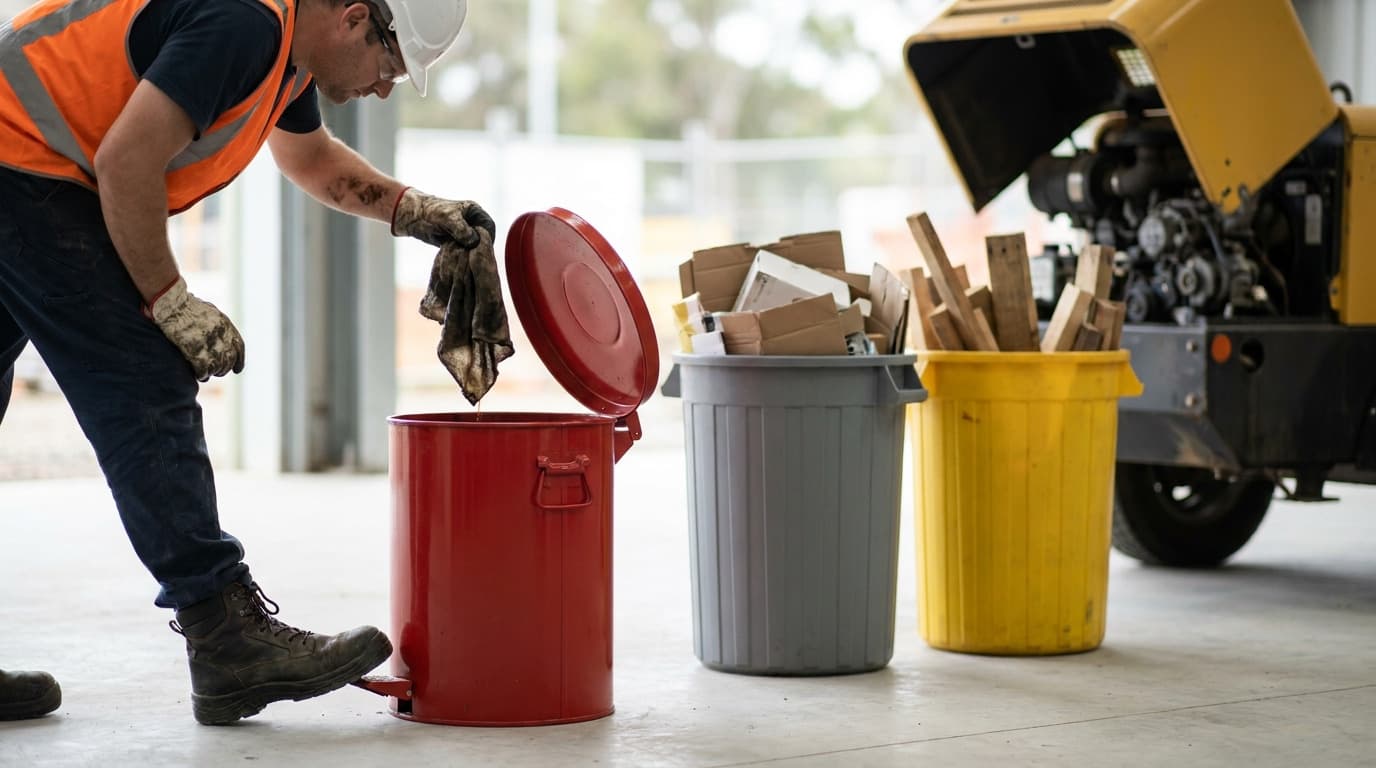
Put containers where the waste is generated. The single most effective change on most sites. If a worker has to walk 30 metres to a skip, offcuts end up on the floor. Containers at the work face, emptied before they overflow, with separate containers for general waste, combustible scrap, and oily rags.
Cover the containers that need covering. Under 1926.25(c), containers for oily, flammable, or hazardous waste must have covers. Oily rags in an open bin are a self-ignition risk.
Store materials properly:
- Stacked, racked, blocked, or interlocked so nothing can slide or collapse (1926.250(a)(1))
- Never against a guardrail, on a platform edge, or where it can be knocked from height
- Out of walkways and circulation routes, not in them
- With aisles kept clear and in good repair (1926.250(a)(3))
Deal with protruding nails immediately. 1926.25(a) names them specifically because puncture wounds through boot soles are a routine and entirely preventable injury. Nails are bent over or removed as the material is stripped, not later.

Use chutes for debris removal. Under 1926.252, material dropped more than 20 feet outside a building requires an enclosed chute. Where debris drops through floor holes, barricade the drop zone at least 42 inches high, 6 feet back from the edge, with warning signs.
Assign it, or it will not happen. Housekeeping that belongs to everyone belongs to nobody. Name who is responsible for each area, build cleanup time into the schedule rather than expecting it after hours, and check it as part of the daily walk.
Treat a deteriorating site as a leading indicator. Housekeeping is the first thing to slip when a job is behind schedule or under-resourced. A site that is getting messier is telling you something about pressure and staffing before any incident does.
Before you start#
- Look at your work area and identify what debris will be generated by today's task.
- Confirm there is a waste container within reasonable reach, with covers where required.
- Check that walkways, stairs, and access routes are clear before you start, not just at the end.
- Identify any protruding nails in stripped material and deal with them as you go.
- Confirm stored material is stacked, secured, and not near an edge or a guardrail.
- Check that combustible scrap is not accumulating anywhere near hot work or temporary heating.
- Confirm oily rags have a covered container, not an open bin.
- Know who is responsible for housekeeping in this area, and whether cleanup time is in today's plan.
Talk it over#
- Look around this area right now. What is on the floor that should be in a container, and how long has it been there?
- Where is the nearest waste container to where we are working? Is it close enough that people will actually use it?
- If a fire started in this area, what is on the ground that would feed it, and which exit route is currently blocked?
The bottom line#
Housekeeping is not tidiness — it is the only control on this site that addresses trip hazards, fire load, falling objects, and blocked egress at the same time. 1926.25 requires debris to be kept cleared during construction, not cleaned up afterwards, and the surfaces we walk on injure more construction workers than ladders do. Put containers where the waste is made, cover the ones holding oily rags, secure stored material away from edges, deal with protruding nails as they appear, and treat a site that is getting messier as an early warning about everything else.
Frequently asked questions about workplace housekeeping#
What does OSHA 1926.25 require?
Under 29 CFR 1926.25(a), form and scrap lumber with protruding nails and all other debris must be kept cleared from work areas, passageways, and stairs during construction. 1926.25(b) requires combustible scrap and debris to be removed at regular intervals, and 1926.25(c) requires containers for waste, trash, and oily rags — with covers on containers holding oily, flammable, or hazardous waste.
Why do oily rags need a covered container?
Because they can ignite without any external ignition source. Oil-soaked rags generate heat as the oil oxidizes, and in an enclosed pile that heat can build until the rags reach ignition temperature. 29 CFR 1926.25(c) specifically requires covered containers for oily, flammable, or hazardous waste for this reason.
How does housekeeping prevent injuries beyond trips?
It controls four hazard families at once: trip and slip hazards from debris in walkways, fire load from combustible scrap, falling objects from material stored near edges, and blocked access and egress routes during an emergency. No other single control addresses all four.
When should debris be cleared?
Continuously, during the work. 1926.25(a) requires debris to be kept cleared, which is an ongoing obligation rather than an end-of-shift task. Waste generated by a task is removed as part of that task, and combustible scrap must be removed at regular intervals under 1926.25(b).
What are the rules for dropping debris from height?
Under 29 CFR 1926.252, material dropped more than 20 feet to any point outside the exterior walls of a building must be dropped through an enclosed chute. Where debris is dropped through floor holes without a chute, the area must be barricaded at least 42 inches high and not less than 6 feet from the projected edge, with warning signs posted.
How should materials be stored to prevent injuries?
Under 29 CFR 1926.250(a)(1), material stored in tiers must be stacked, racked, blocked, interlocked, or otherwise secured to prevent sliding, falling, or collapse. Storage must be clear of aisles and passageways (1926.250(a)(3)), and storage areas kept free from accumulations that create tripping, fire, explosion, or pest hazards (1926.250(b)(1)).
Download the workplace housekeeping toolbox talk PDF#
Get this workplace housekeeping toolbox talk as a print-ready PDF — available in English, Spanish, Portuguese, and Turkish. Print it, hand it to the crew, and collect signatures on the included attendance sheet.
Download the PDF — free account required. New members get 3 free downloads.
Related toolbox talks#
Sources#
- OSHA, 29 CFR 1926.25 — Housekeeping: https://www.osha.gov/laws-regs/regulations/standardnumber/1926
- CPWR, Fatal and Nonfatal Falls in the U.S. Construction Industry, 2011–2022, Data Bulletin March 2024: https://www.cpwr.com/wp-content/uploads/DataBulletin-March2024.pdf
- OSHA, Construction Focus Four: Fall Hazards: https://www.osha.gov/sites/default/files/falls_ig.pdf
- Bureau of Labor Statistics, Survey of Occupational Injuries and Illnesses: https://www.bls.gov/iif/