Powder-Actuated Tools
Updated 2026-08-01
In this bundle Tools & Machinery
Working in Washington? See the WA DOSH edition → Washington (WA DOSH)
Print-ready PDF
Download this talk as a print-ready PDF, available in 4 languages.
A powder-actuated tool is the only thing on most sites that fires a live cartridge, and crews handle it accordingly — eye protection on, muzzle down, everyone stands back. That discipline is real and it works. It also protects entirely the wrong person, because the risk it is aimed at is the one everybody can see. This Powder-Actuated Tools Toolbox Talk (Safety Talk / Tailgate Talk) is about the one they cannot.
Here is the distinction that carries this whole talk: the person most likely to be killed by a powder-actuated tool is not the one holding it. OSHA wrote a provision specifically about this. 1926.302(e)(8): driving into materials easily penetrated shall be avoided "unless such materials are backed by a substance that will prevent the pin or fastener from passing completely through and creating a flying missile hazard on the other side." The operator is looking at a wall. The regulation is worried about the room behind it.
Where the boundary of this talk sits#
Pneumatic nailers, trigger mechanisms and the sequential-versus-contact question belong to the nail gun talk in this same pair. General power tool duties and guarding belong to the hand and power tools talk. Struck-by mechanics generally belong to the struck-by talk. Eye and face protection selection belongs to that talk, under 1926.102. This talk owns the powder-actuated tool itself and what 1926.302(e) requires of it.
Read the substrate, not the tool#
Two provisions sit either side of the anchor, and between them they cover every substrate mistake.
Too soft — 1926.302(e)(8). The fastener passes clean through and becomes a projectile in whatever space is on the other side. That space is often a corridor, an occupied office, a stairwell, a scaffold platform or the public footway. Nobody in it knows the work is happening. The control is not a better stance; it is knowing what is behind the substrate and either backing it or clearing it.
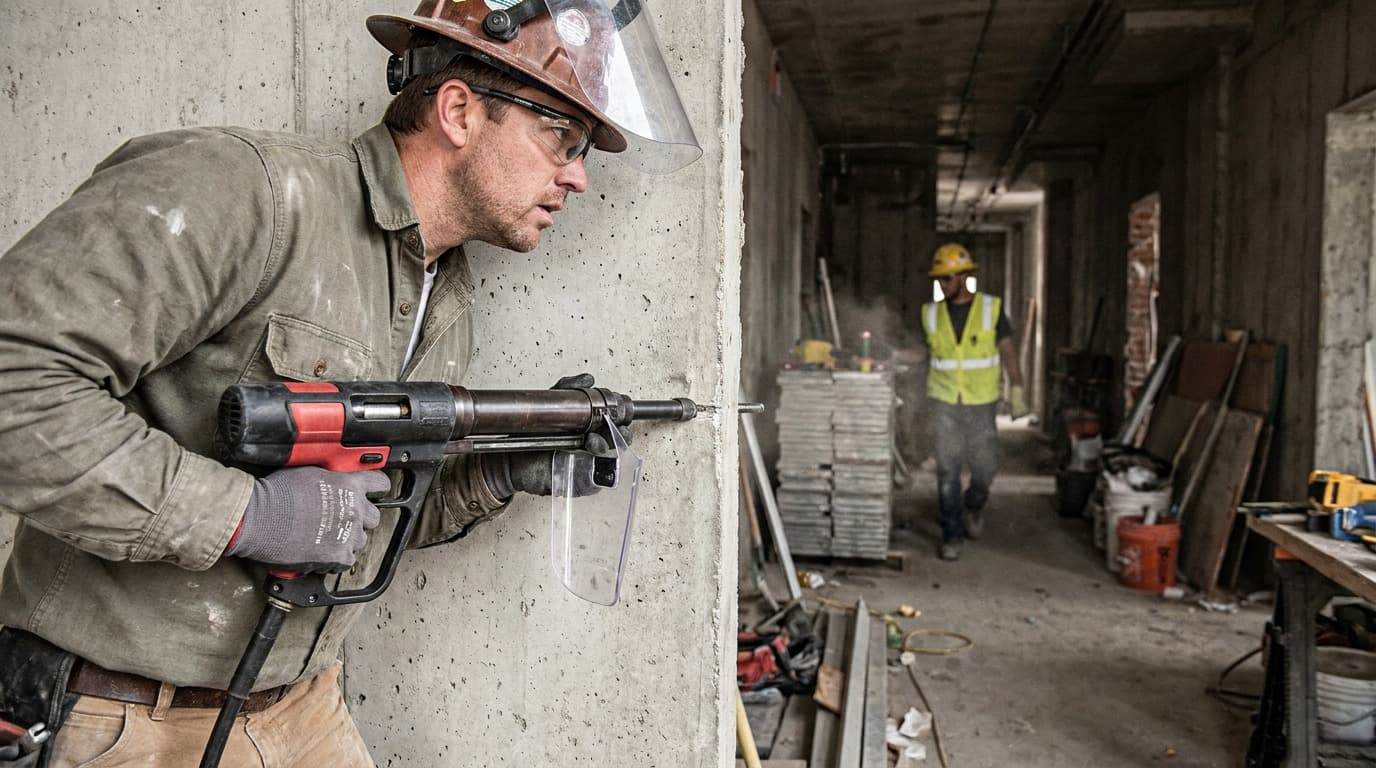
Too hard or brittle — 1926.302(e)(7). Fasteners shall not be driven into very hard or brittle materials including, but not limited to, cast iron, glazed tile, surface-hardened steel, glass block, live rock, face brick, or hollow tile. Here the fastener does not pass through; it deflects, and the substrate shatters. The projectile comes back at the operator and everyone near them, which is why the eye protection matters and why bystander distance matters.
And never into a spalled area — 1926.302(e)(9). No fastener shall be driven into a spalled area caused by an unsatisfactory fastening. The concrete there has already failed once; it has no holding capacity and it will spall again.
So the sequence before every fastening is: what is this material, and what is on the other side of it? That question is the whole job.
The training rule is narrower than people think#
1926.302(e)(1): "Only employees who have been trained in the operation of the particular tool in use shall be allowed to operate a powder-actuated tool."
Read "the particular tool in use." This is not training in powder-actuated tools as a category. A worker trained on one manufacturer's tool is not, by that fact, trained on a different make or model with different loads, safety mechanisms and testing procedures. Card in the wallet does not mean trained on this tool.
OSHA has been asked who may deliver it. In a 2006 letter of interpretation the agency confirmed that the standard does not specify particular qualifications for the trainer, and that the trainer need not be the manufacturer's representative — but that as a practical matter they need sufficient knowledge of the tool and sufficient ability to convey it. So the duty is on the outcome, not the credential.
The provision most people have never heard of#
Here is a genuine surprise, and it matters more each year as gas tools spread.
In a 2005 letter of interpretation, OSHA was asked whether the 1926.302(e)(1) training requirement reaches fuel-actuated fastening tools — the gas-cartridge nailers that look and behave much like powder-actuated tools. The answer: it does not. The provision "applies specifically to powder-actuated tools", and fuel-actuated tools fall under 1926.302(c), Fuel powered tools, which contains no training requirement at all.
What remains is 1926.21(b)(2) — the general duty to instruct each employee in the recognition and avoidance of unsafe conditions.
So the tool that looks like the regulated one may not be the regulated one. That is not a reason to train people less. It is a reason not to assume the certification you are looking at covers the tool in somebody's hands.
The rest of 1926.302(e), in the order it bites#
(e)(2) — test it every day, before loading. The tool shall be tested each day before loading to see that safety devices are in proper working condition, by the manufacturer's recommended method. Not weekly, not when it feels odd. Daily, and before the cartridge goes in.
(e)(3) — a defect ends its shift. Any tool found not in proper working order, or that develops a defect during use, shall be immediately removed from service and not used until properly repaired.
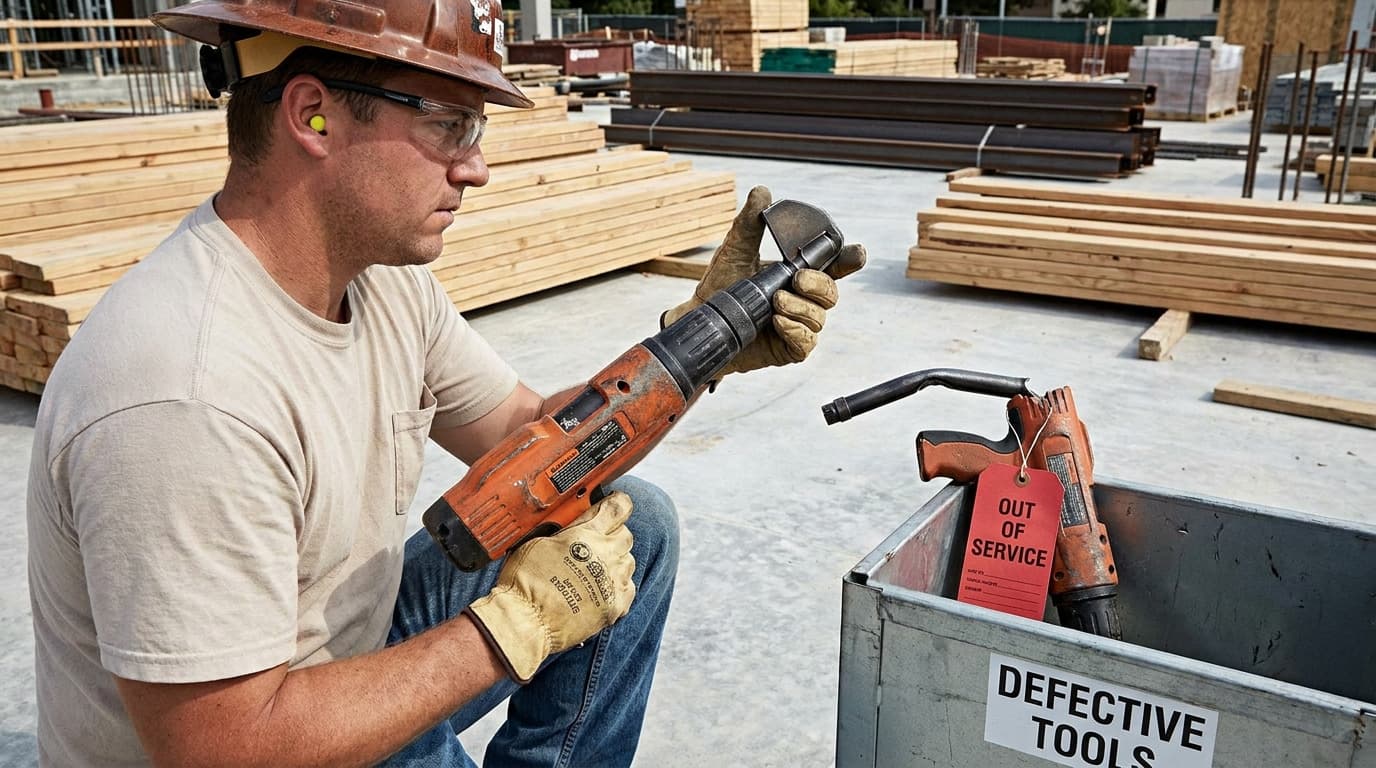
(e)(4) — PPE per Subpart E, which for this tool means eye protection as a minimum and face protection where the work justifies it.
(e)(5) — the firearm rules, in the regulation. Tools shall not be loaded until just prior to the intended firing time. Neither loaded nor empty tools are to be pointed at any employee. Hands shall be kept clear of the open barrel end. Note "neither loaded nor empty" — OSHA removed the argument.
(e)(6) — loaded tools shall not be left unattended. A loaded tool set down on a bench during a break is an unattended firearm on a construction site.
(e)(10) — not in an explosive or flammable atmosphere. It is a controlled explosion; treat it as an ignition source.
(e)(11) — the correct shield, guard or attachment recommended by the manufacturer. The shield is what contains spall and controls the fastener; running without it because it will not fit the detail is the point at which the tool stops being a tool.
(e)(12) — and everything else in ANSI A10.3-1970, Safety Requirements for Explosive-Actuated Fastening Tools. Note the date: the consensus standard the regulation leans on is from 1970. Manufacturer instructions for a current tool will be more demanding, and they are the practical floor.
Loads, fasteners and the edge#
Three practical points that sit alongside the regulation.
The load is selected, not assumed. Powder loads are colour and number coded by power level, and the correct level is the lowest that will set the fastener properly. Starting high because it is quicker is how you produce a through-penetration or a spall.
The fastener has to suit the base material and the manufacturer's tables govern. A fastener that works in poured concrete is not automatically right for block, steel or masonry.
Edge distance and spacing matter. Fastening too close to an unsupported edge or corner of concrete, or too close to a previous fastening, is what causes the material to break away — and manufacturer instructions give the minimum distances for the tool and base material in use.
Where the duty sits#
1926.302(e) is the standard, and it is unusually complete: training, daily testing, removal from service, PPE, loading discipline, muzzle discipline, unattended tools, substrate rules, spalled areas, atmospheres, shields and a consensus-standard catch-all.
Around it: 1926.302(c) covers fuel powered tools, which are not subject to (e). 1926.102 covers eye and face protection. 1926.21(b)(2) requires instruction in recognising and avoiding unsafe conditions — which is what carries the duty for fuel-actuated tools. And Section 5(a)(1) applies to recognised hazards not otherwise covered.
What can go wrong?#
Fastening into a wall without knowing what is on the other side, and putting a fastener into an occupied space.
Driving into cast iron, glazed tile, hardened steel, glass block, live rock, face brick or hollow tile, and taking the deflection back.
Re-firing into a spalled area because the first fastening did not hold.
Assuming a training card covers this tool, when the requirement is training in the particular tool in use.
Assuming a gas nailer is covered by the same rule, when OSHA has confirmed it is not.
Skipping the daily test because the tool worked yesterday.
Leaving a loaded tool on a bench at break.
Removing the shield because it will not fit the detail.
How do we manage this properly?#
Ask what is on the other side before every fastening run, and either back the substrate, clear the far side, or use a different method.
Identify the base material and check it against the manufacturer's table — and treat cast iron, glazed tile, hardened steel, glass block, live rock, face brick and hollow tile as prohibited.
Test the tool daily before loading, by the manufacturer's procedure, and record it.
Load only immediately before firing, and never set a loaded tool down.
Keep the shield on and use the attachment made for the detail — if there isn't one, that is a design question, not an operator decision.
Select the lowest load level that sets the fastener, and work up rather than down.
Respect edge distance and spacing from the manufacturer's instructions.
Check that the operator is trained on this specific tool, and hold the record.
Treat gas-actuated tools as needing the same competence, even though the specific rule does not reach them.
Barricade or attend the far side where a through-penetration is credible, and tell whoever works there.
Before you start#
- Confirm what the base material is and that it is not on the prohibited list.
- Confirm what is on the other side of it, and who is there.
- Confirm the operator is trained on this particular make and model.
- Confirm the tool has been tested today, before loading.
- Confirm the correct shield or attachment for this detail is fitted.
- Confirm the load level and fastener match the manufacturer's table.
- Confirm eye and face protection for the operator and anyone nearby.
- Confirm nobody will leave a loaded tool unattended at break.
Talk it over#
- What is on the other side of the wall we are fastening into this morning?
- Who here is trained on this exact tool, not just on powder-actuated tools?
- When was this tool last tested, and by whom?
- Has anyone ever had a fastener come back at them, and what was it driven into?
The bottom line#
The person most likely to be killed by a powder-actuated tool is not the one holding it. OSHA wrote the provision for it: 1926.302(e)(8) requires that driving into easily penetrated materials be avoided "unless such materials are backed by a substance that will prevent the pin or fastener from passing completely through and creating a flying missile hazard on the other side." The operator sees a wall; the regulation is worried about the room behind it. The mirror provision is (e)(7) — fasteners shall not be driven into very hard or brittle materials including cast iron, glazed tile, surface-hardened steel, glass block, live rock, face brick, or hollow tile — where the fastener deflects instead of passing through and comes back at the operator; and (e)(9) bars driving into a spalled area caused by an unsatisfactory fastening. So the question before every shot is what is this material, and what is on the other side of it. On training, (e)(1) requires that only employees "trained in the operation of the particular tool in use" may operate one — tool-specific, not category-specific — and a 2006 OSHA letter of interpretation confirms the standard does not specify trainer qualifications and the trainer need not be the manufacturer's representative. A 2005 letter of interpretation delivers the surprise: the (e)(1) training rule applies specifically to powder-actuated tools and does not reach fuel-actuated tools, which sit under 1926.302(c), Fuel powered tools — a paragraph containing no training requirement, leaving only 1926.21(b)(2). The rest of (e) runs: (e)(2) test the tool each day before loading by the manufacturer's method; (e)(3) any defect means immediate removal from service; (e)(4) PPE per Subpart E; (e)(5) load only just prior to the intended firing time, neither loaded nor empty tools pointed at any employee, hands clear of the open barrel end; (e)(6) loaded tools shall not be left unattended; (e)(10) never in an explosive or flammable atmosphere; (e)(11) the correct shield, guard or attachment recommended by the manufacturer; and (e)(12) everything else in ANSI A10.3-1970 — a consensus standard from 1970, so the manufacturer's current instructions are the practical floor. Alongside: select the lowest load level that sets the fastener, match the fastener to the base material, and respect edge distance and spacing.
Frequently asked questions about powder-actuated tools#
What is the biggest risk with a powder-actuated tool?
Not the operator — the person on the other side of what you are fastening into. 1926.302(e)(8) requires that driving into easily penetrated materials be avoided "unless such materials are backed by a substance that will prevent the pin or fastener from passing completely through and creating a flying missile hazard on the other side." That other side is often a corridor, office, stairwell, scaffold or footway where nobody knows the work is happening. Establish what is behind the substrate before the first shot.
Which materials are prohibited?
1926.302(e)(7) states that fasteners shall not be driven into very hard or brittle materials including, but not limited to, cast iron, glazed tile, surface-hardened steel, glass block, live rock, face brick, or hollow tile. In these the fastener does not penetrate cleanly — it deflects while the material shatters, sending fragments and the fastener back toward the operator and bystanders. Separately, (e)(9) prohibits driving into a spalled area caused by an unsatisfactory fastening.
Does a powder-actuated tool card mean someone can use any of them?
No. 1926.302(e)(1) requires training "in the operation of the particular tool in use." That is tool-specific, not category-specific: different makes and models have different loads, safety mechanisms and testing procedures. A card showing general powder-actuated training does not establish competence on the tool in somebody's hand today. Check the record against the tool.
Who is allowed to deliver the training?
OSHA addressed this in a 2006 letter of interpretation: the standard does not specify particular qualifications for the trainer, and it does not require the trainer to be the manufacturer's representative. What it does require, as a practical matter, is that the trainer has sufficient knowledge of the tool and sufficient ability to convey it so that employees are genuinely "trained in" its operation. The duty is on the outcome, not on the credential.
Do the same rules apply to gas or fuel-actuated nailers?
No, and this surprises most people. In a 2005 letter of interpretation OSHA confirmed the 1926.302(e)(1) training requirement "applies specifically to powder-actuated tools" and is inapplicable to fuel-actuated tools, which fall under 1926.302(c), Fuel powered tools — a paragraph that includes no training requirement. Only 1926.21(b)(2) applies. Train people anyway; just do not assume the certification you are looking at covers the tool being used.
How often must the tool be tested?
Every day, before loading. 1926.302(e)(2) requires the tool to be tested each day before loading to confirm safety devices are in proper working condition, using the manufacturer's recommended procedure. And under (e)(3), any tool found not in proper working order, or that develops a defect during use, must be immediately removed from service and not used until properly repaired — not finished off and dealt with later.
What are the rules about loading and handling?
They read like firearm rules because that is what the tool is. 1926.302(e)(5): tools shall not be loaded until just prior to the intended firing time; neither loaded nor empty tools are to be pointed at any employee; and hands shall be kept clear of the open barrel end. (e)(6) adds that loaded tools shall not be left unattended. Note that the pointing rule covers empty tools too — the standard removes the "it wasn't loaded" argument.
Download the powder-actuated tools toolbox talk PDF#
Get this powder-actuated tools toolbox talk as a print-ready PDF — available in English, Spanish, Portuguese, and Turkish. Print it, hand it to the crew, and collect signatures on the included attendance sheet.
Download the PDF — free account required. New members get 3 free downloads.
Related toolbox talks#
Sources#
- OSHA, 29 CFR 1926.302 — Power-operated hand tools: https://www.osha.gov/laws-regs/regulations/standardnumber/1926/1926.302
- OSHA, Standard Interpretation, 21 December 2005 — training requirements for fuel-actuated fastening tools: https://www.osha.gov/laws-regs/standardinterpretations/2005-12-21
- OSHA, Standard Interpretation, 10 March 2006 — training requirements for powder-actuated tools: https://www.osha.gov/laws-regs/standardinterpretations/2006-03-10-1
This talk is general awareness guidance for training purposes. It does not qualify anyone to operate a powder-actuated tool. Operation requires training in the particular tool in use under 29 CFR 1926.302(e)(1), together with the manufacturer's instructions for that tool, its loads and its fasteners.
Written by FieldSafetyTalk's safety professional — a CSP, ASP, CHST and OSHA Authorized Outreach Trainer with 14+ years of international construction safety experience across federal, heavy civil, and industrial projects.