Site Security
Updated 2026-07-28
In this bundle Jobsite Fundamentals & Compliance
Print-ready PDF
Download this talk as a print-ready PDF, available in 4 languages.
Site security is usually discussed as a commercial problem — theft of copper, fuel, tools and plant. That framing is why it is so often left to a fence contractor and a camera package, and why the safety consequences get missed entirely. A construction site is a controlled hazardous environment that only works because everyone inside it has been inducted, equipped and supervised. Security is what maintains that condition. This Site Security Toolbox Talk (Safety Talk / Tailgate Talk) treats it as a safety control.
Here is the distinction that carries this whole talk: every security failure puts an uninducted, unequipped, unsupervised person inside a hazardous environment. The intruder does not know where the open riser is. The child through the gap in the hoarding has never heard of an unshored trench. The delivery driver who wandered off has no hard hat and no idea what is happening above him. None of the controls that keep your crew alive apply to any of them, because every one of those controls assumes an inducted person.
There is no site security standard#
Worth stating plainly. OSHA has no standard requiring construction sites to be fenced, gated, guarded, lit or monitored. There is no perimeter specification, no requirement for a security plan and nothing that says who may be on site.
The duty comes from elsewhere:
Section 5(a)(1), the General Duty Clause, requires a workplace free from recognised hazards likely to cause death or serious physical harm. Where an unsecured site creates a recognised hazard with a feasible means of abatement, it sits inside this.
Local law and contract carry most of the enforceable weight. Municipal codes commonly require hoarding, and many jurisdictions apply the legal doctrine of attractive nuisance — the principle that a landowner can be liable to trespassing children drawn onto the property by something hazardous and interesting. Construction sites are the textbook example: plant, ladders, excavations, water, height. Whether that doctrine applies where you are working is a legal question, not an OSHA one.
And several OSHA provisions are security rules in everything but name:
1926.600(a)(1) — all equipment left unattended at night, adjacent to a highway in normal use or adjacent to construction areas where work is in progress, must have lights or reflectors, or barricades equipped with lights or reflectors, to identify its location.
1926.152 governs the storage of flammable liquids, and 1926.200 to 1926.203 cover signs, signals and barricades — including the danger, caution and warning signs that mark where people must not be.
The pattern: OSHA regulates what you must secure and mark, without ever regulating the perimeter that keeps strangers away from it.
The site is most dangerous when it is empty#
That is the sentence worth taking away. Every hazard you control by supervision during the day is uncontrolled at night.
Excavations and openings. Covered and barricaded for a workforce that knows they are there. At 2 a.m. they are unlit holes.
Height. Scaffolds and ladders are climbable, and unauthorised people climb them. Removing ladder access and gating scaffold stairs at the end of the shift is the single most effective evening control on most sites.
Plant. A machine with a key in it is a machine that will be started by someone with no training. Immobilise, remove keys, isolate batteries where appropriate.
Chemicals and fuel. Fuel is stolen, but the greater risk is chemical exposure to someone with no information — and fire. Store to 1926.152, lock it, and keep quantities on site to what the work needs.
Tools and power. Cordless tools are the most stolen item on any site and the most likely to be used untrained. Temporary power left energised overnight is a live installation in an unsupervised building.
Materials. Stacked material is climbable, unstable when pulled at, and heavy. Sheet material is a wind hazard nobody is watching.
Who actually comes on site#
Children. The single most serious category. Sites are genuinely attractive — machines, water, height, spaces to explore — and children have no framework for the risks. Most construction-site fatalities involving non-workers are children.
Metal thieves. They cut into live installations, work at night, take risks a worker never would, and leave the site more dangerous than they found it — stripped cable, removed covers, opened panels.
People sleeping rough, particularly in enclosed structures during cold weather.
Delivery drivers and visitors who arrive at the wrong gate and walk in unaccompanied.
Workers from other contractors entering areas they have no induction for — the most common and least discussed category.
Your own crew returning after hours to finish something, without lighting, supervision or anyone knowing they are there.
What can go wrong?#
A gap in the hoarding that has been there for a fortnight and everyone has stopped noticing.
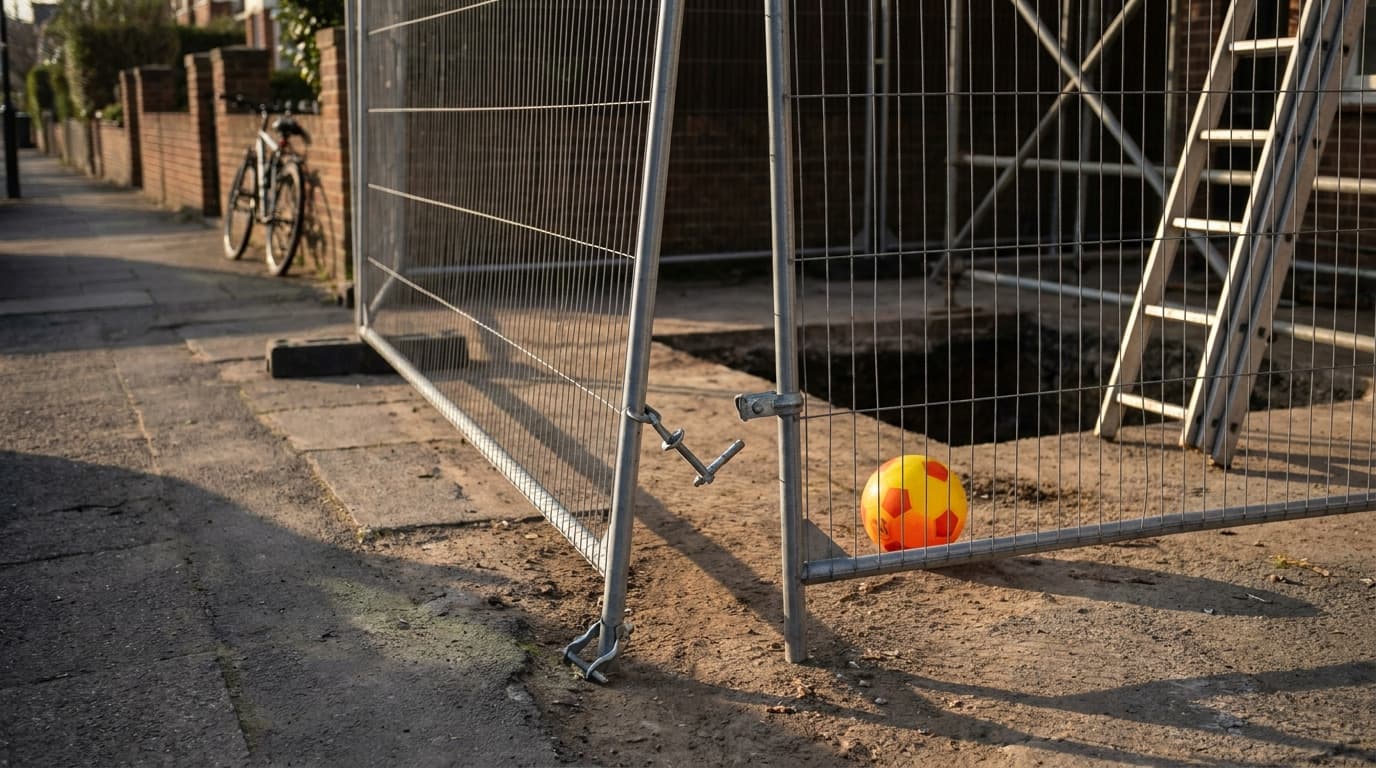
Gates propped open for deliveries and never closed again.
Ladders left in place overnight, giving access to every level.
Keys left in plant, or plant left unlocked and unimmobilised.
Cable and panels opened by thieves, leaving live conductors exposed for the morning shift.
Chemicals and fuel unsecured, available to anyone including children.
No accounting for who is on site, so nobody knows whether the building is empty at the end of the day.
Lone workers staying late with nobody aware.
How do we manage this properly?#
Walk the perimeter, from outside. The gaps are obvious from the street and invisible from within. Do it weekly, and after any delivery that required opening the line.
Close the site down as a task, not a habit. A written end-of-day sequence: ladders removed, scaffold access gated, excavations covered and barricaded, plant immobilised and keys removed, chemicals and fuel locked, temporary power isolated where practicable, materials secured against wind.
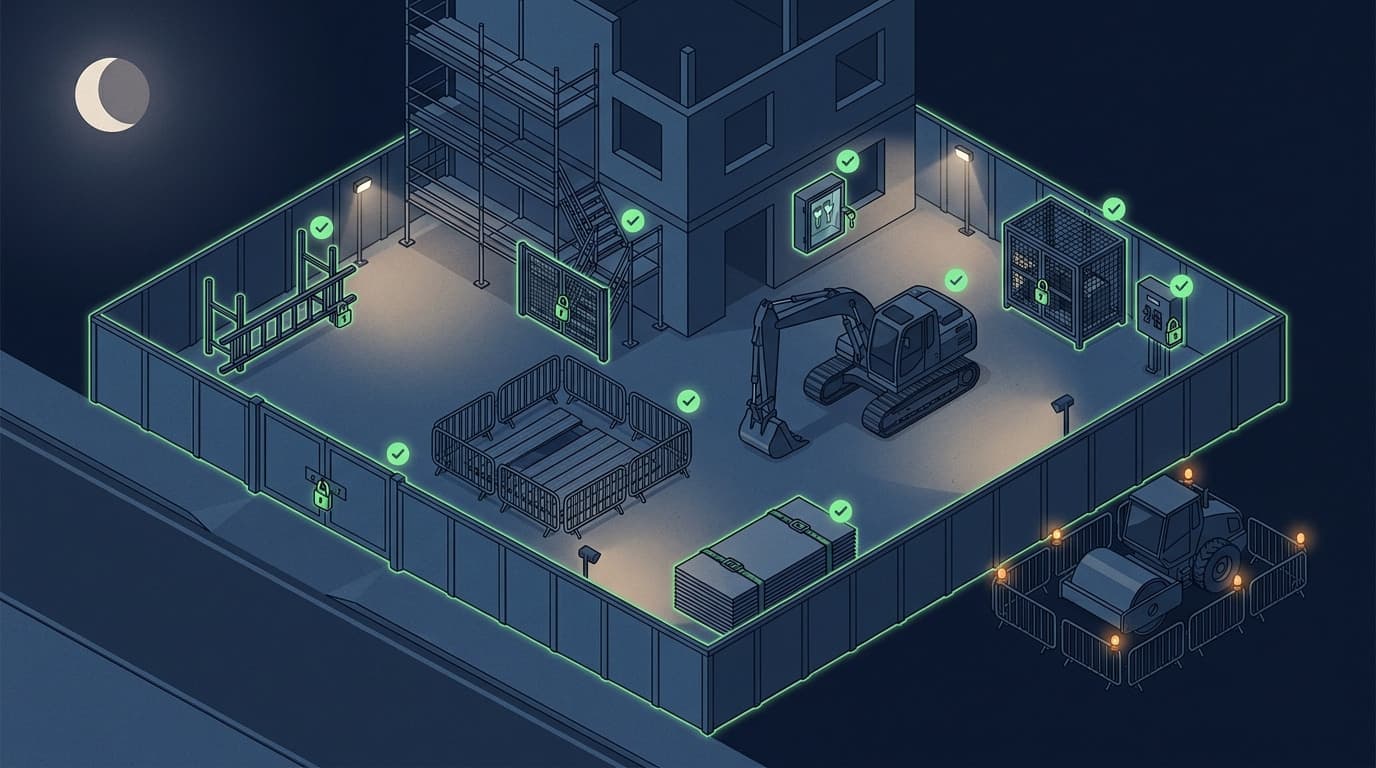
Control access at the gate. Sign-in for everyone, escorted visitors and delivery drivers, and a rule that nobody enters an area they are not inducted for.
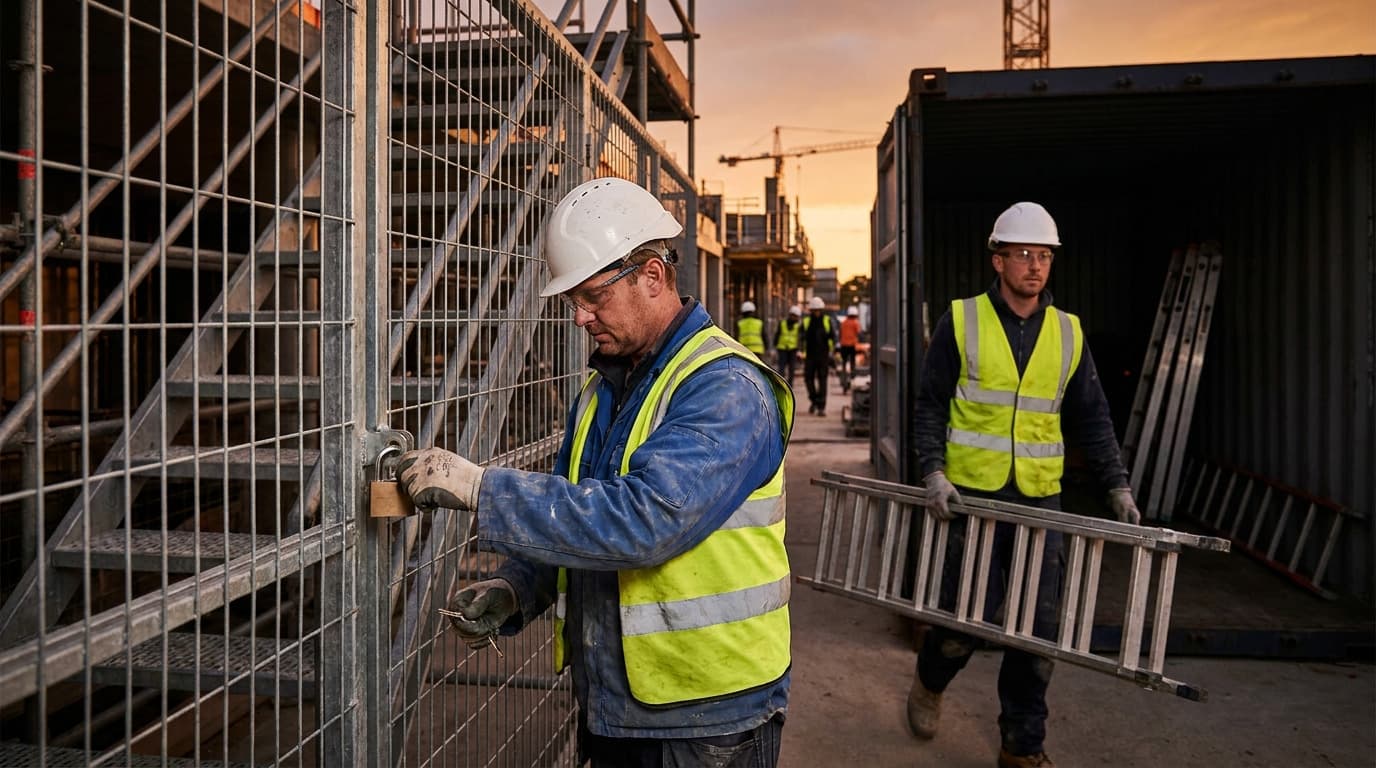
Know who is on site. Then you can answer the only question that matters in an evacuation, and you know whether the site is genuinely empty at the end of the shift.
Treat children as the design case. If your perimeter would not stop a determined ten-year-old, it does not work, whatever it does to your theft figures.
Light what remains a hazard, and mark equipment left adjacent to roads or work areas as 1926.600(a)(1) requires.
Store chemicals and fuel properly and keep site stock low. What is not there cannot be taken, spilled or set alight.
Report and fix breaches immediately. A cut fence found on Monday means the site has been open all weekend, and the first task is to check what changed inside.
Before you start#
- Confirm the perimeter is intact — including from the outside.
- Confirm which gates are open today and who is controlling them.
- Confirm all visitors and delivery drivers are signed in and escorted.
- Confirm nobody is working in an area they have not been inducted for.
- Confirm ladders, plant keys and scaffold access will be secured at the end of the shift.
- Confirm chemicals, fuel and gas cylinders are locked and stock is no more than needed.
- Confirm equipment left overnight beside a road or work area will be lit or barricaded.
- Confirm someone knows who is still on site at the end of the day.
Talk it over#
- Where is the easiest way into this site if you were not supposed to be here?
- What would a child head for first?
- Who was the last unfamiliar person you saw on site, and did anyone ask?
- If you found the fence cut this morning, what would you check first?
The bottom line#
There is no OSHA standard for site security — no perimeter requirement, no security plan, no rule about who may be present. The duty runs through Section 5(a)(1) and its recognised hazards, through local law and contract, and through provisions that are security rules in all but name: 1926.600(a)(1), requiring equipment left unattended at night beside a highway or work area to carry lights, reflectors or barricades; 1926.152 on flammable liquid storage; and 1926.200–203 on signs, signals and barricades. The framing that matters on site is simpler than any of it: every security failure puts an uninducted, unequipped, unsupervised person into a hazardous environment, and the site is at its most dangerous when it is empty — because every control that depends on supervision has gone home. Close the site down as a task, walk the perimeter from outside, and treat children as the design case.
Frequently asked questions about site security#
Does OSHA require construction sites to be fenced?
No. There is no OSHA standard requiring a construction site to be fenced, gated, guarded, lit or monitored, and no perimeter specification. The obligation arises through Section 5(a)(1), the General Duty Clause, where an unsecured site creates a recognised hazard with a feasible means of abatement — and, more directly, through local codes and contract requirements, which usually do specify hoarding.
Why is site security a safety issue rather than a commercial one?
Because of who ends up inside. Every control that keeps a crew safe assumes an inducted, equipped and supervised person. An intruder has none of that: they do not know where the open riser is, they have no hard hat, and nobody knows they are there. Security is what preserves the assumption the rest of the safety system is built on.
What is the most dangerous time on a construction site?
When it is empty. Every hazard managed by supervision during the day — excavations, height, plant, energised temporary power, chemicals — remains in place overnight with nobody watching. That is why an end-of-shift shutdown sequence does more for site security than any amount of daytime vigilance.
What does OSHA require for equipment left overnight?
1926.600(a)(1) requires all equipment left unattended at night, adjacent to a highway in normal use, or adjacent to construction areas where work is in progress, to have appropriate lights or reflectors, or barricades equipped with appropriate lights or reflectors, to identify the location of the equipment.
What is attractive nuisance?
A legal doctrine, not an OSHA rule. It holds that a landowner may be liable for injuries to trespassing children drawn onto the property by something both hazardous and interesting — and construction sites, with machines, ladders, excavations, water and height, are the classic example. Whether and how it applies is a matter of local law, but it is the reason children should be treated as the design case for any perimeter.
What should be secured at the end of the shift?
Access and energy, at minimum: ladders removed and scaffold access gated; excavations and floor openings covered and barricaded; plant immobilised with keys removed; chemicals, fuel and gas cylinders locked; temporary power isolated where practicable; and loose or sheet material secured against wind.
What should happen if the perimeter has been breached?
Treat it as a site condition rather than a theft report. A cut fence found in the morning means the site has been open and unsupervised, so the first task is to check what changed inside — opened panels, stripped cable, removed covers, disturbed excavations, missing guardrails or barricades — before anyone starts work.
Download the site security toolbox talk PDF#
Get this site security toolbox talk as a print-ready PDF — available in English, Spanish, Portuguese, and Turkish. Print it, hand it to the crew, and collect signatures on the included attendance sheet.
Download the PDF — free account required. New members get 3 free downloads.
Related toolbox talks#
Sources#
- OSHA, 29 CFR 1926.600 — Equipment: https://www.osha.gov/laws-regs/regulations/standardnumber/1926/1926.600
- OSHA, 29 CFR 1926.152 — Flammable liquids: https://www.osha.gov/laws-regs/regulations/standardnumber/1926/1926.152
- OSHA, 29 CFR 1926 Subpart G — Signs, Signals, and Barricades: https://www.osha.gov/laws-regs/regulations/standardnumber/1926/1926SubpartG
Written by FieldSafetyTalk's safety professional — a CSP, ASP, CHST and OSHA Authorized Outreach Trainer with 14+ years of international construction safety experience across federal, heavy civil, and industrial projects.