Dry Ice Safety
Updated 2026-08-01
In this bundle Health & Environmental Exposure
Print-ready PDF
Download this talk as a print-ready PDF, available in 4 languages.
Dry ice does not look like a hazardous material. It arrives in a polystyrene box for cooling samples, shipping food, chilling a pipe joint or shrink-fitting a bearing, and everybody handles it with a pair of rigger gloves and a joke about the fog. Then somebody puts the box in a van, or a cold room, or a lift, and closes the door. This Dry Ice Safety Toolbox Talk (Safety Talk / Tailgate Talk) is about what is in the box after it stops being solid.
Here is the distinction that carries this whole talk: carbon dioxide does not just take the place of your air — it makes you breathe harder, so the atmosphere recruits your own lungs to dose you faster. A true simple asphyxiant like nitrogen is silent: it displaces oxygen and your body never objects. Carbon dioxide is the gas your brainstem uses to decide how hard to breathe, so a rising concentration drives your ventilation up. You breathe deeper and faster in exactly the atmosphere where every breath is the problem.
Where the boundary of this talk sits#
Permit-space entry procedure belongs to the confined space talk. Frostbite recognition and first aid — including the long list of things not to do — belong to the cold stress talk. Cylinders and their fittings belong to the compressed gas cylinder talk. And the reason a normal oxygen reading proves nothing is developed in the carbon monoxide talk. This talk owns the sublimation arithmetic, the respiratory drive, and the sealed container.
The arithmetic that should scare you#
Dry ice is solid carbon dioxide. It sublimes at −78.5 °C (−109.3 °F), going straight from solid to gas with no puddle to warn you.
Here is the conversion, and it is worth doing out loud. Carbon dioxide has a molar mass of about 44 g/mol, so one kilogram is roughly 22.7 moles. At room temperature and atmospheric pressure a mole of gas occupies about 24.5 litres. So one kilogram (2.2 lb) of dry ice becomes about 555 litres — over half a cubic metre — of carbon dioxide gas. Solid to gas, that is an expansion of roughly 800 times.
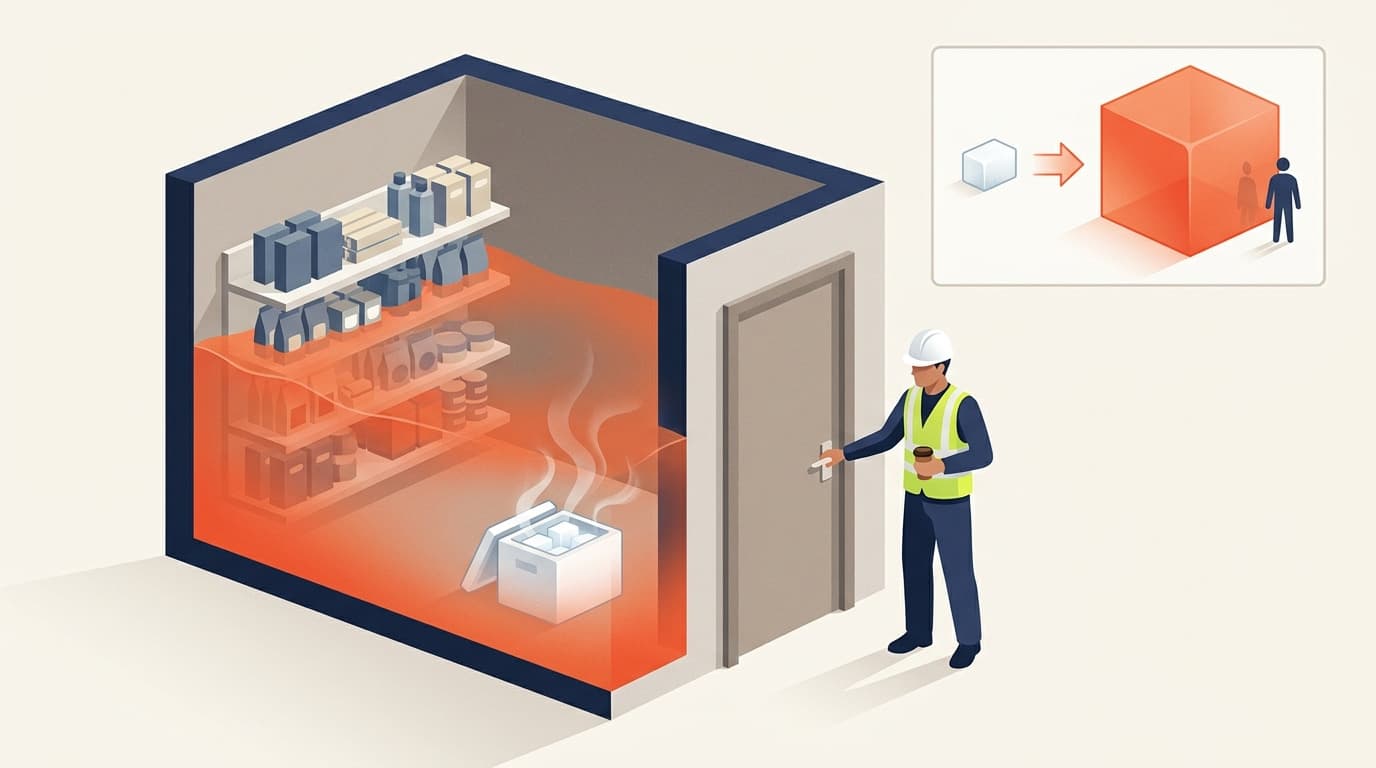
Now put it in a room. A small cold store or site container measuring 3 m × 2 m × 2.5 m is 15 cubic metres. The NIOSH IDLH for carbon dioxide is 40,000 ppm — 4%. Four per cent of 15 cubic metres is 0.6 cubic metres of gas.
That is about 1.1 kg (2.4 lb) of dry ice. Barely more than a kilogram, sublimating quietly in a small enclosed space, is enough to reach a concentration that is immediately dangerous to life or health. A single shipping box holds many times that.
Why the meter on your belt may not save you#
Carbon dioxide is about 1.5 times heavier than air, so it flows downhill and pools — in pits, trenches, basements, walk-in coolers, lift cars, van footwells and the low end of any sloping floor. Testing at the hatch of a low space tells you very little.
And there is a familiar trap. At the IDLH of 4%, carbon dioxide has displaced only 4% of the atmosphere, so oxygen falls from about 20.9% to roughly 20.1%. OSHA's construction definition at 1926.1202 calls an atmosphere oxygen deficient below 19.5 percent by volume. An oxygen sensor in an IDLH carbon dioxide atmosphere still reads normal. The only instrument that helps is one with a carbon dioxide sensor, in calibration and bump tested.
What the gas does to your breathing#
This is the mechanism, and it is what separates carbon dioxide from every other asphyxiant.
Normal outdoor air is about 0.04% carbon dioxide. Your body uses the carbon dioxide level in your blood — not the oxygen level — as the main signal telling the respiratory centre in the brainstem how hard to breathe. Raise the carbon dioxide you are inhaling and that signal rises with it.
The published response runs like this. 1% to 1.5% is tolerated comfortably. There is very little noticeable respiratory stimulation until inhaled carbon dioxide exceeds about 2%. At 3% there are measurable increases in pulmonary ventilation and tidal volume. At 7.5%, studies found respiratory rate and minute volume both doubled over about ten minutes, alongside rising heart rate and blood pressure.
Read the consequence carefully. Doubling your minute volume doubles the rate at which you take the gas in. Symptoms follow the same curve — headache, dizziness, flushing, sweating, confusion, then loss of consciousness. And at extreme concentrations the drive reverses: hypercapnia eventually depresses and abolishes the respiratory centre it was stimulating.
Two practical points fall out of this. Gasping in a carbon dioxide atmosphere is not panic, it is chemistry — do not read it as somebody losing their nerve. And you cannot hold your breath and dash in to grab something, because breath-holding is exactly what a rising carbon dioxide load defeats fastest.
Never in a sealed container#
This one has a clean rule and a clear reason.
The gas has to go somewhere. A consignment of dry ice in a gas-tight vessel can lead to catastrophic failure of the vessel by over-pressurisation. Manufacturer safety data is unambiguous: dry ice should never be stored in a gas-tight container. Use a vented insulated container, every time.
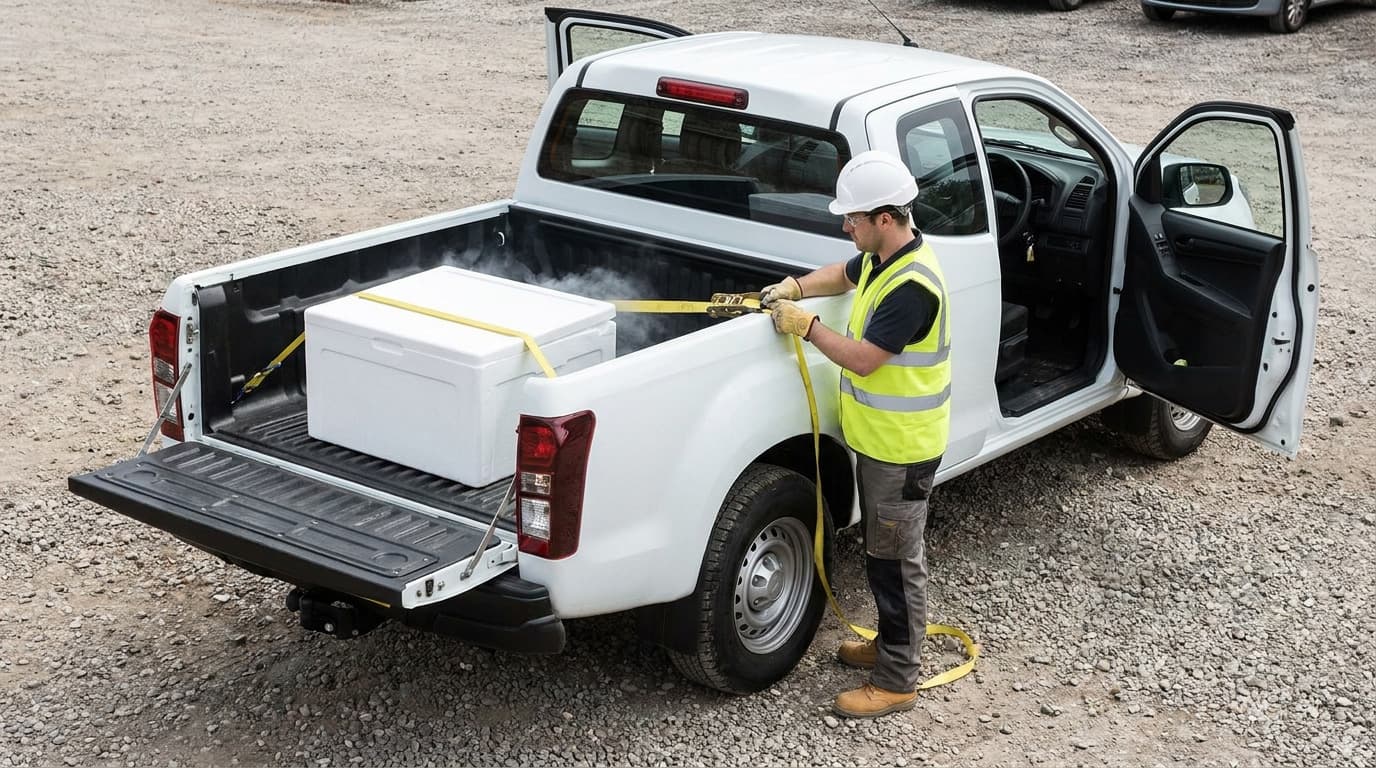
The same logic applies to spaces people are in. Storage containers and equipment for carbon dioxide should not be located in sub-surface or enclosed areas unless the ventilation is engineered to hold the concentration down. That means no dry ice in a closed vehicle cab, no box in a lift car, no chest in an unventilated store. If it is travelling in a vehicle, it goes in a ventilated load space with a window open — not on the passenger seat.
Cold contact#
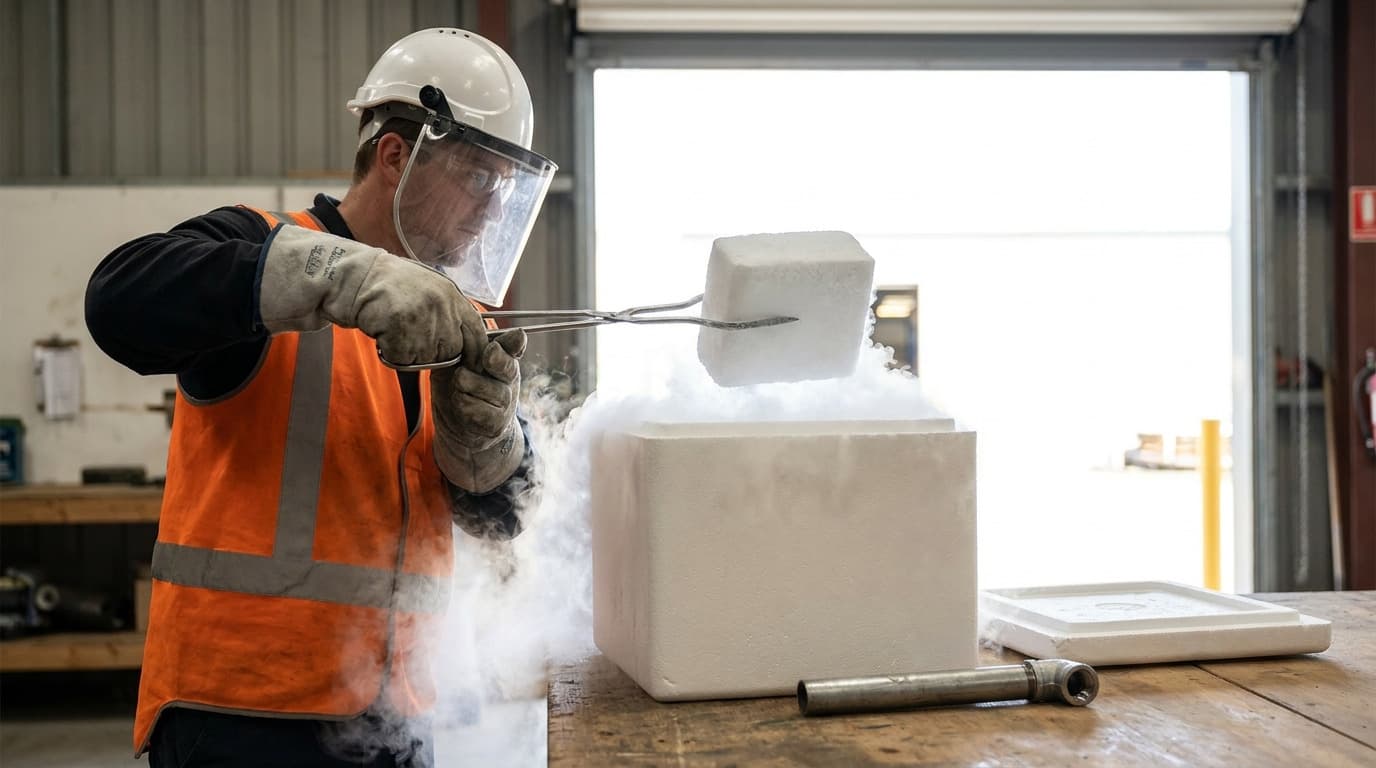
At −78.5 °C (−109.3 °F) dry ice causes rapid cold injury to skin and eyes on contact. Handle with insulated gloves and tongs, never bare hands, and wear eye protection when breaking or crushing it, because chips carry the same temperature. Recognition and first aid for cold injury are covered in the cold stress talk — the important addition here is that people underestimate dry ice specifically, because it does not feel wet and does not look like a burn hazard.
Where the duty sits#
There is no OSHA standard specific to dry ice. State that plainly rather than implying one.
The exposure limit applies through 1926.55 and 1910.1000 Table Z-1: the OSHA PEL for carbon dioxide is 5,000 ppm as an 8-hour TWA. NIOSH recommends the same 5,000 ppm TWA plus a 30,000 ppm 15-minute short-term limit, and the ACGIH threshold limit value matches — 5,000 ppm TWA, 30,000 ppm STEL. NIOSH and ACGIH are consensus standards, not OSHA rules. The IDLH is 40,000 ppm.
1926.55 also sets the order: engineering and administrative controls first wherever feasible. For dry ice that means ventilation and quantity control, not respirators — and note that an air-purifying respirator does nothing against carbon dioxide. 1926.1202 and Subpart AA govern any space that meets the confined space definition, and 1926.21(b)(2) requires the employer to instruct employees in recognising and avoiding these conditions. Where nothing specific reaches the hazard, Section 5(a)(1) still applies.
What can go wrong?#
Putting dry ice in a closed vehicle cab and driving with the windows up.
Storing a box in a walk-in cooler, container or store with no ventilation, so the first person in next morning walks into it.
Sealing dry ice in an airtight container, which over-pressurises and ruptures.
Clearing a space using an oxygen reading, when nothing measured carbon dioxide.
Testing at the top of a pit or hatch, when the gas has pooled at the bottom.
Reading a workmate's gasping as panic rather than as the atmosphere acting on them.
Holding your breath to dash in and retrieve something from a space you know is full.
Handling it bare-handed, or crushing it without eye protection.
How do we manage this properly?#
Order and keep only the quantity you need, because the hazard is directly proportional to mass.
Use vented insulated containers only — never anything gas-tight.
Store and transport in ventilated spaces, never in a cab, lift car, closed van or unventilated room.
Monitor with a carbon dioxide sensor where any quantity is held in an enclosed area, calibrated and bump tested, and test at the low point.
Ventilate mechanically and confirm with the meter, not by how the space feels.
Treat any space holding dry ice as a potential confined space and apply the entry procedure.
Handle with insulated gloves, tongs and eye protection, and never with bare hands.
On any collapse, do not enter. Raise the alarm, ventilate from outside and follow the rescue plan — the space that dropped one person will drop you.
Get anyone with headache, dizziness, breathlessness or confusion into fresh air and to medical assessment, and say that carbon dioxide exposure is suspected.
Before you start#
- Confirm how much dry ice is coming, and whether a smaller quantity would do.
- Confirm the container is vented and not gas-tight.
- Confirm where it will be stored and that the space is ventilated.
- Confirm how it will be transported and that no one shares a sealed cab with it.
- Confirm your monitor has a carbon dioxide sensor, is calibrated and bump tested.
- Confirm any low space will be tested at working depth before entry.
- Confirm insulated gloves, tongs and eye protection are on site.
- Confirm everyone knows nobody enters after a collapse without a rescue plan.
Talk it over#
- Where is the dry ice going to sit overnight, and who opens that door first tomorrow?
- How would we get it to the work face without anyone sharing a closed space with it?
- If somebody came out of the cold store breathless and confused, what would we do?
- Which low spots in our work area would hold this gas?
The bottom line#
Carbon dioxide does not just take the place of your air — it makes you breathe harder, so the atmosphere recruits your own lungs to dose you faster. Unlike nitrogen, a silent simple asphyxiant, carbon dioxide is the signal your brainstem uses to set your breathing: normal air is 0.04%, 1–1.5% is tolerated comfortably, there is little respiratory stimulation until about 2%, at 3% there are measurable increases in ventilation and tidal volume, and at 7.5% studies found respiratory rate and minute volume both doubled in about ten minutes — doubling the rate at which you take it in — before extreme hypercapnia finally depresses and abolishes the drive. So gasping is chemistry, not panic, and breath-holding is the wrong plan. The scale is the other half: dry ice sublimes at −78.5 °C (−109.3 °F), and one kilogram (2.2 lb) becomes about 555 litres of gas — over half a cubic metre, roughly 800 times its solid volume. In a 15 m³ cold store or container, reaching the IDLH of 40,000 ppm (4%) takes only about 1.1 kg (2.4 lb) of sublimed dry ice. The gas is about 1.5 times heavier than air and pools low, so test at working depth — and note that at 4% carbon dioxide, oxygen only falls from 20.9% to about 20.1%, still well above OSHA's 19.5% oxygen-deficiency line at 1926.1202, so an oxygen sensor reads an IDLH atmosphere as normal. Measure carbon dioxide specifically. Never store dry ice in a gas-tight container — a sealed consignment can cause catastrophic failure of the vessel by over-pressurisation — and never in a closed cab, lift car or unventilated room. At −78.5 °C it causes rapid cold injury to skin and eyes; use insulated gloves, tongs and eye protection. There is no OSHA standard specific to dry ice: the PEL for carbon dioxide is 5,000 ppm 8-hour TWA (1910.1000 Table Z-1 via 1926.55), with NIOSH and ACGIH both at 5,000 ppm TWA and a 30,000 ppm STEL — consensus, not OSHA — and 1926.55 requires controls before PPE, which matters because an air-purifying respirator does nothing against carbon dioxide.
Frequently asked questions about dry ice#
How much gas does dry ice actually make?
Far more than people expect. Carbon dioxide has a molar mass of about 44 g/mol, so one kilogram (2.2 lb) of dry ice is roughly 22.7 moles, and at room temperature and pressure that is about 555 litres — over half a cubic metre of gas, an expansion of roughly 800 times its solid volume. In a 15 m³ cold room, about 1.1 kg (2.4 lb) sublimating is enough to reach the IDLH of 40,000 ppm (4%).
Will my gas monitor detect it?
Only if it has a carbon dioxide sensor. An oxygen sensor will not warn you in time: at the IDLH of 4% carbon dioxide, oxygen has fallen only from about 20.9% to 20.1%, still comfortably above the 19.5% oxygen-deficiency threshold in 1926.1202. Check what your instrument measures, that it is calibrated and bump tested, and test at the low point because the gas is heavier than air.
Why is carbon dioxide different from other asphyxiants?
Because it is not just displacing your air — it is actively driving your breathing. Your respiratory centre uses blood carbon dioxide to set how hard you breathe, so a rising concentration increases your ventilation: at 7.5% studies recorded respiratory rate and minute volume doubling in about ten minutes. That doubles your intake rate. Nitrogen, by contrast, produces no such signal at all — it is silent.
Can I hold my breath and go in quickly to get something?
No, and this is one of the most dangerous beliefs about the gas. A rising carbon dioxide load is precisely what defeats breath-holding fastest, because the urge to breathe is driven by carbon dioxide, not by lack of oxygen. You will breathe, and you will breathe harder than normal. Ventilate the space and measure it instead.
Why can't dry ice go in a sealed container?
Because the gas has nowhere to go. As the solid sublimes it generates a very large gas volume, and a consignment of dry ice in a gas-tight vessel can lead to catastrophic failure of the vessel by over-pressurisation. Safety data for the product is explicit that dry ice should never be stored in a gas-tight container. Always use a vented insulated container.
Is it safe to carry dry ice in a vehicle?
Only in a ventilated load space, never in a closed cab with people. Carbon dioxide is heavier than air and pools in footwells, and a vehicle interior is a small enclosed volume — the arithmetic above applies with a much smaller room. Guidance for carbon dioxide equipment and storage is that it should not be located in sub-surface or enclosed areas unless ventilation is engineered to keep the concentration down.
What protects a worker from carbon dioxide — will a respirator do it?
An air-purifying respirator does nothing against carbon dioxide. Cartridges and dust masks are irrelevant here. 1926.55 sets the correct order anyway: engineering and administrative controls first wherever feasible, meaning ventilation, quantity control and keeping the material out of occupied enclosed spaces. Where protection is genuinely needed it means supplied air or SCBA, which is planned work, not an improvised response.
Download the dry ice toolbox talk PDF#
Get this dry ice safety toolbox talk as a print-ready PDF — available in English, Spanish, Portuguese, and Turkish. Print it, hand it to the crew, and collect signatures on the included attendance sheet.
Download the PDF — free account required. New members get 3 free downloads.
Related toolbox talks#
Sources#
- NIOSH, Pocket Guide to Chemical Hazards — Carbon Dioxide: https://www.cdc.gov/niosh/npg/
- EPA, Appendix B — Overview of Acute Health Effects of Carbon Dioxide: https://www.epa.gov/sites/default/files/2015-06/documents/co2appendixb.pdf
- OSHA, 29 CFR 1926.1202 — Definitions, Confined Spaces in Construction: https://www.osha.gov/laws-regs/regulations/standardnumber/1926/1926.1202
This talk is general awareness guidance for training purposes. It is not medical advice and nothing in it is a diagnosis. Anyone with a suspected carbon dioxide exposure or cold injury should be moved to fresh air and assessed by a qualified medical professional, who should be told that carbon dioxide exposure is suspected.
Written by FieldSafetyTalk's safety professional — a CSP, ASP, CHST and OSHA Authorized Outreach Trainer with 14+ years of international construction safety experience across federal, heavy civil, and industrial projects.