Laser Safety
Updated 2026-08-06
In this bundle Health & Environmental Exposure
Print-ready PDF
Download this talk as a print-ready PDF, available in 4 languages.
Construction runs on lasers now — the rotary laser setting grade across a slab, the line laser squaring a wall, the alignment laser down a pipe run. They are so ordinary and so low-powered that they get treated like flashlights, and most of the time that casual treatment is fine, because a construction laser really is designed to be safe under normal use. But "safe under normal use" hides the actual mechanism, and understanding that mechanism is what tells you which uncommon situations are genuinely dangerous. The beam does not hurt you when you catch it across the eye for a fraction of a second — and the reason it doesn't is not that the beam is harmless. This Laser Safety Toolbox Talk (Safety Talk / Tailgate Talk) is about that reason, because everything dangerous about a construction laser is a way of defeating it.
Here is the distinction that carries this whole talk: a construction laser is safe because your eye protects itself — the quarter-second blink reflex limits the exposure before it can hurt you, which means the real hazard isn't the beam, it's anything that beats the blink: staring into it, or looking at it through a scope or binoculars that concentrate it faster than you can flinch. Most construction lasers are Class 2 or Class 3R — under five milliwatts — and their safety rating is built on the aversion response: when a bright beam hits your eye, you blink and turn away in about a quarter of a second, and that is fast enough to keep a low-power beam from injuring the retina. The rating assumes that reflex works. So the hazards are the situations where it can't: when you override it by staring on purpose, and when an optical instrument gathers the beam and delivers a full dose in the instant before you can blink. The beam didn't get stronger; your protection got bypassed.
Where the boundary of this talk sits#
The eye and face protection talk owns PPE for the eyes in general — safety glasses, face shields, the impact and splash hazards. The eye strain talk owns fatigue from screens and close work. This talk owns the laser specifically: why a low-power construction laser is safe by way of the blink reflex, the two ways that protection gets defeated, and where the rules require real laser eye protection and a qualified operator. Where the question is general eye PPE, that is the eye and face protection talk; this one owns the laser as its own distinct hazard.
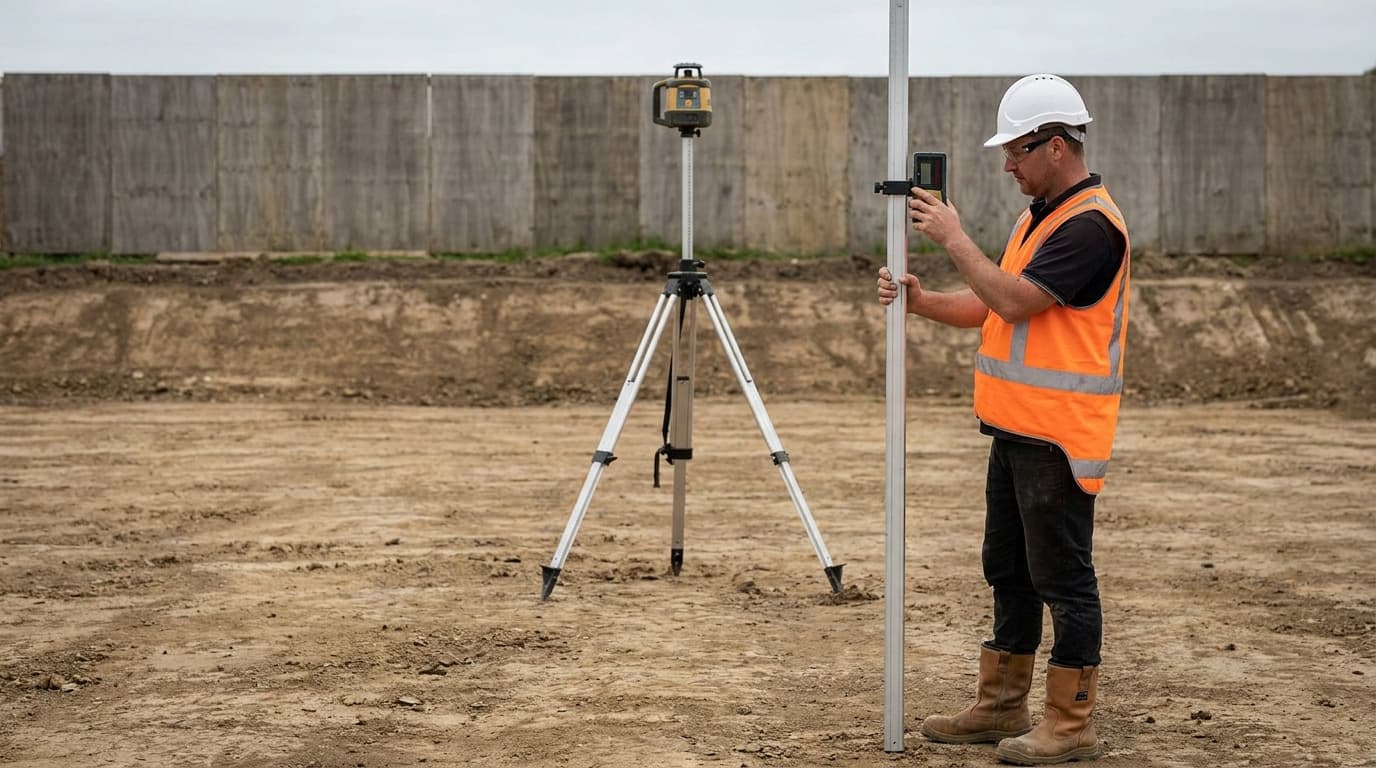
Why the blink reflex is the whole safety case#
A Class 2 laser puts out less than one milliwatt; a Class 3R laser, one to five. Those classes are rated safe for accidental exposure, and the rating rests on a single physiological fact: the aversion response. When a visible beam of that power enters your eye, the natural blink-and-turn-away happens in roughly a quarter of a second, and for a beam under five milliwatts that is quick enough that the retina does not accumulate a damaging dose. This is why glancing across a construction laser during setup does not hurt you, and why these lasers can be used on busy job sites without everyone wearing goggles. But notice what the safety case depends on: it depends on the reflex firing and on nothing concentrating the beam. Remove either of those conditions and the rating no longer describes your situation. The laser is safe the way a guardrail is safe — as long as you don't climb over it.
Defeating the blink, part one: staring#
The first way to beat the reflex is the simplest: override it. If you deliberately hold your gaze on the beam — staring at the dot to check alignment, following the line to see where it lands, showing someone "look, it's right there" — you are consciously suppressing the aversion response that the safety rating assumes. The longer the retina is exposed, the more energy it absorbs, and a Class 2 or 3R beam that is completely safe for a quarter-second glance can begin to cause harm when you force yourself to look at it for seconds. This is why the oldest rule in laser work still holds: never look directly into the beam or the aperture, and never point a laser at anyone's eyes, even a low-power one, even as a joke. The reflex only protects you if you let it work.
Defeating the blink, part two: optical aids#
The second way is the one that catches trained people, because it is not obvious. An optical instrument — a transit or level scope, binoculars, a camera lens, a rifle-style spotting scope — gathers light over its whole front lens and focuses it down, and when what it gathers is a laser beam, it concentrates that beam onto your retina far more intensely than your naked eye ever would. Looking at a construction laser through magnifying optics can deliver, in the instant before you blink, a dose that the beam could never have delivered on its own. This is the crucial point that "it's only a Class 2" misses: the class rating describes the beam meeting a naked eye with a working blink reflex. Put an optical aid in the path and you have changed the exposure entirely. The rule is direct — never view a laser beam, of any class, through binoculars, a scope, or any magnifying optic — and it matters most for exactly the trades that use both lasers and optical instruments, like survey and layout.
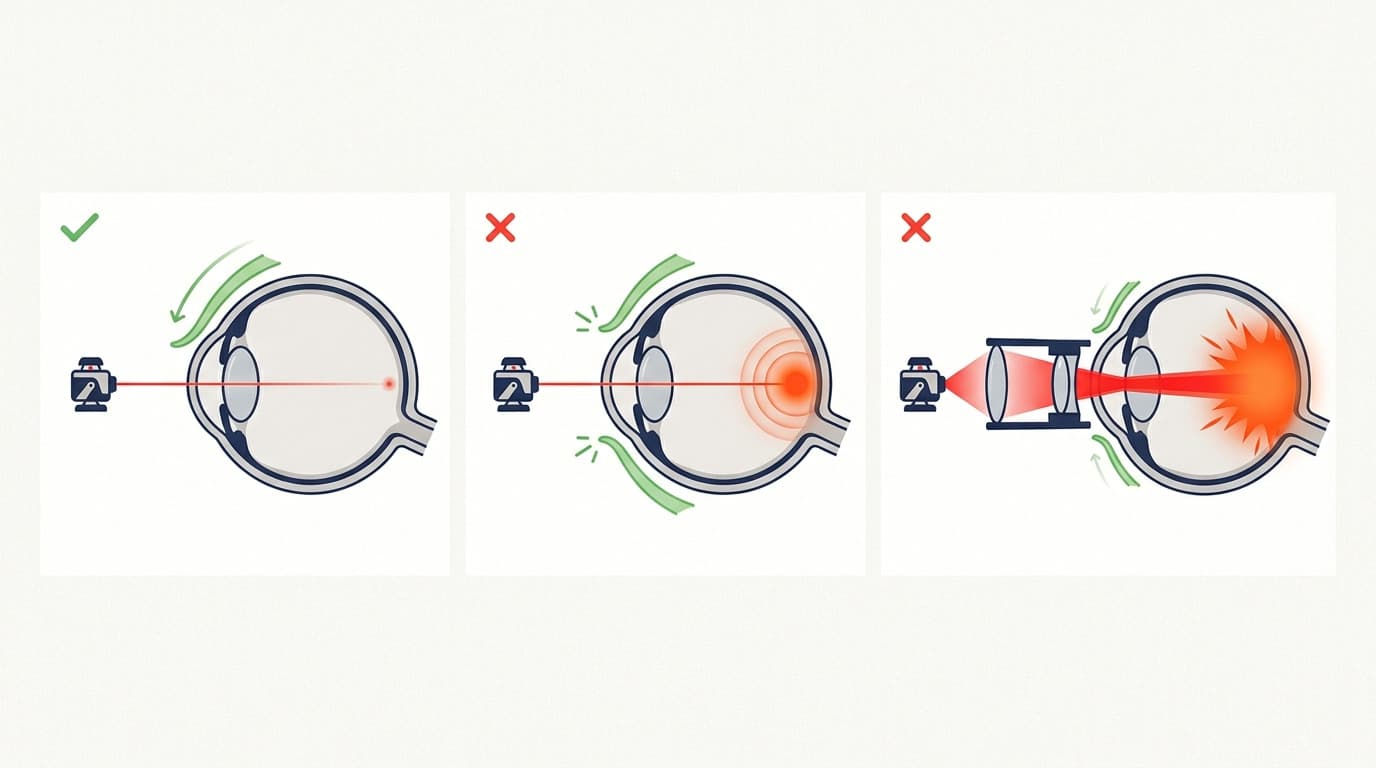
Where OSHA draws the line: five milliwatts#
The regulation puts a hard number on all of this. OSHA's construction laser rule requires that where employees have potential exposure to direct or reflected laser light greater than five milliwatts, they be provided with antilaser eye protection — real laser goggles matched to the beam, not general safety glasses. Below that threshold, the blink reflex is doing the protecting and the rules are about not defeating it; at or above it, the beam can outrun the reflex and eye protection becomes mandatory. Two more requirements sit alongside it: only qualified and trained employees may install, adjust, and operate laser equipment, and the operator's proof of qualification has to be on them at all times — a laser is not a grab-any-hand tool. Areas where lasers are used must be posted with laser warning placards. And the beam must be shut off or capped when transmission isn't actually needed, and turned off entirely when the laser is left unattended — over lunch, overnight, or at shift change — so a live beam is never crossing a site with nobody minding it.
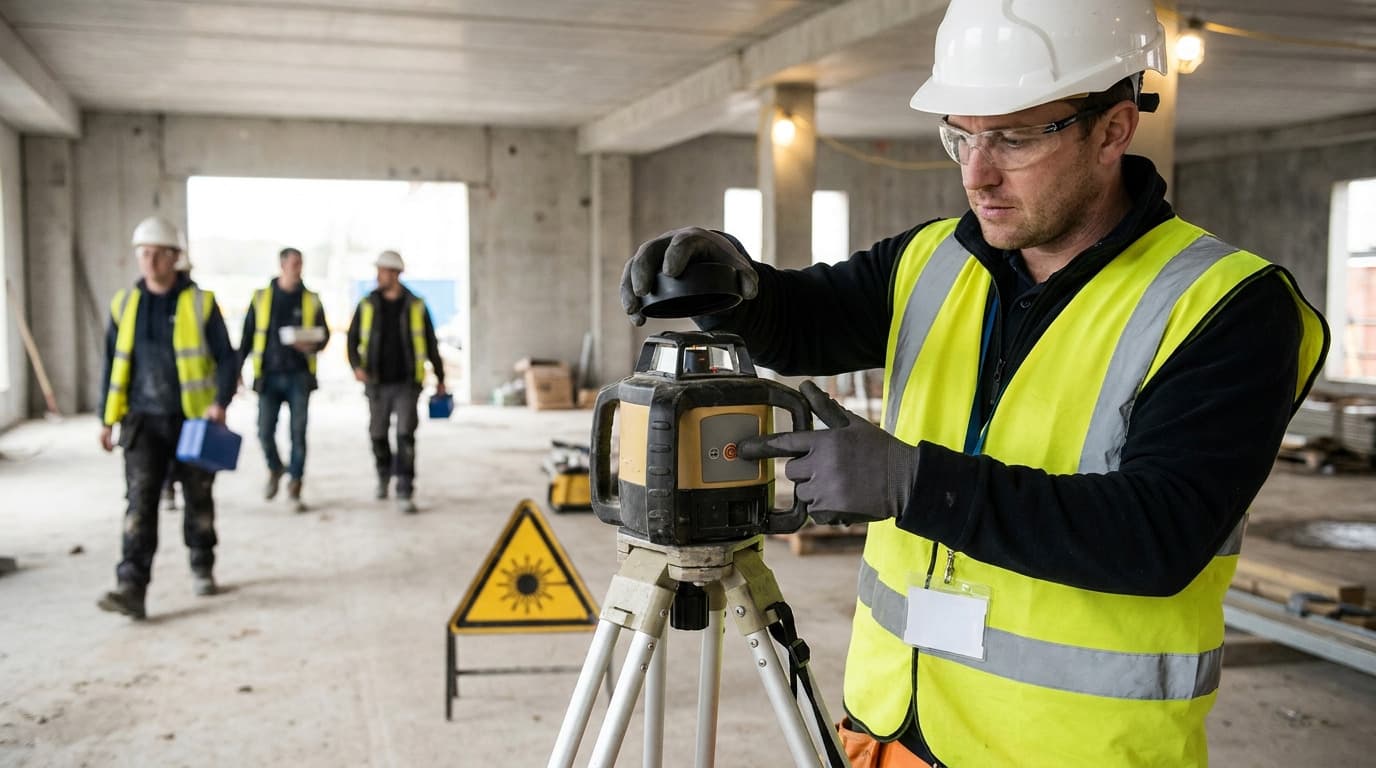
The reflected beam counts too#
One detail in that rule is easy to miss and worth pulling out: the five-milliwatt threshold applies to direct or reflected laser light. A construction laser aimed at a shiny surface — polished metal, glass, a mirror-finished panel, even wet concrete at the right angle — can bounce a beam in a direction nobody intended, and a specular reflection can carry enough of the beam's power to matter. This is why beam paths should be planned to terminate on a dull, non-reflective surface, why you check what is behind and around your target before you power up, and why a laser set at eye level across a floor is a particular concern — the beam and the reflections travel at the height of people's eyes. Controlling where the beam ends is as much a part of laser safety as controlling where it starts.
Where the duty sits#
The construction laser requirements live in 1926.54, the nonionizing radiation standard: qualified and trained operators only, proof of qualification carried at all times, antilaser eye protection where exposure exceeds five milliwatts, warning placards posted, and the beam shut off or capped when not in use and turned off when unattended. It is worth being precise that OSHA does not have a comprehensive laser standard — its own technical guidance says so — and that 1926.54 is the construction rule, with the PPE requirements of Subpart E filling in the eye protection. The consensus standard that fills the technical detail is ANSI Z136.1, which defines the laser classes and the controls for each, and which is where the class ratings on your equipment come from. The general duties to train workers and protect against recognized hazards run through 1926.21(b)(2) and the General Duty Clause, Section 5(a)(1). And the manufacturer's classification and instructions on the specific laser govern its safe use.
What can go wrong?#
- A worker stares at the beam to check alignment and overrides the reflex that keeps it safe.
- Someone views a construction laser through a level scope or binoculars, concentrating it onto the retina.
- A laser above five milliwatts is used without antilaser eye protection.
- The beam reflects off polished metal, glass, or wet concrete into someone's eyes.
- An untrained worker sets up or operates the laser with no proof of qualification.
- The laser is left running and unattended over lunch or overnight, beam live across the site.
- A low-power laser is pointed at someone's eyes "as a joke."
- A beam set at eye level crosses a work area with no thought to where it terminates.
How do we manage this properly?#
- Understand the beam is safe because of the blink reflex — never defeat it.
- Never stare into the beam or aperture, and never point a laser at anyone's eyes.
- Never view a laser through optics — binoculars, a scope, a camera — of any class.
- Where exposure could exceed five milliwatts, wear antilaser eye protection matched to the beam.
- Only qualified, trained operators set up and run lasers — proof of qualification on them.
- Post laser warning placards where lasers are in use.
- Shut off or cap the beam when it's not needed; turn it off when unattended.
- Plan the beam path to terminate on a dull surface; watch for reflective surfaces.
Before you start#
- Confirm you know the laser's class and have read its instructions.
- Confirm the operator is qualified and trained, with proof available.
- Confirm whether exposure could exceed five milliwatts — and if so, that laser eye protection is on hand.
- Confirm no one will need to view the beam through a scope or optical instrument.
- Confirm the beam path is planned to end on a dull, non-reflective surface.
- Confirm there are no polished or wet surfaces that could reflect the beam at eye level.
- Confirm warning placards are posted where the laser is used.
- Confirm the plan for shutting the beam off when it's not needed or unattended.
Talk it over#
- Does everyone here know what class the lasers on this site are, and what that means?
- Has anyone ever caught themselves staring at a laser dot to line something up?
- If you're running a level or transit near a laser, how do you keep the beam out of the scope?
- Where does our laser's beam actually end — and what's it reflecting off along the way?
The bottom line#
A construction laser is safe because your eye protects itself — the quarter-second blink reflex limits the exposure before it can hurt you, which means the real hazard isn't the beam, it's anything that beats the blink: staring into it, or looking at it through a scope or binoculars that concentrate it faster than you can flinch. Class 2 and Class 3R construction lasers — under five milliwatts — are rated safe on the strength of the aversion response, and that rating assumes the reflex fires and nothing concentrates the beam. Both assumptions can be broken: staring overrides the reflex and lets the retina accumulate a dose, and an optical aid — a level scope, binoculars, a camera — gathers and focuses the beam to deliver in an instant what your naked eye and blink would have stopped, which is exactly why "it's only a Class 2" is not the end of the risk assessment. OSHA draws the hard line at five milliwatts under 1926.54: below it, protect the blink reflex by never staring, never pointing it at eyes, and never viewing it through optics; at or above it, antilaser eye protection is mandatory, and either way only a qualified operator with proof of qualification in hand may run the laser, placards must be posted, and the beam must be capped or shut off when not needed and off when unattended. Remember the threshold counts reflected light too, so plan where the beam ends. OSHA has no comprehensive laser standard — 1926.54 plus ANSI Z136.1 carry it. The test is one question: is anything on this setup defeating the blink reflex the safety rating depends on — a stare, a scope, a reflection, or a beam left live and unminded?
Frequently asked questions about laser safety#
If construction lasers are low-power, why are they a hazard at all?
Because their safety depends on a reflex that can be defeated. A Class 2 or Class 3R construction laser is under five milliwatts and is rated safe for accidental exposure — but that rating rests entirely on the aversion response, the blink-and-turn-away that happens in about a quarter of a second and limits how much energy the retina absorbs. The beam itself is not harmless; it is that your eye normally protects itself before harm accumulates. So the hazard is any situation where that protection doesn't work: staring into the beam on purpose, or viewing it through an optical aid that concentrates it. The low power is real, but it is only safe within the assumptions of the rating.
Why is looking at a laser through a scope or binoculars so dangerous?
Because optics gather the beam over a wide lens and focus it down, delivering far more of the beam's energy to your retina than your naked eye would receive. A construction laser that is safe to glance at with the naked eye — because the blink reflex limits the dose — can cause injury when viewed through a level scope, binoculars, or a camera lens, because the optic concentrates the beam and delivers the dose in the instant before you can blink. The class rating describes the beam meeting an unaided eye; an optical aid changes the exposure completely. The rule is never to view a laser beam of any class through magnifying optics, and it matters most for survey and layout crews who use lasers and scopes side by side.
What does the five-milliwatt threshold mean?
It is the line in OSHA's construction laser rule where antilaser eye protection becomes mandatory. Where employees have potential exposure to direct or reflected laser light greater than five milliwatts (0.005 watts), they must be provided with antilaser eye protection — laser goggles matched to the beam's wavelength, not ordinary safety glasses. Below that threshold, the blink reflex is the protection and the rules focus on not defeating it. At or above it, the beam can deliver a damaging dose faster than the reflex can respond, so eye protection is required. Note that the threshold counts reflected light too, not just the direct beam.
Who is allowed to operate a construction laser?
Only qualified and trained employees, and OSHA requires the operator's proof of qualification to be on them at all times. A laser is not a tool anyone can pick up and point — setting it up, adjusting it, and operating it call for someone who understands its class, its hazards, and its controls. This pairs with the other operational rules: areas where lasers are in use must be posted with warning placards, the beam must be capped or shut off when transmission is not actually needed, and the laser must be turned off entirely when it is left unattended, such as over lunch, overnight, or at shift change, so a live beam is never crossing the site with no one minding it.
Do I need special eye protection for every laser?
No — and this is where the class and the threshold matter. For a typical Class 2 or Class 3R construction laser used normally, below five milliwatts, the blink reflex is your protection and no special laser goggles are required; the safety comes from not defeating the reflex. Antilaser eye protection becomes mandatory where exposure could exceed five milliwatts, and when it is required it must be matched to the specific beam, because laser goggles are wavelength-specific — the wrong pair can be useless. General safety glasses are not laser eye protection. So the answer depends on the laser's class and power: know which you have, and provide real laser eye protection where the rule requires it.
How is this different from the general eye protection talk?
The general eye and face protection talk covers protecting the eyes from impact, dust, splash, and flying debris — the hazards safety glasses and face shields are built for. This talk covers a hazard those cannot address: a laser beam, which injures by delivering light energy to the retina, and which is governed by its own rules and its own kind of eye protection. Ordinary safety glasses do nothing against a laser; laser eye protection is specific to the beam's wavelength. The laser is a distinct hazard with a distinct safety mechanism — the blink reflex and the five-milliwatt line — which is why it gets its own talk rather than folding into general eye PPE.
Download the laser safety toolbox talk PDF#
Get this laser safety toolbox talk as a print-ready PDF — available in English, Spanish, Portuguese, and Turkish. Print it, hand it to the crew, and collect signatures on the included attendance sheet.
Download the PDF — free account required. New members get 3 free downloads.
Related toolbox talks#
Sources#
- OSHA, Nonionizing radiation — 29 CFR 1926.54 (only qualified and trained employees may install, adjust, and operate laser equipment, with proof of qualification carried at all times; antilaser eye protection where potential exposure to direct or reflected laser light exceeds 0.005 watts / 5 milliwatts; warning placards posted; beam shut off or capped when not required and turned off when unattended): https://www.osha.gov/laws-regs/regulations/standardnumber/1926/1926.54
- OSHA, Technical Manual (OTM) Section III, Chapter 6 — Laser Hazards (OSHA does not have a comprehensive laser standard; 29 CFR 1926.54 is applicable to construction, and PPE requirements may apply): https://www.osha.gov/otm/section-3-health-hazards/chapter-6
- ANSI/LIA, Z136.1 Safe Use of Lasers (defines the laser hazard classes — Class 1 through Class 4 — and the control measures for each; the basis for the class ratings on construction laser equipment): https://www.lia.org/resources/laser-safety-information/laser-safety-standards/ansi-z136-standards
This talk is general awareness guidance for training purposes. It does not replace your employer's laser safety program, OSHA's nonionizing radiation standard, the OSH Act General Duty Clause, ANSI Z136.1, the laser manufacturer's classification and instructions, or a competent person's duties, and it is not legal advice. Where a manufacturer's instruction or a site laser procedure sets a specific requirement, that requirement governs.
Written by FieldSafetyTalk's safety professional — a CSP, ASP, CHST and OSHA Authorized Outreach Trainer with 14+ years of international construction safety experience across federal, heavy civil, and industrial projects.