Glazing & Glass Handling
Updated 2026-08-05
In this bundle Manual Handling & Body Mechanics
Print-ready PDF
Download this talk as a print-ready PDF, available in 4 languages.
Glass gets treated on site as a fragile object that is fine as long as you do not drop it. That model is wrong in a way that matters, because it says the danger is the moment of impact and nothing else. In practice the lite that hurts somebody is usually one that was damaged days earlier by someone who felt nothing happen. This Glazing & Glass Handling Toolbox Talk (Safety Talk / Tailgate Talk) is about the gap between the two.
Here is the distinction that carries this whole talk: glass does not fail where you hit it — it fails from a flaw you cannot see, and handling is what puts the flaw there. The tensile strength of a glass plate is governed by micro-defects and scratches induced during production, transport and handling, not by the bulk material, and edge strength depends on the quality of the edge finish. So a nick taken on Tuesday can be the origin of a break on Friday, or after installation. The damage and the failure are separated in time, which is exactly why nobody connects them.
Where the boundary of this talk sits#
Cut injury mechanics, glove cut levels and ANSI/ISEA 105 belong to the hand injuries talk. Lifting technique, team lifts and the NIOSH equation belong to the manual handling talks. Stacking geometry and securing stored material under 1926.250 belong to the piling and shelving talk. Eye and face protection selection under 1926.102 belongs to that talk. This talk owns the material: how glass fails, what handling does to it, and what that means before it goes in the frame.
Why the edge is the whole story#
Glass has no ductility. It cannot yield locally to relieve a stress concentration the way steel does, so every flaw stays a flaw and the plate fails when tension at some defect reaches the limit.
That is why the edge dominates. Edges carry both the highest tensile stresses in bending and the highest concentration of handling damage — chips, nips, shells, scratches from being set down on grit. Published analysis of glass plate failure treats edge strength as materially lower than the general surface strength, on the order of 80 per cent of the given tensile strength, precisely because of edge finish quality and handling damage.
Two consequences follow, and both change what the crew does.
A chipped edge is not cosmetic. It is a rejection criterion. A lite with edge damage is weaker for the whole of its service life, and the failure will happen later, under wind load or thermal movement or frame movement, with nobody present who remembers the chip.
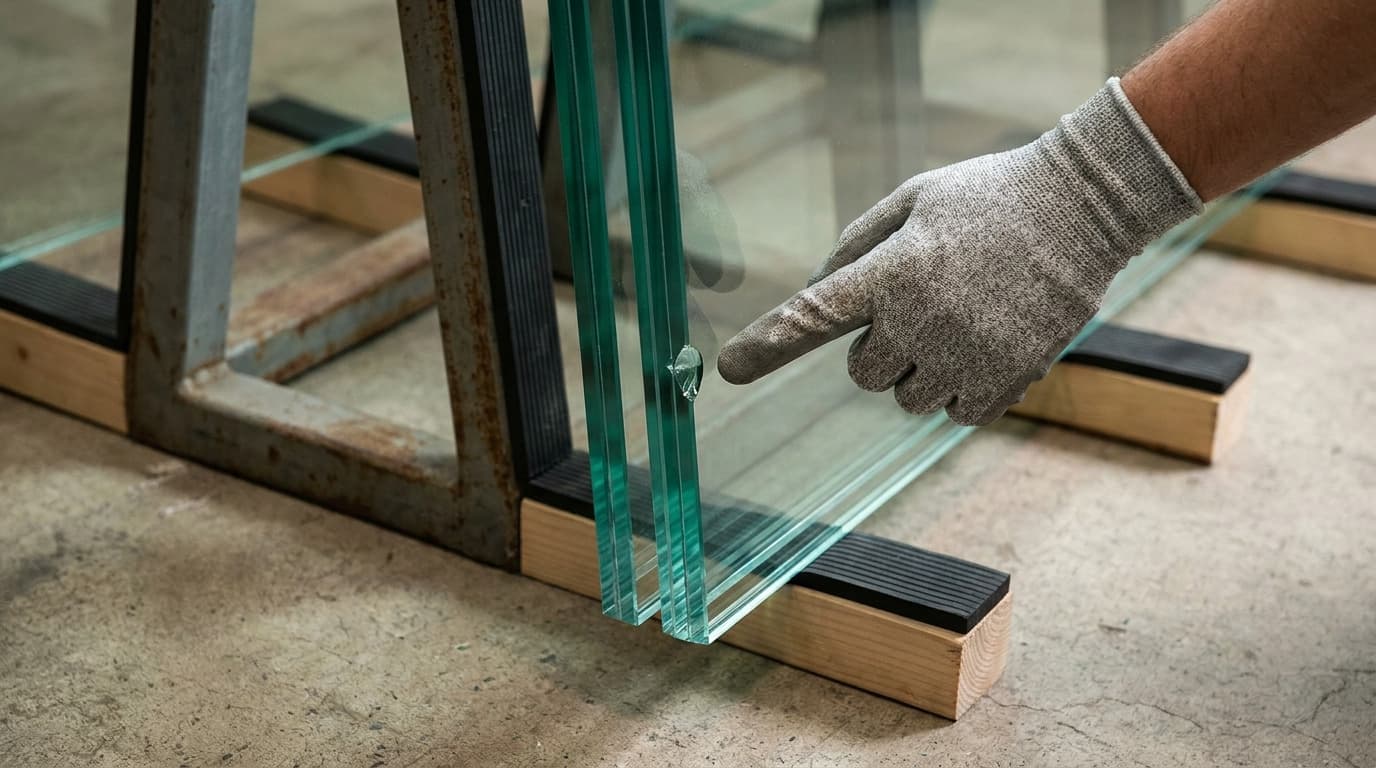
Where you set glass down decides its strength. Setting a lite on concrete, on grit, on a nail head, or on the edge of a pallet is how the flaw arrives. Glass goes on clean timber, rubber or purpose-made blocks — never on the bare slab, never on its corner.
The rule people break on site#
This is the most useful single fact in the talk, and it produces a real change in behaviour.
Cutting, drilling, notching and edge finishing must all be completed before the glass is tempered. The final dimensions, holes and polished edges have to be confirmed before the pane is heat treated. Altering a tempered lite afterwards is likely to break it — and if it does not break immediately, you have created exactly the edge defect this talk is about.
So the field consequence is simple and unwelcome: a tempered lite that does not fit is a re-order, not a job for an angle grinder. There is no site rework on tempered glass. Nipping a corner, grinding an edge, drilling a fixing hole — none of it is available.
That also explains why measurement discipline matters more in glazing than in almost any other trade. The cost of a wrong dimension is a whole unit and a lead time, and the temptation to "just take a bit off" is the hazard.
Annealed, heat-strengthened, tempered — they fail differently#
Know which one you are carrying, because the failure mode determines the injury.
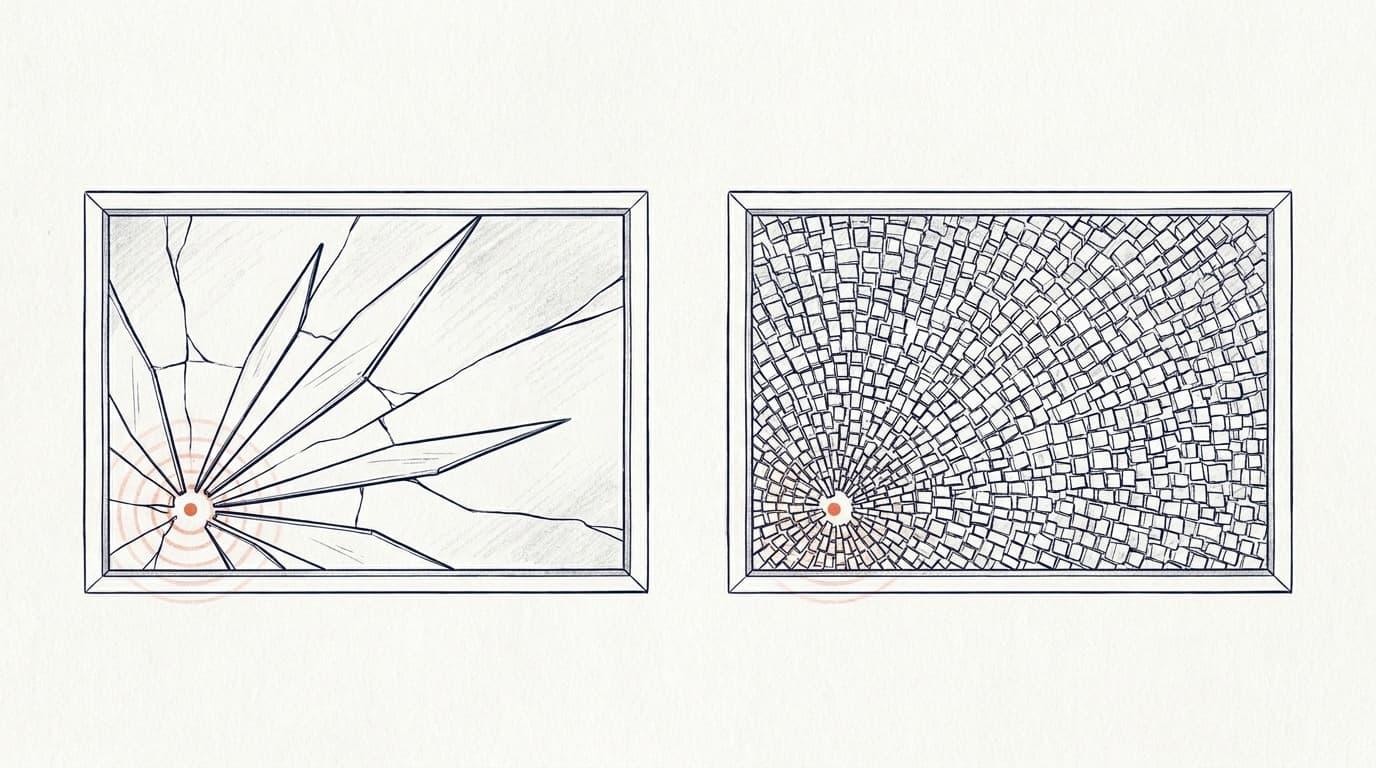
Annealed glass breaks into large, sharp shards. This is the laceration and amputation risk, and it is the reason a dropped annealed lite is an emergency for everybody standing nearby, not just the person holding it.
Heat-strengthened glass has surface compression making it approximately twice as strong as annealed, and is used where thermal or mechanical loads require it. Its break pattern remains relatively large.
Tempered glass is four to five times stronger than annealed, and the tempering process creates surface compression with an interior tension zone. When it fails, that stored energy releases at once and the pane fragments into thousands of small pieces rather than shards. Safer fragments — but note what "at once" means when you are holding it: the whole lite goes, instantly and completely, with no warning crack.
Spontaneous breakage, and what it is not#
This gets discussed on site more than it happens, and the useful part is the distinction.
Nickel sulfide inclusions are microscopic particles that can form in float glass. In tempered glass they sit in the centre tension zone and can undergo a phase change with a volume increase, which is enough to shatter the pane with nobody touching it, potentially long after installation. The break is often identifiable by a "butterfly wing" or "double D" fragment pair at the origin.
Three things matter about them. They are genuinely rare. They are not visually detectable — inspection for them is impractical to impossible. And heat soaking to EN 14179-1 reduces the incidence but does not guarantee elimination.
Now the correction. Edge-related failure and inclusion failure are different mechanisms and get confused constantly. Published guidance is explicit that edge-impact or edge-damage failure begins with physical damage or stress at an edge or corner, and that this is not the same thing as spontaneous breakage from an inclusion. Not every unexplained break is an inclusion.
That distinction is not academic. "It must have been a nickel sulfide inclusion" is the explanation that stops anybody looking at how the glass was handled — and handling damage is the one you can actually prevent.
Frames break glass too#
Worth naming because glaziers cause it and then inherit it.
Missing or inadequate setting blocks, edge blocks or gaskets allow glass-to-metal contact as the frame and the glass expand and contract at different rates. That contact produces edge and surface damage, which produces stresses, which produce a failure later that looks spontaneous. The blocks are not packing — they are what keeps the glass off the metal.
Thermal stress is a related cause: differential heating across a pane, often from partial shading, edge conditions or applied films, sets up stresses the edge quality then has to survive.
Handling it#
Carry glass on edge, never flat. A lite carried flat is being loaded in bending across its weakest axis, and if it goes it folds onto the people carrying it.
Know the weight before you lift. Glass is heavier than it looks and the weight scales with area and thickness together — a two-person lift becomes a four-person lift faster than people expect. Get the figure from the schedule rather than estimating by eye.

Suction lifters are rated equipment, not accessories. Check the pads for damage and contamination, check the seal on the actual glass surface before taking weight, and respect the rated capacity — which assumes a clean, dry, flat, undamaged surface. Coated glass, dirty glass and cold, wet glass are not the surface the rating was established on.
Store on edge, at a slight lean, on clean blocks, supported so a stack cannot walk or fan out. Never leave a lite freestanding.
Keep the traffic route clear before you pick up, because you cannot set glass down quickly.
Wear the right protection — cut-resistant gloves selected for the task, eye protection, and forearm protection where the work justifies it. 1926.95 puts PPE selection on the employer and 1926.102 covers eye and face.
Where the duty sits#
There is no OSHA glazing standard. Say that plainly.
The duties are generic. 1926.250 covers material storage and securing against sliding, falling or collapse. 1926.95 and 1926.28(a) cover PPE. 1926.102 covers eye and face protection. 1926.21(b)(2) requires instruction in recognising and avoiding hazards. And Section 5(a)(1) applies to recognised hazards without a specific standard.
The technical requirements come from elsewhere: ANSI Z97.1 and the applicable building code govern where safety glazing is required, EN 14179-1 governs heat soak testing, and the manufacturer's and fabricator's handling and glazing instructions are the practical standard for storage, edge protection, setting blocks and lifter use.
What can go wrong?#
Treating a chipped edge as cosmetic, when it is a rejection criterion and a future failure.
Setting a lite down on concrete, grit, a nail head or its own corner.
Trying to trim, nip, grind or drill tempered glass on site, which cannot be altered after tempering.
Carrying glass flat instead of on edge.
Using a suction lifter on coated, dirty, wet or cold glass and assuming the rated capacity still applies.
Blaming an unexplained break on a nickel sulfide inclusion, so nobody examines the handling.
Glazing without setting blocks or edge blocks, allowing glass-to-metal contact.
Leaving a lite freestanding or a stack unsupported.
How do we manage this properly?#
Inspect every edge on delivery and again before installation, and reject damaged lites rather than installing them and hoping.
Never set glass on the slab — clean timber, rubber or purpose-made blocks, always.
Confirm dimensions before the order goes to tempering, because there is no site rework.
Get the weight from the schedule and size the lift and the crew to it.
Check suction pads and take a test seal on the actual surface before committing to a lift.
Store on edge, leaning, blocked and restrained, with a clear route out.
Fit setting blocks and edge blocks as specified and keep glass off metal.
Investigate breakages as handling events by default, and reserve the inclusion explanation for cases with the fragment evidence to support it.
Specify heat-soaked glass where the consequence of a spontaneous break is serious, understanding it reduces rather than eliminates the risk.
Brief following trades that a lite installed today can be carrying damage done last week.
Before you start#
- Confirm what type of glass this is — annealed, heat-strengthened or tempered.
- Confirm the weight per lite and the crew size for the lift.
- Confirm every edge has been inspected and no damaged lite is in the stack.
- Confirm where glass will be set down, and that it is not the bare slab.
- Confirm suction lifters have been checked and the surface suits them.
- Confirm setting blocks and edge blocks are on site and specified.
- Confirm nobody intends to alter a tempered lite to make it fit.
- Confirm the route is clear before anybody picks up.
Talk it over#
- Has anyone checked the edges on the lites we are installing this morning?
- What are we setting glass down on today?
- If a pane does not fit, what happens next?
- Who is carrying glass flat, and why?
The bottom line#
Glass does not fail where you hit it — it fails from a flaw you cannot see, and handling is what puts the flaw there. The tensile strength of a plate is governed by micro-defects and scratches induced during production, transport and handling rather than by the bulk material, and edge strength depends on the quality of the edge finish — published analysis treats edge strength as materially lower, on the order of 80 per cent of the given tensile strength. Because glass has no ductility, every flaw stays a flaw, so a chipped edge is a rejection criterion, not a cosmetic issue, and where you set a lite down decides its strength: clean timber, rubber or purpose-made blocks, never the bare slab, never its corner. The damage and the failure are separated in time, which is why nobody connects them. The field rule that follows is absolute: cutting, drilling, notching and edge finishing must all be completed before tempering, and altering a tempered lite afterwards is likely to break it — so a tempered lite that does not fit is a re-order, not a job for a grinder. Know which product you are carrying, because the failure mode is the injury: annealed breaks into large sharp shards; heat-strengthened is about twice as strong as annealed; tempered is four to five times stronger, with surface compression and an interior tension zone, so when it goes it fragments into thousands of small pieces at once — safer fragments, but the whole lite, instantly, with no warning crack. On spontaneous breakage: nickel sulfide inclusions sit in the centre tension zone, can shatter a pane with nobody touching it long after installation, often leaving a "butterfly wing" or "double D" fragment pair — but they are genuinely rare, not visually detectable, and heat soaking to EN 14179-1 reduces without eliminating them. The correction that matters: edge-damage failure and inclusion failure are different mechanisms, published guidance says so explicitly, and "it must have been an inclusion" is the explanation that stops anybody examining the handling. Frames break glass too — missing or inadequate setting blocks, edge blocks or gaskets allow glass-to-metal contact, producing edge and surface damage and a later failure that looks spontaneous. Handling: carry on edge, never flat; get the weight from the schedule; treat suction lifters as rated equipment whose capacity assumes a clean, dry, undamaged surface; store on edge, leaning, blocked and restrained. There is no OSHA glazing standard — duties run through 1926.250 storage, 1926.95 and 1926.28(a) PPE, 1926.102 eye and face, 1926.21(b)(2) instruction and Section 5(a)(1), with ANSI Z97.1, the building code, EN 14179-1 and the fabricator's handling instructions supplying the technical requirements.
Frequently asked questions about glazing and glass handling#
Why does glass break somewhere other than where it was hit?
Because glass strength is controlled by surface and edge defects, not by the bulk material, and glass has no ductility to relieve a stress concentration. The tensile strength of a plate is governed by micro-defects and scratches induced during production, transport and handling, with edge strength depending on the quality of the edge finish. The plate fails wherever tension first reaches the limit at a defect — which is usually an edge, and usually a defect somebody put there earlier.
Is a small chip on the edge really a problem?
Yes, and it is a rejection criterion rather than a cosmetic one. Edges carry both the highest tensile stresses in bending and the highest concentration of handling damage, and published analysis treats edge strength as materially lower than surface strength — on the order of 80 per cent of the given tensile strength. A chipped lite is weaker for its whole service life, and the failure arrives later under wind, thermal or frame movement, with nobody present who remembers the chip.
Can we trim a tempered pane that does not fit?
No. Cutting, drilling, notching and edge finishing must all be completed before the glass is tempered — final dimensions, holes and polished edges are confirmed before heat treatment. Altering a tempered lite afterwards is likely to break it, and if it survives, you have created the exact edge defect that causes failure later. A tempered lite that does not fit is a re-order, not a job for a grinder.
How do annealed and tempered glass differ when they break?
Substantially, and it decides the injury. Annealed glass breaks into large, sharp shards — the laceration and amputation risk. Tempered glass is four to five times stronger than annealed and carries surface compression with an interior tension zone, so on failure the stored energy releases at once and the pane fragments into thousands of small pieces. Safer fragments, but the whole lite goes instantly, with no warning crack, which matters if you are holding it. Heat-strengthened sits between, at roughly twice the strength of annealed.
What actually causes spontaneous glass breakage?
Most often, damage — not inclusions. Nickel sulfide inclusions are microscopic particles that in tempered glass sit in the centre tension zone and can expand enough to shatter the pane long after installation, often leaving a "butterfly wing" or "double D" fragment pair at the origin. But they are genuinely rare and not visually detectable. Published guidance is explicit that edge-impact or edge-damage failure is a different mechanism — so not every unexplained break is an inclusion.
Does heat soaking eliminate the risk?
No. Heat soaking to EN 14179-1 is intended to induce failure in panes containing unstable inclusions before they leave the factory, and it reduces the incidence of spontaneous breakage. It does not guarantee 100 per cent elimination, and it adds cost, cycle time and scrap. It is worth specifying where the consequence of a spontaneous break is serious — overhead glazing, high-occupancy areas — but it should be understood as risk reduction rather than removal.
What are the rules for storing and carrying glass?
Carry on edge, never flat — a lite carried flat is loaded in bending across its weakest axis and folds onto the carriers if it goes. Store on edge at a slight lean, on clean blocks, supported so a stack cannot walk or fan, and never leave a lite freestanding. Get the weight from the schedule rather than estimating. Treat suction lifters as rated equipment: check pads for damage and contamination and take a test seal on the actual surface, because the rating assumes clean, dry, undamaged glass.
Download the glazing and glass handling toolbox talk PDF#
Get this glazing and glass handling toolbox talk as a print-ready PDF — available in English, Spanish, Portuguese, and Turkish. Print it, hand it to the crew, and collect signatures on the included attendance sheet.
Download the PDF — free account required. New members get 3 free downloads.
Related toolbox talks#
Sources#
- Construction Specifier, Spontaneous Glass Breakage: Why it happens and what to do about it: https://www.constructionspecifier.com/spontaneous-glass-breakage-why-it-happens-and-what-to-do-about-it/
- Vitro Architectural Glass, Nickel Sulfide and Spontaneous Breakage: https://glassed.vitroglazings.com/nickel-sulfide-and-spontaneous-breakage
- OSHA, 29 CFR 1926.250 — General requirements for storage: https://www.osha.gov/laws-regs/regulations/standardnumber/1926/1926.250
This talk is general awareness guidance for training purposes. It does not qualify anyone to specify, fabricate, handle or install architectural glass. Glass type, thickness, safety glazing requirements and lifting arrangements must follow the design, the applicable building code and the fabricator's handling and glazing instructions for the specific product.
Written by FieldSafetyTalk's safety professional — a CSP, ASP, CHST and OSHA Authorized Outreach Trainer with 14+ years of international construction safety experience across federal, heavy civil, and industrial projects.