Masonry Work Safety
Updated 2026-09-15
Print-ready PDF
Download this talk as a print-ready PDF, available in 4 languages.
Masonry looks like the most solid trade on the site — block, brick, mortar, a wall you can lean on. That is exactly the problem. Two ways that solidity is a lie: a freshly laid wall has almost no strength of its own until the mortar cures, so it is a tipping load waiting for a gust of wind, and the dust off a masonry saw looks like nothing at all while carrying silica fine enough to lodge in the lung for good. One kills today. The other kills in twenty years. Both hide behind the same three words: it's just block.
Where the boundary of this talk sits#
This talk owns masonry work as a trade — the wall under construction, the limited access zone, bracing, block and brick cutting, tuckpointing, mortar handling, and moving the material. It hands the deep dive on silica exposure, respirators, and medical surveillance to the silica talk below, and the scaffold platform itself to the scaffolding talk; both are linked. It does not cover the caustic skin injury from wet mortar in depth — that mechanism belongs to the skin-hazards talk — but it names the hazard and the control. Impalement on rebar that masons work above is its own talk.
The anchor#
Here is the distinction that carries this whole talk: a masonry wall has no strength of its own until the mortar cures — the wall you just laid is a stack of heavy blocks held by wet paste, so a green wall over eight feet is a tipping load, not a structure, and the dust from the saw that cut those blocks is not dirt but silica fine enough to never leave the lung; so the trade runs as a sequence and every step guards one of the two killers — set the limited access zone before the first course, wet the blade before it touches block, brace before the wall can lean, and treat mortar and dust as the chemical hazards they are — because the wall that comes down today and the lung that fails in twenty years both start with a crew that trusted "it's just block."
Killer one: the wall that is not yet a wall#
A masonry wall is built one course at a time, and until the mortar cures and the wall is tied into the structure, it is a tall, thin stack of heavy units held together by wet material with almost no tensile strength. Its own weight keeps it upright in still air. A gust of wind, a bump from a piece of equipment, a stack of block leaned against it, or a load placed on top before it can carry one, and the whole thing rotates about its base and comes down — onto the very people building it and anyone standing on the wrong side.
OSHA's masonry standard, 29 CFR 1926.706, is built entirely around that moment. It has two parts, and masons should know both by heart.
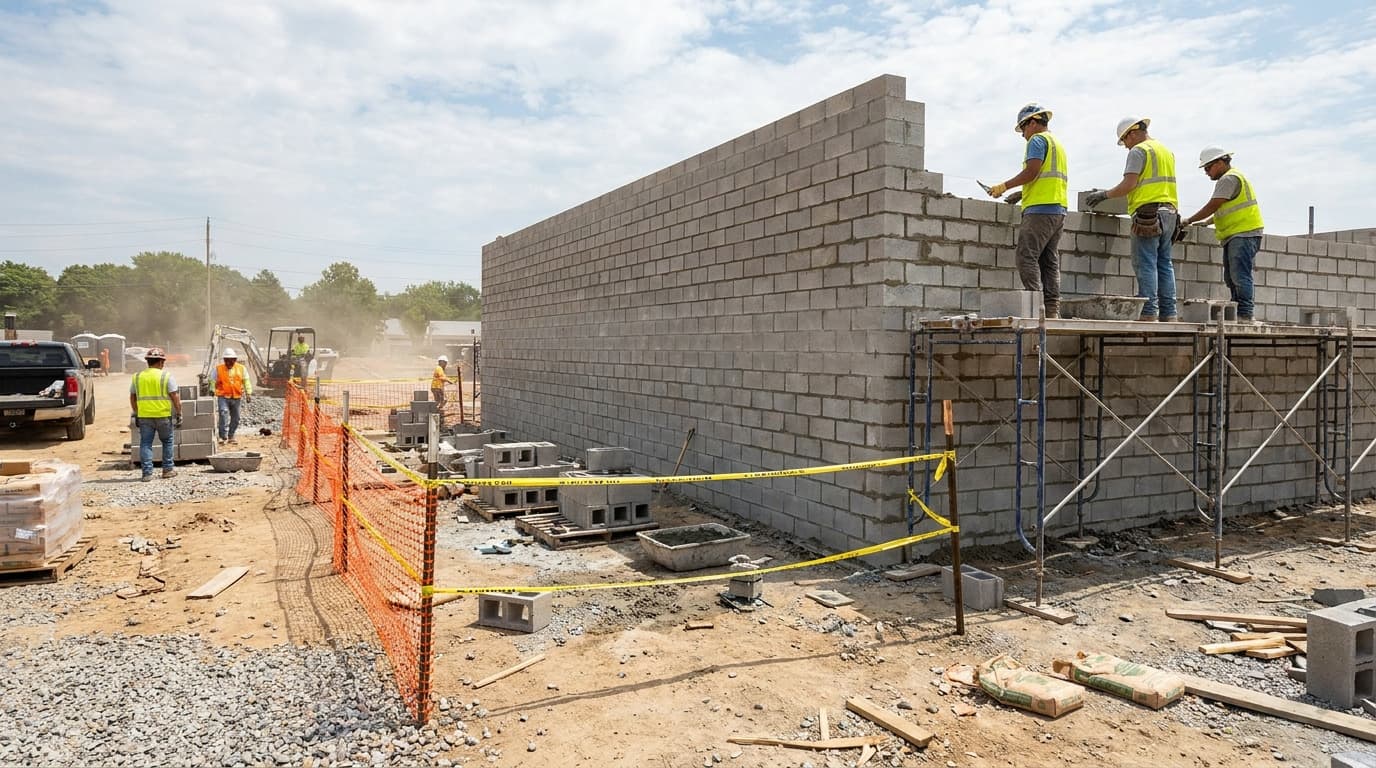
The limited access zone. Under 1926.706(a), a limited access zone must be established whenever a masonry wall is being constructed — before the first course goes down, not after. Its size is fixed: the height of the wall to be built plus four feet, running the entire length of the wall, on the unscaffolded side. Only employees actively engaged in building the wall may enter it; nobody else. The zone stays in place until the wall is adequately supported against overturning and collapse. The logic is simple: if a wall of height H tips over, it lands within H plus a margin, so the zone is the footprint of the fall. OSHA has clarified that the zone is sized by the unsupported height — a tall wall with only its top ten feet unsupported needs a fourteen-foot zone, not an eighty-four-foot one — and that any marking, barrier, or sign is acceptable as long as it effectively identifies the zone to someone approaching.
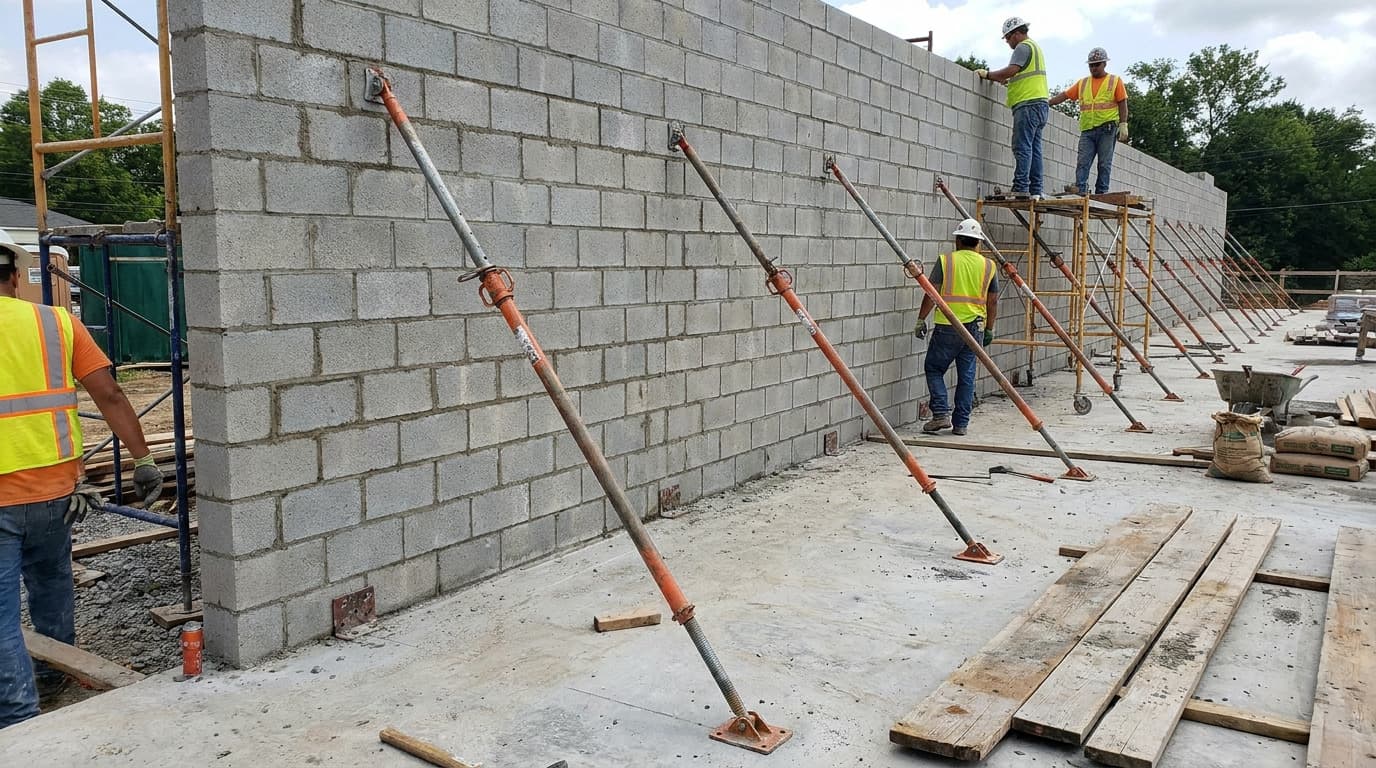
Bracing over eight feet. Under 1926.706(b), every masonry wall over eight feet in height must be adequately braced to prevent overturning and collapse, unless it is otherwise adequately supported so that it will not overturn — and the bracing stays until the permanent supporting elements of the structure are in place. OSHA has said this is a performance requirement: the employer must ensure a wall can withstand all normally expected forces, including prevailing wind, and an engineering evaluation of the bracing method may be appropriate. The distinction that matters most: for a wall of eight feet or less, the employer may choose either a limited access zone or adequate support; for a wall over eight feet, the limited access zone cannot substitute for bracing — the wall must be braced or supported regardless.
The practical rule for the crew: the zone goes up before you start, the bracing goes on before the wall can lean, and a wall that "feels solid" is exactly the one that has not been evaluated.
Killer two: the dust that looks like nothing#
Every cut through concrete block, brick, stone, or mortar releases respirable crystalline silica — quartz particles so fine they hang in the air, pass the body's defenses, and lodge permanently in the lung, where they scar the tissue over years. That scarring is silicosis, and it is incurable, progressive, and still killing tradespeople. A mason who dry-cuts block on a stationary saw, or grinds out mortar joints, is standing in the highest-exposure tasks in construction, and the dust does not feel dangerous in the moment. It feels like dust.
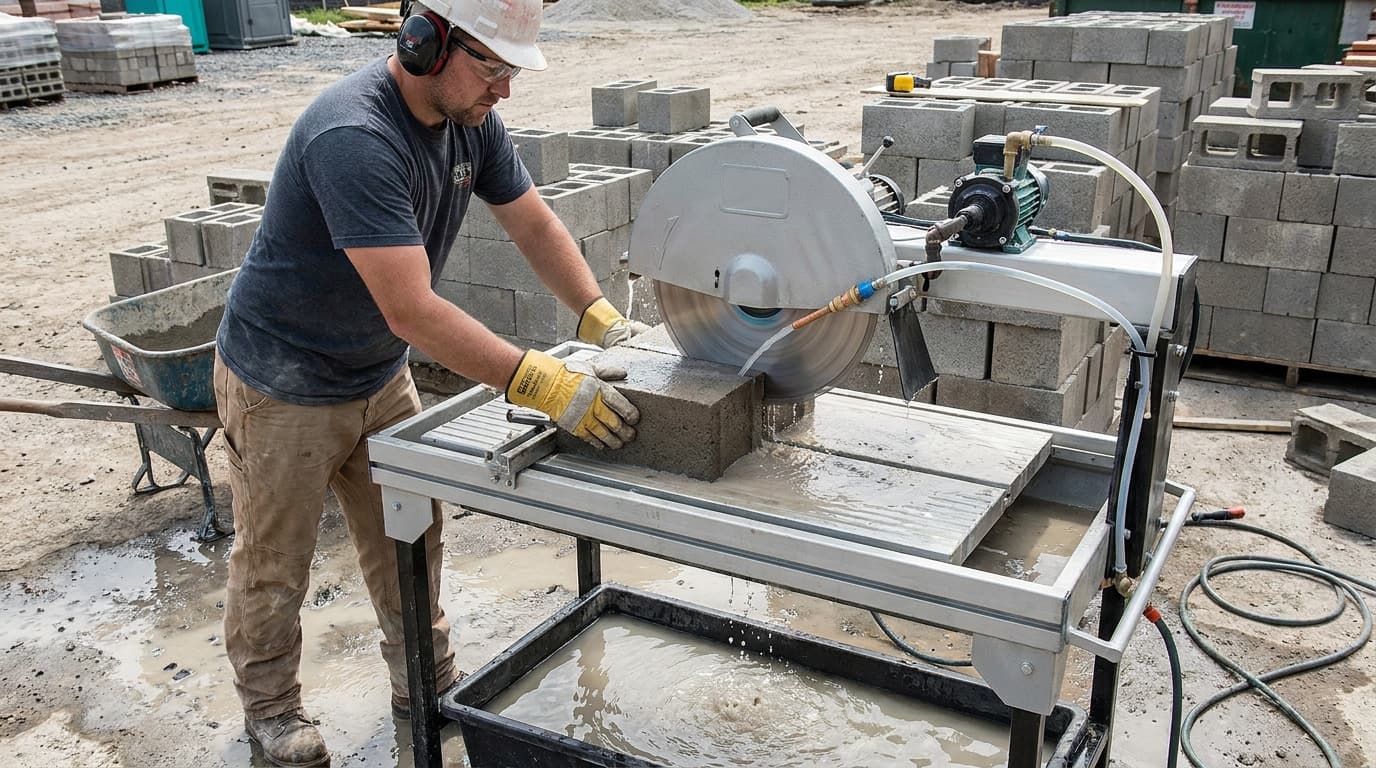
OSHA's construction silica standard, 29 CFR 1926.1153, sets a permissible exposure limit of 50 micrograms per cubic meter of air as an eight-hour average and an action level of 25, at which monitoring and medical surveillance obligations begin. For masons the most useful part of the rule is Table 1, which lists common tasks with the specific engineering controls, work practices, and respirator (if any) required. Follow Table 1 fully and properly for a task and the employer does not have to separately prove the exposure is under the limit. Two masonry entries matter most: the stationary masonry saw requires an integrated water delivery system that continuously feeds water to the blade — wet cutting, not dust suppression after the fact — and mortar removal (tuckpointing) with a handheld grinder requires a commercially available shroud with dust collection, plus a respirator for the longer-duration work. There is no exemption for short jobs: OSHA has said the standard does not exclude tasks that take only fifteen minutes a day.
The crew-level translation: the blade gets wet before it touches block, every time. A dry cut "just this once" is a full dose. The water is the control; the dust mask is the last resort.
The rest of the trade#
Mortar is a chemical. Wet mortar and cement are strongly alkaline, and prolonged skin contact causes chemical burns and dermatitis that can take hours to show. That mechanism is owned in depth by the skin-hazards talk, but the control belongs here: gloves rated for cement, eye protection when mixing and cutting, no kneeling in wet mortar, and rinse skin promptly. Mortar carries an SDS under HazCom (1926.59) and workers should know where it is.
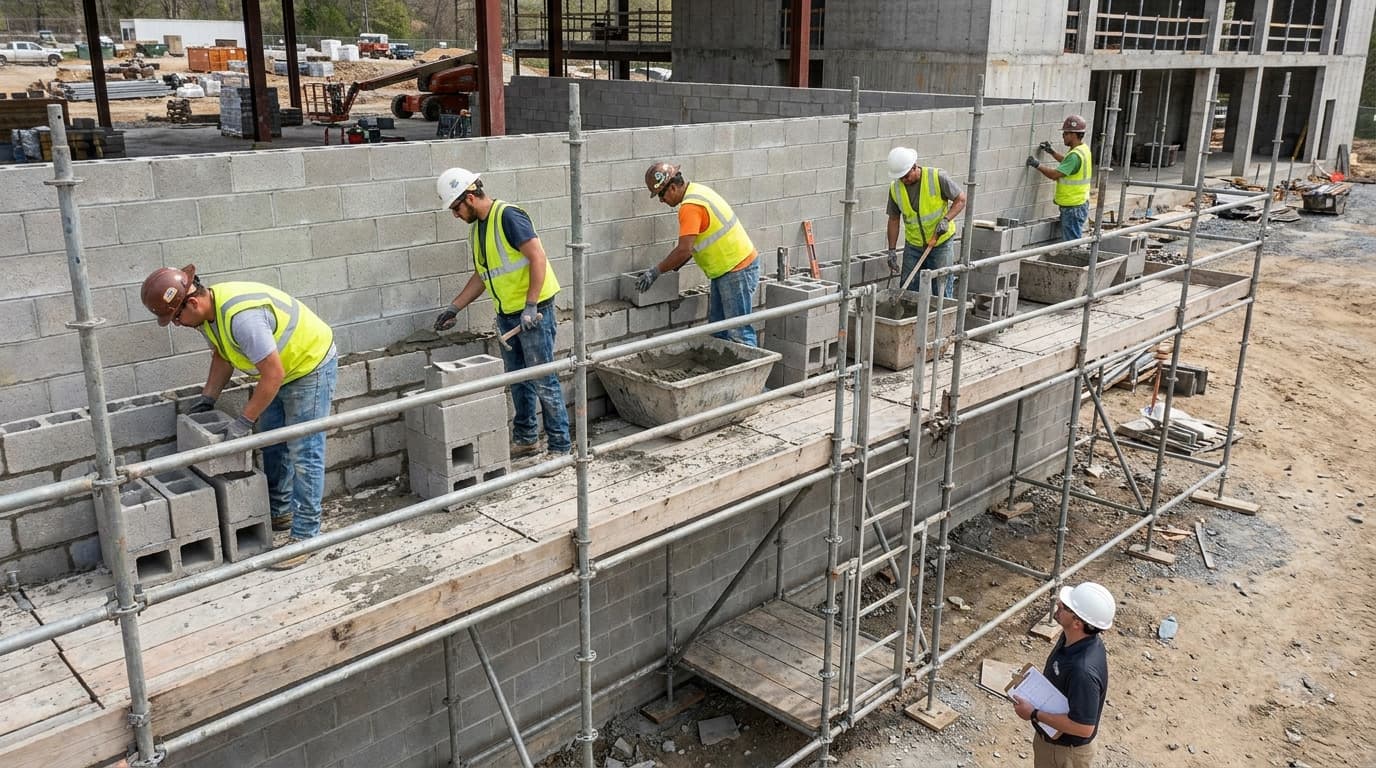
Scaffold is your floor. Masons spend the shift on a platform, often a mason's scaffold loaded with block and mortar tubs. The platform, its load rating, its guardrails, and its inspection are governed by 1926.451 and belong to the scaffolding talk — but a mason's specific hazard is overloading: block is heavy, and stacking a day's worth on the platform can exceed the rating. Know the rating, stage material in small lots, and never work a platform that has not been inspected by the competent person that shift.
Block is heavy and the saw is a saw. A standard concrete block weighs roughly 30 to 40 pounds, and a mason lifts hundreds a day; manual-handling injury is the slow-burn hazard of the trade, and it is owned by the manual-handling talk below. The masonry saw is a power tool with a spinning blade near hands and water near electricity — guards on, GFCI on the circuit, blade rated for the material, and never freehand a cut.
Where the duty sits#
The masonry-specific duty is 1926.706 — the limited access zone at (a) and bracing over eight feet at (b) — and it is the employer's to establish and maintain. Silica exposure is governed by 1926.1153, with Table 1 as the compliance path for cutting and tuckpointing. The scaffold platform falls under 1926.451 (Subpart L), and the chemical hazard of mortar under HazCom, 1926.59. Manual handling and the saw itself run through the general construction standards and the related talks. None of these substitute for one another: a braced wall does nothing for the lung, and a wet saw does nothing for a wall that tips.
What can go wrong?#
- A crew starts laying block without setting the limited access zone; a laborer walks along the unscaffolded side to fetch material and a gust tips the green wall onto him.
- A twelve-foot wall is "protected" by a limited access zone alone, with no bracing; overnight wind brings it down across the zone.
- The bracing is pulled to make room for the scaffold move, before the permanent roof structure is tied in.
- The stationary saw's water pump fails and the crew keeps cutting dry to finish the pour; every worker in the area takes a full silica dose.
- A mason grinds out mortar joints for tuckpointing with no shroud and no vacuum, in an enclosed corner.
- Block is leaned against a green wall as a staging shortcut, adding a lateral load the wall cannot carry.
- A full day's block is stacked on one section of the scaffold platform, past its rating.
- A mason kneels in wet mortar through the shift and shows up the next morning with cement burns on both knees.
How do we manage this properly?#
- Zone before the first course — limited access zone, wall height plus four feet, full length, unscaffolded side, marked so anyone approaching sees it; only the wall crew inside.
- Brace before it can lean — any wall over eight feet gets adequate bracing (or engineered support) that stays until permanent structure is tied in; the zone never substitutes for bracing on a tall wall.
- Wet the blade first — stationary saws run integrated water delivery to the blade; tuckpointing grinders run a shroud with dust collection; no dry cuts, no exceptions for short jobs.
- Follow Table 1 — match each cutting and mortar-removal task to its listed control and respirator, and follow the exposure control plan.
- Treat mortar as a chemical — cement-rated gloves, eye protection, no kneeling in wet mortar, rinse skin, SDS available.
- Respect the platform — know the scaffold rating, stage block in small lots, work only on a platform the competent person inspected this shift.
- No load on a green wall — nothing leaned against it, nothing set on top of it, until it is cured and supported.
Before you start#
Walk the wall line and confirm the limited access zone is set — height plus four feet, full length, unscaffolded side — before anyone lays block. Know the planned height of today's lift and whether it crosses eight feet, and confirm the bracing plan and who signs off that it is adequate. Check the saw's water delivery and the grinder's shroud and vacuum before the first cut. Confirm cement-rated gloves and eye protection are on hand and the mortar SDS is available. Look at the scaffold platform, its rating, and this shift's inspection.
Talk it over#
- Where is our limited access zone right now, and is anyone besides the wall crew inside it?
- Today's wall — will it pass eight feet, and what exactly is bracing it before it does?
- When was the last time someone cut dry "just to finish"? What was the dose?
- Is our tuckpointing grinder running a shroud and a vacuum, or just a mask?
- Who has come in with mortar burns, and what did we change afterward?
The bottom line#
A masonry wall has no strength of its own until the mortar cures, so a green wall over eight feet is a tipping load and the crew's first job is the limited access zone — height plus four feet, unscaffolded side, before the first course — and adequate bracing that stays until the permanent structure is in, because on a tall wall the zone never substitutes for the brace. The dust off the saw is silica, not dirt, and the only control that works is the wet blade and the shrouded grinder under Table 1 — a dry cut is a full dose, no matter how short. Treat mortar as a chemical, respect the scaffold rating, and put nothing against a wall that is not yet a wall. Two killers, one trade, and both start the moment somebody decides it's just block.
Frequently asked questions about masonry work safety#
How big does the limited access zone have to be, and which side of the wall?
The size is fixed by 1926.706(a): the height of the wall to be constructed plus four feet, running the entire length of the wall, on the side that will not be scaffolded. It must be established before construction starts, and only employees actively engaged in building the wall may enter it. OSHA has clarified that the zone is based on the unsupported height of the wall — so on a tall wall that is tied in except for its top section, the zone is sized to that unsupported section, not the full height. The zone stays until the wall is adequately supported against overturning; for a wall over eight feet, that means until the bracing requirement of 1926.706(b) is met.
Can we use the limited access zone instead of bracing a tall wall?
Not for a wall over eight feet. OSHA has interpreted 1926.706 this way: for walls eight feet and less, the employer may choose either to adequately support the wall or to establish a limited access zone on the unscaffolded side. For walls over eight feet, that option goes away — the wall must be adequately braced or supported to prevent overturning and collapse, and the limited access zone cannot be used in lieu of bracing. The zone and the brace do different jobs: the zone keeps people out of the fall footprint, the brace keeps the wall from falling. On a tall wall you need the brace.
What counts as "adequately braced" under 1926.706(b)?
The standard is performance-based — it says the wall must be braced to prevent overturning and collapse, but does not prescribe how. OSHA has explained that it is the employer's responsibility to ensure a wall not adequately supported can withstand all normally expected forces, which include prevailing wind, building geometry, and wall location, and that an engineering evaluation of the bracing method may be appropriate. The bracing remains until the permanent supporting elements of the structure are in place. A wall that would come down under normal expected forces is, by definition, not adequately braced — so "it feels solid" is not the test; the test is whether it has been evaluated against the loads it will actually see.
Why is dry cutting block such a big deal if it's just for a minute?
Because there is no short-duration exemption. OSHA has stated that the construction silica standard does not exclude tasks that involve only short exposures, such as fifteen minutes a day, and the dust from cutting concrete block, brick, or mortar is among the highest-silica dust in construction. Respirable crystalline silica lodges permanently in the lung; the damage is cumulative and the disease it causes, silicosis, is incurable. Under Table 1, a stationary masonry saw must run an integrated water delivery system that continuously feeds water to the blade — that is the engineering control, and it has to be working before the cut, not turned on afterward. A dry cut "just this once" is a full dose.
What does Table 1 actually require for tuckpointing?
Mortar removal with a handheld grinder is its own Table 1 task, separate from general grinding. It requires a commercially available shroud and dust-collection system on the grinder, operated per the manufacturer's instructions with the filter and vacuum working, and respiratory protection for the longer-duration work. The reason it gets its own entry is that grinding out joints throws a concentrated stream of mortar dust straight at the worker's face, often in a confined corner. A dust mask alone is not the control — the shroud and vacuum are, with the respirator layered on top for the longer jobs. The silica talk below covers the respirator program and medical surveillance in depth.
Is wet mortar really dangerous to touch?
Yes. Wet mortar and cement are strongly alkaline, and prolonged contact — kneeling in it, letting it sit inside a glove or boot — causes chemical burns that can develop over hours without much pain until the damage is done, along with contact dermatitis over repeated exposure. The full mechanism, and why alkaline burns are sneakier than acid burns, is owned by the skin-hazards talk; the controls belong here. Wear gloves rated for cement, wear eye protection when mixing and cutting, never kneel in wet mortar, and rinse skin promptly with water if mortar gets inside your gear. Mortar has a safety data sheet under HazCom, and every mason should know where it is.
How much block can we put on the scaffold platform?
Only what the platform is rated for, and the rating is on the scaffold, not in your head. A standard concrete block weighs roughly 30 to 40 pounds, and a full day's supply stacked on one section can exceed the load rating of a mason's platform — scaffolds and their components must support at least four times their maximum intended load under 1926.451, but that rating assumes the load is what was intended. Stage block in small lots, spread it along the platform, keep mortar tubs from concentrating weight, and never work a platform that the competent person has not inspected this shift. The scaffolding talk below covers the platform itself.
Download the masonry work safety toolbox talk PDF#
Download this masonry work safety toolbox talk as a printable PDF in English, Spanish, Portuguese, and Turkish for your next tailgate meeting, and walk the wall line with it before the first course goes down.
Related toolbox talks#
Sources#
- OSHA, 29 CFR 1926.706 — Requirements for masonry construction (the limited access zone at (a): established before construction, height plus four feet, full length, unscaffolded side, restricted to the wall crew; bracing of walls over eight feet at (b) until permanent supporting elements are in place): https://www.osha.gov/laws-regs/regulations/standardnumber/1926/1926.706
- OSHA standard interpretations on 1926.706 — February 6, 1989 (zone sized by unsupported height; any effective marking acceptable), July 10, 1991 and June 25, 1996 (adequate bracing is performance-based and must withstand normally expected forces including wind; engineering evaluation may be appropriate), and February 16, 1993 (for walls over eight feet the limited access zone may not be used in lieu of bracing): https://www.osha.gov/laws-regs/standardinterpretations/1993-02-16-3
- OSHA, 29 CFR 1926.1153 — Respirable crystalline silica (PEL 50 µg/m³ and action level 25 µg/m³ as 8-hour TWAs; Table 1 specified exposure control methods including the stationary masonry saw with integrated water delivery and mortar removal with a shrouded, dust-collecting grinder; no short-duration exemption per OSHA's 2019 interpretation and FAQ 2): https://www.osha.gov/laws-regs/regulations/standardnumber/1926/1926.1153
Written by FieldSafetyTalk's safety professional — a CSP, ASP, CHST and OSHA Authorized Outreach Trainer with 14+ years of international construction safety experience across federal, heavy civil, and industrial projects.