Anchor Point Selection
Updated 2026-07-24
In this bundle Fall Protection & Heights
Print-ready PDF
Download this talk as a print-ready PDF, available in 4 languages.
Look at what you are wearing. The harness came with a label, a rating, a manufacturer, a date of manufacture, and a booklet of instructions. So did the lanyard. So did the snaphook. Now look at what you are about to clip to. A beam. A bolt somebody left in a wall. A pipe. It arrived with none of those things — no label, no rating, no manufacturer, no inspection history, and frequently no record that anyone ever thought about it at all. This anchor point selection talk is about the only component of your fall arrest system that is not equipment.
Here is the distinction that carries this whole talk: every other part of the system was issued to you, already tested, already certified by someone whose job it was to test it. The anchor is chosen — usually in the moment, usually by the person who is about to hang off it, usually on the basis of how solid it looks. And "looks solid" is not a rating. OSHA itself is blunt about this. Appendix C to Subpart M opens its guidance on tie-offs by saying that of all the parts of a personal fall protection system, planning for suitable anchorage points is "probably the most overlooked component." That is the regulator, in the regulation, telling you where the gap is.
What is an anchor point?#
An anchor point is the fixed attachment that the rest of a personal fall arrest system connects to — the one component chosen on site rather than issued, rated and certified by a manufacturer. Under 29 CFR 1926.502(d)(15), an anchorage used for fall arrest must be independent of any anchorage being used to support or suspend platforms, and capable of supporting at least 5,000 pounds (22.2 kN) per employee attached — or, alternatively, be designed, installed and used as part of a complete personal fall arrest system that maintains a safety factor of at least two, under the supervision of a qualified person. Both halves of that first requirement are binding, and the independence clause is the one most often missed.
What does an anchor actually have to do?#
There is no clean national dataset isolating deaths caused by anchorage failure — they are recorded as falls to a lower level like any other, so be sceptical of any number quoted for it. What we do have is the requirement itself, and it is more demanding than most crews realise, in a way that has nothing to do with the famous number.
29 CFR 1926.502(d)(15) contains two requirements, and almost everyone quotes only the second one. Anchorages used for attachment of personal fall arrest equipment shall be:
- independent of any anchorage being used to support or suspend platforms, and
- capable of supporting at least 5,000 pounds (22.2 kN) per employee attached.
The first clause is the one that disappears. You cannot tie off to the thing that is holding you up. Not the suspended scaffold you are standing on, not the swing stage, not the frame supporting your work platform. The logic is not subtle: if that structure fails, it takes the platform and the fall arrest system with it in the same movement, and you have a fall protection system whose survival depends on the exact thing whose failure you were protecting against.
The second clause has an alternative route that also gets skipped. Instead of 5,000 pounds per person, an anchorage may be designed, installed and used (i) as part of a complete personal fall arrest system maintaining a safety factor of at least two, and (ii) under the supervision of a qualified person. Both conditions, together. This is how engineered anchor systems and horizontal lifelines are legitimately used at loads below 5,000 pounds — and it is not a loophole that lets a foreman make the call.
Competent person is not qualified person#
This distinction decides who is allowed to approve an anchor, and most sites use the two terms as if they were the same word.
- Competent person — 1926.32(f). One who is capable of identifying existing and predictable hazards in the surroundings or working conditions which are unsanitary, hazardous, or dangerous to employees, and who has authorization to take prompt corrective measures to eliminate them. The defining features are hazard recognition plus authority to act.
- Qualified — 1926.32(m). One who, by possession of a recognized degree, certificate, or professional standing, or who by extensive knowledge, training, and experience, has successfully demonstrated his ability to solve or resolve problems relating to the subject matter, the work, or the project. The defining feature is demonstrated technical problem-solving ability.
Anchorage design under 1926.502(d)(15)(ii) requires a qualified person. So does horizontal lifeline design under 1926.502(d)(8). Your competent person can inspect the harness, halt the work, and pull people off a deck — and still not be the person authorised to certify that a particular beam is an adequate anchor. Those are two different jobs held to two different standards.
OSHA anchor point requirements (29 CFR 1926 Subpart M)#
- Anchorage criteria — 1926.502(d)(15). Independent of platform-supporting anchorages, and 5,000 lb per employee attached, or engineered to a safety factor of at least two under a qualified person's supervision.
- Never a guardrail — 1926.502(d)(23). Personal fall arrest systems must not be attached to guardrail systems, nor to hoists except as specified elsewhere in the part. A guardrail is designed to resist a person leaning on it, not to catch one falling.
- Hoist areas — 1926.502(d)(24). Where a personal fall arrest system is used at hoist areas, it must be rigged to allow movement only as far as the edge of the walking or working surface.
- Horizontal lifelines — 1926.502(d)(8). Designed, installed and used under the supervision of a qualified person, as part of a complete system maintaining a safety factor of at least two. Sag geometry means an HLL can carry loads far higher than the lanyard imposes, so this is genuinely engineering work.
- One person per vertical lifeline — 1926.502(d)(10)(i). Each employee must be attached to a separate vertical lifeline. The only exception, under (d)(10)(ii), is elevator shaft construction with a 10,000 lb lifeline, two employees atop a guardrailed false car, and all other lifeline criteria met.
- Positioning devices are different — 1926.502(e)(2). A positioning device anchorage must support twice the potential impact load or 3,000 pounds, whichever is greater — a lower bar than fall arrest, and a common source of confusion when the same D-ring gets used for both.
- Installed before the work — 1926.502(a)(2). The employer must provide and install the required fall protection before the employee begins the work that necessitates it. Anchorage is not something you solve once you are already up there.
Appendix C, paragraph (h), is where the anchorage guidance lives:
- (h)(1) Planning anchorages is the most overlooked part of the system, and should ideally happen while the structure is being built, so the points exist for later maintenance work too.
- (h)(1)(i) Where anchorages must be installed immediately before use, a registered professional engineer with experience in designing fall protection systems, or another qualified person with appropriate education and experience, should design them.
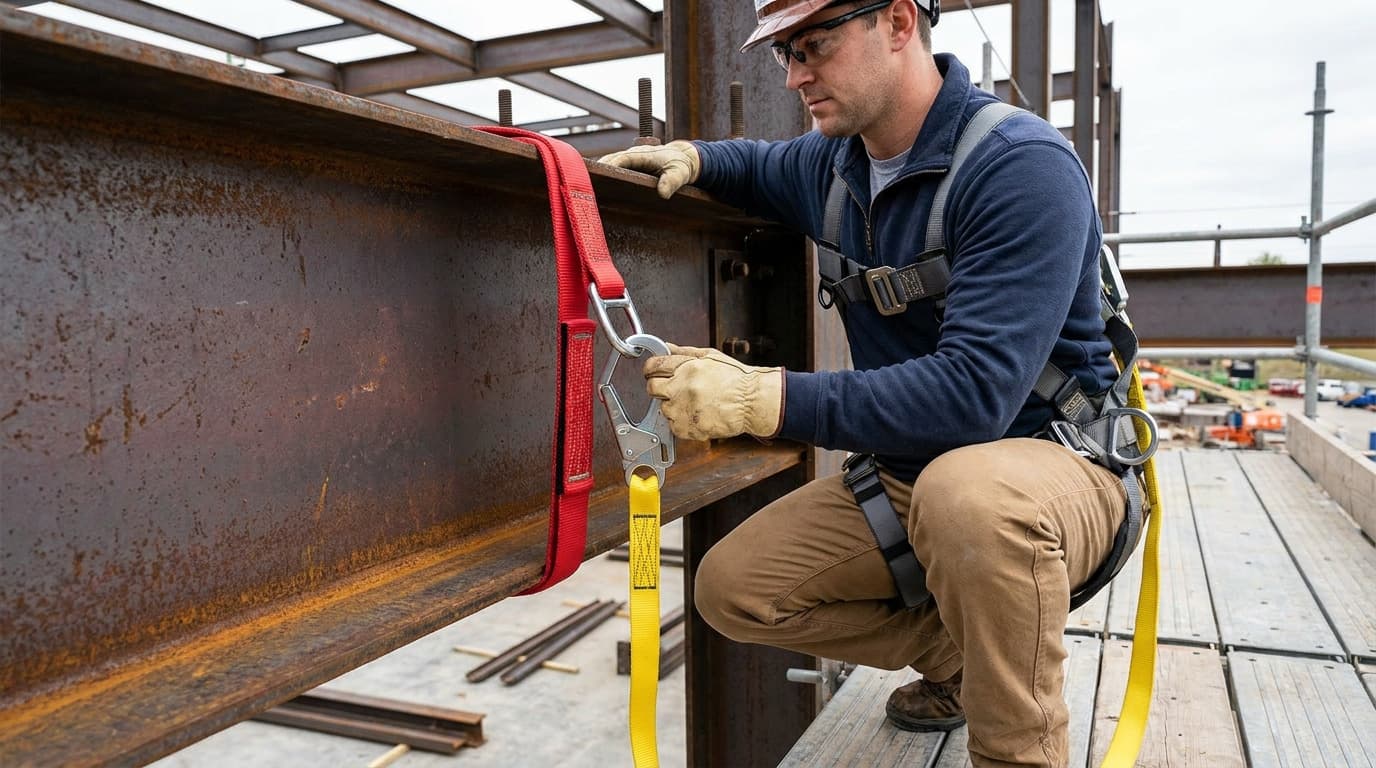
- (h)(1)(ii) OSHA's own list of what might be appropriate improvised anchorages: steel members or I-beams if an acceptable strap is available — with the explicit warning not to use a lanyard with a snaphook clipped back onto itself; large eye-bolts of an appropriate grade steel; guardrails or railings only if they were designed for use as an anchor point; and masonry or wood members only where the attachment point is substantial and precautions ensure the bolts will not pull through. A qualified person should evaluate any such improvised anchorage with a focus on proper strength.
- (h)(2) If the means of attachment reduces the strength of the system, that component must be replaced with a stronger one that still maintains the correct maximum arresting force.
- (h)(7) An eye-bolt's strength is rated along the axis of the bolt and is greatly reduced when force is applied at an angle to that axis — in shear. Also, the eye must be sized correctly to avoid accidental disengagement of a snaphook not designed to be compatible with it.
On USACE and NAVFAC projects, EM 385-1-1 applies and is more prescriptive on anchorage documentation, proof-testing, and certification in several places.
What can go wrong#
Tying off to what is holding you up. The failure 1926.502(d)(15) opens by prohibiting. A suspended scaffold's suspension rigging, the frame of the platform you are standing on, the outrigger beam above a swing stage. One failure takes both systems.
Tying off to a guardrail. Explicitly banned by 1926.502(d)(23), and it happens constantly because the rail is at a convenient height and feels solid under the hand. A guardrail is built for a static push. Arresting a falling body is a different physical event by an order of magnitude.
Assuming the structure is stronger than it is. Roof decking, purlins, conduit, sprinkler pipe, ductwork, ladder rungs, vent stacks, small-bore handrail. Things that carry their own weight comfortably and have never been asked to carry a shock load.
Anchoring to something not yet complete. Steel that is bolted but not welded, a wall that is up but not tied in, a frame still being assembled. It will be a good anchor next week. It is not one today.
Snaphook clipped back onto its own lanyard around a beam. Named in Appendix C (h)(1)(ii) as the thing not to do. It loads the snaphook gate sideways in a way it was never designed for, and it is the most common improvised beam wrap on any jobsite.
Eye-bolts loaded sideways. Straight from Appendix C (h)(7). The rating on the bolt is an axial rating. Pull it at an angle and you are working well below the number stamped on it, with no way to know by how much.
Multiple workers on one anchor, or one vertical lifeline. The 5,000 lb figure is per employee attached, and (d)(10)(i) requires a separate vertical lifeline for each worker. Two people on one line means one person's arrest can pull the other off.
Horizontal lifelines rigged by whoever was closest. A horizontal lifeline is engineered equipment requiring a qualified person under (d)(8). Sag geometry amplifies the load substantially, and a line rigged by eye can be carrying multiples of what anyone assumed.
Corrosion and age on a permanent anchor. Fixed anchors on existing buildings can be decades old, painted over, sitting in a wall of unknown condition behind them. The plate you can see is not the fixing you are relying on.
The anchor chosen for convenience. Low, behind you, or off to one side — the three positions that respectively add free fall, invite swing fall, and cause the lanyard to run over an edge. An anchor that is technically strong enough can still be in the wrong place.
And the failure underneath all of them: nobody was asked. The anchor was picked by the person clipping to it, in the moment, on the basis of it looking substantial. No calculation, no drawing, no qualified person, no record.
How do we select anchor points properly?#
Find out whether an engineered anchor already exists. On many structures, permanent anchor points, certified davit sockets, or a designed horizontal lifeline are already installed and documented. Using a designed anchor beats evaluating an improvised one every time. Appendix C (h)(1)(i) says properly planned anchorages should be used if they are available.
Know which route you are on. Either the anchorage genuinely supports 5,000 lb per person attached, or it has been engineered to a safety factor of at least two under the supervision of a qualified person. There is no third option, and "it looks strong" is not either of them.
Check the independence clause first. Before strength, ask: is this connected to whatever is supporting my platform? If yes, it is not a legal anchor no matter how strong it is.
Anchor overhead. Every foot the anchor sits above your dorsal D-ring is free fall removed from the total, and free fall is what drives arresting force. An anchor at foot level can be perfectly strong and still let you fall further than the system was tested for.
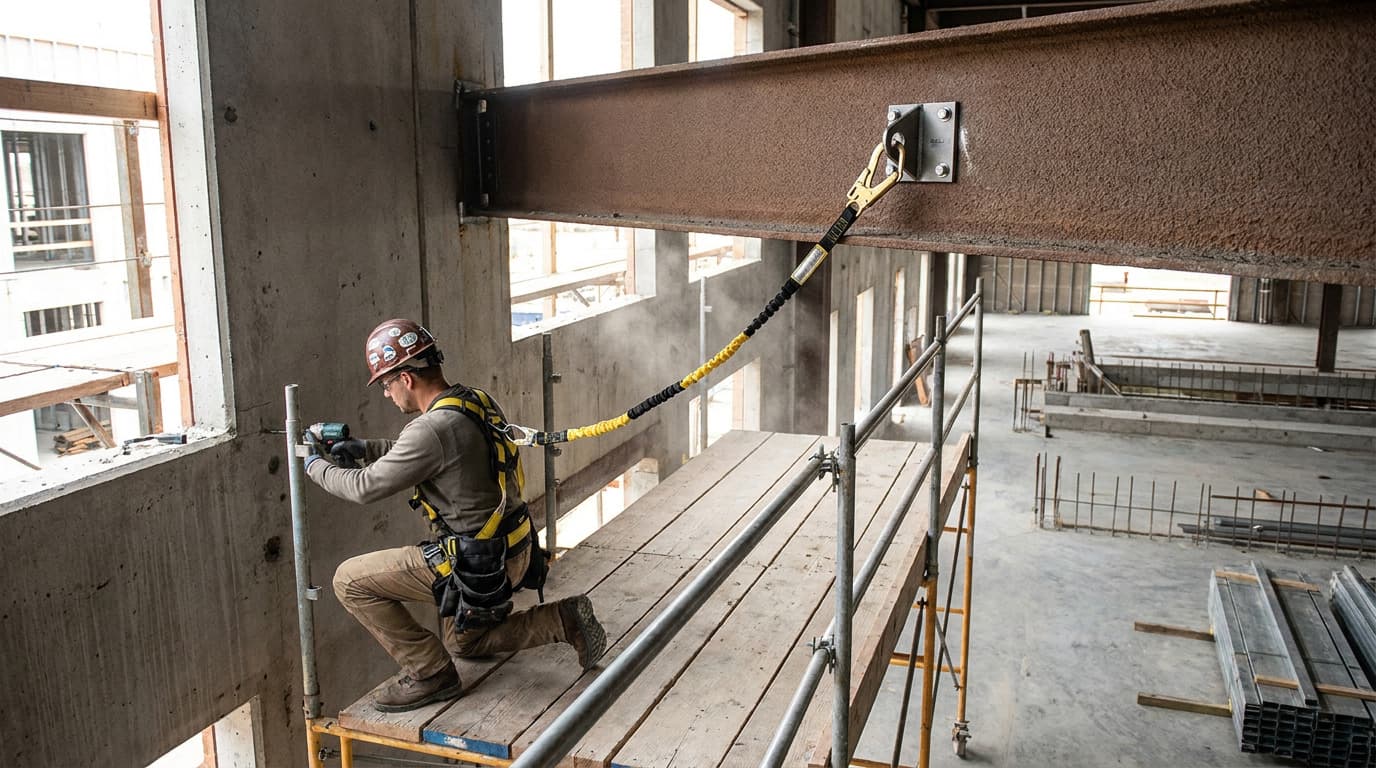
Anchor in line with the work. Work as close to directly beneath the anchor as the task allows. Lateral offset creates a swing that carries you into structure at speed and takes you lower than the point directly below the anchor.
Use the right connector for the structure. A rated beam strap or anchorage connector around steel — never a lanyard with the snaphook clipped back onto itself. Appendix C (h)(1)(ii) names that specific practice as one to avoid.
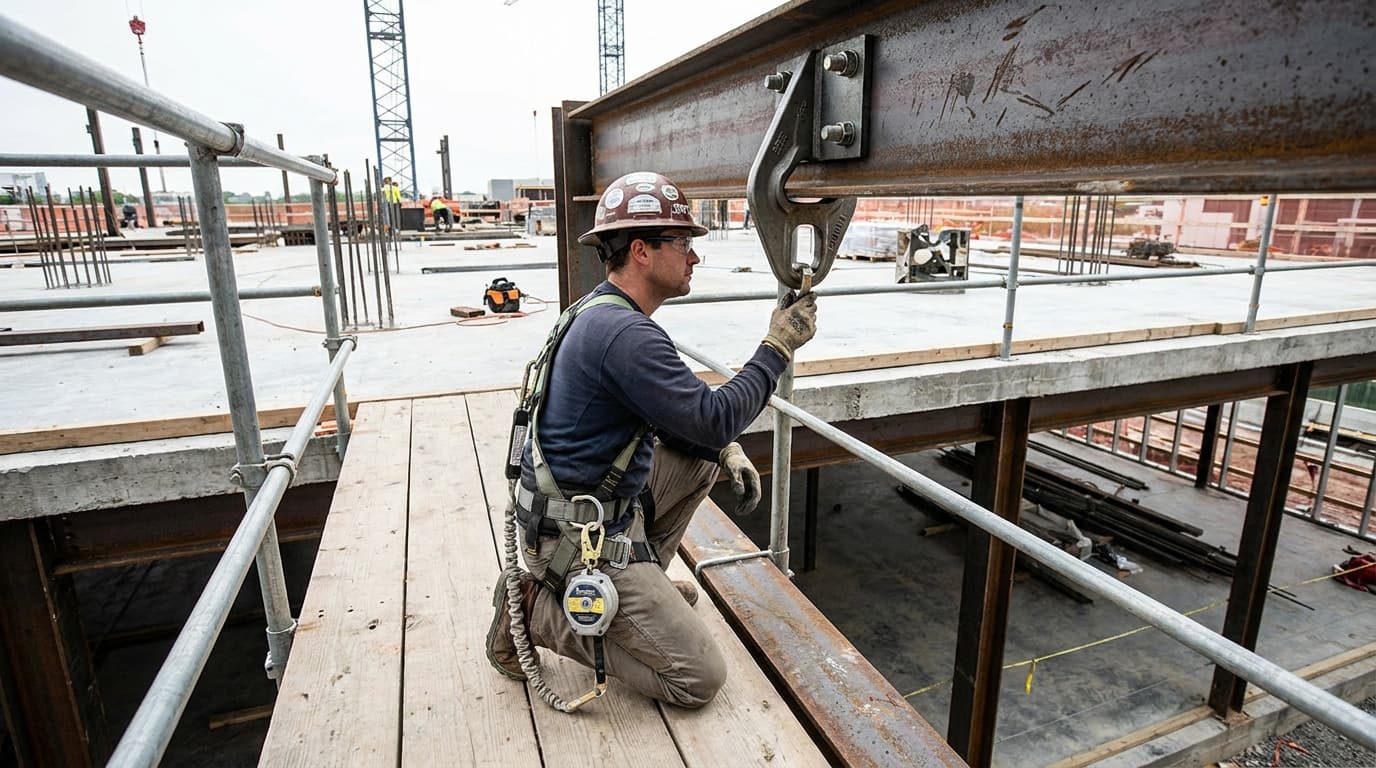
Protect the line from the edge. Anything the lifeline or lanyard passes over becomes part of the anchorage in practice. Pad it, use an edge-rated device, or reposition the anchor.
Treat eye-bolts as directional. Load along the axis. If the pull will be at an angle, the eye-bolt is not the right anchor and needs a qualified person to say what is.
One worker, one anchor, one vertical lifeline — unless a qualified person has designed the system for more.
Get horizontal lifelines designed, not improvised. Under (d)(8) this is qualified-person work. Ask for the design, the sag figure, and the maximum number of users. If nobody can produce them, the line has not been designed.
Write it down before the shift. The anchor should be decided in planning, not at height. Put it in the JHA or pre-task plan: which anchor, who approved it, on what basis, and how many people it covers.
Re-evaluate when anything changes. A new work position, a different connector, added workers, structure removed or altered below. The anchor was approved for a specific configuration and does not automatically carry over to the next one.
Before you start#
- Confirm the anchorage is independent of anything supporting or suspending your work platform.
- Confirm which compliance route applies: 5,000 lb per person, or engineered to a safety factor of two under a qualified person.
- Confirm who approved it, and that they meet the 1926.32(m) qualified definition, not just competent person.
- Confirm the anchor is at or above your dorsal D-ring.
- Check your lateral offset and walk the swing arc.
- Confirm you are using a rated anchorage connector, not a lanyard choked back on itself.
- Check for edges the line will bear on, and pad or reroute.
- Confirm the anchor covers the number of people who will actually be attached to it.
- If a horizontal lifeline is in use, ask for the design, the sag figure, and the user limit.
- Confirm you are not clipped to a guardrail — prohibited under 1926.502(d)(23).
Talk it over#
- Point at the anchor you are about to use. Who decided it was an anchor, and what did they base that on?
- Is anything holding up the platform you are standing on also holding your lanyard? Trace it back and check.
- If that anchor let go, what else on this structure would come with it?
The bottom line#
29 CFR 1926.502(d)(15) requires a fall arrest anchorage to be independent of anything supporting or suspending your platform and capable of supporting 5,000 pounds per employee attached — or engineered to a safety factor of at least two under the supervision of a qualified person, which under 1926.32(m) is a different and higher bar than the competent person who runs your inspections. Never tie off to a guardrail. Anchor overhead and in line with the work. Use a rated connector rather than a snaphook clipped back on itself, treat eye-bolts as axial-only, and give each worker their own anchor and their own vertical lifeline. And decide the anchor during planning, on the ground — because OSHA's own guidance says anchorage planning is the most overlooked part of the whole system, and it is the only part that arrived without a label.
Frequently asked questions about anchor points#
What is an anchor point?
The fixed attachment a personal fall arrest system connects to. Under 29 CFR 1926.502(d)(15) it must be independent of any platform-supporting anchorage and able to hold at least 5,000 pounds (22.2 kN) per employee attached — or be designed, installed and used as part of a complete personal fall arrest system maintaining a safety factor of at least two, under the supervision of a qualified person.
How strong does a fall protection anchor point need to be?
Under 29 CFR 1926.502(d)(15), at least 5,000 pounds (22.2 kN) per employee attached — or, alternatively, the anchorage may be designed, installed and used as part of a complete personal fall arrest system maintaining a safety factor of at least two, under the supervision of a qualified person. It must also be independent of any anchorage being used to support or suspend platforms.
Can I tie off to a guardrail?
No. 29 CFR 1926.502(d)(23) states that personal fall arrest systems must not be attached to guardrail systems, nor to hoists except as specified elsewhere in the part. Appendix C notes that guardrails or railings may only serve as anchor points if they were specifically designed for that use — which standard guardrail is not.
Who is allowed to approve an anchor point?
For the engineered route under 1926.502(d)(15)(ii), a qualified person. Under 1926.32(m), that means someone who by a recognized degree, certificate, or professional standing, or by extensive knowledge, training and experience, has demonstrated the ability to solve problems relating to the work. This is a different standard from a competent person under 1926.32(f), who is defined by hazard recognition and the authority to correct hazards. Appendix C adds that anchorages installed immediately before use should be designed by a registered professional engineer experienced in fall protection, or another qualified person.
Can two workers use the same anchor point?
Only if it was designed for it. The 5,000 lb requirement in 1926.502(d)(15) is expressly per employee attached, so two workers means 10,000 lb unless a qualified person has engineered the anchorage for multiple users. Separately, 1926.502(d)(10)(i) requires each employee to be attached to a separate vertical lifeline — the only exception being elevator shaft construction under (d)(10)(ii).
Why can't I tie off to the scaffold I'm standing on?
Because 1926.502(d)(15) requires the anchorage to be independent of any anchorage being used to support or suspend platforms. If the structure supporting your platform fails, it takes your fall arrest system down with it in the same event — leaving you with no protection against the exact failure you were protecting against.
Is wrapping a lanyard around a beam and clipping it back on itself acceptable?
No. Appendix C, paragraph (h)(1)(ii) explicitly warns against using a lanyard with a snaphook clipped onto itself, and directs that an acceptable strap be used for connections to steel members or I-beams. Choking a lanyard back on itself loads the snaphook in a direction it was not designed for and can reduce the strength of the connection substantially.
Does the direction of pull matter on an eye-bolt?
Yes, considerably. Appendix C, paragraph (h)(7) states that an eye-bolt's strength is rated along the axis of the bolt and is greatly reduced if the force is applied at an angle to that axis, in the direction of shear. The same paragraph warns to select the eye diameter carefully to avoid accidental disengagement of snaphooks not designed to be compatible with the connection.
Download the anchor point selection toolbox talk PDF#
Get this anchor point toolbox talk as a print-ready PDF — available in English, Spanish, Portuguese, and Turkish. Print it, hand it to the crew, and collect signatures on the included attendance sheet.
Download the PDF — free account required. New members get 3 free downloads.
Related toolbox talks#
Sources#
- OSHA, 29 CFR 1926.502 — Fall protection systems criteria and practices: https://www.osha.gov/laws-regs/regulations/standardnumber/1926/1926.502
- OSHA, 1926 Subpart M Appendix C — Personal Fall Arrest Systems, Non-Mandatory Guidelines: https://www.osha.gov/laws-regs/regulations/standardnumber/1926/1926SubpartMAppC
- OSHA, 29 CFR 1926.32 — Definitions: https://www.osha.gov/laws-regs/regulations/standardnumber/1926/1926.32