Infectious Diseases
Updated 2026-07-28
In this bundle Health & Environmental Exposure
Print-ready PDF
Download this talk as a print-ready PDF, available in 4 languages.
Construction has an unusual relationship with infectious disease. The work itself is mostly outdoors, spread out and physically separated — and then everybody eats in the same container, travels in the same van, shares the same tools and queues for the same welfare unit. The exposure is real, but it is almost never where people look for it. This Infectious Diseases Toolbox Talk (Safety Talk / Tailgate Talk) is about where it actually happens.
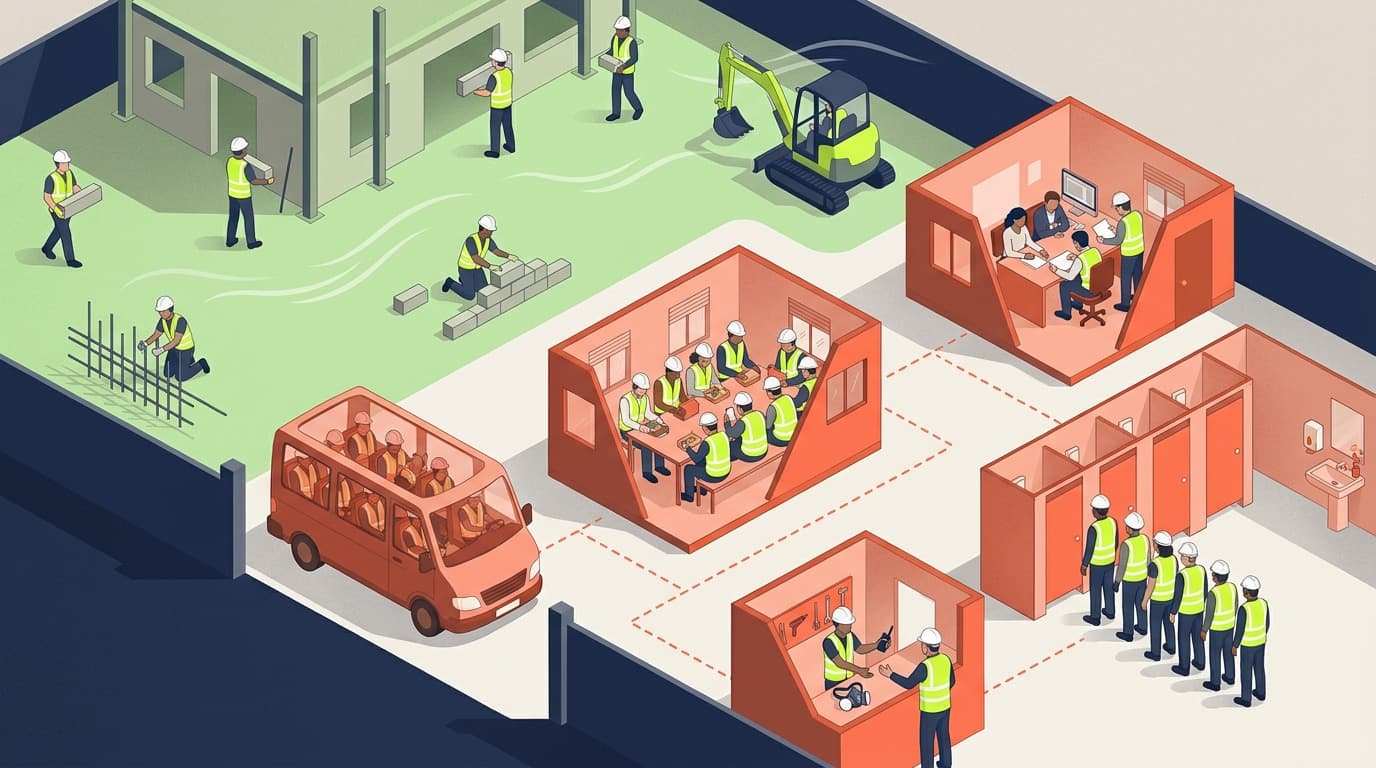
Here is the distinction that carries this whole talk: the work is not the risk — the gaps between the work are. Two people fixing steel ten metres apart in open air are in one of the safer environments there is. The same two people in a six-person welfare unit at lunch, in a crew cab at 6 a.m., or crowded round a drawing in a site office, are in one of the worse ones. Every control that follows targets the gaps, not the task.
No standard, and what that leaves#
OSHA has no general standard for infectious disease. There is no permissible exposure limit for a virus, no required control programme, and no construction-specific rule. What exists is the framework you have met throughout this bundle:
Section 5(a)(1), the General Duty Clause — a workplace free from recognised hazards likely to cause death or serious physical harm. A recognised infectious disease hazard with a feasible means of abatement sits inside it.
1926.21(b)(2) — instruction of each employee in the recognition and avoidance of unsafe conditions.
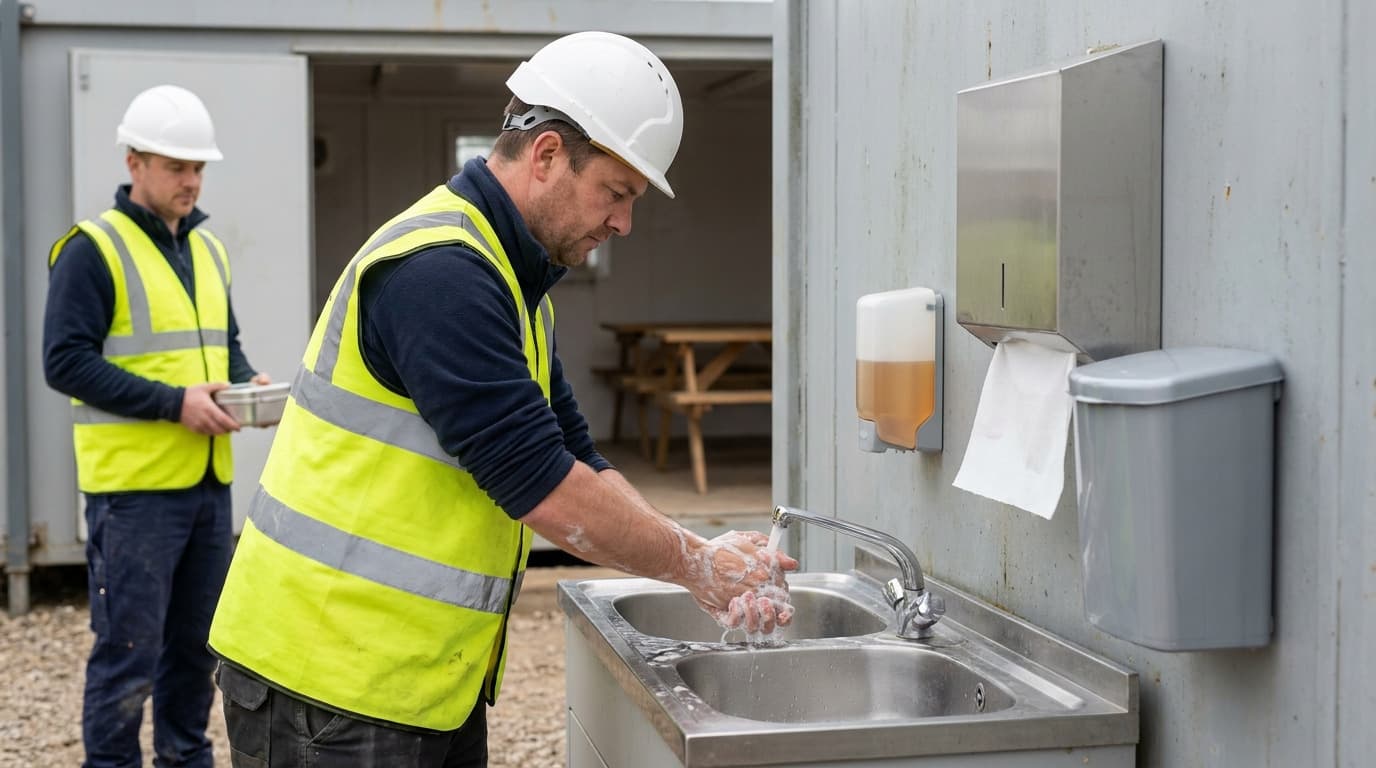
1926.51 — sanitation. The provisions that matter most here are the practical ones: an adequate supply of potable water, toilet facilities, and washing facilities on the site. Handwashing is not a soft control; it is the one the standard actually requires, and the details of those facilities are covered in the personal hygiene talk.
Part 1904 — recordkeeping. A work-related illness is recordable on the same basis as an injury, which means the question "did they catch it at work?" is not rhetorical — it has a recordkeeping consequence, and it is genuinely difficult to answer for a disease circulating in the wider community.
That thin framework is why infectious disease control on a construction site is mostly a management problem rather than a compliance one. Nobody is going to hand you a threshold.
Where transmission actually happens#
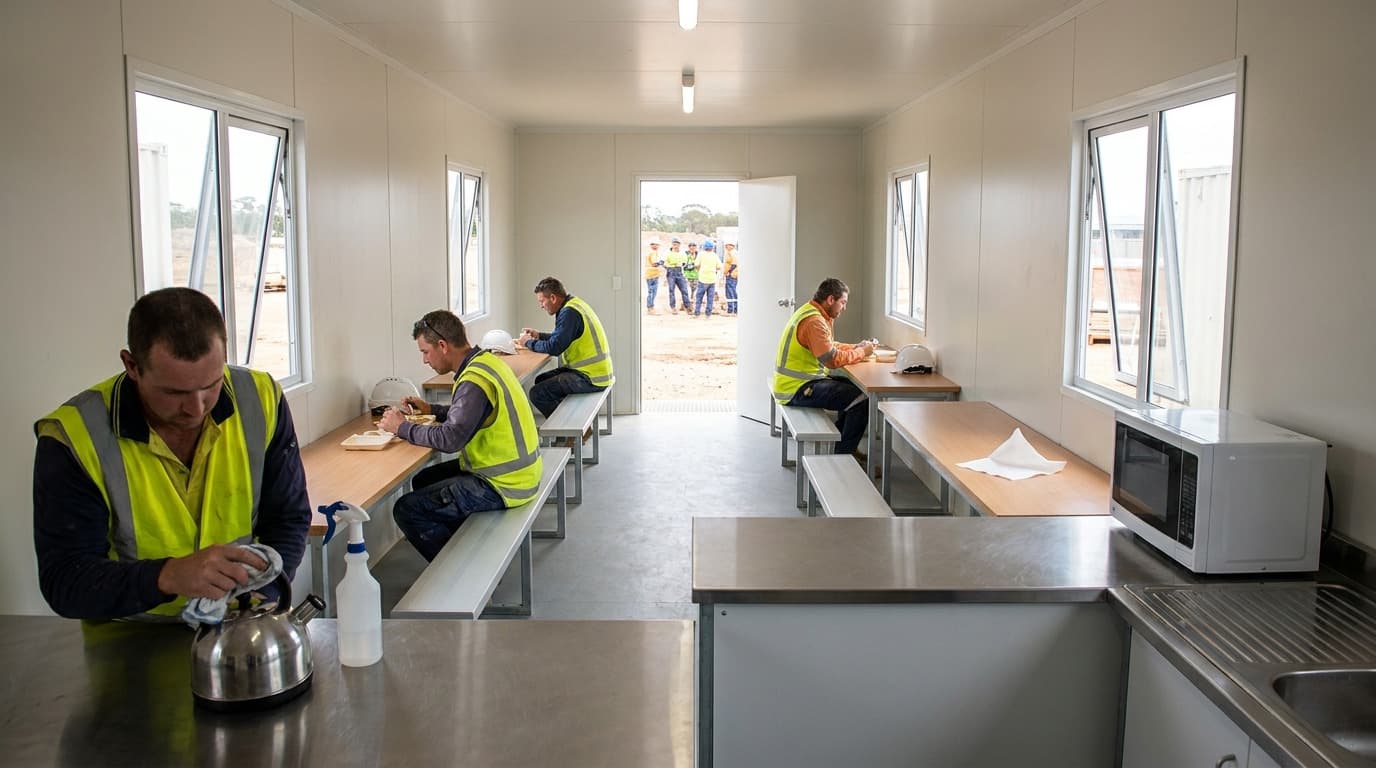
The welfare unit. Enclosed, small, poorly ventilated, everybody in it at the same time, food and hands and surfaces. If you change one thing on a site, change this.
Crew transport. A van at the start of a shift is a sealed box with several people breathing in it for an hour. It is the highest-exposure period of many people's day and nobody counts it as work.
Shared accommodation. Where crews are housed together, transmission at home and transmission at work are the same event.
Shared tools, radios and PPE. Hand-to-surface-to-hand is the route people forget, and shared respirators, harnesses and radios are worse than shared hand tools because they touch the face.
Toilets and washing facilities. Necessary, shared, and only as good as their cleaning and supplies.
The induction room, the site office and the huddle. Enclosed spaces used briefly by everybody, often unventilated.
Coming to work ill. The one that undoes all the others.
Presenteeism is the control that fails first#
Every infectious disease plan on every site depends on one thing that is entirely outside its written procedures: whether an unwell worker stays away.
On construction sites, several forces push the wrong way. Day rates and self-employment mean absence costs money directly. Agency and subcontract workers may fear losing the placement. Crews are small, so being absent visibly loads work onto people you know. And there is a real culture of pushing through, which serves the industry well in a rainstorm and badly in an outbreak.
The result is that a site can have an immaculate procedure and still have someone infectious in the welfare unit at lunch, because staying home was made expensive.
If you want the control to work, the honest questions are financial and cultural, not procedural: what does a worker lose by staying away, who do they tell, will they be believed, and does anything happen to them afterwards? A plan that does not answer those is a plan that assumes people will act against their own interest.
What can go wrong?#
One welfare unit for a hundred people. Peak occupancy at the same moment, every day.
The unit is never ventilated. Windows sealed for heat retention, no through-flow, a full extractor filter.
Nobody cleans the touch points. Door handles, kettle, microwave, taps, tables, sign-in pens and tablets.
Handwashing facilities without soap or towels. The requirement is met on paper and defeated in practice.
Shared face-touching equipment. Respirators, safety glasses, radios and harnesses passed between people without cleaning.
Crew transport ignored entirely. Controlled on site, uncontrolled in the van that brought everyone there.
People come in ill because they cannot afford not to.
Nobody knows who was near whom. No means of identifying close contacts after the fact.
How do we manage this properly?#
Fix the welfare unit first. More space or staggered breaks so peak occupancy drops, genuine ventilation, and cleaning of touch points on a schedule someone owns.
Ventilate everything enclosed. Welfare, offices, induction rooms, temporary enclosures — open it up, and treat still air as the hazard it is.
Make handwashing genuinely available. Facilities as 1926.51 requires, stocked with soap and drying, close to where people eat and where they work — not one sink at the gate.
Clean shared equipment between users, and stop sharing anything that touches the face.
Treat crew transport as a workplace. Ventilation, spacing where possible, and the same rules as any enclosed site space.
Remove the cost of staying away as far as you can, and say so out loud. This is the highest-value control available and the one most often left to chance.
Have a reporting route that is used. Someone to tell, a decision that follows, and no penalty for making the call.
Know how you would identify close contacts — who worked with whom, who travelled with whom — before you need to.
Support vaccination and occupational health access where the employer can, without making health information anyone else's business.
Before you start#
- Confirm how many people use the welfare unit at once, and whether breaks could be staggered.
- Confirm the welfare unit and any enclosed space will actually be ventilated today.
- Confirm handwashing facilities have water, soap and a means of drying.
- Confirm who cleans the touch points and how often.
- Confirm no face-contact equipment — respirators, glasses, radios — is being shared uncleaned.
- Confirm how the crew travels to site and whether that space is ventilated.
- Confirm everyone knows who to tell if they are unwell, and what happens next.
- Confirm you could work out who was in close contact with whom if you had to.
Talk it over#
- How many people are in that welfare unit at 12 o'clock?
- Who travelled in with you this morning, and for how long?
- If you woke up unwell tomorrow, what would it cost you to stay home?
- When was the last time anyone cleaned the door handle you just used?
The bottom line#
There is no OSHA standard for infectious disease, so the duty runs through Section 5(a)(1), with 1926.21(b)(2) for instruction, 1926.51 for the potable water, toilet and washing facilities that make hand hygiene possible, and Part 1904, under which a work-related illness is recordable like any injury. Because the framework is thin, this is a management problem: transmission on construction sites happens in the welfare unit, the crew van, shared accommodation, shared face-contact equipment and the enclosed spaces everyone passes through — not in the open-air work that people picture. And the control that fails first is presenteeism: if staying home costs a day rate, a placement or your standing with the crew, the best-written plan on the site will be defeated by lunchtime.
Frequently asked questions about infectious diseases#
Does OSHA have an infectious disease standard for construction?
No general one. There is no permissible exposure limit or required control programme for infectious disease in construction. The duty runs through Section 5(a)(1), the General Duty Clause, which requires a workplace free from recognised hazards likely to cause death or serious physical harm, supported by 1926.21(b)(2) on instructing employees in recognising and avoiding unsafe conditions.
What does OSHA actually require that helps?
Mostly sanitation. 29 CFR 1926.51 requires an adequate supply of potable water, toilet facilities and washing facilities at the site — which is what makes hand hygiene possible in the first place. The detail of those facilities is covered in the personal hygiene talk.
Where does transmission happen on a construction site?
Rarely at the work face. The higher-risk settings are the enclosed shared spaces: the welfare unit at break time, crew transport, shared accommodation, shared tools and face-contact equipment such as respirators, glasses and radios, and the site office, induction room or huddle. Open-air work with distance between people is comparatively low risk.
Is a work-related illness recordable?
Yes, on the same basis as an injury. Under Part 1904, a work-related illness meeting the recording criteria is recordable — which makes the question of whether an infection was contracted at work a recordkeeping question as well as a medical one, and a genuinely difficult one for a disease circulating in the community.
Why is coming to work ill such a problem to solve?
Because the pressures are financial and social rather than procedural. Day rates, self-employment, agency and subcontract arrangements mean absence has a direct cost, small crews mean absence visibly loads work onto colleagues, and the industry's habit of pushing through works against the control. A plan that does not reduce the cost of staying away is assuming people will act against their own interest.
What is the single highest-value change on most sites?
The welfare unit. It concentrates the whole workforce in a small, enclosed, poorly ventilated space at the same moment every day, with food, hands and shared surfaces. Staggering breaks, increasing space, ventilating properly and cleaning touch points on a schedule addresses more transmission risk than anything done at the work face.
Should we be cleaning shared tools?
Yes, and prioritising by what touches the face. Radios, respirators, safety glasses and anything worn on the head carry more risk than a shovel handle. Cleaning between users, and simply not sharing face-contact equipment, removes a route people routinely overlook.
Download the infectious diseases toolbox talk PDF#
Get this infectious diseases toolbox talk as a print-ready PDF — available in English, Spanish, Portuguese, and Turkish. Print it, hand it to the crew, and collect signatures on the included attendance sheet.
Download the PDF — free account required. New members get 3 free downloads.
Related toolbox talks#
Sources#
- OSHA, 29 CFR 1926.51 — Sanitation: https://www.osha.gov/laws-regs/regulations/standardnumber/1926/1926.51
- OSHA, 29 CFR 1926.21 — Safety training and education: https://www.osha.gov/laws-regs/regulations/standardnumber/1926/1926.21
- OSHA, 29 CFR Part 1904 — Recording and Reporting Occupational Injuries and Illness: https://www.osha.gov/laws-regs/regulations/standardnumber/1904
This talk summarises published regulatory guidance. It is not medical advice. Decisions about illness, testing, treatment and fitness to work are matters for a physician or other licensed health care professional, and individual health information should be treated as confidential.
Written by FieldSafetyTalk's safety professional — a CSP, ASP, CHST and OSHA Authorized Outreach Trainer with 14+ years of international construction safety experience across federal, heavy civil, and industrial projects.