Ground Fault Circuit Interrupter (GFCI)
Updated 2026-07-28
In this bundle Electrical Safety
Print-ready PDF
Download this talk as a print-ready PDF, available in 4 languages.
OSHA gives construction employers a choice on ground-fault protection — the ground fault circuit interrupter (GFCI) or an alternative — and the way the rule is written makes the two options look interchangeable. They are not remotely interchangeable. One of them opens the circuit while a fault is passing through a person. The other proves that a green wire was continuous at some point in the last three months. This GFCI talk is about reading that choice properly — and about the equipment on this site that the GFCI rule never mentions.
Here is the distinction that carries this whole talk: a GFCI is a protective device; an assured equipment grounding conductor program is an inspection programme. A device acts in milliseconds, without anyone deciding anything. A programme acts only as well as the last person who ran the test. Both are legal. Only one of them is working right now, while you read this.
"Either ... or" is not "either is fine"#
29 CFR 1926.404(b)(1)(i) sets the frame:
The employer shall use either ground fault circuit interrupters as specified in paragraph (b)(1)(ii) or an assured equipment grounding conductor program as specified in paragraph (b)(1)(iii) to protect employees on construction sites. These requirements are in addition to any other requirements for equipment grounding conductors.
Read the last sentence twice. Ground-fault protection is not a substitute for the equipment grounding conductor — it is layered on top of it. Choosing GFCIs does not relieve anyone of grounding the tool, and running an assured equipment grounding conductor program does not turn a damaged cord into an acceptable one.
The two options also do different jobs. A GFCI compares the current going out on the hot conductor with the current returning on the neutral. If some of it is leaving by another route — through a wet cord, a damaged tool, a person — the imbalance trips the device. The assured equipment grounding conductor program does not detect anything in real time. It verifies, on a schedule, that the equipment grounding conductor is intact so that a fault will clear through the breaker instead of through a body.
What the GFCI rule actually covers — and what it leaves out#
This is the paragraph that gets quoted from memory and misquoted almost every time. 1926.404(b)(1)(ii) requires GFCI protection on:
All 120-volt, single-phase, 15- and 20-ampere receptacle outlets on construction sites, which are not a part of the permanent wiring of the building or structure and which are in use by employees.
Three qualifiers, and each one carves something out:
- 120-volt, 15- and 20-ampere. A 30-ampere temporary receptacle is not in this sentence. Neither is 240-volt equipment. The "125-volt, 15-, 20- and 30-ampere" wording people recite comes from the National Electrical Code and the general industry standard — not from the construction rule.
- Not part of the permanent wiring. Plug a grinder into an existing wall receptacle in a building you are renovating and the GFCI requirement in (b)(1)(ii) does not reach that outlet. 1926.402(a) reinforces the point: the installation requirements of Subpart K apply to temporary and permanent installations used on the jobsite, but not to existing permanent installations that were in place before the construction activity began.
- In use by employees. A receptacle nobody is using is not the one the rule is aimed at.
There is also an express exemption. Receptacles on a two-wire, single-phase portable or vehicle-mounted generator rated not more than 5 kW, where the circuit conductors are insulated from the generator frame and all other grounded surfaces, need not have GFCI protection.
Now put those carve-outs next to the other option. The assured equipment grounding conductor program under (b)(1)(iii) covers all cord sets, all receptacles which are not part of the building or structure, and all equipment connected by cord and plug that is available for use or used by employees. No voltage limit. No amperage limit. No 5 kW exception.
That is the sting in this standard: the option most sites pick — GFCIs — is the one with the narrower scope, and the equipment that falls through the gaps is the equipment nobody thinks about. The honest way to run a site is to use GFCI protection everywhere the tools plug in, including where the letter of (b)(1)(ii) does not force it.
If you run the programme instead, run it properly#
(b)(1)(iii) is not a filing exercise. It requires all of the following:
- a written description of the programme available at the jobsite for inspection and copying — (A);
- one or more competent persons designated to implement it, competent as defined in 1926.32(f) — (B);
- a visual inspection before each day's use of every cord set, attachment cap, plug, receptacle and cord- and plug-connected item, for deformed or missing pins, insulation damage and signs of internal damage; damaged equipment out of service until repaired — (C);
- two tests on all cord sets, non-permanent receptacles and cord- and plug-connected equipment required to be grounded: continuity of every equipment grounding conductor, and correct attachment of that conductor to its proper terminal — (D);
- those tests performed before first use, before return to service after repair, after any incident that could have caused damage (the standard's own example is a cord set run over), and at intervals not exceeding 3 months — 6 months for cord sets and receptacles that are fixed and not exposed to damage — (E);
- equipment that has not met these requirements not made available for use — (F);
- records identifying each item that passed and the last test date or interval, kept by log, colour coding or other effective means, and available on site — (G).
The colour-coded tape most crews use is not a tradition; it is one of the recording methods the standard contemplates.
What a GFCI will not do for you#
It will not see a hand-to-hand contact. If you bridge hot and neutral, the current leaves and returns on the two conductors the device is comparing. The balance is intact, so nothing trips. The GFCI protects against current leaking to ground, not against every electrical injury.
It is not arc flash protection. A ground-fault device does not limit incident energy, and it does not change what happens when a fault flashes over inside a panel.
It does not replace the equipment grounding conductor — (b)(1)(i) says these requirements are in addition to the grounding requirements.
And the number everyone quotes is not OSHA's. A Class A GFCI trips at a ground-fault current of about 6 mA and does not trip below about 4 mA — that range comes from the product standard UL 943, not from 1926.404. OSHA requires approved ground-fault circuit interrupters for personnel protection; the performance behind that word lives in the listing.
What can go wrong?#
The GFCI is on the reel, and the reel is at the panel. Protection at the source is fine — until someone plugs a second, unprotected cord into an unprotected outlet further along.
A tripping GFCI is treated as a faulty GFCI. It gets swapped, bypassed, or replaced with a standard receptacle. A device that trips repeatedly is usually telling the truth about a wet connector or a failing tool.
Nobody presses the test button. The device has a test function precisely because it can fail internally, and a dead GFCI looks exactly like a working one.
The programme exists on paper only. A written AEGCP with no test records, no competent person and no daily inspection is not the second option — it is no option, and the site has no ground-fault protection at all.
The 30-amp temp panel is forgotten. Welders, large pumps and 240-volt equipment sit outside (b)(1)(ii) and get treated as if that meant they were safe.
How do we do this properly?#
Protect at the point of use. Put GFCI protection as close to the tool as practical, and treat any outlet a worker can reach as one that needs it — regardless of which side of the 15/20-ampere line it falls on.
Test before each shift. Press test, confirm the device trips, press reset. A GFCI that does not trip on test is out of service immediately.
Never bypass a tripping device. Find the fault. Wet connectors, damaged jackets and water inside a tool are the usual answers, and all three are reasons the circuit should have opened.
Inspect the cord anyway. Ground-fault protection and cord inspection are separate duties, and the cord inspection is required daily under the assured equipment grounding conductor program regardless of the GFCI.
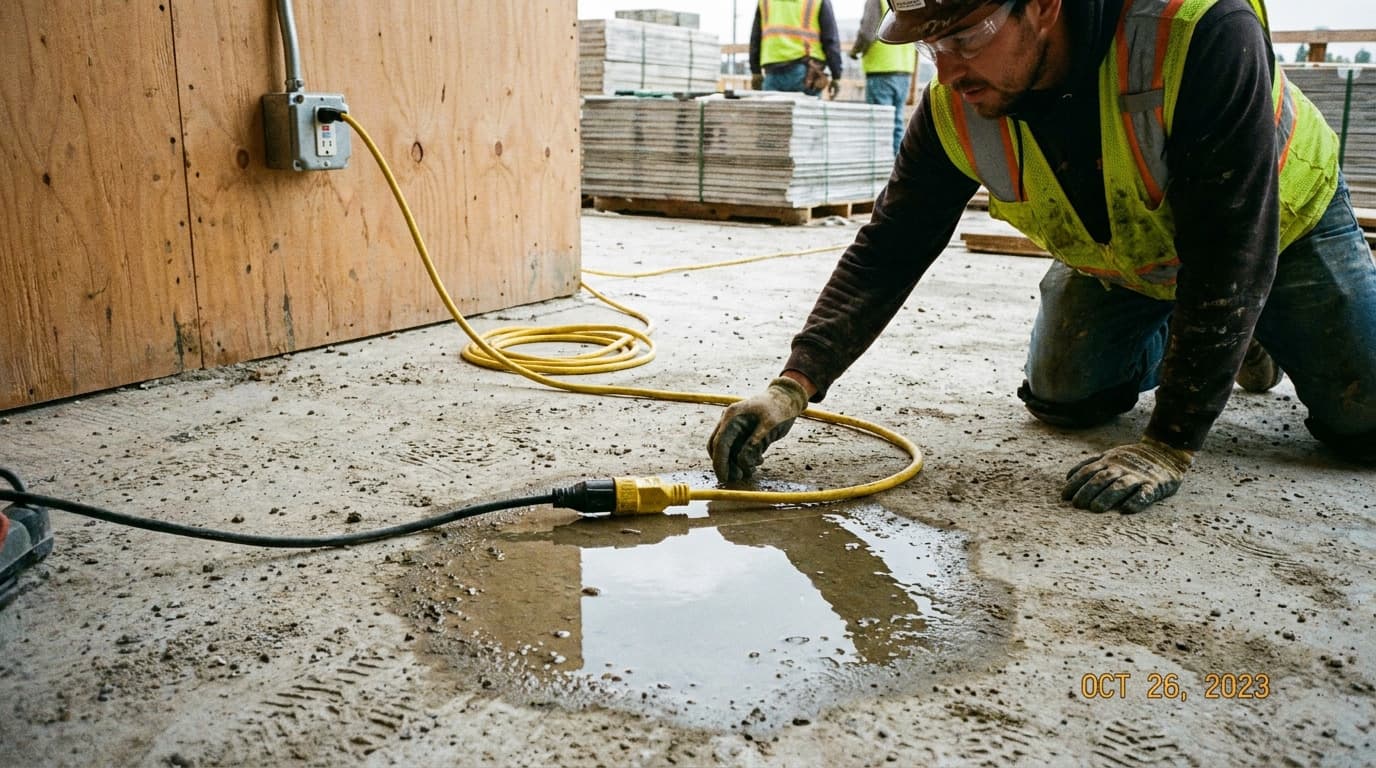
Keep connections out of the water. Standing connectors on a wet deck or leaving them in a puddle causes nuisance trips first and injuries later. Elevate them, cover them, and use connectors rated for the conditions.
If you rely on the programme, prove it. Written description on site, competent person named, tests recorded, colour codes current.
Before you start#
- Confirm every tool you will use today is fed through GFCI protection at or near the point of use.
- Press the test button on each device and confirm it trips and resets.
- Confirm no adaptors, no missing ground pins, no taped repairs on any cord.
- Confirm that connectors are out of standing water and clear of traffic.
- If your site runs an assured equipment grounding conductor program, confirm the equipment carries current test marking.
- Confirm the 30-ampere and 240-volt equipment on your task also has ground-fault protection, even though (b)(1)(ii) does not name it.

Talk it over#
- Has a GFCI ever tripped on you? What did you do next, and what did the crew do next?
- Where on this site do we have receptacles that the rule does not cover?
- Who is our competent person for the grounding conductor programme, and when were these cords last tested?
- What is the wettest place we are working this week, and what is plugged in there?
The bottom line#
1926.404(b)(1)(i) lets the employer choose GFCIs or an assured equipment grounding conductor program — but the two are not equivalent protections. The GFCI rule reaches only 120-volt, single-phase, 15- and 20-ampere receptacles not part of the permanent wiring and in use, with an exemption for two-wire generators rated 5 kW or less. The programme reaches all cord sets and cord- and plug-connected equipment but interrupts nothing — it verifies a path, on a schedule, up to three months old. Neither replaces the equipment grounding conductor, because (b)(1)(i) says these duties are in addition to it. Use GFCI protection at the point of use, test it before the shift, and never let a device that has tripped be treated as the problem.
Frequently asked questions about GFCI on construction sites#
Does OSHA require GFCIs on construction sites?
Not unconditionally. 29 CFR 1926.404(b)(1)(i) requires the employer to use either GFCIs as specified in (b)(1)(ii) or an assured equipment grounding conductor program as specified in (b)(1)(iii). Most sites choose GFCIs because a device that works on its own beats a programme that depends on quarterly testing and paperwork — but both are lawful, and whichever is chosen has to be real.
Which receptacles have to have GFCI protection?
Under 1926.404(b)(1)(ii), all 120-volt, single-phase, 15- and 20-ampere receptacle outlets on construction sites that are not part of the permanent wiring of the building or structure and are in use by employees. Receptacles on a two-wire, single-phase portable or vehicle-mounted generator rated not more than 5 kW, with the circuit conductors insulated from the frame and all other grounded surfaces, are exempt.
Do I need a GFCI for a 30-amp or 240-volt circuit?
The construction GFCI paragraph does not cover them — it names 120-volt, 15- and 20-ampere receptacles only. That is a gap in the wording, not a statement that the hazard is absent, and the assured equipment grounding conductor program option covers all cord sets and cord- and plug-connected equipment without any such limit. Protect the circuit.
What is an assured equipment grounding conductor program?
It is the alternative under 1926.404(b)(1)(iii): a written programme kept on the jobsite, a designated competent person, a visual inspection of cords, plugs, caps, receptacles and cord- and plug-connected equipment before each day's use, and continuity and terminal-attachment tests before first use, after repair, after any suspected damage, and at intervals not exceeding 3 months — 6 months for fixed items not exposed to damage — with records kept and available on site.
How often must cords be tested under that programme?
At intervals not exceeding 3 months, except cord sets and receptacles that are fixed and not exposed to damage, which may be tested at intervals not exceeding 6 months. Tests are also required before first use, before returning equipment to service after repairs, and after any incident that could reasonably be suspected to have caused damage.
At what current does a GFCI trip?
Class A devices — the type used for personnel protection — trip at a ground-fault current of about 6 mA and do not trip below about 4 mA, per the product standard UL 943. That figure is not in the OSHA standard, which requires approved ground-fault circuit interrupters for personnel protection and leaves the performance to the listing.
Does a GFCI protect against every electric shock?
No. It detects current leaving the circuit to ground. If a person contacts the hot and neutral conductors, the current out and the current back stay balanced and the device does not trip. It also provides no protection against arc flash, and it is not a substitute for the equipment grounding conductor.
Download the GFCI toolbox talk PDF#
Get this GFCI toolbox talk as a print-ready PDF — available in English, Spanish, Portuguese, and Turkish. Print it, hand it to the crew, and collect signatures on the included attendance sheet.
Download the PDF — free account required. New members get 3 free downloads.
Related toolbox talks#
Sources#
- OSHA, 29 CFR 1926.404 — Wiring design and protection: https://www.osha.gov/laws-regs/regulations/standardnumber/1926/1926.404
- OSHA, Assured Equipment Grounding Conductor Program (AEGCP): https://www.osha.gov/electrical/hazards/aegcp
- OSHA, 29 CFR 1926.402 — Applicability (Subpart K): https://www.osha.gov/laws-regs/regulations/standardnumber/1926/1926.402