Three-Point Contact
Updated 2026-07-24
In this bundle Fall Protection & Heights
Print-ready PDF
Download this talk as a print-ready PDF, available in 4 languages.
Everyone on this crew has been told about three points of contact. It is probably the most repeated instruction in construction safety. And if you go looking for it in the OSHA construction standards, you will not find the phrase. It is not a citation. There is no paragraph number to quote at somebody. This Three-Point Contact Toolbox Talk (Safety Talk / Tailgate Talk) is about a rule that survives entirely on its own merit — and about the moment on this jobsite that no fall protection rule covers at all.
Here is the distinction that carries this whole talk: every fall hazard we have covered so far triggers a duty at 6 feet. Getting into and out of a machine happens at four feet, or three, or two. 1926.501 never engages. No harness, no guardrail, no plan, no inspection. And it happens to every operator, every truck driver, and every mechanic on this site, six or eight or twelve times a day, for their entire career.
The rule that is not a rule#
Worth being precise about, because people quote it as law.
OSHA's general industry walking-working surfaces standard requires workers to face the ladder when climbing and to keep at least one hand grasping it. In the preamble to that rulemaking, OSHA described the intent behind those provisions as ensuring workers maintain three-point contact while climbing. That is a statement of regulatory intent — the phrase itself is not the operative text, and it sits in the general industry rule rather than the construction one.
On the construction side, 1926.1053 carries parallel climbing requirements for ladders, and OSHA's own guidance on extension ladders tells workers to face the ladder when climbing up or descending. But there is no construction provision that says "maintain three points of contact", and there is certainly nothing that says it about climbing onto an excavator.
So why does everyone teach it? Because it works, and because the duty to teach it exists anyway:
- 1926.21(b)(2) requires the employer to instruct each employee in the recognition and avoidance of unsafe conditions applicable to their work environment.
- The General Duty Clause, Section 5(a)(1), applies to recognised hazards with feasible controls — and falling while climbing off a machine is about as recognised as a hazard gets.
- 1926.602 governs material handling equipment, and manufacturers' operating instructions form part of safe use.
The practical point for the crew: three-point contact is not something you comply with. It is something that works. Nobody is going to write you a citation for jumping off the last step. The consequence is not administrative.
The access system you were given#
Here is the part that reframes the whole topic. Your machine was designed with a way to get on and off it.
SAE J185, Access Systems for Off-Road Machines — first issued in 1970 and revised since — sets minimum criteria for the steps, stairways, ladders, walkways, platforms, handrails, handholds, guardrails, and entrance openings that permit ingress to and egress from operator, inspection, maintenance and service positions on off-road machines. Somebody engineered those steps. Somebody sized those grab handles, positioned them, and specified their strength.
Which means every one of these is a decision to leave the system that was built for you:
- Stepping on a tyre or a track
- Using the door frame, the door edge, or the steering wheel as a handhold
- Using a hydraulic hose or line to pull yourself up
- Jumping the last step instead of using it
- Climbing on the counterweight, the bucket, or the fuel tank
None of those were designed to be touched by a person under load. The tyre is round and often greasy. The door swings. The hose moves. The counterweight has no edge to grip.
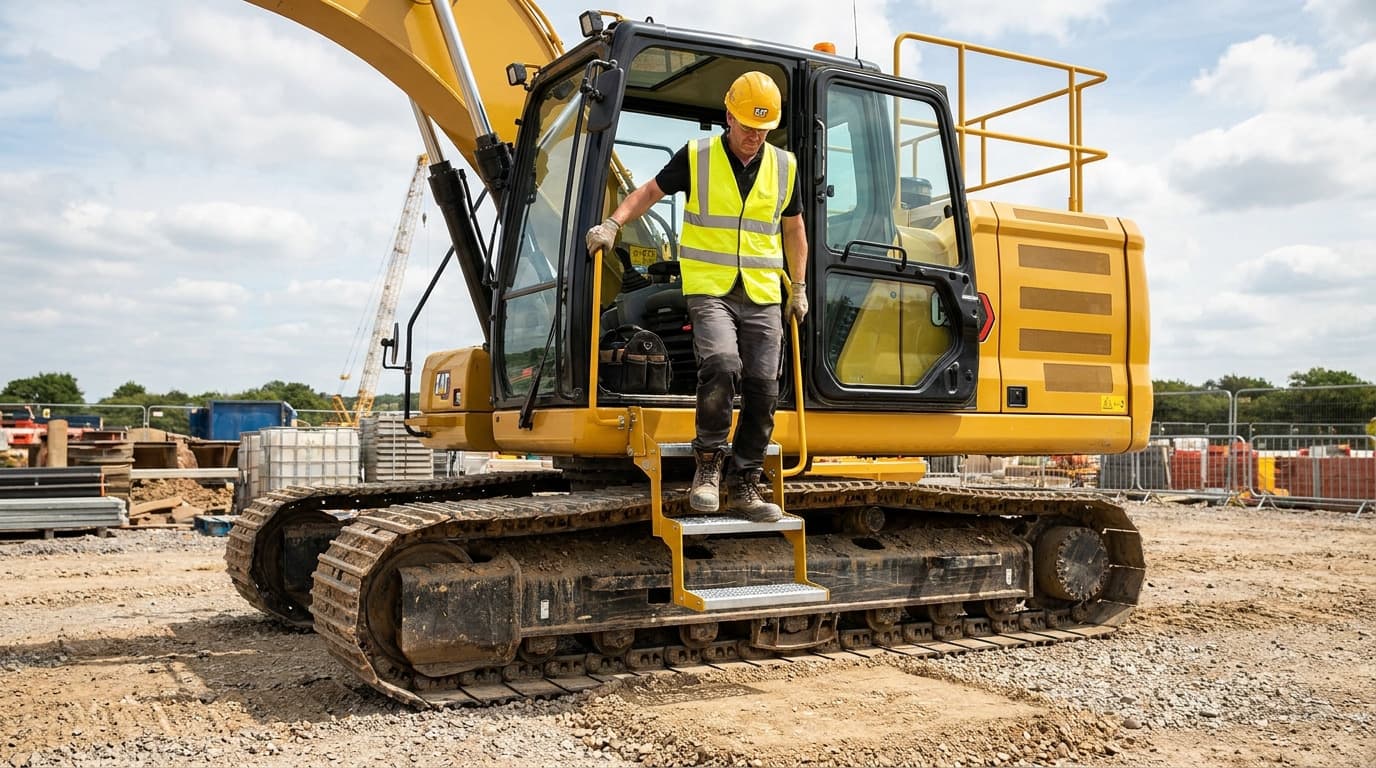
Three points of contact simply means using the access system as designed — two hands and one foot, or two feet and one hand, always on purpose-built steps and handholds. That is the whole technique.
Why the way down is worse than the way up#
Ask the crew which direction they think causes more injuries. Almost everyone says climbing up. It is the other one, and the reasons are structural rather than careless:
- You are facing outward. Coming down facing away from the machine is faster, and it removes your handholds and your view of the steps at the same time.
- The last step is invisible. You cannot see the ground from the top step, so you cannot see the rut, the rebar offcut, the spoil pile, or the ice you are about to land on.
- You do it tired. Getting out happens at the end of a task or the end of a shift. Getting in happens when you are fresh.
- You are carrying something. A flask, a radio, a clipboard, a tool. One hand gone.
- The drop is deceptive. A step that feels like nothing when you are fresh becomes an ankle, a knee, or a lower back when you land on uneven ground with your legs already loaded from a shift of vibration.
That last point ties this topic back to the rest of the bundle. Jumping down is a loading event, and the load goes through the same structures that manual handling injures. The person landing off a cab step is not falling from height — they are absorbing several times their body weight through the knees, ankles, and spine, onto ground they could not see.
What can go wrong#
Jumping the last step. The single most common habit on any site, and the one that produces the ankle and knee injuries.
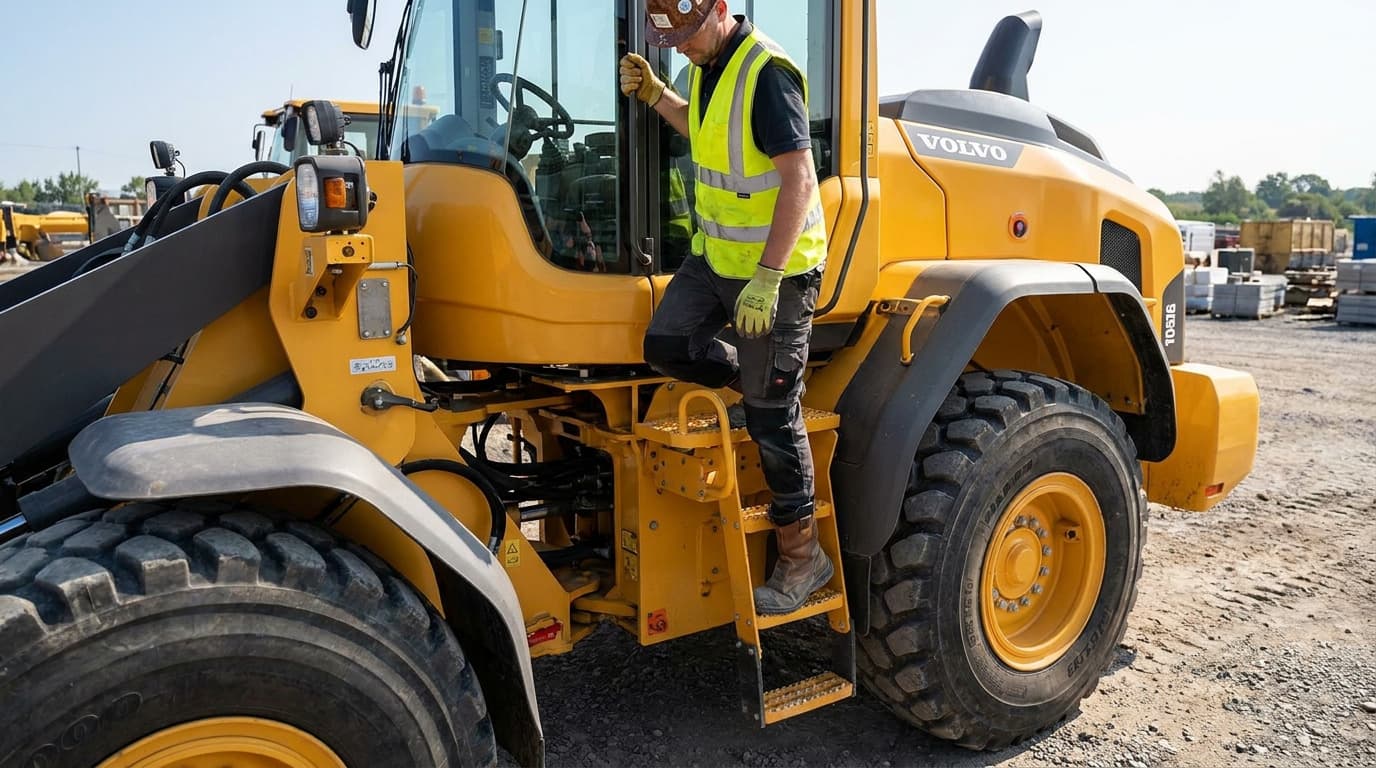
Descending facing outward. No handholds available, no sight of the steps.
Carrying something down. Hands are for the machine. Anything you carry down should have been lowered or left in the cab.
Mud, ice, diesel, and grease on the steps. The access system only works if the surfaces are usable, and steps collect exactly what the machine drives through.
Damaged or missing steps and handholds. Bent, torn off, or never replaced after a repair — and nobody reported it because you can still get up there.
Worn-out boot tread. The interface between the worker and the step is a boot sole that nobody inspects.
Landing on uneven ground. Spoil, ruts, cable, offcuts, and the pile of material that was not there this morning.
Three-point contact "except for the last bit." The habit of releasing the last handhold early, which is where balance is actually lost.
Rushing at shift change or when someone is waiting. The most reliable predictor of a mount/dismount injury is somebody watching or waiting.
Dismounting a machine that is still moving, or before it has fully stopped and been secured.
How do we do this properly?#
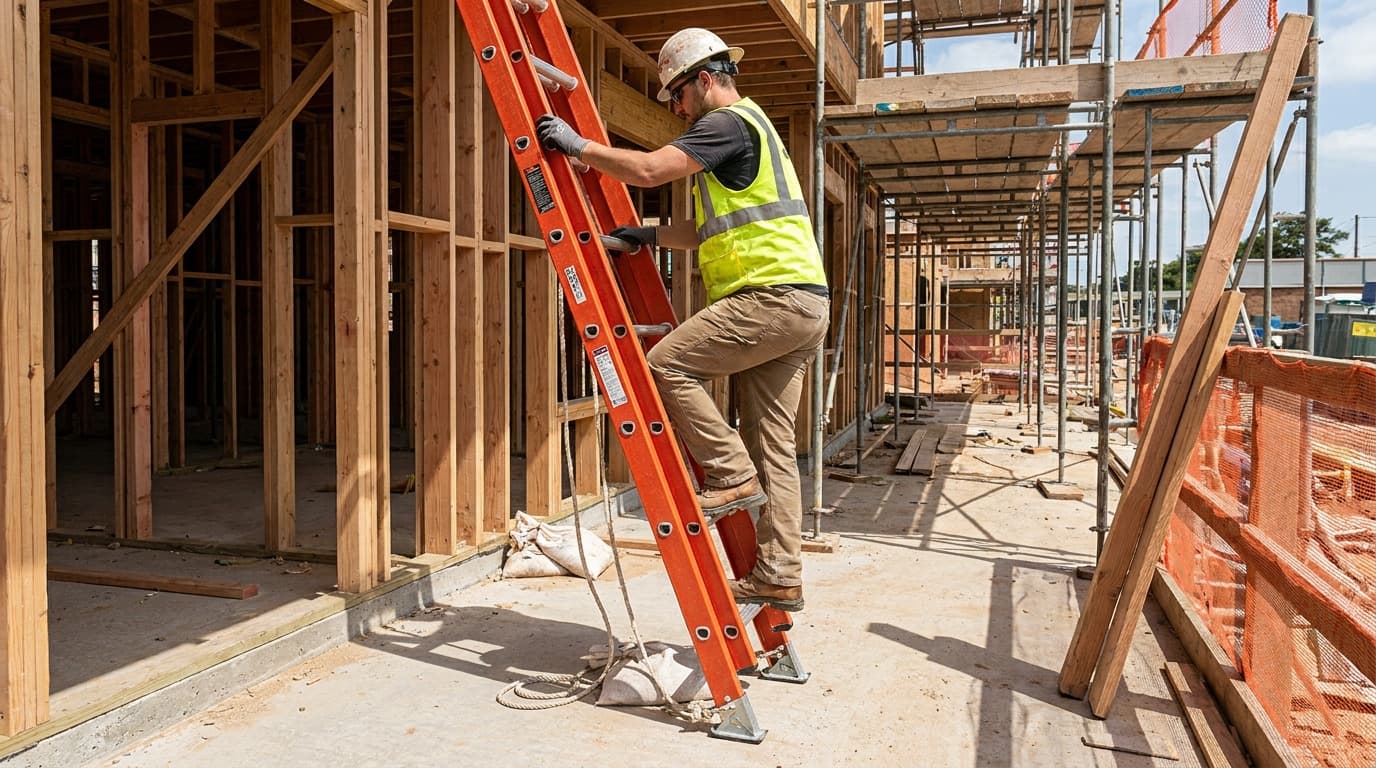
Use the access system, always. Designed steps and designed handholds. If you have to touch a tyre, a track, a hose, or a door frame, you are outside the system.
Face the machine going down, every time. This is the single highest-value habit in the topic and the one most often skipped.
Three limbs on the machine at all times — two hands and a foot, or two feet and a hand. Deliberate, not approximate.
Nothing in your hands. Lower tools, leave the flask in the cab, come back for it. Hands are load-bearing equipment on the way down.
Look at where you are going to land before you commit. Ground conditions change during a shift. What you stepped onto this morning may have a spoil pile on it now.
Never jump. Not the last step, not from the bed, not from the track. Use every step that exists.
Clean the steps and clean your boots. Both ends of the interface. Kick off mud before you climb.
Inspect steps and handholds as part of the machine walkaround, and report damage rather than working around it. This sits naturally in the pre-use inspection you already do.
Stop the machine, lower attachments, set the brake, and secure it before dismounting.
Slow down at shift change. If somebody is waiting for the machine, they can wait the extra four seconds.
On USACE and NAVFAC projects, EM 385-1-1 applies and carries its own requirements for equipment access and operator practices.
Before you start#
- Look at the access system on this machine and identify the designed steps and handholds.
- Check that all steps and handholds are present, secure, and undamaged.
- Clean mud, ice, grease, or diesel off the steps before use.
- Check your own boot tread.
- Confirm the ground where you will step down is clear and level, and re-check it later in the shift.
- Confirm you have nothing in your hands before descending.
- Confirm the machine is stopped, attachments lowered, and brake set before dismounting.
- Plan to face the machine on the way down.
- Confirm nobody is rushing you at shift change.
- Report any damaged access component instead of working around it.
Talk it over#
- Which is more dangerous on this machine, getting on or getting off — and why?
- What do you have in your hands the last time you climbed out of a cab?
- Look at the ground beside the steps. Would you be happy to land on it from a metre up, tired, without looking?
The bottom line#
Three points of contact is not an OSHA construction requirement — the phrase does not appear in the construction standards, and no inspector will cite you for breaking it. It survives because it works, and because 1926.21(b)(2) and the General Duty Clause still require you to be instructed in avoiding a hazard this obvious. Your machine was built with an access system to SAE J185 — designed steps, designed handholds — and every tyre, track, hose, and door frame is a decision to leave it. Face the machine going down, keep three limbs on it, carry nothing, look at the ground before you commit, and never jump the last step. This is the fall hazard that sits below every regulatory trigger on site, and the one that will happen to you more times than any other.
Frequently asked questions about three-point contact#
Is three-point contact an OSHA requirement?
Not as a phrase, and not in the construction standards. OSHA's general industry walking-working surfaces rule requires workers to face the ladder when climbing and to keep at least one hand grasping it, and OSHA described the intent behind those provisions as maintaining three-point contact. But there is no construction provision stating "maintain three points of contact", and none applying it to mounting or dismounting equipment. The duty to train on the hazard still exists under 1926.21(b)(2) and the General Duty Clause, Section 5(a)(1).
What does three-point contact actually mean?
Keeping three limbs in firm contact with the machine at all times while climbing — either two hands and one foot, or two feet and one hand — using purpose-built steps and handholds rather than whatever is within reach. In practice it means using the machine's access system exactly as it was designed to be used.
Does fall protection apply when climbing on and off equipment?
Generally no. 1926.501(b)(1) triggers fall protection duties at 6 feet (1.8 m) above a lower level, and mounting or dismounting a machine or truck usually happens well below that. This is precisely why the practice matters — the exposure is real and frequent, but no fall protection standard engages, so nothing but technique and equipment condition protects the worker.
Why is getting down more dangerous than getting up?
Because the conditions are worse in every respect. Workers commonly descend facing outward, which removes the handholds and the view of the steps at the same time; the ground is not visible from the top step; the descent typically happens at the end of a task when the worker is fatigued; and hands are more often occupied. Getting on happens fresh and facing the machine.
Can I step on the tyre or the track?
No. Those are not part of the access system. SAE J185, Access Systems for Off-Road Machines, sets minimum criteria for the steps, stairways, ladders, walkways, platforms, handrails, handholds, guardrails, and entrance openings provided for getting on and off the machine. A tyre is round, often contaminated, and was never intended as a step. The same applies to door frames, door edges, steering wheels, and hydraulic lines used as handholds.
What if a step or handhold is damaged or missing?
Report it and get it repaired rather than working around it. Damaged access components are frequently unreported precisely because the worker can still climb up without them — which means the machine is being used with a degraded access system indefinitely. Include steps and handholds in the pre-use walkaround.
Why does jumping down cause so many injuries?
Because it is a loading event, not a fall. Landing from a cab step drives several times body weight through the ankles, knees, and lower back — onto ground the worker could not see from the top step, at the end of a shift, with legs already fatigued. That is the same set of structures that manual handling injures, which is why this topic belongs with lifting rather than with fall protection.
Download the three-point contact toolbox talk PDF#
Get this three-point contact toolbox talk as a print-ready PDF — available in English, Spanish, Portuguese, and Turkish. Print it, hand it to the crew, and collect signatures on the included attendance sheet.
Download the PDF — free account required. New members get 3 free downloads.
Related toolbox talks#
Sources#
- OSHA, 29 CFR 1926.501 — Duty to have fall protection: https://www.osha.gov/laws-regs/regulations/standardnumber/1926/1926.501
- OSHA, 29 CFR 1926.21 — Safety training and education: https://www.osha.gov/laws-regs/regulations/standardnumber/1926/1926.21
- OSHA, Reducing Falls in Construction: Safe Use of Extension Ladders, Fact Sheet OSHA 3660: https://www.osha.gov/sites/default/files/publications/OSHA3660.pdf
- SAE International, J185 — Access Systems for Off-Road Machines: https://www.sae.org/standards/content/j185_200305/
Written by FieldSafetyTalk's safety professional — a CSP, ASP, CHST and OSHA Authorized Outreach Trainer with 14+ years of international construction safety experience across federal, heavy civil, and industrial projects.