Fire Extinguisher Use
Updated 2026-07-24
In this bundle Fire, Hot Work & Emergency
Print-ready PDF
Download this talk as a print-ready PDF, available in 4 languages.
There is a phrase buried in OSHA's extinguisher training rule that quietly defines the entire topic: employees must be familiarised with the general principles of extinguisher use and the hazards involved with incipient stage firefighting. Incipient stage. Not "a fire." Not "a small fire." A specific, bounded thing — the very beginning, when a fire can still be controlled by one person with one portable unit and no protective clothing. This Fire Extinguisher Use Toolbox Talk (Safety Talk / Tailgate Talk) is about that boundary, and about knowing when you have already crossed it.
Here is the distinction that carries this whole talk: every other control we brief tells you what to do. This one is the only one whose most important lesson is when not to act. A fire extinguisher is a tool with roughly ten to twenty seconds of discharge in it. The skill is not aiming it. The skill is deciding, in about two seconds, whether it is the right tool at all — and being willing to answer no.
What "incipient" actually bounds#
An incipient stage fire is one still in its earliest phase: small, contained, not spreading, producing little smoke, and approachable without breathing apparatus or turnout gear. Once a fire is beyond that, a portable extinguisher is not undersized — it is the wrong category of equipment, and using it puts a person inside a hazard that needs a fire service response.
Four questions decide it, and they all have to be yes:
- Is it small and not spreading? If it has moved beyond what it started in, it is past incipient.
- Can you fight it with your back to a clear exit? If the fire is between you and the way out, the decision has already been made for you.
- Is the smoke light enough that you do not need to hold your breath? Smoke is the thing that kills; if you are breathing it, leave.
- Do you have the right extinguisher, and does it have enough in it? One unit, one attempt.
And one more that overrides all four: has the alarm been raised? Raising the alarm comes first, always, because it is the only step that helps if your attempt fails.
The two tiers of training nobody separates#
29 CFR 1910.157(g) sets out two distinct obligations, and they are routinely collapsed into one:
- (g)(1) Where the employer has provided portable fire extinguishers for employee use, the employer shall also provide an educational programme to familiarise employees with the general principles of fire extinguisher use and the hazards involved with incipient stage firefighting — and (g)(2) requires this upon initial employment and at least annually thereafter.
- (g)(3) Employees who have been designated to use firefighting equipment as part of an emergency action plan shall be provided with training in the use of the appropriate equipment — and (g)(4) requires this upon initial assignment and at least annually thereafter.
Read the difference. (g)(1) is awareness for everyone who might pick one up — what these things do and where the limits are. (g)(3) is skills training for the named few who are expected to fight a fire as part of the plan. If your site has designated fire response people, awareness training does not cover them.
On a construction site the picture is different, and worth being straight about. 1910.157 is a general industry standard. Construction's fire protection duties sit in 1926.150, which requires extinguishers to be provided, conspicuously located, and maintained — and the duty to instruct workers in recognising and avoiding hazards comes through 1926.21(b)(2). The training expectation is real; it simply arrives by a different route, and the annual cycle in 1910.157(g)(2) is the sensible benchmark to work to.
Provision, in one line#
1926.150(c)(1)(i) sets the baseline: a fire extinguisher rated not less than 2A shall be provided for each 3,000 square feet of the protected building area, or major fraction thereof, and travel distance from any point of the protected area to the nearest fire extinguisher shall not exceed 100 feet. Under 1926.150(a)(4), firefighting equipment must be conspicuously located, and under (a)(5) it must be periodically inspected and maintained in operating condition, with defective equipment immediately replaced.
That is where extinguishers come from. What they are for is the rest of this talk.
Classes: matching the extinguisher to the fuel#
Using the wrong class ranges from useless to actively dangerous:
- Class A — ordinary combustibles: timber, paper, packaging, fabric.
- Class B — flammable liquids and gases: fuel, solvents, paints, adhesives.
- Class C — energised electrical equipment. The rating means the agent is non-conductive; it does not mean the electricity is safe. De-energise if you can.
- Class D — combustible metals: magnesium, titanium, sodium. Needs a specific dry powder agent.
- Class K — cooking oils and fats. Site canteens and welfare units.
The dangerous mismatch to name out loud: water or foam on energised electrical, and water on a fuel or oil fire. Water on burning liquid does not extinguish it — it spreads it, and where the liquid is hot, it can throw burning fuel outward violently. Most site extinguishers are ABC dry powder, which covers the common cases, but the fuel store, the generator, and the canteen are each their own question.
PASS, and what it leaves out#
The technique is simple and worth rehearsing physically rather than describing:
- P — Pull the pin, breaking the tamper seal.
- A — Aim low, at the base of the fire, not the flames. The flames are the product; the fuel is the problem.
- S — Squeeze the handle in a controlled grip.
- S — Sweep side to side across the base until the fuel stops burning.
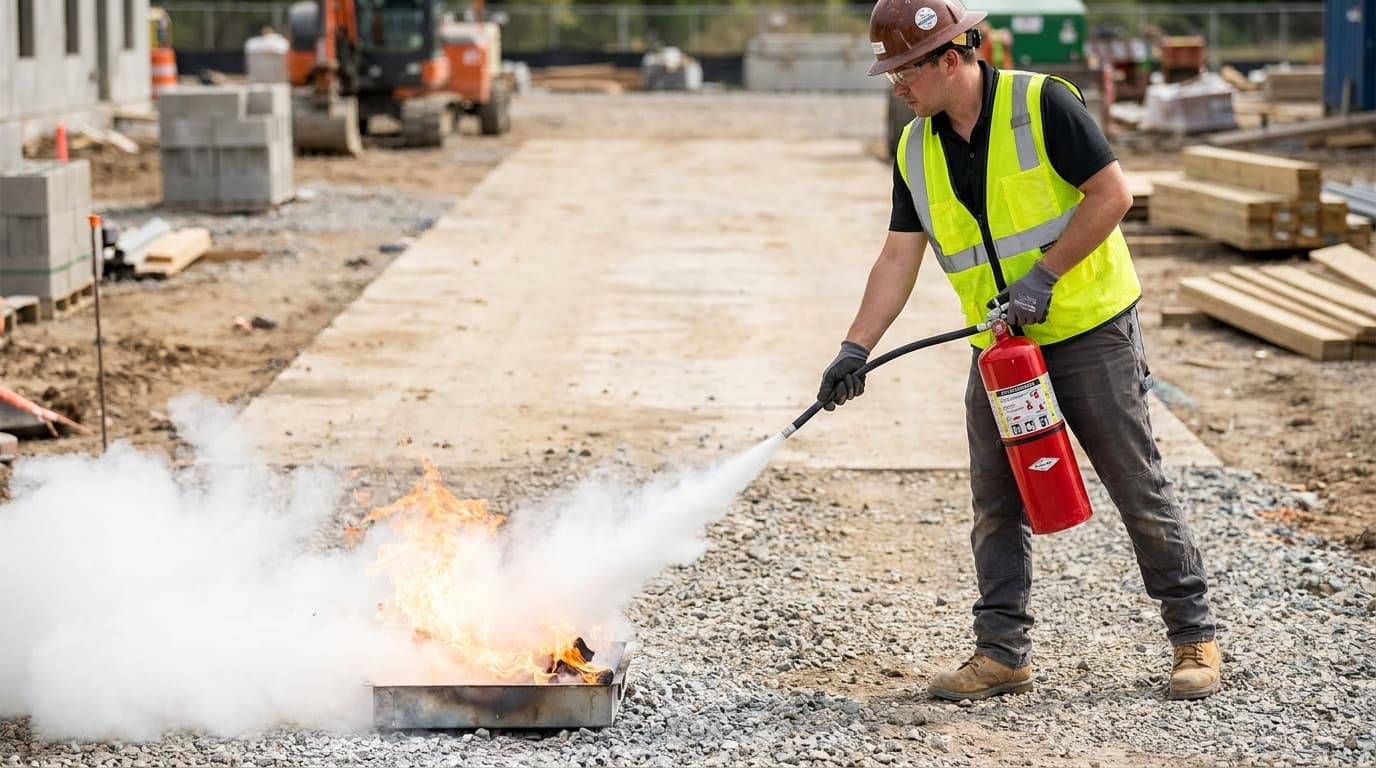
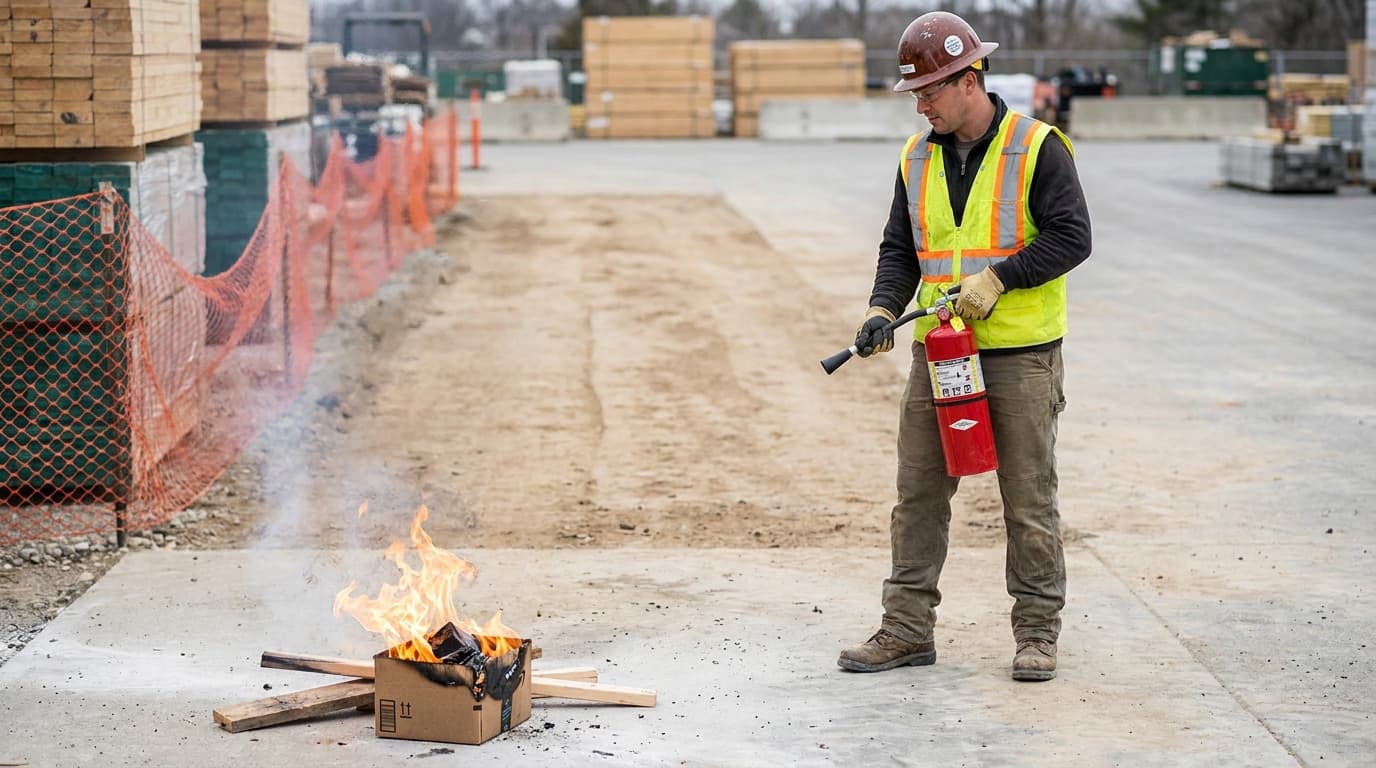
What PASS omits is everything around it. Stand back — most units have a rated range of several metres, and standing too close puts you in the heat and can scatter loose fuel. Keep your exit behind you. Watch for re-ignition, especially on liquids and on anything that has been heated. And stop and leave the moment the extinguisher empties or the fire does not visibly shrink — you get one attempt, not two.
On USACE and NAVFAC projects, EM 385-1-1 applies and is more prescriptive on extinguisher provision, inspection and training.
What can go wrong#
Fighting a fire that is past incipient. The single decision that turns a fire into a fatality.
Nobody raised the alarm. Everyone assumed the person with the extinguisher had it, and no call was made.
Fire between the worker and the exit. Attention on the flames rather than the route out.
Wrong class for the fuel. Water or foam on electrical, water on liquid fuel.
Standing too close, in the heat and the smoke.
Aiming at the flames rather than the base — the fire is unaffected and the extinguisher empties.
No training. People will use them anyway; the question is whether they have ever held one.
Extinguisher missing, discharged, obstructed, or out of date. Found at the moment of need.
Nobody knows where the nearest one is on a site where the layout changed last week.
Re-ignition after everyone walked away, especially on liquid or hot surfaces.
Smoke ignored because the flames looked small. Smoke incapacitates long before burns do.
Going back in for the second attempt, or for equipment.
How do we handle this properly?#
Raise the alarm first, every time. Before assessing, before reaching for anything. If the attempt works you have lost nothing; if it fails you have gained the only thing that mattered.
Apply the incipient test before you commit. Small and not spreading, clear exit behind you, light smoke, right extinguisher. Anything less is an evacuation, not a fire fight.
Know your escape route before you turn towards the fire, and keep it behind you throughout.
Match the class to the fuel — and know specifically what covers the fuel store, the generator, and the canteen.
Use PASS from a proper distance, aimed at the base, sweeping.
One attempt. If the unit empties or the fire is not visibly shrinking, get out and close the door behind you if you safely can.
Never go back in. Not for a second extinguisher, not for tools, not for anything.
Train people annually, and give designated responders the separate skills training the standard distinguishes.
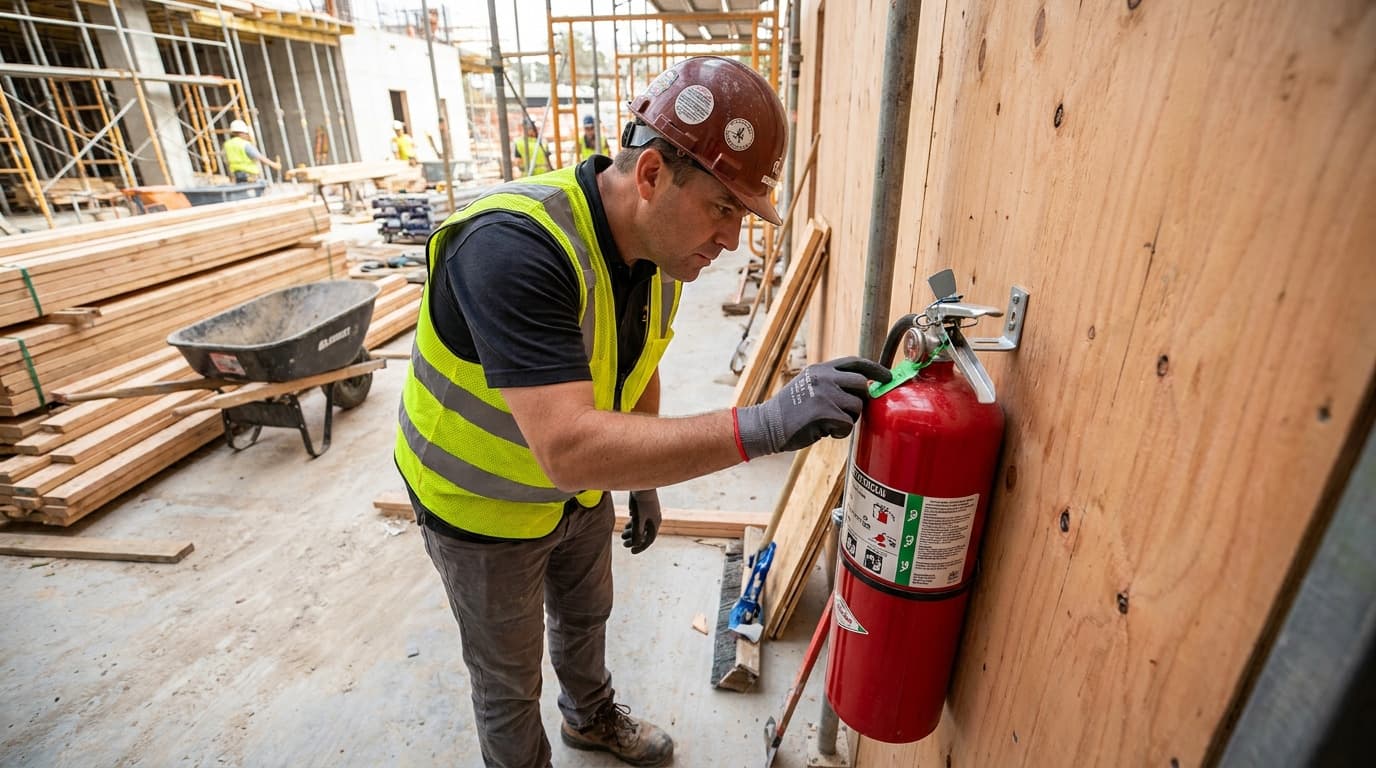
Check placement weekly as part of the site walk — present, unobstructed, in date, pin and seal intact, gauge in the green.
Re-brief when the site layout changes, because the nearest extinguisher moves when the building does.
Before you start#
- Know where the nearest extinguisher is from where you are working today.
- Check it is present, unobstructed, in date, with the pin and seal intact.
- Check its class suits the fuels in your area.
- Know how you would raise the alarm, and who you would call.
- Identify your escape route from your work position, and a second one.
- Decide in advance what you would do if the fire were bigger than one extinguisher.
- Confirm you have actually been trained, not just told where they are.
- If you are a designated responder, confirm your training is current.
- Confirm nobody assumes someone else will call.
- Agree that walking away is the correct answer whenever the test is not met.
Talk it over#
- Point to the nearest extinguisher without looking around. How far is it, and what class is it?
- If a fire started at the fuel point, would the extinguisher nearest to it be the right one?
- Who calls it in — and what happens if everyone assumes someone else did?
The bottom line#
OSHA's own training language sets the limit: employees must understand the general principles of extinguisher use and the hazards involved with incipient stage firefighting — 1910.157(g)(1) — with education upon initial employment and at least annually, and separate training under (g)(3) for anyone designated to fight fires under an emergency action plan. Construction gets its extinguishers through 1926.150(c)(1)(i) — a 2A unit per 3,000 square feet with travel distance no more than 100 feet — and its instruction duty through 1926.21(b)(2). Raise the alarm first. Apply the test: small, not spreading, exit behind you, light smoke, right class. Aim at the base, sweep, and take one attempt. And treat walking away as the trained response it is, not the failure it feels like.
Frequently asked questions about fire extinguishers#
What does "incipient stage" mean?
It is the earliest phase of a fire — still small, contained, not spreading, producing limited smoke, and approachable without breathing apparatus or protective firefighting clothing. OSHA uses the term in 29 CFR 1910.157(g)(1), which requires employees to be familiarised with the general principles of extinguisher use and the hazards involved with incipient stage firefighting. Beyond that stage a portable extinguisher is not simply too small — it is the wrong category of equipment.
How often is fire extinguisher training required?
Under 1910.157(g)(2), the educational programme required by (g)(1) must be provided upon initial employment and at least annually thereafter. Separately, under (g)(3) and (g)(4), employees designated to use firefighting equipment as part of an emergency action plan must receive training in the use of the appropriate equipment upon initial assignment and at least annually thereafter.
Is there a difference between education and training here?
Yes, and the standard is deliberate about it. (g)(1) education is for anyone who might use an extinguisher — general principles and the hazards of incipient stage firefighting. (g)(3) training is for the named individuals expected to fight fires as part of the emergency action plan, and covers the actual use of the appropriate equipment. Awareness for everyone does not satisfy the designated-responder requirement.
How many extinguishers does a construction site need?
Under 29 CFR 1926.150(c)(1)(i), a fire extinguisher rated not less than 2A must be provided for each 3,000 square feet of protected building area, or major fraction thereof, and the travel distance from any point of the protected area to the nearest extinguisher must not exceed 100 feet. Under 1926.150(a)(4) and (a)(5), equipment must be conspicuously located, periodically inspected, maintained in operating condition, and defective units replaced immediately.
What are the fire classes?
Class A — ordinary combustibles such as timber, paper and fabric. Class B — flammable liquids and gases. Class C — energised electrical equipment, where the rating indicates a non-conductive agent. Class D — combustible metals such as magnesium and titanium. Class K — cooking oils and fats. Using water or foam on energised electrical equipment, or water on a liquid fuel fire, is actively dangerous rather than merely ineffective.
What is the PASS technique?
Pull the pin, Aim low at the base of the fire rather than the flames, Squeeze the handle, and Sweep side to side across the base. Just as important are the things PASS omits: stand back at the unit's rated range, keep your exit behind you, watch for re-ignition, and stop immediately if the extinguisher empties or the fire does not visibly shrink.
When should you not fight a fire?
Whenever any part of the incipient test fails: the fire is spreading or has grown beyond what it started in; the fire is between you and your exit; the smoke is heavy enough that you are breathing it; you do not have the correct class of extinguisher; or you have already used one unit without visible effect. In all of those cases the correct, trained response is to leave, close the door behind you if you safely can, and let the fire service handle it.
Download the fire extinguisher toolbox talk PDF#
Get this fire extinguisher use toolbox talk as a print-ready PDF — available in English, Spanish, Portuguese, and Turkish. Print it, hand it to the crew, and collect signatures on the included attendance sheet.
Download the PDF — free account required. New members get 3 free downloads.
Related toolbox talks#
Sources#
- OSHA, 29 CFR 1926.150 — Fire protection: https://www.osha.gov/laws-regs/regulations/standardnumber/1926/1926.150
- OSHA, 29 CFR 1910.157 — Portable fire extinguishers: https://www.osha.gov/laws-regs/regulations/standardnumber/1910/1910.157
- OSHA, Evacuation Plans and Procedures eTool — Portable Fire Extinguishers: Use: https://www.osha.gov/etools/evacuation-plans-procedures/emergency-standards/portable-extinguishers/use
Written by FieldSafetyTalk's safety professional — a CSP, ASP, CHST and OSHA Authorized Outreach Trainer with 14+ years of international construction safety experience across federal, heavy civil, and industrial projects.