High Winds
Updated 2026-08-06
In this bundle Health & Environmental Exposure
Print-ready PDF
Download this talk as a print-ready PDF, available in 4 languages.
A tornado is an event you shelter from. Sustained high wind is different — it is a condition you work in, or decide not to, for hours at a stretch. It usually will not knock you down where you stand. What it does instead is quieter and, on a construction site, more common: it turns the things you are already working with into the hazard. This high winds talk is about that shift, and about why the decision that protects you is made before the gust arrives, not after.
Here is the distinction that carries this whole talk: sustained high wind rarely hurts you directly — it turns your equipment and materials into the hazard, and the stop-work decision has to be made before the gust that tips the load, not after. The wind does not usually injure a worker by pushing on them. It injures them by tipping the crane, by catching the suspended load and swinging it, by lifting the sheet of plywood or the loose decking, by toppling the stacked block or the free-standing wall, by blowing someone off an aerial lift. Every one of those is something on the site becoming dangerous because of the wind — and every one of them is only preventable if you have already decided your limit and stopped before the wind reached it. Once the gust hits the load, the decision has been made for you.
Where the boundary of this talk sits#
The tornado and severe wind talk owns the sudden event — the watch, the warning, taking cover. The severe weather and extreme weather talks own storms in general. This talk owns sustained high wind as an ongoing work condition — the crane and lift shutdown decision, securing loose materials, and the stop-work call. Where the question is "a tornado is coming, take shelter," that talk owns it; this one owns "the wind is picking up, do we keep lifting?" The two are companions: 153 is the take-cover moment, 198 is the keep-working-or-stop judgment.
The number that matters is on the load chart, not the weather app#
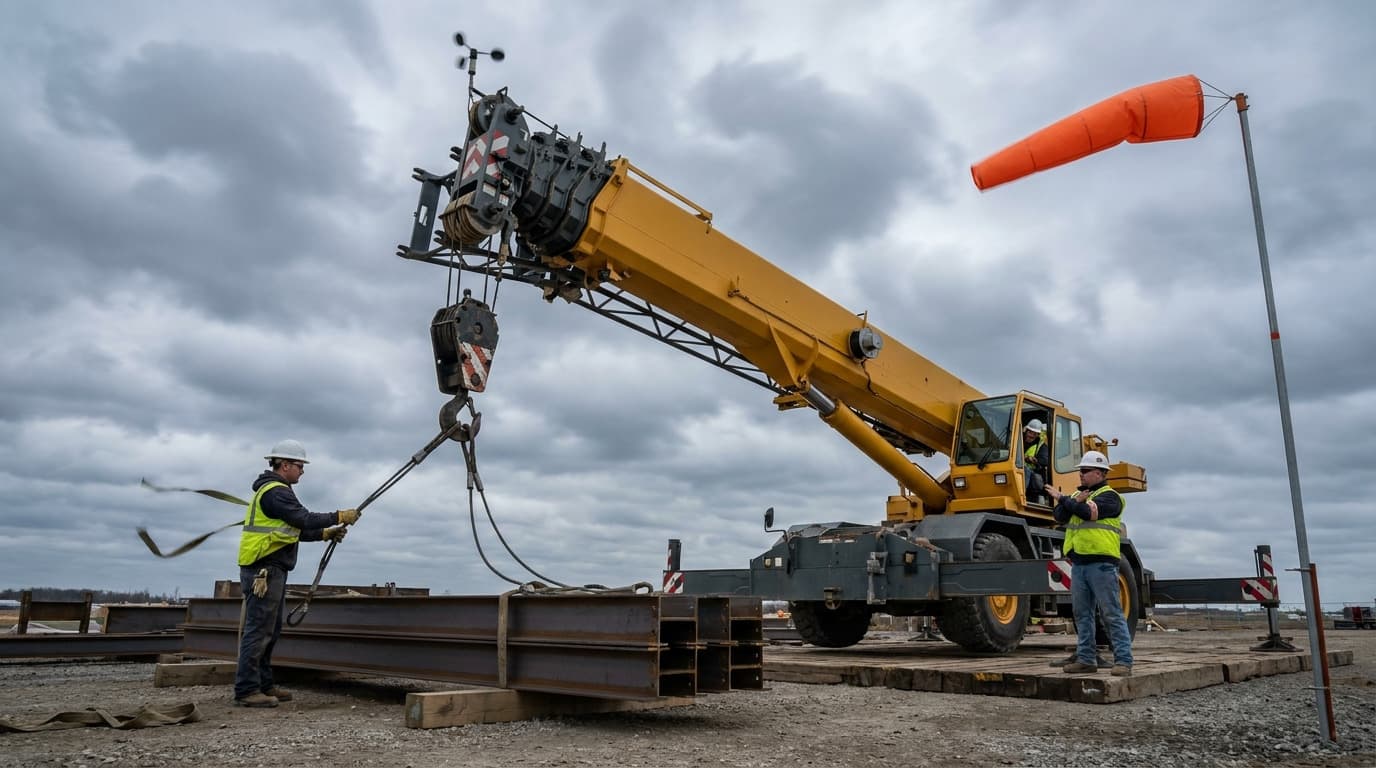
The instinct is to ask "how windy is too windy?" and expect a single number. There isn't one for most work, and that is the important part. OSHA does not set one universal wind-speed limit for cranes. Instead, the rule is that crane use must follow the manufacturer's specifications and load chart, because wind is a force acting on the boom, the jib, the whole superstructure, and the suspended load — and how much force is too much depends entirely on that specific crane in that specific configuration. So the real wind limit for a lift is the number the manufacturer gives for that machine, and exceeding it is not a warranty problem — it is an enforceable OSHA violation. For tower cranes, the standard says outright that wind must not exceed the manufacturer's recommended speed, and if the manufacturer gives no limit, a qualified person has to determine the maximum safe wind speed.
There is one hard floor beneath all of that, and it is worth memorizing: when a crane is hoisting personnel, and sustained wind or gusts exceed 20 mph at the platform, a qualified person must decide whether it is still safe to lift. If it is not, the lift must not begin — and if it is already underway, it must be terminated. That 20 mph figure is the one specific number OSHA puts in writing, and it exists because a person in a suspended platform is the least forgiving load there is.
The practical takeaway: the crew watching the actual wind speed — with a real anemometer, not a guess — and comparing it to the load chart and the manufacturer's limit is what makes the stop-work call a decision instead of an accident. And OSHA expects the shutdown to be documented — date, time, wind conditions, reason — so the decision to stop is a recorded, defensible one, not an argument to have in the moment.
It is not just the crane#
The crane is the clearest case, but sustained wind turns many ordinary things into hazards, and the fixes are mostly about securing what the wind can move.
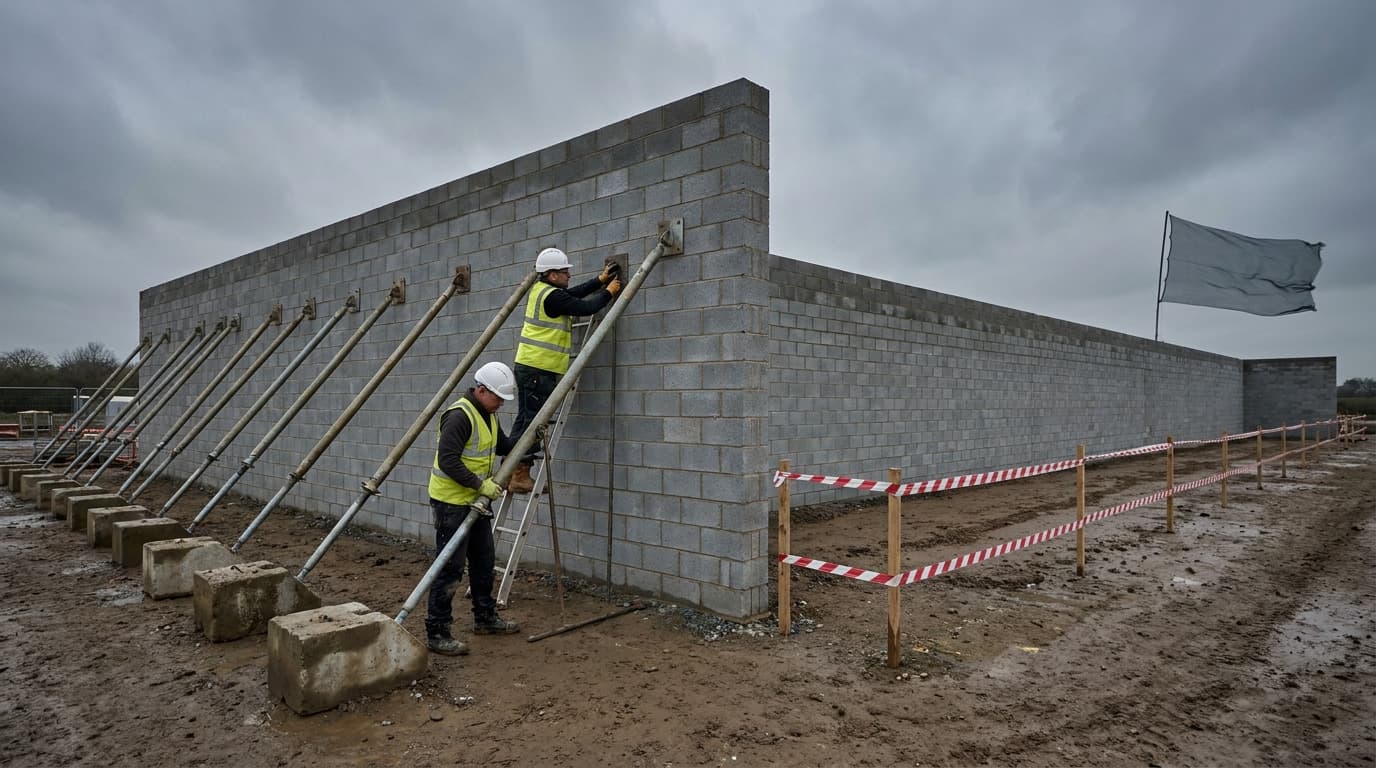
Loose materials and debris become projectiles: sheet goods, insulation, empty containers, scrap, unsecured tools at height. Before the wind builds, these get tied down, weighted, moved inside, or removed. Stacked and stored materials — block, brick, lumber, panels — can topple; height gets reduced and stacks get secured or banded. Free-standing and partially built structures are especially dangerous: unbraced walls and freshly set trusses have collapsed and killed crews in high winds, so temporary bracing and the sequence of when walls are freed becomes a wind decision, not just a structural one. Scaffolds are governed directly: work on a scaffold is prohibited in storms or high winds unless a competent person determines it is safe and workers are protected by fall arrest or wind screens — and if wind screens are added, the scaffold has to be secured to handle the extra wind load they catch, or it can tip. Aerial and boom lifts put a worker high on a small platform in the wind's full force; manufacturer wind limits and fall protection govern, and the honest answer is often to bring the platform down. Large sheet materials being carried or hoisted — plywood, siding, glass, formwork — act like sails; a gust can tear one out of your hands or out of a rigging, so these get handled low, with extra hands, or not moved at all until the wind drops.
Making the stop-work call before it is too late#
The whole talk comes down to deciding in advance and acting early. Set the wind thresholds before the shift — the manufacturer's crane limit, the 20 mph personnel-hoist floor, the site's own limits for material handling and lifts — and put someone in charge of watching the actual wind. Stop while you still have margin, because gusts run well above the sustained speed and a lift or a stack that is fine at the average will fail at the gust. Give the crew clear authority to call a stop without fear — the worker who says "the wind's too much for this panel" is doing the job right. And plan the sequence so a rising wind does not catch you mid-task with a load in the air or a wall unbraced. Stopping early costs a delay; stopping late costs the load, the equipment, or a life.
Where the duty sits#
High wind runs on the same weather-group framework, with specific equipment standards doing the heavy lifting.
For cranes, 1926.1431(k)(8)(i) sets the 20 mph personnel-platform trigger; 1926.1435 requires tower cranes not to exceed the manufacturer's wind limit; and across crane work, OSHA enforces the manufacturer's specifications as the standard. Documenting a weather shutdown — date, time, wind conditions, reason — is a strong recommended practice rather than an explicit OSHA requirement, but it makes the stop a defensible, recorded decision. For scaffolds, 1926.451(f)(12) prohibits work in storms or high winds unless a competent person allows it with protections. Behind the equipment standards, the General Duty Clause, Section 5(a)(1) covers the recognized hazard of working in high wind, and a written Emergency Action Plan (1910.38) should address severe wind. On federal contract work, EM 385-1-1 carries wind and severe-weather provisions. Where a manufacturer's limit, a site plan, or a contract sets a specific wind threshold, that number governs — and the manufacturer's limit is enforceable, not advisory.
What can go wrong?#
- A lift continues past the manufacturer's wind limit and the crane tips or the load swings.
- Personnel are hoisted above 20 mph without a qualified person's evaluation.
- Loose materials, sheet goods, or debris become wind-driven projectiles.
- Stacked block or lumber topples, or an unbraced wall or fresh trusses collapse.
- A worker stays on an aerial lift in wind above the manufacturer's limit.
- A large panel or sheet acts as a sail and is torn from a worker's hands or the rigging.
- Wind screens are added to a scaffold that is not secured for the extra load, and it tips.
- The stop-work call is made after the gust instead of before, when it is already too late.
How do we manage this properly?#
- Treat the wind as turning equipment and materials into hazards, not as a direct push.
- Use the manufacturer's wind limit and load chart — there is no single universal crane number.
- Know the 20 mph personnel-hoisting floor and stop or evaluate at it.
- Watch real wind speed with an anemometer and stop while you still have margin for gusts.
- Secure loose materials, stacks, and debris before the wind builds; reduce stack heights.
- Brace free-standing walls and trusses and sequence work so wind does not catch them unbraced.
- Bring aerial lifts down and stop scaffold work per the competent person and manufacturer limits.
- Document the shutdown and give the crew clear authority to call a stop early.
Before you start#
- Confirm the wind thresholds for cranes, lifts, and material handling are set for the shift.
- Confirm someone is assigned to monitor actual wind speed with an anemometer.
- Confirm the crane's manufacturer wind limit and load chart are known to the operator and crew.
- Confirm loose materials, debris, and stored stacks are secured against rising wind.
- Confirm free-standing walls and trusses are braced, and the sequence accounts for wind.
- Confirm scaffold and aerial-lift wind rules and fall protection are in place.
- Confirm the crew has authority to call a stop, and knows to stop with margin for gusts.
- On federal work, confirm the EM 385-1-1 wind and severe-weather provisions are in place.
Talk it over#
- What's the wind limit for the lift we're doing today, and where does that number come from?
- Who's watching the actual wind speed, and what's our stop number?
- What's loose on this site right now that a strong gust could pick up and throw?
- Is there a wall, a stack, or a panel here that the wind could take — and is it secured?
The bottom line#
Sustained high wind rarely hurts you directly — it turns your equipment and materials into the hazard, and the stop-work decision has to be made before the gust that tips the load, not after. The wind injures crews by tipping the crane, swinging the suspended load, lifting loose sheet goods, toppling stacks and unbraced walls, and blowing workers off lifts — every one a thing on the site made dangerous by the wind, and every one preventable only if you set your limit and stopped before the wind reached it. The number that matters is not on the weather app; it is on the load chart and the manufacturer's limit, because there is no single universal OSHA wind number for cranes — with one hard floor: at 20 mph sustained or gusting at a personnel platform, a qualified person must decide, and if it is unsafe the lift stops. Beyond the crane, the work is securing what the wind can move — materials, debris, stacks, walls, trusses, panels, scaffolds, and lifts — and making the stop-work call early, with margin for gusts, because a load that holds at the average fails at the gust. The duty runs through the crane standards (1926.1431, 1926.1435), the scaffold rule (1926.451(f)(12)), and the General Duty Clause 5(a)(1) — with the manufacturer's limit enforceable, not advisory. The test for any windy day is one question: have we set our limit and are we ready to stop before the gust — or are we waiting to find out where the limit was?
Frequently asked questions about high winds#
What wind speed is too high to keep working?
For most work there is no single number — and that is the point. OSHA does not set one universal crane wind limit; crane use must follow the manufacturer's specifications and load chart, because how much wind is too much depends on the specific machine, configuration, and lift. The real limit for a lift is the manufacturer's wind speed for that crane. The one hard floor is that when a crane is hoisting personnel and sustained wind or gusts exceed 20 mph at the platform, a qualified person must decide whether it is still safe.
Why is the manufacturer's limit so important?
Because wind is a force acting on the boom, jib, superstructure, and load, and the manufacturer's limit reflects what that specific crane can safely handle. OSHA enforces the manufacturer's specifications as the standard, so exceeding the stated wind limit is not just a warranty issue — it is a regulatory violation. For tower cranes, the standard says outright that wind must not exceed the manufacturer's recommended speed, and if none is given, a qualified person must determine the maximum safe wind speed.
What's the 20 mph rule?
Under 1926.1431(k)(8)(i), when a crane is hoisting personnel and sustained wind or gusts exceed 20 mph at the personnel platform, a qualified person must determine whether it is still safe to lift. If it is not, the lift must not begin, and if it is already in progress it must be terminated. This is the one specific wind number OSHA puts in writing, and it applies to lifting people — the least forgiving load there is — not to every crane operation.
Besides the crane, what does high wind put at risk?
Anything the wind can move or destabilize. Loose materials, sheet goods, insulation, and debris become projectiles; stacked block and lumber can topple; free-standing walls and fresh trusses can collapse and have killed crews; large panels act like sails when carried or hoisted; aerial lifts put a worker in the wind's full force; and scaffolds are prohibited in high winds unless a competent person allows it with protections. The work is securing what the wind can move before it builds, and stopping the tasks the wind makes unsafe.
When should we stop work?
Early — while you still have margin. Gusts run well above the sustained wind speed, so a lift, a stack, or a wall that is fine at the average will fail at the gust. Set the thresholds before the shift, put someone on monitoring the actual wind speed with an anemometer, and stop before the wind reaches the limit rather than at it. Stopping early costs a delay; stopping late costs the load, the equipment, or a life. OSHA also expects the shutdown to be documented.
Should we document a wind shutdown?
There is no explicit OSHA construction standard that mandates a written wind-shutdown log, so documenting a weather shutdown is a strong recommended practice rather than a regulatory requirement. Recording the date, time, wind conditions, and reason still makes the decision to stop a recorded, defensible one rather than a judgment argued about in the moment, and it lets a site track patterns over time. What is enforceable is the substance behind the call: the crane manufacturer's wind limits and the 20 mph personnel-hoisting threshold are requirements, so keeping a record of the shutdown protects both the crew and the employer if the decision is ever questioned.
Download the high winds toolbox talk PDF#
Get this high winds toolbox talk as a print-ready PDF — available in English, Spanish, Portuguese, and Turkish. Print it, hand it to the crew, and collect signatures on the included attendance sheet.
Download the PDF — free account required. New members get 3 free downloads.
Related toolbox talks#
Sources#
- OSHA, 1926.1431 — Hoisting Personnel (20 mph sustained/gust threshold at the personnel platform; qualified-person determination): https://www.osha.gov/laws-regs/regulations/standardnumber/1926/1926.1431
- OSHA, 1926.1435 — Tower Cranes (wind not to exceed the manufacturer's recommended speed; qualified person if none given): https://www.osha.gov/laws-regs/regulations/standardnumber/1926/1926.1435
- OSHA, 1926.451(f)(12) — Scaffolds (work prohibited in storms/high winds unless a competent person allows it with protections): https://www.osha.gov/laws-regs/regulations/standardnumber/1926/1926.451
This talk is general awareness guidance for training purposes. It does not replace your employer's severe-weather or crane program, the OSHA crane and scaffold standards, the manufacturer's operating limits, the OSH Act General Duty Clause, or a competent or qualified person's duties, and it is not legal advice. Wind thresholds must come from the manufacturer's limits, the load chart, and a qualified person's determination for the specific equipment and lift.