VOCs (Volatile Organic Compounds)
Updated 2026-07-31
In this bundle Health & Environmental Exposure
Print-ready PDF
Download this talk as a print-ready PDF, available in 4 languages.
Volatile organic compounds are the hazard construction handles most casually. Nobody signs a permit to glue a pipe. But the tin in your hand is mostly solvent, the solvent is designed to evaporate, and everything that leaves that tin ends up in the air you are breathing for the rest of the task. This VOCs (volatile organic compounds) talk is about what happens to the part that disappears.
Here is the distinction that carries this whole talk: your nose is the only monitor most crews have, and it is calibrated backwards. Odour adaptation means that as you stay in a smell, your detection threshold rises — you stop noticing it. Worse, adaptation happens faster when the odour is more intense. So the stronger the exposure, the quicker the warning disappears. The smell fading is not evidence the air is clearing. It is evidence your nose has stopped reporting.
What a VOC actually is#
Kept simple, because the definition explains the behaviour.
A volatile organic compound is a carbon-containing compound that evaporates readily at ordinary temperatures. "Volatile" is the operative word: it wants to leave the liquid and become vapour, at room temperature, without being heated.
That single property produces every hazard in this talk. It is why the product works — a solvent has to evaporate to leave the adhesive or the coating behind — and it is why it is dangerous. You cannot have one without the other.
Common ones on a construction site: toluene and xylene in paints, coatings and adhesives; acetone, methyl ethyl ketone (MEK) and tetrahydrofuran (THF) in pipe cements and primers; styrene in resins and insulation; formaldehyde in resins, adhesives and boards; benzene in fuels.
Where they come from on site: solvent-based adhesives and pipe cements, paints and primers, sealants and caulks, degreasers and cleaners, form release agents, curing compounds and sealers, spray foam, fuels, and thinners.
The tin is mostly solvent#
This is the number that changes how a crew sees the task.
For conventional PVC pipe adhesives, the typical solids content — the part that stays behind — is only about 10 to 20%. The balance of the formulation is solvent. Conventional solvent-based pipe adhesives have been formulated at VOC levels in the range of 750 to 850 grams per litre.
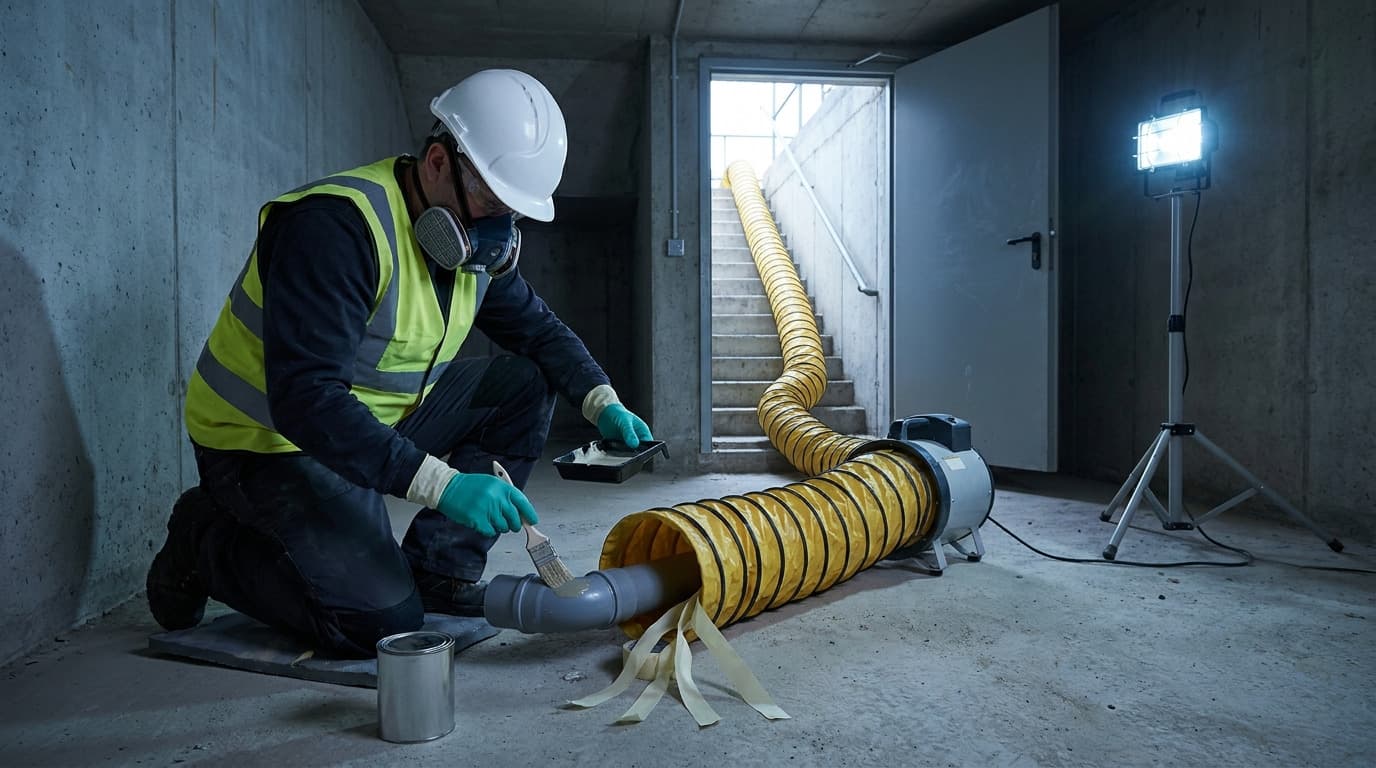
So when you glue a joint, roughly four fifths of what leaves that tin is going into the air around you, by design. In an open trench with a breeze, that disperses. In a basement, a riser cupboard, a plant room or a pit, it does not.
And the primer makes it worse: the surface usually has to be prepared with a primer such as THF or a cleaner such as acetone before the adhesive is applied — so more solvent again, before you have even started.
The vapour goes down, not up#
The second mechanism, and the one that turns a health hazard into a fatality.
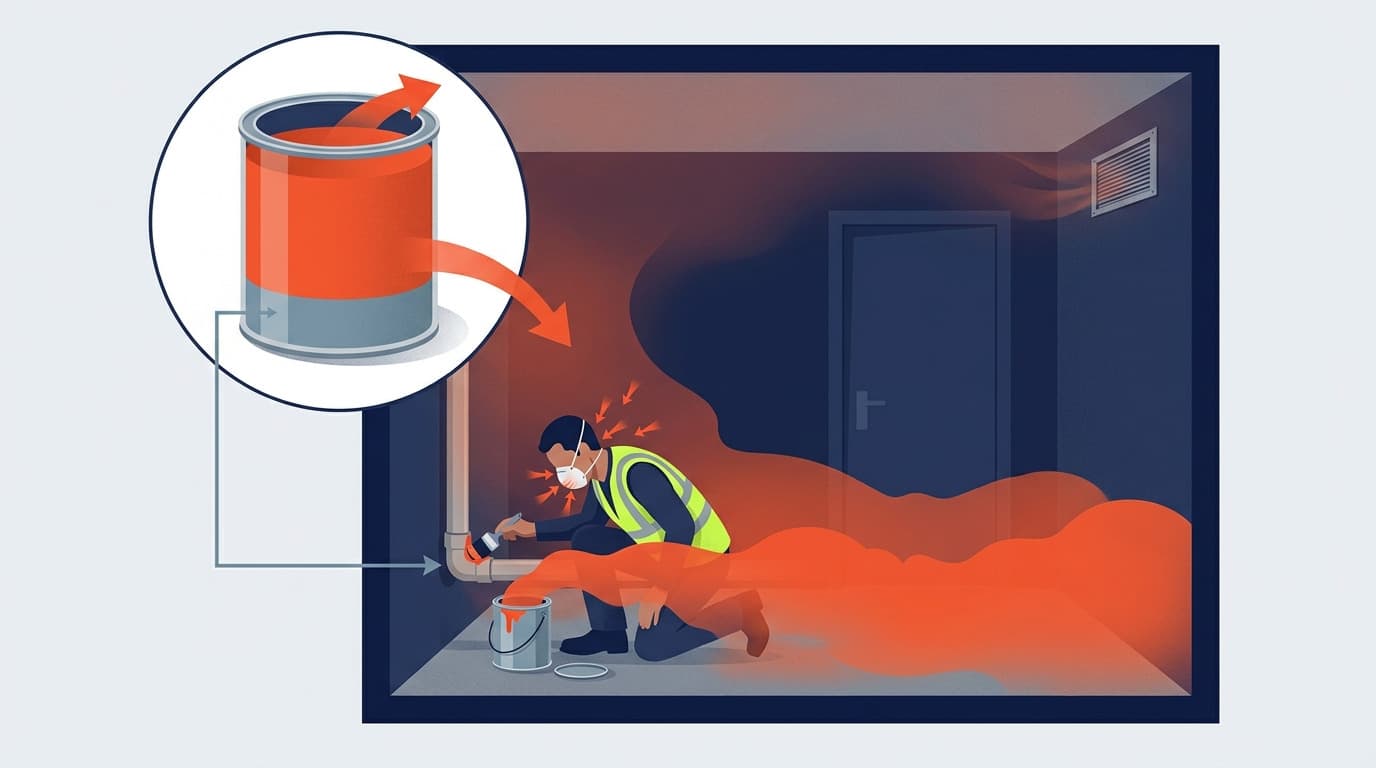
Most solvent vapours are heavier than air. They do not rise and disperse like steam. They flow downhill and pool — in excavations and trenches, pits, sumps, basements, tank bottoms, lift shafts, manholes and the low end of a sloping floor.
Three consequences follow.
The concentration where you are working is not the concentration at head height. Somebody kneeling or lying to reach a joint is in the worst air in the room.
The vapour travels. It can flow along a floor or a trench to an ignition source some distance away and flash back to the source.
And these are the places people work alone, in poor ventilation, often in a confined space where the atmosphere is exactly what the entry procedure exists to test for.
Same property, two hazards#
Volatility creates the health hazard and the fire hazard simultaneously, and crews tend to think about only one at a time.
Health. Solvent vapours irritate the eyes and upper respiratory tract and commonly cause watery eyes, headaches and malaise. Higher exposures cause dizziness, nausea, poor coordination and confusion — which on a construction site is a fall or a cut before it is a health effect. Some VOCs carry serious long-term health concerns, which is why the safety data sheet for the specific product matters more than any general rule.
Fire. Conventional solvent-based adhesives and primers generally have low flash points. The vapour, not the liquid, is what burns — and it burns only within a concentration band, which is precisely the band a poorly ventilated space passes through as the vapour builds.
Hot work, grinding, a light switch, a non-rated extension lead or a running engine near a pooling vapour is the mechanism.
Where the duty sits#
There is no single OSHA "VOC standard." Say that plainly rather than implying one exists. Exposure limits are set substance by substance, and the construction provision that applies is 1926.55, Gases, vapors, fumes, dusts, and mists.
Two features of it matter for this talk.
It sets limits by reference, so the number you need is the one for the specific substance in the product — which is in Section 8 of the safety data sheet, alongside the recommended controls.
And it sets an order. To achieve compliance, administrative or engineering controls must first be implemented wherever feasible; protective equipment is for when such controls are not feasible to achieve full compliance. That inverts the usual site reflex. The first answer to solvent vapour is ventilation, substitution and quantity — not a respirator.
Also relevant: 1926.59 applies the Hazard Communication Standard to construction, which is how you get the label and the SDS in the first place; 1926.152 covers flammable liquids, their storage and handling; and 1926.353 covers ventilation for welding and cutting, which is the other route by which vapours are generated.
Where respiratory protection genuinely is required, selection and fit are covered in the respiratory protection talk — and note that a dust mask does nothing against vapour, which is one of the most common and most dangerous PPE errors on any site.
What can go wrong?#
Gluing pipe in a basement or riser with the door shut and no ventilation.
Vapour pooling in a trench where somebody is kneeling, while the air at head height reads fine.
A dust mask worn against solvent vapour, providing no protection at all.
Hot work near a space where solvent has been used, with vapour still present.
The smell fading and being taken as the all-clear.
Cleaning hands or tools with solvent, in an enclosed space, out of habit.
A tin left open during the task, evaporating the whole time.
Ventilation blowing across the top of an excavation, doing nothing to the heavy vapour at the bottom.
How do we manage this properly?#
Read Section 8 of the SDS before you start, not after somebody feels unwell — it gives the exposure limit and the controls for the actual product.
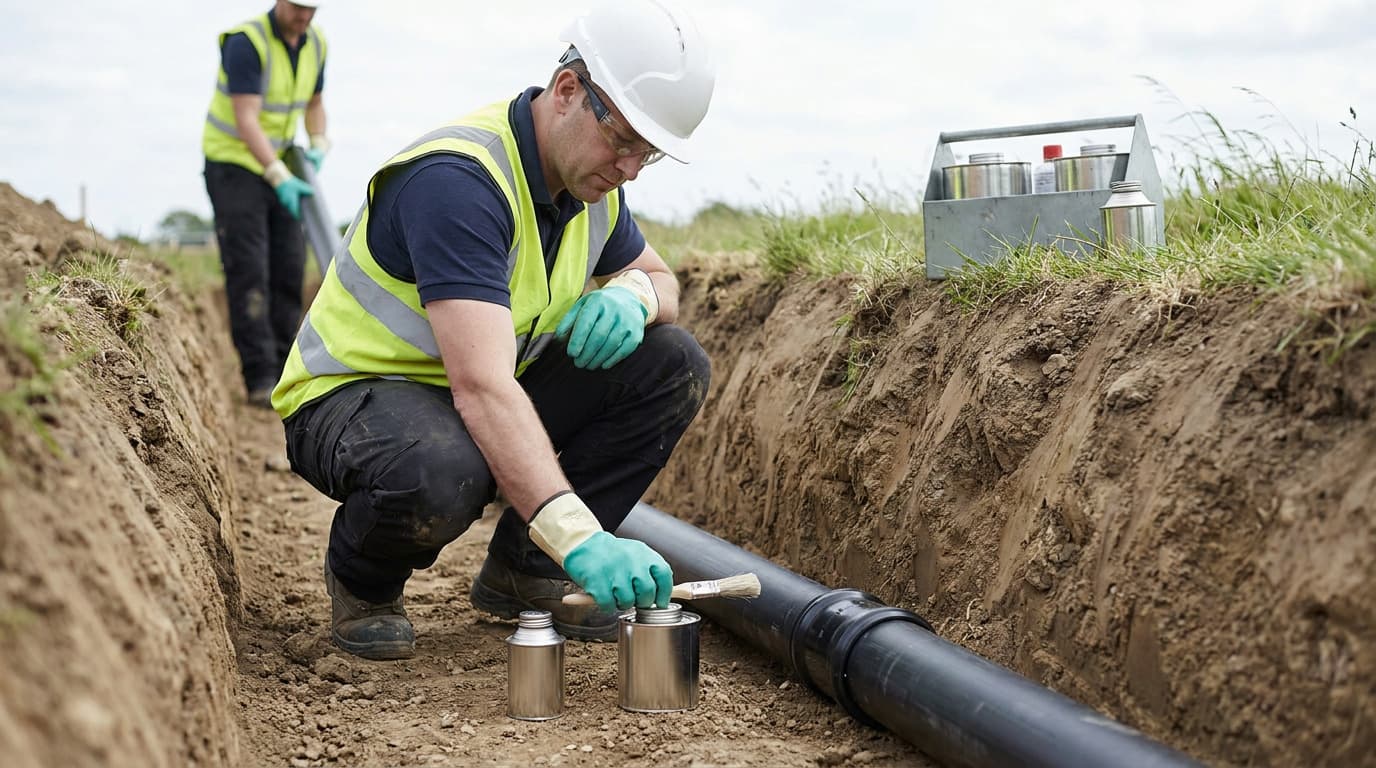
Substitute where you can. Low-VOC and water-based products exist for many applications and are the cleanest control available.
Ventilate deliberately, and extract low. Because the vapour is heavy, general air movement at head height does not clear a pit or a trench.
Limit the quantity out. Decant what you need, keep tins closed between applications, and take the container out of the space when you are not using it.
Never use solvent to clean skin.
Control ignition sources in and around any space where solvent is being used, and remember the vapour travels.
Treat enclosed and low spaces as different work, with the atmosphere tested where the vapour actually is — near the floor.
Do not rely on smell, ever — for the reason at the top of this talk.
And if anybody gets dizzy, nauseous or has a headache, get them into fresh air and treat it as an exposure, not as somebody being under the weather.
Before you start#
- Confirm what product you are using and that you have read Section 8 of its SDS.
- Confirm whether a lower-VOC or water-based alternative would do the job.
- Confirm the space you will be working in and whether vapour can escape from it.
- Confirm the ventilation extracts from low down if you are in a pit, trench or basement.
- Confirm no ignition sources are in the space, or anywhere the vapour could flow.
- Confirm you are not planning to rely on a dust mask against vapour.
- Confirm the minimum quantity is open and tins are closed between uses.
- Confirm somebody knows you are working in that space and will check on you.
Talk it over#
- What is the most enclosed place anybody here has glued a pipe?
- Has anyone stopped noticing a smell and assumed it had gone?
- Where would the vapour collect in today's work area?
- What would you do if a workmate came out of a pit with a headache?
The bottom line#
Your nose is the only monitor most crews have, and it is calibrated backwards. Odour adaptation raises your detection threshold the longer you stay in a smell, and adapts faster at higher intensity — so the stronger the exposure, the quicker the warning goes. The smell fading is not the air clearing. A VOC is a carbon-containing compound that evaporates readily at ordinary temperatures, and that single property both makes the product work and makes it dangerous. Scale it: conventional PVC pipe adhesives have a typical solids content of only about 10–20% — the balance is solvent, formulated at 750–850 g/L VOC — so roughly four fifths of what leaves the tin enters the air you are breathing, with THF primer or acetone cleaner applied before that. Then the physics: most solvent vapours are heavier than air, so they flow downhill and pool in excavations, pits, basements, sumps and shafts, meaning the air where you are kneeling is not the air at head height, and vapour can travel to an ignition source and flash back. Volatility creates both hazards at once — irritation, headaches, watery eyes and malaise, then dizziness and confusion; and low flash points, where the vapour burns, not the liquid. There is no single OSHA VOC standard: limits are substance by substance under 1926.55, which requires that administrative or engineering controls be implemented first wherever feasible, with PPE where controls are not feasible. The first answer is ventilation, substitution and quantity — not a respirator — and a dust mask does nothing against vapour.
Frequently asked questions about VOCs on construction sites#
What is a VOC?
A volatile organic compound — a carbon-containing compound that evaporates readily at ordinary temperatures, without needing to be heated. That single property is why solvent-based products work, because the solvent has to evaporate to leave the adhesive or coating behind, and it is also why they are hazardous. Common site examples include toluene, xylene, acetone, MEK, THF, styrene, formaldehyde and benzene.
Where do VOCs come from on a construction site?
From products used daily without ceremony: solvent-based adhesives and pipe cements, paints, primers, sealants and caulks, degreasers and cleaners, form release agents, curing compounds and sealers, spray foam, fuels and thinners. Because none of these require a permit, the exposure tends to be unplanned — which is precisely why it accumulates in the worst places.
Can I rely on the smell to warn me?
No, and the reason is the most important point in this talk. Odour adaptation raises your detection threshold the longer you remain in a smell, so you stop noticing it — and adaptation occurs faster when the odour is more intense. The stronger the exposure, the sooner the warning disappears. A fading smell is not evidence that the air is clearing; it is evidence your nose has stopped reporting.
Why does solvent vapour collect in trenches and basements?
Because most solvent vapours are heavier than air. Rather than rising and dispersing, they flow downhill and pool in excavations, trenches, pits, sumps, basements, tank bottoms, shafts and manholes. Two consequences follow: the air where somebody is kneeling is not the air at head height, and the vapour can travel along a floor or trench to a distant ignition source and flash back.
Is a dust mask any use against solvent vapour?
None whatsoever, and this is among the most dangerous PPE errors on any site. A particulate mask filters dust; vapour passes straight through it. Where respiratory protection is genuinely needed the correct type, cartridge and fit matter — but under 1926.55 the order is the other way round: administrative or engineering controls first wherever feasible, with protective equipment where such controls are not feasible for full compliance.
Is there an OSHA standard for VOCs?
There is no single OSHA "VOC standard." Exposure limits are set substance by substance, applied in construction through 1926.55, Gases, vapors, fumes, dusts, and mists — so the figure you need is the one for the specific substance in the product, found in Section 8 of the safety data sheet. Related provisions include 1926.59 for hazard communication, 1926.152 for flammable liquids and 1926.353 for welding and cutting ventilation.
What should I do if somebody feels unwell after using solvents?
Get them into fresh air immediately and treat it as an exposure rather than as somebody being under the weather. Dizziness, nausea, headache, poor coordination and confusion are recognised effects of solvent vapour, and on a construction site the immediate danger is often a fall or a cut caused by that impairment. Take the safety data sheet with them if they need medical assessment.
Download the VOCs toolbox talk PDF#
Get this VOCs toolbox talk as a print-ready PDF — available in English, Spanish, Portuguese, and Turkish. Print it, hand it to the crew, and collect signatures on the included attendance sheet.
Download the PDF — free account required. New members get 3 free downloads.
Related toolbox talks#
Sources#
- OSHA, 29 CFR 1926.55 — Gases, vapors, fumes, dusts, and mists: https://www.osha.gov/laws-regs/regulations/standardnumber/1926/1926.55
- OSHA, 29 CFR 1926.152 — Flammable liquids: https://www.osha.gov/laws-regs/regulations/standardnumber/1926/1926.152
- NIOSH, Pocket Guide to Chemical Hazards: https://www.cdc.gov/niosh/npg/
This talk is general awareness guidance for training purposes. It is not medical advice and does not replace the safety data sheet for the specific product in use, which governs the exposure limits, controls and first aid measures that apply. Anyone who feels unwell after solvent exposure should be moved to fresh air and assessed by a qualified medical professional.