Deep Foundations Safety
Updated 2026-08-06
In this bundle Jobsite Fundamentals & Compliance
Print-ready PDF
Download this talk as a print-ready PDF, available in 4 languages.
Deep foundations — drilled shafts, caissons, piers, bell-bottom footings — carry the whole weight of a structure down to soil or rock that can hold it, and building them means opening narrow vertical holes that can run many feet or many stories into the ground. That hole is a different kind of hazard than most excavation work, and the difference is easy to underestimate because for most of the job nobody is standing in it. A drilling rig turns an auger, the spoil comes up, casing goes down, and concrete gets placed, all with the crew working at the surface around the opening. It feels like equipment work, not confined or below-grade work — right up until the moment someone has to go down the hole to inspect the base, clean it out, or fix a problem. This Deep Foundations Safety Toolbox Talk (Safety Talk / Tailgate Talk) is about why that hole concentrates several of construction's deadliest hazards into one small footprint, and why the danger changes completely the moment anyone goes below grade.
Here is the distinction that carries this whole talk: a deep foundation is not a trench you work in — it's a narrow vertical hole you mostly work around, and it stacks three separate killers into one small footprint: you can fall into it, it can cave in on you if you go down, and the bottom of a deep unventilated hole is a confined space that can suffocate you, so the danger changes completely the moment anyone goes below grade. A trench is a horizontal excavation you climb down into and work along; a deep foundation shaft is a vertical hole you mostly work around the top of, until inspection or cleanout sends someone down. When it is just an open hole in the ground, the hazard is falling in — yours or a piece of equipment's. When a person goes down, that same hole becomes three hazards at once: an excavation that can collapse, a confined space that may not have breathable air, and a place a fall or a dropped object is far more serious. Recognizing which of those situations you are in at any moment is the whole discipline of this work.
Where the boundary of this talk sits#
Deep foundation work overlaps several other talks, and this one ties them together for the specific case of a deep vertical hole. The excavation and trenching talk owns Subpart P in general — soil classification, sloping, shoring, and the protective systems for open-cut and trench work. The confined space talk owns permit-space entry, atmospheric testing, and the attendant. The fall protection talk owns work at height and open holes. This talk owns the deep foundation specifically: the drilled shaft, pier, or caisson as a vertical hole that is a fall hazard when open, an excavation and a confined space the moment someone enters it, and a struck-by hazard from the rig the whole time. Where the work is a trench, a general permit space, or a fall from height, those talks own the detail; this one owns why a deep footing hole forces you to manage all of them at once.
When it's an open hole: keep everything out of it#
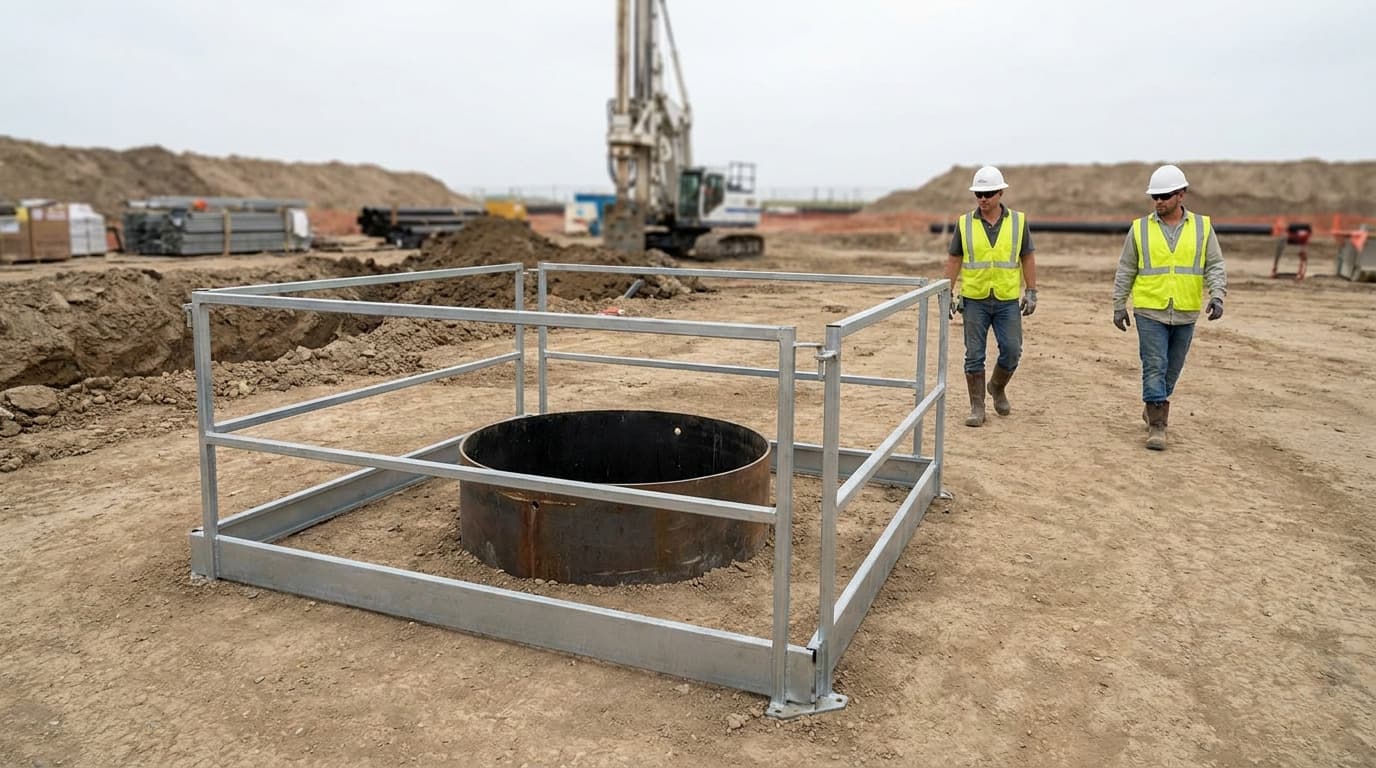
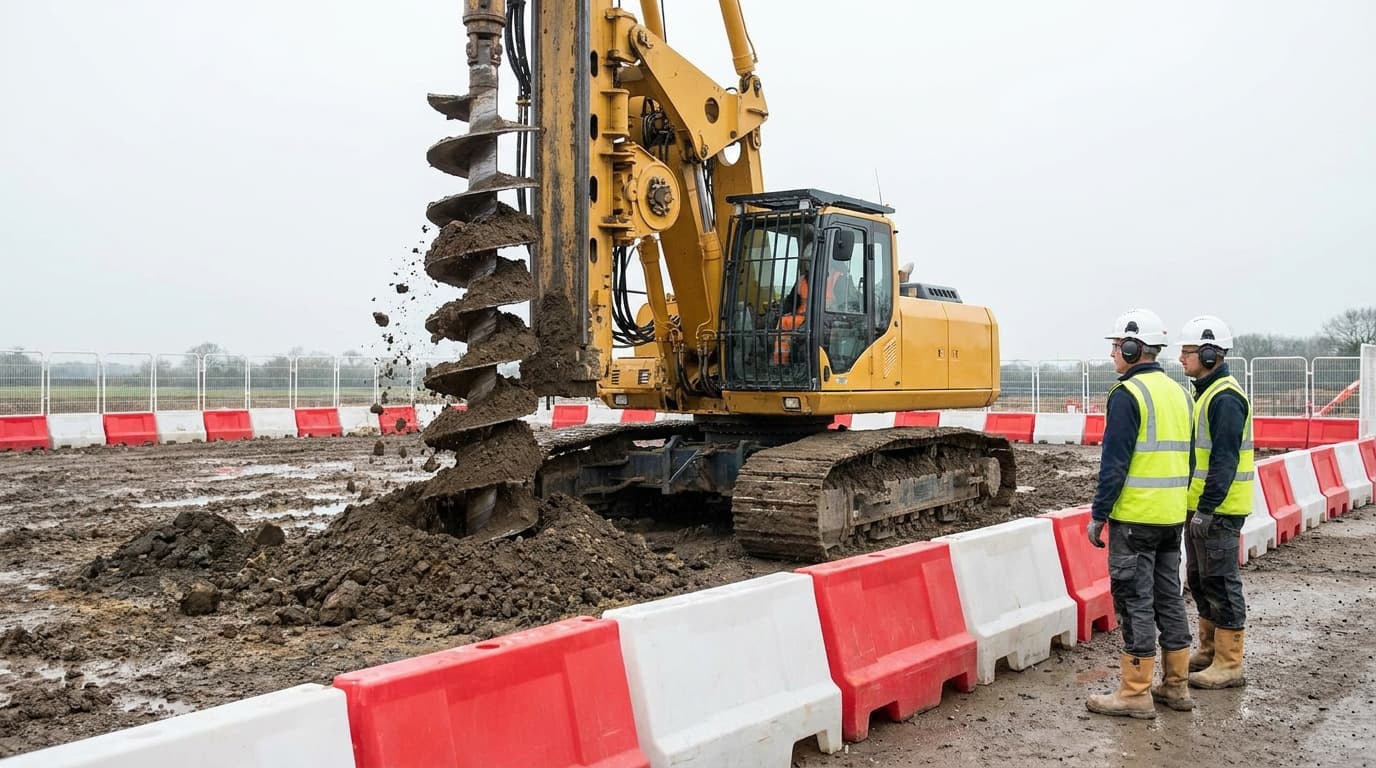
For most of the job the shaft is an open hole with a rig working over it, and the governing hazard is anything falling in — a person, a tool, or spoil. An unprotected drilled shaft is an open hole, and people and equipment have to be kept away from the unguarded edge; where the opening cannot be actively worked it gets covered or guarded. Excavated material and equipment are kept back from the edge so nothing rolls or slides into the hole onto anyone below or destabilizes the wall. The drilling rig itself is a serious struck-by and caught-in hazard the entire time: the auger is a large rotating tool that can catch clothing or a limb, spoil flies off it, and the rig and its Kelly bar swing. Nobody belongs in the rig's swing radius or near the turning auger, and loose clothing near rotating drilling tools is the same entanglement hazard it is on any machine. Managing the open hole is mostly about distance — keeping people, materials, and body parts out of a hole and away from a machine that are both indifferent to you.
When someone goes down: now it's three hazards at once#
The moment a worker enters the shaft — to inspect or clean the base of a drilled pier, most commonly — the situation transforms, and every hazard multiplies. First, it is an excavation that can cave in: the walls of a deep hole can collapse inward, and unless the hole is cased or the soil is competent and evaluated, entering an uncased deep shaft exposes the worker to burial. Second, it is a confined space: a deep, narrow, unventilated hole restricts air movement, and the atmosphere at the bottom can be oxygen-deficient or contain hazardous gas — which is why the air has to be tested before and during entry, exactly as in any confined space. Third, a fall or a dropped object is now potentially fatal in a way it was not when the hole was empty. OSHA recognizes this specific danger: the standard addresses employees entering bell-bottom pier holes or other similar deep and confined footing excavations and requires that they wear a harness with a lifeline, separate from the load line, tended at all times by a person at the top who can see the worker and respond. That harness-and-observer rule exists precisely because a deep footing hole is simultaneously a fall hazard, a cave-in hazard, and a confined space.
The rules that come from below-grade entry#
Because entering the shaft stacks those hazards, entry is a planned operation, not something anyone does casually. A competent person inspects the excavation daily and before entry — and again after any rainstorm or event that could have changed the soil — and removes people from the hole at the first sign of a possible cave-in, protective-system failure, or hazardous atmosphere. Cave-in protection is required in excavations five feet or deeper unless a competent person has determined the exposed rock or soil is stable, and for a deep drilled shaft that protection is most often the casing that lines the hole. The atmosphere gets tested and, where needed, the hole is ventilated before and during entry. The entrant wears the harness and lifeline tended by an observer at the top, who is also the person who summons rescue — and non-entry rescue from the top is the plan, because a second worker climbing down to a collapsed or overcome first worker is how a deep-hole incident becomes a double fatality. Caisson work under compressed air, and true underground construction, carry additional specialized requirements beyond an ordinary drilled pier.
Stability of what's around the hole#
One more hazard is easy to miss because it is not in the hole at all: what the hole does to the ground and structures around it. Drilling a deep shaft removes support from the surrounding soil, and excavating below the base of an existing foundation or retaining wall nearby can undermine it. The standard does not permit excavation below the base of a footing or foundation where it could endanger employees unless a support system such as underpinning is provided, or a registered professional engineer has determined the structure is far enough away to be unaffected or that the work will not pose a hazard. On a congested site, the deep foundation you are drilling can threaten the stability of an adjacent building, a road, or another excavation — so the survey of what is around the hole is part of planning it, not an afterthought. The competent person and, where structures are involved, the engineer decide whether the ground around the shaft stays where it belongs.
Where the duty sits#
Deep foundation excavations fall under OSHA's excavation standard, 1926 Subpart P, when personnel are exposed. The daily competent-person inspection and the removal of exposed employees at the first sign of danger come from 1926.651(k); the cave-in protective-system requirement for excavations five feet and deeper is 1926.652(a); keeping spoil and equipment back from the edge and covering or guarding openings come from 1926.651(j); and the stability-of-adjacent-structures rule is 1926.651(i). The specific provision for employees entering bell-bottom pier holes or other deep and confined footing excavations — a harness and lifeline, separate from the load line, tended by an observer — sits in 1926.651. Where the atmosphere is a concern, confined-space testing principles and 1926 Subpart AA apply; caisson work under compressed air is governed by 1926.801 in Subpart S. The General Duty Clause, Section 5(a)(1) and training under 1926.21(b)(2) apply throughout. Where the geotechnical report, the shaft design, or a competent person or engineer sets a specific requirement, that requirement governs.
What can go wrong?#
- A worker or a piece of equipment falls into an open, unguarded drilled shaft.
- Spoil or material stored at the edge slides into the hole onto someone below.
- A worker enters an uncased deep shaft and the wall caves in and buries them.
- Someone goes down a deep footing hole with no atmospheric test and is overcome by bad air.
- An entrant works below grade with no harness, lifeline, or observer tending from the top.
- A rescuer climbs down to an overcome worker and becomes the second casualty.
- The turning auger or swinging rig catches a worker standing too close.
- Drilling below an adjacent foundation undermines it with no underpinning or engineer sign-off.
How do we manage this properly?#
- Treat the open shaft as a hole that must be guarded, covered, or kept clear — people and equipment back from the edge.
- Keep spoil and materials well back from the opening so nothing rolls or slides in.
- Stay out of the rig's swing radius and clear of the turning auger — no loose clothing near it.
- Before anyone enters, run the competent-person inspection and test the atmosphere.
- Enter only with cave-in protection — casing or an evaluated stable shaft — never an uncased deep hole casually.
- The entrant wears a harness and lifeline tended by an observer at the top at all times.
- Plan non-entry rescue from the top — never send a second person down after the first.
- Check stability of adjacent structures — underpinning or engineer sign-off before undermining a foundation.
Before you start#
- Confirm whether today's work is around the open hole, or whether anyone is entering it.
- Confirm the shaft edge is guarded or covered and spoil is set back from it.
- Confirm everyone knows the rig's swing radius and stays clear of the auger.
- If anyone is entering: confirm the competent-person inspection is done and the atmosphere is tested.
- If anyone is entering: confirm cave-in protection (casing or evaluated soil) is in place.
- If anyone is entering: confirm the harness, separate lifeline, and top-side observer are set.
- Confirm the rescue plan is non-entry from the top, and the observer knows how to summon help.
- Confirm adjacent structures were assessed if drilling could undermine them.
Talk it over#
- Is anyone going down a shaft today, and if so, do we have the harness, lifeline, and observer set?
- When was the last competent-person inspection, and has anything — rain, a nearby dig — changed the ground?
- Where is the rig's swing radius right now, and is everyone on foot clear of it and the auger?
- If someone were overcome at the bottom of a hole, what exactly would we do — without sending anyone down?
The bottom line#
A deep foundation is not a trench you work in — it's a narrow vertical hole you mostly work around, and it stacks three separate killers into one small footprint: you can fall into it, it can cave in on you if you go down, and the bottom of a deep unventilated hole is a confined space that can suffocate you, so the danger changes completely the moment anyone goes below grade. While it is an open hole, the job is keeping people, materials, and body parts out of it and clear of the rig's turning auger and swing. The instant a worker goes down, it becomes three hazards at once — a cave-in risk needing casing or evaluated soil, a confined space needing atmospheric testing, and a fall/dropped-object risk — which is why OSHA's rule for bell-bottom pier holes requires a harness and lifeline tended by an observer at the top, and why rescue is non-entry from above. It all sits in 1926 Subpart P — the inspection in 1926.651(k), cave-in protection in 1926.652(a), the pier-hole harness rule in 1926.651 — with atmospheres under Subpart AA and compressed-air caissons under 1926.801. The question to carry is the one that changes everything: is anyone going below grade in that hole today — and if so, is it cased, tested, and tended, or are we treating a confined excavation like an open one?
Frequently asked questions about deep foundations safety#
How is a deep foundation different from a trench?
A trench is a horizontal excavation you climb down into and work along its length, so you are inside it for much of the job and the whole focus is protecting the person in the trench from a cave-in. A deep foundation — a drilled shaft, pier, or caisson — is a narrow vertical hole that you mostly work around from the surface while a rig drills it, places casing, and pours concrete. For most of the job nobody is in it, so the governing hazard is things falling into the open hole and the rig's own struck-by and entanglement hazards. The transformation happens when someone goes down the shaft to inspect or clean the base: at that moment the same hole becomes a cave-in hazard, a confined space, and a serious fall hazard all at once. So the difference is not just orientation — it is that a deep foundation flips between an around-the-hole job and an in-the-hole job, and the second one is far more dangerous.
What are the three hazards a deep hole combines?
Falling in, caving in, and suffocating. First, an open drilled shaft is a hole in the ground, so a person or a piece of equipment can fall into it, and once it is deep that fall is severe or fatal. Second, the moment someone is inside, the walls can collapse inward — a cave-in — burying the worker, unless the hole is cased or the soil has been evaluated as stable. Third, a deep, narrow, unventilated hole restricts air movement, so the atmosphere at the bottom can be oxygen-deficient or hold hazardous gas, making it a confined space that can suffocate someone even if it never collapses. The reason deep foundation work needs its own attention is that these three are not separate jobs you do one at a time — the instant a worker enters the shaft, all three apply simultaneously, which is exactly why OSHA wrote a specific harness-and-observer rule for deep footing holes.
What does OSHA require for someone entering a pier hole?
The standard specifically addresses employees entering bell-bottom pier holes or other similar deep and confined footing excavations, and it requires that the worker wear a harness with a lifeline that is separate from any load line and is tended at all times by a person stationed at the top of the hole. That top-side person is the observer: they watch the entrant, stay in communication, and are positioned to respond and summon help if something goes wrong. The rule exists because a deep footing hole is simultaneously a fall hazard, a cave-in hazard, and a confined space, so the entrant needs to be attached and watched the entire time they are below grade. Beyond that specific provision, the general excavation rules still apply — the competent-person inspection, cave-in protection, and atmospheric testing where the air could be bad — and the rescue plan has to be non-entry from the top so a second worker is never sent down after the first.
Why is rescue from a deep hole so dangerous?
Because the thing that overcame the first worker is almost always still there, and a deep narrow hole is one of the hardest places to get someone out of. If a worker collapses at the bottom of a shaft from bad air, the same oxygen-deficient or toxic atmosphere is waiting for anyone who climbs down after them — and the instinct to go straight down to help is exactly how a single incident becomes a double fatality. If the collapse was a cave-in, the hole is now even more unstable. This is why the observer at the top is not just a watcher but the person who summons trained rescue, and why the rescue plan has to be non-entry: getting the entrant out using the lifeline and equipment from above, rather than sending a second body into the same hazard. Planning that rescue before anyone enters, and never improvising a climb-down, is the single most important rule of below-grade foundation work.
Do we have to worry about the ground around the hole too?
Yes — drilling a deep shaft removes support from the surrounding soil, and that can affect nearby structures. Excavating below the base of an existing footing, foundation, or retaining wall can undermine it, and the standard does not permit that where it could endanger employees unless a support system such as underpinning is provided, or a registered professional engineer has determined the structure is far enough away to be unaffected or that the work will not pose a hazard. On a tight site, the pier you are drilling can threaten an adjacent building, a road, or another excavation, so assessing what is around the hole is part of planning it. The competent person handles the routine evaluation, and where existing structures could be affected, an engineer makes the call. The stability of the ground around the shaft is as much a part of deep foundation safety as the shaft itself.
What about the drilling rig?
The rig is a struck-by and entanglement hazard for the entire job, open hole or not. A foundation drilling rig turns a large auger — a rotating tool that can catch loose clothing, a glove, or a limb the same way any rotating machine part can, only much larger — and spoil comes off it with force. The rig and its Kelly bar also swing, so there is a swing radius around the machine that people on foot must stay out of. Because the rig is running while the crew works around the open hole, these hazards are present during the part of the job that feels routine, which is exactly when attention drifts. The controls are the ordinary ones for heavy rotating equipment and swinging machines: stay out of the swing radius, keep well clear of the turning auger, never wear loose clothing near it, and treat the rig as the powerful, indifferent machine it is even while the more dramatic hole sits right next to it.
Download the deep foundations safety toolbox talk PDF#
Get this deep foundations safety toolbox talk as a print-ready PDF — available in English, Spanish, Portuguese, and Turkish. Print it, hand it to the crew, and collect signatures on the included attendance sheet.
Download the PDF — free account required. New members get 3 free downloads.
Related toolbox talks#
Sources#
- OSHA, Specific Excavation Requirements — 29 CFR 1926.651 (employees entering bell-bottom pier holes or other similar deep and confined footing excavations wear a harness with a lifeline separate from the load line, tended by an observer; daily competent-person inspection and removal of employees at signs of cave-in, protective-system failure, or hazardous atmosphere; spoil and equipment kept back from the edge; stability of adjacent structures): https://www.osha.gov/laws-regs/regulations/standardnumber/1926/1926.651
- OSHA, Requirements for Protective Systems — 29 CFR 1926.652 (each employee in an excavation protected from cave-ins by an adequate protective system except where less than 5 feet deep and a competent person finds no indication of a potential cave-in): https://www.osha.gov/laws-regs/regulations/standardnumber/1926/1926.652
- OSHA, Caissons — 29 CFR 1926.801 (specialized requirements for caisson work, including shafts, staircases and ladders with landing platforms, and shields in compressed-air caisson work): https://www.osha.gov/laws-regs/regulations/standardnumber/1926/1926.801
This talk is general awareness guidance for training purposes. It does not replace your employer's excavation program, OSHA Subpart P, the confined space or caisson standards, the OSH Act General Duty Clause, the geotechnical report and shaft design, or a competent person's or engineer's duties, and it is not legal advice. Where the geotechnical report, the shaft design, or a competent person or engineer sets a specific requirement, that requirement governs.
Written by FieldSafetyTalk's safety professional — a CSP, ASP, CHST and OSHA Authorized Outreach Trainer with 14+ years of international construction safety experience across federal, heavy civil, and industrial projects.